In May 2024, cybercrime actors operating under the moniker UNC5537 (closely linked with ShinyHunters and Sp1d3r) began auctioning massive database dumps from enterprise Snowflake cloud accounts. Over the subsequent eight weeks, this single campaign expanded into one of the largest corporate cloud data exfiltrations on record: 165 organisations notified, more than 1.2 billion records compromised, and at least $370,000 paid in cryptocurrency ransoms.
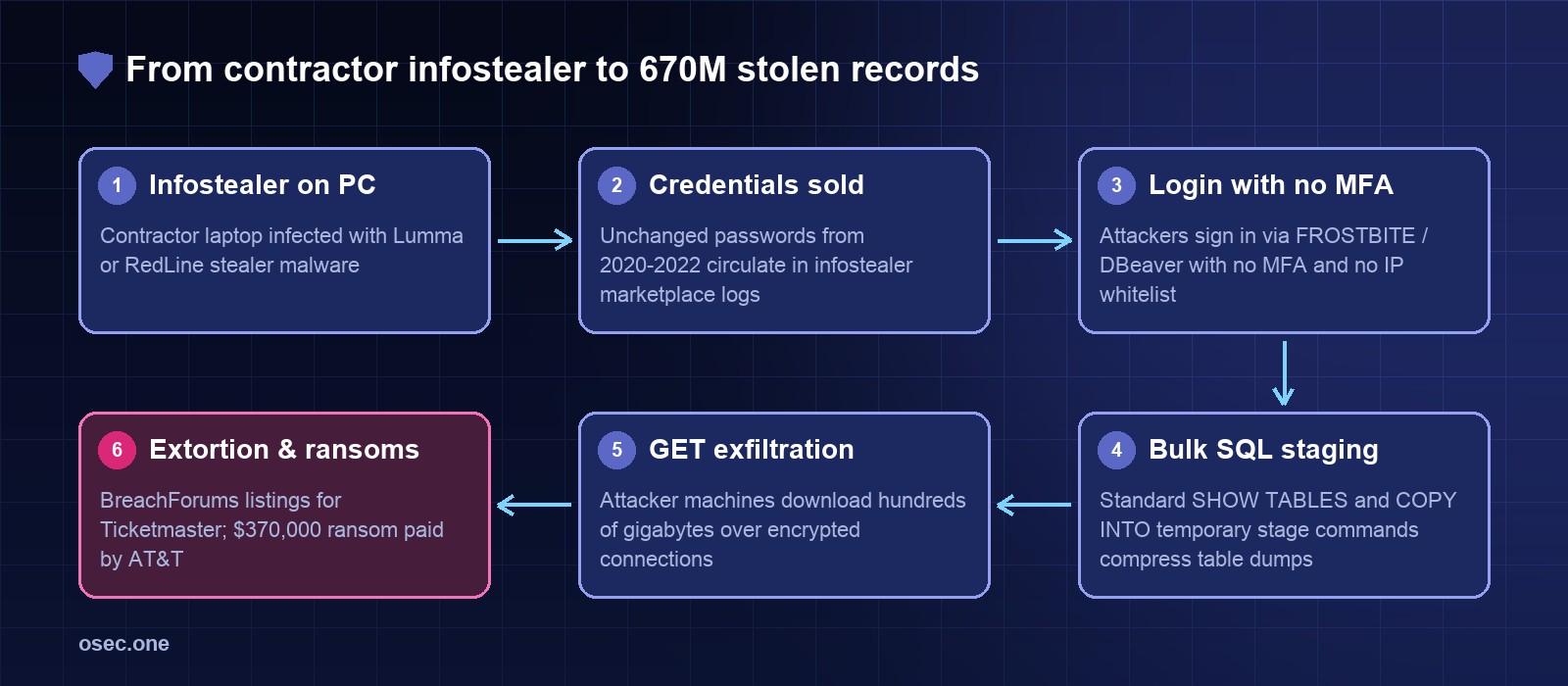
The defining characteristic of the breach was its total absence of platform exploits. Threat intelligence investigations by Mandiant and CrowdStrike confirmed that Snowflake's core systems were never breached. Attackers simply logged in using valid username and password combinations harvested by commodity infostealer malware (Lumma, RedLine, Vidar, RisePro) from contractor laptops as early as 2020. Because these database instances had no multi-factor authentication (MFA) and no network allow-lists, stolen single-factor credentials were all that was required to export full production databases.
The victim toll: 1.2 billion records across 165 organisations
While 165 organisations received private compromise notices from Snowflake and Mandiant, several massive consumer enterprises faced public extortion demands, data auctions, and mandatory SEC Form 8-K filings:
| Victim | Records Exposed | Data Compromised | Ransom Demand / Outcome | Breach Window |
|---|---|---|---|---|
| AT&T | ~110 million accounts | 6 months of call/text logs & cell tower IDs | $370,000 paid (5.7 BTC to negotiator) | April 14 – 25, 2024 |
| Ticketmaster / Live Nation | 560 million customer records | Names, emails, ticket orders, partial card numbers | $500,000 demanded on BreachForums | May 20 – 27, 2024 |
| Advance Auto Parts | 380 million profiles + 358k staff | Sales histories, loyalty records, employee SSNs | $100,000 demanded (3 TB offered) | April 14 – May 24, 2024 |
| Santander Bank | 30 million customers & staff | Customer data and employee banking details (ES/CL/UY) | Undisclosed ransom demand | May 2024 |
| QuoteWizard (LendingTree) | ~200 million records | Consumer insurance quotes, financial applications | $2,000,000 demanded | May 2024 |
| Neiman Marcus | 1.1 million customer accounts | Contact records, partial cards, gift card numbers | Database put up for sale on dark web | April – May 2024 |
Case 1: AT&T's $370,000 ransom payment for 110 million call records
On July 12, 2024, AT&T filed an 8-K with the US SEC disclosing that unauthorized parties had accessed and copied customer data from an AT&T workspace on Snowflake between April 14 and April 25, 2024. AT&T first discovered the intrusion on May 19.
The scope of the exfiltration was unprecedented for telecommunications metadata:
• Full call and text interaction logs: Records of nearly every AT&T cellular customer in the United States between May 1, 2022 and October 31, 2022, plus January 2, 2023.
• Virtual operators included: Customers of third-party mobile virtual network operators (MVNOs) utilizing AT&T's wireless network, as well as landline customers who placed or received calls to/from cellular numbers during the period.
• Interaction metrics: Telephone numbers involved in calls and text messages, total count of interactions, and aggregate call duration.
• Cell tower identifiers: For a significant subset of records, cell site identification numbers were captured, allowing investigators or adversaries to map the approximate physical location where calls originated or terminated.
To prevent public release of the telemetry data, AT&T quietly engaged third-party ransom negotiation firm Reddington. On May 17, 2024, AT&T transferred 5.7 Bitcoin (worth approximately $370,000 at the time) to a cryptocurrency wallet controlled by hacker 'John Erin' in exchange for a video recording showing the attacker deleting the copied AT&T database files. The US Department of Justice granted AT&T two formal delays in filing its public 8-K disclosure, citing acute national security and public safety considerations before the July public release.
Case 2: Ticketmaster's 560 million records and the contractor link
Ticketmaster parent Live Nation Entertainment detected unauthorized activity in its cloud database on May 20, 2024. On May 27, hacker group ShinyHunters publicly listed a 1.3-terabyte database containing 560 million Ticketmaster customer records for sale on BreachForums for $500,000.
The database contents spanned ticket buyer names, postal addresses, email addresses, phone numbers, complete ticketing order histories, and truncated payment card data (customer name, card brand, last four digits, and expiration dates).
Security research by Hudson Rock uncovered the root vector: an engineer at major IT outsourcing vendor EPAM Systems had suffered a malware infection from Lumma Stealer and RedLine on their workstation. The stealer had captured browser-saved credentials and session tokens for client Snowflake workspaces dating back to 2020. The contractor's unrotated passwords circulated in private Telegram channels and marketplace logs until UNC5537 began testing thousands of exposed corporate logins.
How the data was staged and stolen: 4 lines of SQL
UNC5537 executed the intrusions using custom automation (.NET/Java client 'FROSTBITE') and standard GUI query tools like DBeaver Ultimate. Once authenticated, the attack bypassed all endpoint detection because it executed routine SQL operations:
1. Reconnaissance: Run SHOW DATABASES; and SHOW TABLES; to enumerate schemas, row counts, and table names containing customer records or telecommunications logs.
2. Staging: Create an internal storage buffer with CREATE TEMPORARY STAGE temp_dump; in any schema where the compromised credentials had write privileges.
3. Compression & packaging: Execute bulk copy commands that serialize entire tables into compressed archives:COPY INTO @temp_dump/export_ FROM (SELECT * FROM target_db.target_schema.target_table) FILE_FORMAT = (TYPE = CSV COMPRESSION = GZIP);
4. Download: Pull the staged files directly to the attacker's server over TLS using Snowflake's command line driver: GET @temp_dump file:///local/dump/;.
Because database activity was conducted entirely over legitimate SQL API connections using valid user credentials, traditional perimeter firewalls and WAFs observed nothing malicious. The only indicators of compromise were unfamiliar foreign IP addresses, novel client strings, and sudden terabyte-scale export queries from accounts that typically only ran daily reporting dashboards.
Audit your Snowflake account: 3 queries you can run right now
If your organisation uses Snowflake, run these queries from a worksheet with ACCOUNTADMIN or SECURITYADMIN privileges to identify identical vulnerabilities:
1. Find active user accounts without MFA:
Every human user returned without MFA is vulnerable to immediate takeover if their password ever leaks in a stealer log.
2. Verify whether Network Policies (IP allowlists) are active:
If the account parameter NETWORK_POLICY is unset, any user with valid credentials can log in from any residential ISP, commercial VPN, or tor exit node worldwide.
3. Detect abnormal historical bulk table staging:
Review large COPY INTO queries executed by human user accounts rather than automated ETL service principals.
The defense checklist for cloud data warehouses
• Mandatory MFA at the account policy level: Enforce authentication policies globally (ALTER ACCOUNT SET AUTHENTICATION_POLICY = ...). In July 2024, Snowflake introduced admin-level mandatory MFA; ensure legacy service users and human users cannot bypass it.
• Strict Network Allow-lists: Attach network policies to every privileged and integration account. Access should be restricted strictly to corporate VPN subnets and fixed static IPs of production applications.
• Contractor workstation hygiene: Treat contractor devices as unmanaged endpoints. Enforce dedicated virtual desktop infrastructure (VDI) or hardware-enforced FIDO2 security keys rather than static passwords.
• Role and warehouse isolation: Never grant ACCOUNTADMIN or broad cross-database query permissions to standard users. Restrict COPY INTO and temporary stage creation permissions to dedicated data engineering service roles.
osec.one provides passwordless authentication, email OTP codes, and biometric passkeys so your users and services never rely on reusable passwords that malware can harvest.
Protect your loginsSources: SEC Form 8-K: AT&T Inc. (July 12, 2024); SEC Form 8-K: Live Nation Entertainment, Inc. (May 31, 2024); Mandiant Threat Intelligence: UNC5537 Targets Snowflake Customer Instances (June 10, 2024); Wired: AT&T Paid a Hacker $370,000 to Delete Stolen Phone Records (July 14, 2024); Snowflake Security Advisory: Customer Account Hardening (June 2024).