On 19 June 2024 about 15,000 car dealerships in the US and Canada lost the software that writes their deals, books service appointments and looks up parts. They did not lose it because of an attack on any dealership. They lost it because one vendor, CDK Global, shut its systems down. This is a case about concentration risk: what one hosted dealer management system (DMS) takes with it when it stops, what the attackers (attributed to the BlackSuit ransomware group) were reportedly paid, and what we do and do not know. One thing up front: CDK has never published how the attackers got in, so this article does not claim a help-desk reset or any other entry route.
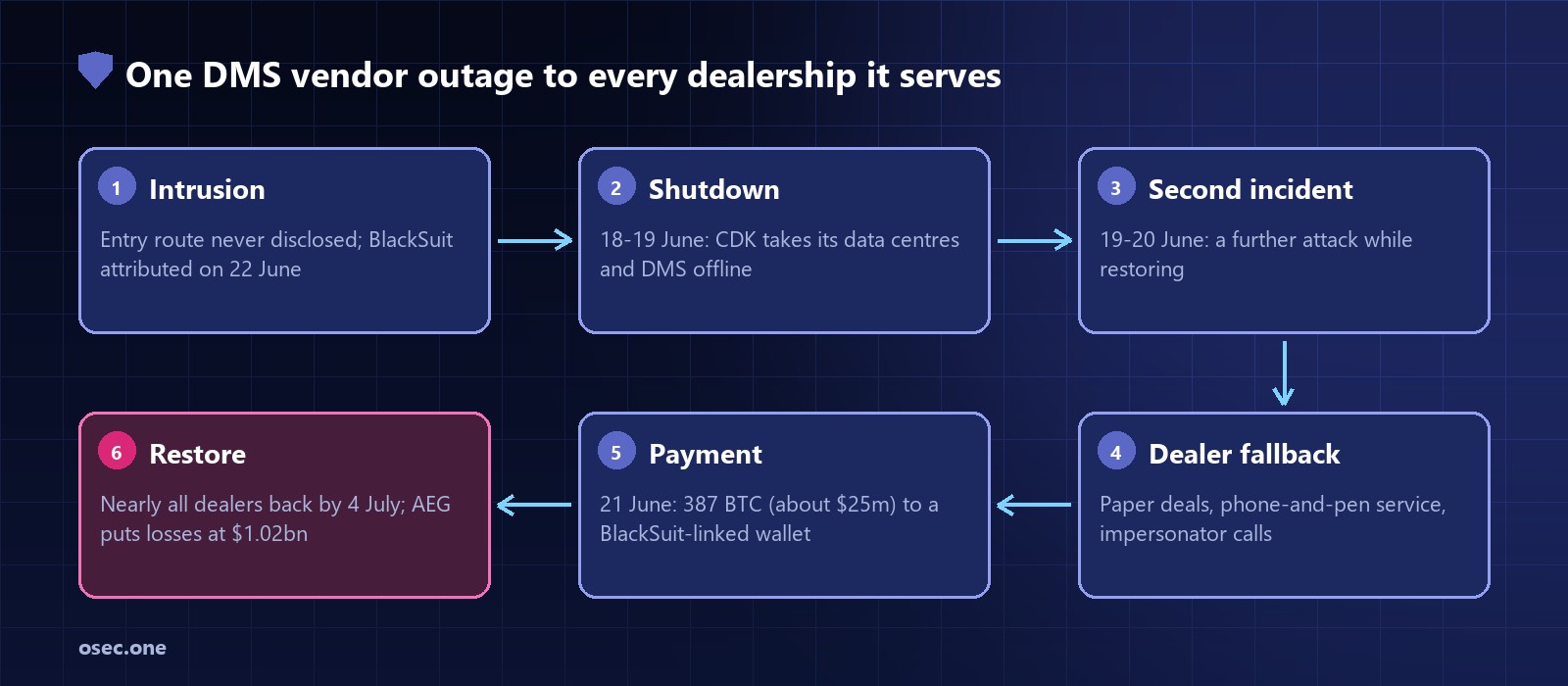
What is established and what is not
| Claim | Status | Source |
|---|---|---|
| CDK shut down most of its systems after a cyber incident, 19 June 2024 | Established | CDK statement of 20 June, quoted by CyberScoop, 24 June 2024 |
| A second incident hit while CDK was restoring | Reported; dates differ (19 or 20 June) | CyberScoop, 24 June 2024 |
| BlackSuit ransomware behind it | Reported | BleepingComputer first (22 June); Recorded Future's Allan Liska to CyberScoop |
| Ransom demand of 'tens of millions of dollars' | Reported | Bloomberg, 21 June 2024 |
| About 387 bitcoin (roughly $25 million) went to a BlackSuit-linked wallet on 21 June | On-chain movement established; link to CDK not proven | TRM Labs to CyberScoop, 12 July 2024; CDK and its owner Brookfield declined to answer questions on a payment |
| How the attackers got in | Not disclosed | No source we read gives an entry route |
The entry-route gap matters. Our analyses of MGM and Caesars and Change Healthcare could name the first step because the victim or investigators did. For CDK nobody has, and write-ups that say 'help desk social engineering' or 'phishing' for CDK are guessing. What we can analyse is everything after the first step, and above all why the impact was so wide.
Why one shutdown reached 15,000 stores
A DMS is a dealership's system of record: customer and deal records, inventory, accounting, service scheduling and parts. CDK ran it as a hosted service out of two data centres, so every dealership depended on the same two places. When CDK took them offline on 19 June, the question was not 'has my dealership been breached?' Its software had simply gone away.
This is the same shape as Kaseya VSA in 2021: one provider with reach into thousands of customers. Here the customers were not encrypted at all; they were switched off by their own vendor's containment decision. The listed dealer groups said so in their filings:
| Dealer group | Filing | What it said |
|---|---|---|
| Sonic Automotive | 8-K signed 21 June 2024 | Incident 'has had, and is likely to continue to have, a negative impact on the Company's business operations' |
| Group 1 Automotive | 8-K, event date 19 June, signed 24 June | CDK incident 'has disrupted the Company's business applications and processes in its U.S. operations'; UK stores not affected |
| AutoNation | 8-K signed 24 June | Outages 'have been disruptive and adversely impacted our business', all locations remain open |
Note what is missing: none of them disclosed a breach of their own network. Dealers on other systems were largely spared; Penske's automotive operations, for example, were reported as little affected because they are not on CDK.
The two weeks, day by day
| Date (2024) | Event |
|---|---|
| 18-19 June | Cyber incident; CDK shuts down most systems, including its two data centres, by early 19 June |
| 19-20 June | A second incident during restoration; recovery pushed back (reports differ on the day) |
| 21 June | About 387 BTC sent to a BlackSuit-linked wallet (TRM Labs); Bloomberg reports a demand of tens of millions |
| 22 June | BleepingComputer attributes the attack to BlackSuit |
| 24 June | Six listed dealer groups (Lithia, Group 1, Penske, Sonic, Asbury, AutoNation) report operational impact |
| 28 June | First dealers regain access; phased restoration |
| 4 July | CDK says it has restored service to nearly all dealerships |
The cost, with the arithmetic
| Item | Figure | Source |
|---|---|---|
| Payment (TRM Labs) | 387 BTC, roughly $25 million | CyberScoop, 12 July 2024 |
| Dealer losses, Anderson Economic Group (AEG) | $1.02 billion, 19 June to 15 July (first estimate $944 million) | AEG, revised after June sales data |
| Lost new-vehicle sales (AEG) | 56,200 | AEG |
| AutoNation, Q2 earnings effect | About $1.50 per share, including guaranteed pay for sales staff | AutoNation, July 2024, via press |
| Lithia, Q2 earnings effect | About $1.10 per share | CEO Bryan DeBoer, via press |
Worked checks. $25 million / 387 BTC is about $64,600 per bitcoin, in line with the price around 21 June 2024. AEG's $1.02 billion / 56,200 lost sales is about $18,100 of dealer loss per lost sale, which covers gross profit, finance and insurance, and service, not only the car. Lithia's $1.10 per share on about 27.2 million shares is roughly $30 million. The reported $25 million is about 2.5% of AEG's dealer-side estimate: the dealers' downtime cost about 41 times the ransom (1,020 / 25 = 40.8). That ratio is the whole economic argument for paying, and also why vendors become targets. AEG says its figure excludes consumer harm, reputation, litigation and other categories.
What dealers did without a DMS
Press coverage at the time (Associated Press, Fortune, SecurityWeek) describes dealers falling back to pens and paper: handwritten deal jackets, paper repair orders, manual parts lookups, and phone calls to lenders. Some customers could not complete registration or titling through the usual electronic channels. Groups with a second system for parts, scheduling or accounting recovered sooner; groups with every function on one vendor had nothing to switch to. This is a fallback design problem, and a rehearsal costs very little next to what a week of it costs.
The impersonation wave on top
While the DMS was down, CDK's dealer hotline reported people contacting dealerships and posing as CDK staff to obtain access or credentials, and CDK said it would not contact customers to ask for alternative access or credentials. The Canadian Automobile Dealers Association passed on similar reports. This is a separate, opportunistic step, not the cause of the outage: a vendor outage creates an expected phone call ('we're CDK, give us your login'), and staff who know systems are down are primed to comply. Our MGM and Caesars analysis covers the same pretext aimed at a help desk instead.
Controls that break each step
| Step | Control | Check |
|---|---|---|
| Vendor concentration | Know which functions sit on one hosted vendor; ask for a recovery time and a separate read-only export of deals, inventory and open repair orders | Can you open yesterday's open deals and service appointments without the vendor? |
| No fallback | Printed deal and repair-order packs, a lender contact list, one rehearsal a year | Time from 'system down' to first paper deal |
| Vendor-outage impersonation | Written rule: the vendor never asks for credentials by phone; call back on the number in the contract | Staff can state the rule without looking it up |
| Shared credentials into the vendor | Per-person logins with MFA for every DMS user, not one shared store login | Count of DMS accounts without MFA |
| Contract | Notification, restoration targets and security attestations in the vendor agreement | A named incident contact and a dated attestation |
What to take from it
1. Availability is the damage. CDK's customers were stopped, not breached. List what stops if each vendor disappears for two weeks.
2. The vendor's containment is your outage. Ask how a vendor shuts down, who decides, and how you work meanwhile.
3. Say what you do not know. The entry route, whether CDK paid, and the exact demand are unconfirmed. Keep them that way in your own incident write-ups.
4. Outages bring impostors. Expect the 'we're from the vendor' call and write the rule before it comes.
5. No password to hand over. If you run logins of your own, passwordless sign-in leaves a phone caller nothing to ask for.
A password is something a caller can ask for. osec.one logins use one-time codes and Apple/Google sign-in, so your customers have no password to hand over. Free to start.
Add passwordless loginSources: CyberScoop, 12 July 2024: wallets tied to CDK ransom group received $25 million; CyberScoop, 24 June 2024: CDK ransomware and car dealers; Group 1 Automotive 8-K; AutoNation 8-K; Sonic Automotive 8-K; Anderson Economic Group estimate via Fox 2 Detroit; Fortune, 24 June 2024; SecurityWeek: dealerships revert to pens and paper; CBT News: AutoNation and Sonic hit hardest in Q2. The impersonation-call reports and the AutoNation and Lithia per-share figures come from press coverage; we did not read CDK's original notice or the Q2 releases.