The attacker, Ryan Mitchell Kramer, 25, of Santa Clarita, California, agreed in May 2025 to plead guilty to two federal felonies. Disney moved most of its business off Slack. This write-up walks through the chain step by step: the poisoned add-on, the fake Python packages inside it, what the stealer took, how a home PC reached a company Slack, and the control that breaks each step.
"},{"id":145796,"block_type":"screenshot","html":"Six steps from a free AI add-on to 44 million leaked Slack messages. The first three happened on a personal computer."},{"id":145797,"block_type":"heading_h2","html":"
Timeline
"},{"id":145798,"block_type":"html","html":"
\n
When
What happened
Source
\n
Feb 2024 (WSJ) or Apr-May 2024 (court filings)
Engineer downloads a free AI image tool from GitHub on his home PC
WSJ; US Attorney, C.D. Cal.
\n
Spring 2024
Malicious ComfyUI_LLMVISION add-on and trojanised packages circulate; same payloads on Hugging Face
SentinelOne Labs
\n
May 2024
Attacker signs in to Disney Slack with the stolen logins, downloads about 1.1 TB
US Attorney, C.D. Cal.
\n
9 Jun 2024
The add-on's GitHub page reads \"COMPROMISED BY NULLBULGE GROUP\"
404 Media
\n
11 Jul 2024
Engineer gets a Discord message quoting a private Slack conversation of his
WSJ
\n
12 Jul 2024
\"NullBulge\" publishes the Slack data plus the engineer's bank, medical and personal details
US Attorney; SiliconANGLE
\n
Aug 2024
Disney 10-Q: investigating \"over a terabyte of data from one of its communication systems\", no material impact expected
Disney 10-Q
\n
Sep 2024
CFO memo: most of the business off Slack later in 2024
WDWNT; The Register
\n
1-2 May 2025
Kramer agrees to plead guilty to two felonies (up to 5 years each)
CBS LA; The Register
\n
"},{"id":145799,"block_type":"paragraph","html":"
The two download dates don't agree: the Wall Street Journal's account says February 2024, filings in the criminal case put it in April-May 2024. Either way the attacker had the logins before the Slack download in May, and the engineer only found out in July. From February that's about 5 months on the machine, which is what the WSJ reported.
ComfyUI is a popular open-source tool for running image models like Stable Diffusion on your own GPU; people extend it with community "custom nodes" from GitHub. ComfyUI_LLMVISION promised to plug hosted vision models from OpenAI and Anthropic into it. It looked like any other node: a README, a few Python files, a requirements.txt. The engineer ran it on his home PC, the same machine he used for personal accounts and, through his password manager, for work.
SentinelOne found the trick in requirements.txt. Instead of the real openai and anthropic packages from PyPI, it pulled wheel files hosted elsewhere with the same names. The fake openai packages were numbered 1.16.2 and 1.16.3, just above the real release at the time, so they looked like a routine newer version. Reading the add-on's Python files showed nothing wrong; the payload came in as a dependency during pip install -r requirements.txt.
• Saved browser passwords from Chrome and Firefox (a script named Fadmino.py decrypts Firefox's store through its NSS library). • System details: installed apps, security products, hardware, and files matching keywords. • Financial data, crypto wallets and screenshots (vpnMentor's analysis). • The password manager's contents. The engineer's 1Password vault had no second factor. 1Password's own position: with a keylogging trojan on the machine, "an attacker has nearly unrestricted access".
"},{"id":145807,"block_type":"paragraph","html":"
Everything went out as an HTTP POST to a Discord webhook, encrypted in the code so a quick read wouldn't show where. Discord traffic is ordinary on a hobbyist's PC, so nothing on the network looked strange.
Among the stolen logins and browser session cookies were the engineer's Disney Slack credentials. Court filings say the attacker used them in May 2024 to get into Disney's Slack workspace and download about 1.1 TB of data from thousands of channels; NullBulge later claimed "almost 10,000". Nothing in Disney's network was exploited. A working login from an unmanaged device was enough, and every channel that login could see was readable in bulk.
In July 2024, Kramer contacted the engineer as NullBulge, presented as a Russia-based group fighting for "artists' rights" against AI. When the engineer didn't answer, he published the Slack data on 12 July 2024, along with the engineer's bank, medical and personal information. The engineer's credit cards were used, his children's Roblox accounts hijacked, and his home camera logins leaked. Disney fired him about 11 days later, citing content on his work laptop, which he disputes. Prosecutors say there were at least two other victims of the same malware. SentinelOne rated the group as low on sophistication and driven by money, not a cause.
park pricing, cloud login credentials, cruise staff passport and visa details
WSJ
\n
Disney+ revenue figure exposed
over $2.4 billion in the quarter to 30 Mar 2024
WSJ, via Reuters
\n
"},{"id":145814,"block_type":"paragraph","html":"
Some arithmetic on those numbers: 1.1 TB over 10,000 channels averages about 110 MB per channel, and 44 million messages over 10,000 channels averages 4,400 messages per channel, so the download was full history, not a sample. The Disney+ figure was internal: Disney reported $5.642 billion for its whole direct-to-consumer segment that quarter, so the leak exposed a split (about 42.5% from Disney+ alone, 2.4 / 5.642) the company didn't publish.
• "Turn on 2FA on the password manager." Do it: it stops someone reusing a stolen master password from another device. It doesn't stop malware on a computer where the vault is already unlocked. Here the stealer ran on the owner's own machine. • "Use MFA on Slack." A stolen session cookie is a sign-in that already passed MFA. Session cookie theft after MFA goes through why, and what device-bound sessions change. • "Read the code before you install." The add-on's own code was clean. The payload was a dependency pulled from a non-PyPI URL with a believable version number. • "Endpoint protection." Disney's managed laptops weren't involved. The home PC was outside every company control.
Separate machine, VM or container for hobby AI tools; nothing work-related signed in there
The stealer finds no work logins
\n
Trojanised packages in requirements.txt
Read requirements.txt before installing; refuse direct URLs and --index-url/--extra-index-url lines; install with pip install --require-hashes from a lockfile; let new releases age a few days
A wheel from a stranger's server or a day-old version doesn't install
\n
Browser passwords and vault taken
Work logins only in the company's password manager on company devices; 2FA on every vault; passkeys where the site supports them
Fewer secrets to lift, and passkeys can't be replayed
\n
Data out through a Discord webhook
On managed devices, alert on or block posts to discord.com/api/webhooks from non-browser processes
Exfiltration is noticed
\n
Slack sign-in from the home PC
Work SSO only from managed, compliant devices (device compliance in conditional access); Slack Enterprise session duration limits and IP allowlists
A stolen password or cookie fails from the attacker's machine
\n
1.1 TB read from thousands of channels
Alert on one account reading or exporting far more channels than usual; Slack audit logs to the SIEM
The May download is caught in May, not July
\n
Secrets in chat
No cloud credentials in Slack; scan messages for keys and rotate what turns up
Leaked chat doesn't hand over cloud logins
\n
"},{"id":145819,"block_type":"paragraph","html":"
For any download you install or fetch more than once, pin the bytes you checked. The Pinned download check gives a file's SHA-256 and the snippet to verify it; it proves the file didn't change after you looked, not that it was safe when you looked. The 3-day release cooldown covers the PyPI side.
In LastPass's 2022 breach an engineer's home Plex server was the way in, and a keylogger caught the master password to a vault holding company keys. Disney is the same shape two years later: a personal machine, a password manager holding work secrets, and no line between the two. Lumma Stealer shows the commercial version of step 3: stealer-as-a-service sold by subscription. NullBulge ran its own small one, hidden in a hobbyist's AI add-on.
"},{"id":145822,"block_type":"paragraph","html":"
The less a site stores in a password manager, the less a stealer can lift from one. A sign-in with a one-time email code, or Google or Apple, leaves no password for the vault to hold. osec.one's passwordless sign-in does all three, with no OAuth setup on your side, and it's free.
"},{"id":145823,"block_type":"cta","html":"
Sign-ins with email codes, Google and Apple: no password for a stealer to take from a vault, no OAuth app to set up. Free.
Disney's Slack wasn't broken into through Disney. In 2024 a Disney engineer installed a free AI image-generation add-on from GitHub on his home computer. The add-on carried an infostealer. It took the passwords saved in his browser and the logins in his password manager, which had no second factor, and sent them to the attacker's Discord server. In May 2024 the attacker used those logins to sign in to Disney's Slack and download about 1.1 TB from thousands of channels. In July he posed as a "hacktivist" group called NullBulge, threatened the engineer, and published the lot.
\n
Ad
\n
The attacker, Ryan Mitchell Kramer, 25, of Santa Clarita, California, agreed in May 2025 to plead guilty to two federal felonies. Disney moved most of its business off Slack. This write-up walks through the chain step by step: the poisoned add-on, the fake Python packages inside it, what the stealer took, how a home PC reached a company Slack, and the control that breaks each step.
\n
Six steps from a free AI add-on to 44 million leaked Slack messages. The first three happened on a personal computer.
\n
Timeline
\n
\n
When
What happened
Source
\n
Feb 2024 (WSJ) or Apr-May 2024 (court filings)
Engineer downloads a free AI image tool from GitHub on his home PC
WSJ; US Attorney, C.D. Cal.
\n
Spring 2024
Malicious ComfyUI_LLMVISION add-on and trojanised packages circulate; same payloads on Hugging Face
SentinelOne Labs
\n
May 2024
Attacker signs in to Disney Slack with the stolen logins, downloads about 1.1 TB
US Attorney, C.D. Cal.
\n
9 Jun 2024
The add-on's GitHub page reads \"COMPROMISED BY NULLBULGE GROUP\"
404 Media
\n
11 Jul 2024
Engineer gets a Discord message quoting a private Slack conversation of his
WSJ
\n
12 Jul 2024
\"NullBulge\" publishes the Slack data plus the engineer's bank, medical and personal details
US Attorney; SiliconANGLE
\n
Aug 2024
Disney 10-Q: investigating \"over a terabyte of data from one of its communication systems\", no material impact expected
Disney 10-Q
\n
Sep 2024
CFO memo: most of the business off Slack later in 2024
WDWNT; The Register
\n
1-2 May 2025
Kramer agrees to plead guilty to two felonies (up to 5 years each)
CBS LA; The Register
\n
\n
The two download dates don't agree: the Wall Street Journal's account says February 2024, filings in the criminal case put it in April-May 2024. Either way the attacker had the logins before the Slack download in May, and the engineer only found out in July. From February that's about 5 months on the machine, which is what the WSJ reported.
\n
How the attack worked, step by step
\n
1. A free AI add-on, on a personal computer
\n
ComfyUI is a popular open-source tool for running image models like Stable Diffusion on your own GPU; people extend it with community "custom nodes" from GitHub. ComfyUI_LLMVISION promised to plug hosted vision models from OpenAI and Anthropic into it. It looked like any other node: a README, a few Python files, a requirements.txt. The engineer ran it on his home PC, the same machine he used for personal accounts and, through his password manager, for work.
\n
2. The malware wasn't in the add-on's code
\n
SentinelOne found the trick in requirements.txt. Instead of the real openai and anthropic packages from PyPI, it pulled wheel files hosted elsewhere with the same names. The fake openai packages were numbered 1.16.2 and 1.16.3, just above the real release at the time, so they looked like a routine newer version. Reading the add-on's Python files showed nothing wrong; the payload came in as a dependency during pip install -r requirements.txt.
\n
3. What the stealer took
\n
• Saved browser passwords from Chrome and Firefox (a script named Fadmino.py decrypts Firefox's store through its NSS library). • System details: installed apps, security products, hardware, and files matching keywords. • Financial data, crypto wallets and screenshots (vpnMentor's analysis). • The password manager's contents. The engineer's 1Password vault had no second factor. 1Password's own position: with a keylogging trojan on the machine, "an attacker has nearly unrestricted access".
\n
Everything went out as an HTTP POST to a Discord webhook, encrypted in the code so a quick read wouldn't show where. Discord traffic is ordinary on a hobbyist's PC, so nothing on the network looked strange.
\n
4. A home PC reaches a company Slack
\n
Among the stolen logins and browser session cookies were the engineer's Disney Slack credentials. Court filings say the attacker used them in May 2024 to get into Disney's Slack workspace and download about 1.1 TB of data from thousands of channels; NullBulge later claimed "almost 10,000". Nothing in Disney's network was exploited. A working login from an unmanaged device was enough, and every channel that login could see was readable in bulk.
\n
5. The fake hacktivists
\n
In July 2024, Kramer contacted the engineer as NullBulge, presented as a Russia-based group fighting for "artists' rights" against AI. When the engineer didn't answer, he published the Slack data on 12 July 2024, along with the engineer's bank, medical and personal information. The engineer's credit cards were used, his children's Roblox accounts hijacked, and his home camera logins leaked. Disney fired him about 11 days later, citing content on his work laptop, which he disputes. Prosecutors say there were at least two other victims of the same malware. SentinelOne rated the group as low on sophistication and driven by money, not a cause.
\n
What leaked, in numbers
\n
\n
Item
Figure
Source
\n
Data downloaded
about 1.1 TB
US Attorney; NullBulge claim
\n
Channels
thousands (NullBulge: almost 10,000)
US Attorney; SiliconANGLE
\n
Slack messages
44 million+
WSJ, via Reuters
\n
Spreadsheets
18,800+
WSJ
\n
PDFs
13,000+
WSJ
\n
Other contents
park pricing, cloud login credentials, cruise staff passport and visa details
WSJ
\n
Disney+ revenue figure exposed
over $2.4 billion in the quarter to 30 Mar 2024
WSJ, via Reuters
\n
\n
Some arithmetic on those numbers: 1.1 TB over 10,000 channels averages about 110 MB per channel, and 44 million messages over 10,000 channels averages 4,400 messages per channel, so the download was full history, not a sample. The Disney+ figure was internal: Disney reported $5.642 billion for its whole direct-to-consumer segment that quarter, so the leak exposed a split (about 42.5% from Disney+ alone, 2.4 / 5.642) the company didn't publish.
\n
Why the usual answers fall short
\n
• "Turn on 2FA on the password manager." Do it: it stops someone reusing a stolen master password from another device. It doesn't stop malware on a computer where the vault is already unlocked. Here the stealer ran on the owner's own machine. • "Use MFA on Slack." A stolen session cookie is a sign-in that already passed MFA. Session cookie theft after MFA goes through why, and what device-bound sessions change. • "Read the code before you install." The add-on's own code was clean. The payload was a dependency pulled from a non-PyPI URL with a believable version number. • "Endpoint protection." Disney's managed laptops weren't involved. The home PC was outside every company control.
\n
Controls that break each step
\n
\n
Step
Control
Effect here
\n
Add-on installed on a personal PC
Separate machine, VM or container for hobby AI tools; nothing work-related signed in there
The stealer finds no work logins
\n
Trojanised packages in requirements.txt
Read requirements.txt before installing; refuse direct URLs and --index-url/--extra-index-url lines; install with pip install --require-hashes from a lockfile; let new releases age a few days
A wheel from a stranger's server or a day-old version doesn't install
\n
Browser passwords and vault taken
Work logins only in the company's password manager on company devices; 2FA on every vault; passkeys where the site supports them
Fewer secrets to lift, and passkeys can't be replayed
\n
Data out through a Discord webhook
On managed devices, alert on or block posts to discord.com/api/webhooks from non-browser processes
Exfiltration is noticed
\n
Slack sign-in from the home PC
Work SSO only from managed, compliant devices (device compliance in conditional access); Slack Enterprise session duration limits and IP allowlists
A stolen password or cookie fails from the attacker's machine
\n
1.1 TB read from thousands of channels
Alert on one account reading or exporting far more channels than usual; Slack audit logs to the SIEM
The May download is caught in May, not July
\n
Secrets in chat
No cloud credentials in Slack; scan messages for keys and rotate what turns up
Leaked chat doesn't hand over cloud logins
\n
\n
For any download you install or fetch more than once, pin the bytes you checked. The Pinned download check gives a file's SHA-256 and the snippet to verify it; it proves the file didn't change after you looked, not that it was safe when you looked. The 3-day release cooldown covers the PyPI side.
\n
How it compares with LastPass and Lumma
\n
In LastPass's 2022 breach an engineer's home Plex server was the way in, and a keylogger caught the master password to a vault holding company keys. Disney is the same shape two years later: a personal machine, a password manager holding work secrets, and no line between the two. Lumma Stealer shows the commercial version of step 3: stealer-as-a-service sold by subscription. NullBulge ran its own small one, hidden in a hobbyist's AI add-on.
\n
The less a site stores in a password manager, the less a stealer can lift from one. A sign-in with a one-time email code, or Google or Apple, leaves no password for the vault to hold. osec.one's passwordless sign-in does all three, with no OAuth setup on your side, and it's free.
\n
Sign-ins with email codes, Google and Apple: no password for a stealer to take from a vault, no OAuth app to set up. Free.
Disney 2024: a fake AI art tool on an engineer's PC and 1.1 TB of internal Slack
Disney's Slack wasn't broken into through Disney. In 2024 a Disney engineer installed a free AI image-generation add-on from GitHub on his home computer. The add-on carried an infostealer. It took the passwords saved in his browser and the logins in his password manager, which had no second factor, and sent them to the attacker's Discord server. In May 2024 the attacker used those logins to sign in to Disney's Slack and download about 1.1 TB from thousands of channels. In July he posed as a "hacktivist" group called NullBulge, threatened the engineer, and published the lot.
Ad
The attacker, Ryan Mitchell Kramer, 25, of Santa Clarita, California, agreed in May 2025 to plead guilty to two federal felonies. Disney moved most of its business off Slack. This write-up walks through the chain step by step: the poisoned add-on, the fake Python packages inside it, what the stealer took, how a home PC reached a company Slack, and the control that breaks each step.
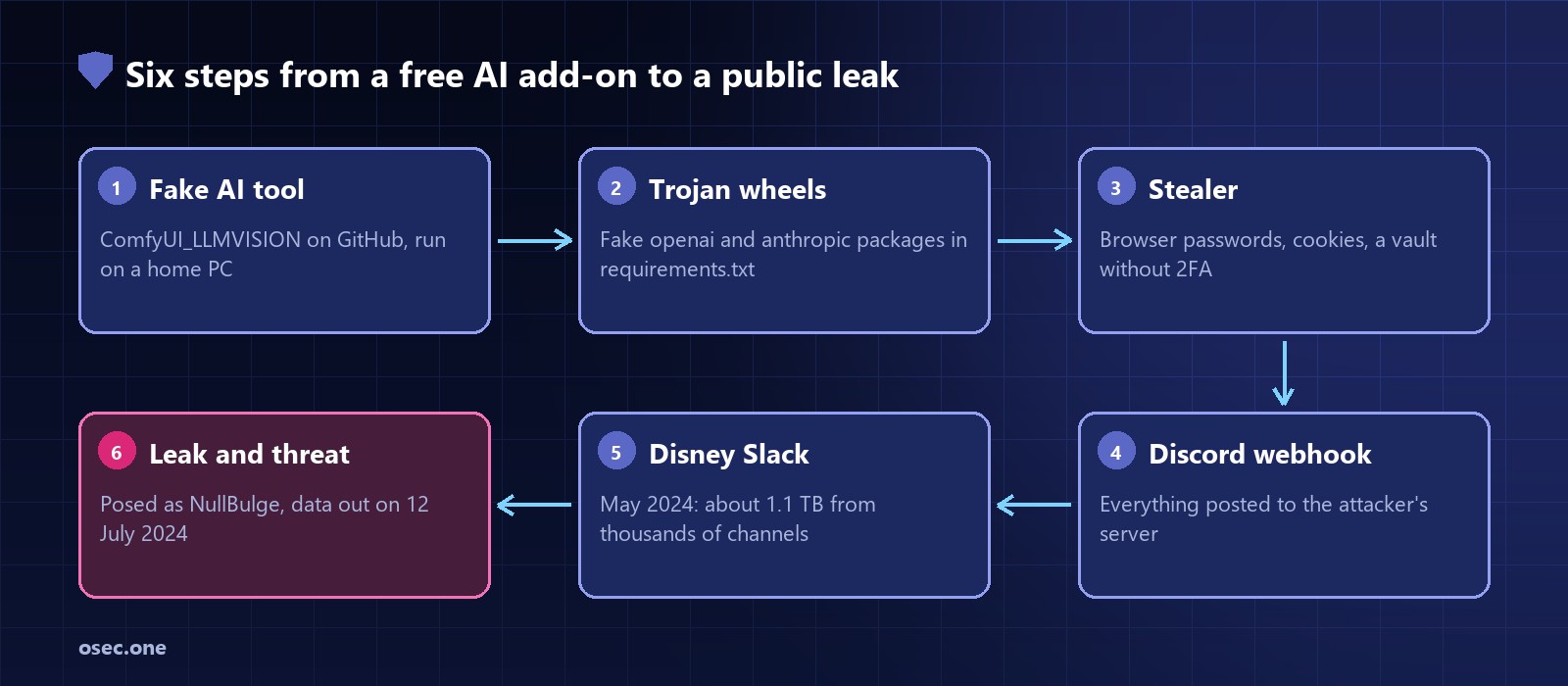
Six steps from a free AI add-on to 44 million leaked Slack messages. The first three happened on a personal computer.
Timeline
When
What happened
Source
Feb 2024 (WSJ) or Apr-May 2024 (court filings)
Engineer downloads a free AI image tool from GitHub on his home PC
WSJ; US Attorney, C.D. Cal.
Spring 2024
Malicious ComfyUI_LLMVISION add-on and trojanised packages circulate; same payloads on Hugging Face
SentinelOne Labs
May 2024
Attacker signs in to Disney Slack with the stolen logins, downloads about 1.1 TB
US Attorney, C.D. Cal.
9 Jun 2024
The add-on's GitHub page reads "COMPROMISED BY NULLBULGE GROUP"
404 Media
11 Jul 2024
Engineer gets a Discord message quoting a private Slack conversation of his
WSJ
12 Jul 2024
"NullBulge" publishes the Slack data plus the engineer's bank, medical and personal details
US Attorney; SiliconANGLE
Aug 2024
Disney 10-Q: investigating "over a terabyte of data from one of its communication systems", no material impact expected
Disney 10-Q
Sep 2024
CFO memo: most of the business off Slack later in 2024
WDWNT; The Register
1-2 May 2025
Kramer agrees to plead guilty to two felonies (up to 5 years each)
CBS LA; The Register
The two download dates don't agree: the Wall Street Journal's account says February 2024, filings in the criminal case put it in April-May 2024. Either way the attacker had the logins before the Slack download in May, and the engineer only found out in July. From February that's about 5 months on the machine, which is what the WSJ reported.
How the attack worked, step by step
1. A free AI add-on, on a personal computer
ComfyUI is a popular open-source tool for running image models like Stable Diffusion on your own GPU; people extend it with community "custom nodes" from GitHub. ComfyUI_LLMVISION promised to plug hosted vision models from OpenAI and Anthropic into it. It looked like any other node: a README, a few Python files, a requirements.txt. The engineer ran it on his home PC, the same machine he used for personal accounts and, through his password manager, for work.
2. The malware wasn't in the add-on's code
SentinelOne found the trick in requirements.txt. Instead of the real openai and anthropic packages from PyPI, it pulled wheel files hosted elsewhere with the same names. The fake openai packages were numbered 1.16.2 and 1.16.3, just above the real release at the time, so they looked like a routine newer version. Reading the add-on's Python files showed nothing wrong; the payload came in as a dependency during pip install -r requirements.txt.
3. What the stealer took
• Saved browser passwords from Chrome and Firefox (a script named Fadmino.py decrypts Firefox's store through its NSS library). • System details: installed apps, security products, hardware, and files matching keywords. • Financial data, crypto wallets and screenshots (vpnMentor's analysis). • The password manager's contents. The engineer's 1Password vault had no second factor. 1Password's own position: with a keylogging trojan on the machine, "an attacker has nearly unrestricted access".
Everything went out as an HTTP POST to a Discord webhook, encrypted in the code so a quick read wouldn't show where. Discord traffic is ordinary on a hobbyist's PC, so nothing on the network looked strange.
4. A home PC reaches a company Slack
Among the stolen logins and browser session cookies were the engineer's Disney Slack credentials. Court filings say the attacker used them in May 2024 to get into Disney's Slack workspace and download about 1.1 TB of data from thousands of channels; NullBulge later claimed "almost 10,000". Nothing in Disney's network was exploited. A working login from an unmanaged device was enough, and every channel that login could see was readable in bulk.
5. The fake hacktivists
In July 2024, Kramer contacted the engineer as NullBulge, presented as a Russia-based group fighting for "artists' rights" against AI. When the engineer didn't answer, he published the Slack data on 12 July 2024, along with the engineer's bank, medical and personal information. The engineer's credit cards were used, his children's Roblox accounts hijacked, and his home camera logins leaked. Disney fired him about 11 days later, citing content on his work laptop, which he disputes. Prosecutors say there were at least two other victims of the same malware. SentinelOne rated the group as low on sophistication and driven by money, not a cause.
What leaked, in numbers
Item
Figure
Source
Data downloaded
about 1.1 TB
US Attorney; NullBulge claim
Channels
thousands (NullBulge: almost 10,000)
US Attorney; SiliconANGLE
Slack messages
44 million+
WSJ, via Reuters
Spreadsheets
18,800+
WSJ
PDFs
13,000+
WSJ
Other contents
park pricing, cloud login credentials, cruise staff passport and visa details
WSJ
Disney+ revenue figure exposed
over $2.4 billion in the quarter to 30 Mar 2024
WSJ, via Reuters
Some arithmetic on those numbers: 1.1 TB over 10,000 channels averages about 110 MB per channel, and 44 million messages over 10,000 channels averages 4,400 messages per channel, so the download was full history, not a sample. The Disney+ figure was internal: Disney reported $5.642 billion for its whole direct-to-consumer segment that quarter, so the leak exposed a split (about 42.5% from Disney+ alone, 2.4 / 5.642) the company didn't publish.
Why the usual answers fall short
• "Turn on 2FA on the password manager." Do it: it stops someone reusing a stolen master password from another device. It doesn't stop malware on a computer where the vault is already unlocked. Here the stealer ran on the owner's own machine. • "Use MFA on Slack." A stolen session cookie is a sign-in that already passed MFA. Session cookie theft after MFA goes through why, and what device-bound sessions change. • "Read the code before you install." The add-on's own code was clean. The payload was a dependency pulled from a non-PyPI URL with a believable version number. • "Endpoint protection." Disney's managed laptops weren't involved. The home PC was outside every company control.
Controls that break each step
Step
Control
Effect here
Add-on installed on a personal PC
Separate machine, VM or container for hobby AI tools; nothing work-related signed in there
The stealer finds no work logins
Trojanised packages in requirements.txt
Read requirements.txt before installing; refuse direct URLs and --index-url/--extra-index-url lines; install with pip install --require-hashes from a lockfile; let new releases age a few days
A wheel from a stranger's server or a day-old version doesn't install
Browser passwords and vault taken
Work logins only in the company's password manager on company devices; 2FA on every vault; passkeys where the site supports them
Fewer secrets to lift, and passkeys can't be replayed
Data out through a Discord webhook
On managed devices, alert on or block posts to discord.com/api/webhooks from non-browser processes
Exfiltration is noticed
Slack sign-in from the home PC
Work SSO only from managed, compliant devices (device compliance in conditional access); Slack Enterprise session duration limits and IP allowlists
A stolen password or cookie fails from the attacker's machine
1.1 TB read from thousands of channels
Alert on one account reading or exporting far more channels than usual; Slack audit logs to the SIEM
The May download is caught in May, not July
Secrets in chat
No cloud credentials in Slack; scan messages for keys and rotate what turns up
Leaked chat doesn't hand over cloud logins
For any download you install or fetch more than once, pin the bytes you checked. The Pinned download check gives a file's SHA-256 and the snippet to verify it; it proves the file didn't change after you looked, not that it was safe when you looked. The 3-day release cooldown covers the PyPI side.
How it compares with LastPass and Lumma
In LastPass's 2022 breach an engineer's home Plex server was the way in, and a keylogger caught the master password to a vault holding company keys. Disney is the same shape two years later: a personal machine, a password manager holding work secrets, and no line between the two. Lumma Stealer shows the commercial version of step 3: stealer-as-a-service sold by subscription. NullBulge ran its own small one, hidden in a hobbyist's AI add-on.
The less a site stores in a password manager, the less a stealer can lift from one. A sign-in with a one-time email code, or Google or Apple, leaves no password for the vault to hold. osec.one's passwordless sign-in does all three, with no OAuth setup on your side, and it's free.
Sign-ins with email codes, Google and Apple: no password for a stealer to take from a vault, no OAuth app to set up. Free.