Visitor identification (knowing that the same browser came back, without a login) is useful for fraud checks, free-trial limits and bot filtering. Fingerprint sells it as a hosted service, and its pricing starts to hurt once traffic grows. We're building a smaller version, osec Fingerprint Lite, for small and mid-sized sites. This article compares the two on price and on what you give up. Where we're weaker, we say so.
The short version
• Fingerprint Pro Plus: $99 a month for 20,000 identifications, then $4 per 1,000 more. The free tier covers 1,000 a month.
• osec Fingerprint Lite: 500 identifications a day free on every osec account (about 15,000 a month). More capacity costs $5 for 10 credits, $10 for 20 or $50 for 100. Each credit adds 500 a day for 30 days.
• Accuracy: Lite is less accurate. Fingerprint's homepage calls its accuracy "industry-leading" without a number, and a third-party write-up quotes 99.5%. We haven't measured Lite yet, so we don't quote a number.
What each one does
• Fingerprint Pro: collects browser signals, adds server-side analysis and keeps data for 30 days on Pro Plus (90 days on Enterprise).
• osec Fingerprint Lite: the page script reads 12 browser signals (user agent, language, timezone, screen, cores, memory, platform, touch points, canvas, WebGL, audio and installed fonts). The server gives a visitor ID for an exact match, or for a match on at least 11 of the 12 signals seen in the last 30 days. It adds a bot check (headless browsers, automation flags, missing canvas).
• Not used by Lite: IP addresses, cookies, storage, and any server-side model.
What it costs
Monthly prices, in USD, for identifications per month (one identification = one call):
• 1,000 a month: Fingerprint $0 (free tier). osec $0 (free allowance).
• 20,000 a month: Fingerprint $99 ($0.005 per call). osec $0.
• 100,000 a month: Fingerprint $419 ($99 plus 80 × $4). osec $5 for 10 credits, enough for about 165,000 a month.
• 1,000,000 a month: Fingerprint $4,019 ($99 plus 980 × $4). osec $50 for 100 credits, enough for about 1.5 million a month.
Two things to know before you compare:
• osec is priced on capacity, not usage. A credit gives you a daily allowance for 30 days. If you don't use it, you still paid for it. At full use, the 100-credit pack works out to about $0.00003 per identification, against $0.004 per call for Fingerprint's overage: more than 100 times the price.
• The allowance is shared. All osec tools on one account draw on the same daily quota: identifications, captcha checks, monitors and login checks.
Our cost to run it is a shared server (a $48 droplet that also runs other services) plus database writes. We haven't load-tested it yet, so we don't have a measured cost per call. Pricing will change as we get that number, and we'll publish it.
What you give up with Lite
• Accuracy. Fingerprint combines browser signals with server-side analysis and more data. Lite uses only the browser signals, so expect more false "new visitor" results and some false matches. We will publish a test result once we have one.
• Clean profiles. A new browser profile, a new device or a privacy browser that changes its signals will count as a new visitor.
• Spoofing. Anyone who wants to fool a browser fingerprint can change these signals. Lite flags the common automation signals, but it isn't a defence against a determined attacker.
• Retention. Visitor records are kept for 30 days from the last visit, and older rows are deleted.
• Scale and support. Fingerprint has an enterprise tier with a 99.9% SLA and a dedicated manager. Lite is a single service on one shared server.
Who should use which
• Fingerprint Pro: you need high accuracy, server-side signals or an SLA, and your budget covers it.
• osec Fingerprint Lite: you run a small or mid-sized site or app, you want a rough visitor ID for free-trial limits, bot filtering or fraud hints, and you can live with lower accuracy.
• Neither: if you only need to count visitors, use a privacy-friendly analytics tool. You don't need a fingerprint.
Privacy and consent
• A browser fingerprint is personal data under the GDPR and UK GDPR, and under US state privacy laws, even without a name or cookie attached.
• In the EU, regulators generally expect consent before a script reads device attributes for identification. Check this with your own legal adviser before you turn it on for EU visitors.
• Put a notice on the page where the script runs and say what it's for. Store the least you need, and delete it on time.
• This article isn't legal advice.
How to add Lite to a site
1. Create an account at osec.one and add a site key. Give it your hostnames, so the key only works from your sites.
2. Add the page script with your public site key:
3. Listen for the result in the browser, or call the API yourself:
4. From your server, check a visitor with your secret key (sent in the X-Osec-Secret header, never in the browser):
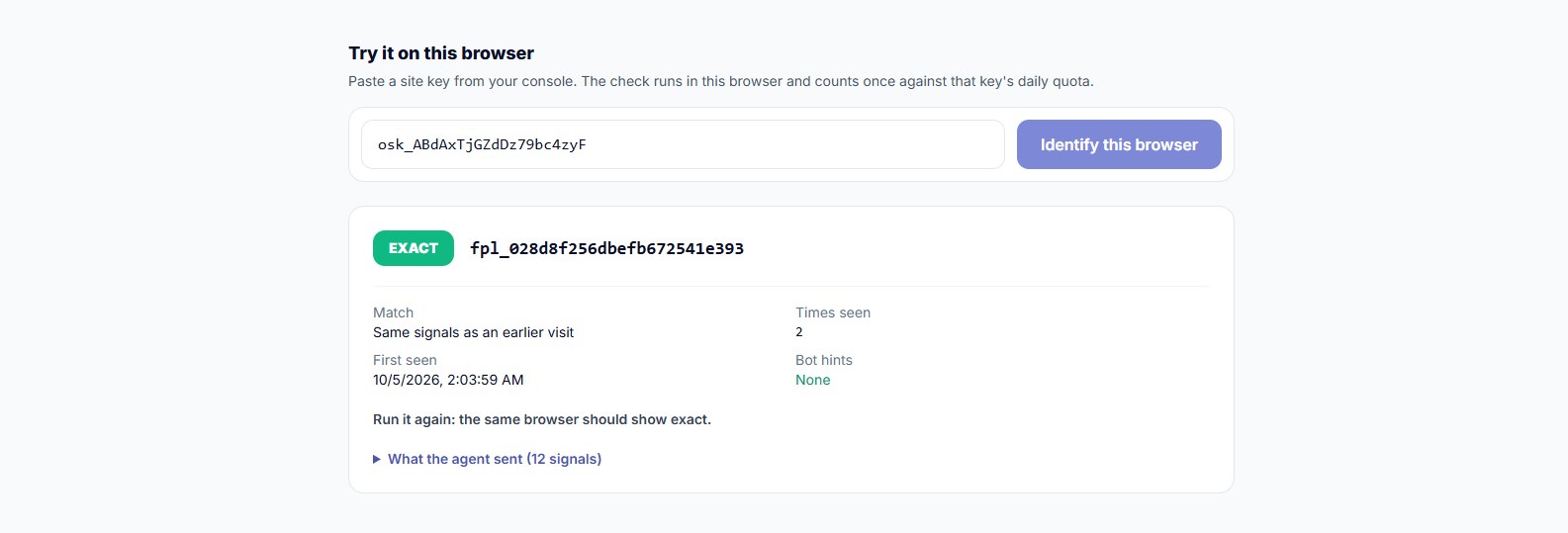
Identify a browser yourself with your site key, no install and no cookies. 500 a day free.
Try osec Fingerprint LiteMethod and sources
• Fingerprint prices: https://fingerprint.com/pricing/ (checked 2026-10-04). Prices can change; check the page before you buy.
• Fingerprint accuracy: their homepage gives no figure (checked 2026-10-04). The 99.5% figure comes from a third-party write-up, and we haven't verified it.
• osec prices: the osec.one pricing page (credit packs and how credits work).
• Lite design and limits: osec.tools source code (the matching rules and limits described above).
• All osec calculations use one identification per call and the credit prices on the osec.one pricing page.