

Most online stores already load one script from Google on every page: the Google Tag Manager (GTM) snippet that feeds analytics and ad pixels. Since 2021, Magecart groups have used that same snippet to deliver card skimmers. Recorded Future counted 316 stores in the first year and 314 confirmed GTM infections by August 2022, with 165,000+ card records from them for sale. In February 2025 Sucuri cleaned a Magento store where the GTM tag sat in a database block, and in June 2026 Sansec found GTM containers that pull a skimmer out of a Stripe customer record and post the stolen cards back to Stripe.
What these cases share: nothing on the page looks foreign. The loader comes from googletagmanager.com, a host every store's security policy already allows, and in the newest case the stolen data goes to api.stripe.com, which a store's checkout has to allow anyway. This write-up goes through how a tag manager becomes a checkout stealer, why the usual allowlists and integrity hashes don't catch it, and the checks that do.
Timeline
| When | What happened | Source |
|---|---|---|
| 4 Feb 2021 | First trojanized GTM container seen on a store | Recorded Future (Gemini Advisory) |
| Dec 2021 | 316 stores with skimmers in GTM containers, at least 88,000 card records posted to dark web shops; two variants; mostly US Magento stores | Recorded Future |
| 25 Aug 2022 | 569 infected domains, 314 confirmed GTM-based, 87 still infected; 165,000+ card records; average 3.5 months before removal; a third, XOR-obfuscated variant from July 2022 | Recorded Future Insikt |
| 6 Feb 2025 | Sucuri: GTM-MLHK2N68 loaded from Magento's cms_block.content table, skimmer on checkout, backdoor in media/index.php; container on at least 6 sites | Sucuri |
| 31 Mar 2025 | PCI DSS v4.0 requirements 6.4.3 (inventory and authorise every payment-page script) and 11.6.1 (detect changes on payment pages) stop being optional | PCI Security Standards Council |
| 24 Dec 2025 | Stripe customer record that later held a skimmer payload created | Sansec |
| 4 Jun 2026 | Sansec: four GTM containers load a skimmer from Stripe customer metadata and upload stolen cards to Stripe as fake customers; a Firestore variant | Sansec |
Five years in, the method has barely changed. What changed is where the code sits: first inside the container, then on a domain the container calls, and now inside a payments API the store itself trusts.
How a tag manager becomes a loader
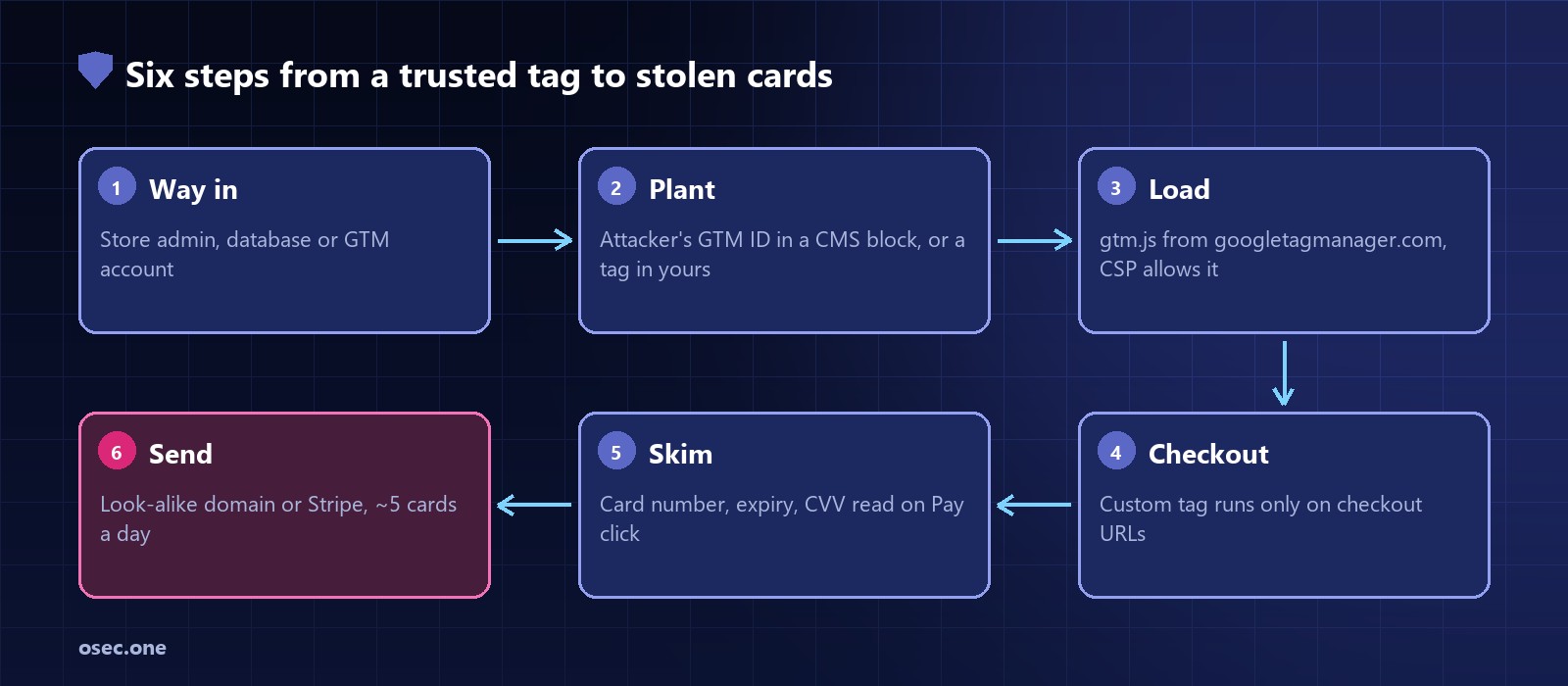
The GTM snippet is a few lines of inline JavaScript that add https://www.googletagmanager.com/gtm.js?id=GTM-XXXXXXX to the page. The container behind that ID holds tags and triggers, and one tag type, Custom HTML, runs any JavaScript you put in it, on any page the trigger matches. Whoever controls the container controls what runs on the store.
The public cases show two ways in:
1. The attacker's own container on your store. The attacker gets write access to the store (an admin password, an unpatched extension, a Magento bug such as CosmicSting) and pastes a GTM snippet with their container ID into a place the store prints on every page. On Magento that's usually the database, not a file: a CMS block (cms_block.content, Sucuri's 2025 case), a CMS page, or the theme's head HTML in core_config_data (path design/head/includes). A file scan finds nothing, and the same container ID on several unrelated stores is the giveaway that it isn't the store's.
2. A custom tag in your own container. Anyone who can publish in the store's GTM account (a marketing agency, a former contractor, a phished Google account) can add a Custom HTML tag set to fire on /checkout. No change to the store at all. The public reports don't say how often this route was used, but Sansec's advice to review every tag you didn't add yourself covers it.
Once the tag runs, the skimmer is ordinary: wait for the checkout form, read the card fields when the buyer clicks to pay, encode them, send them out. Sansec's 2026 loader only runs on URLs containing checkout, waits 2 seconds, saves a card only when number, expiry month, expiry year and CVV are all present, and uploads 1 second after each page load and then every 60 seconds.
Three generations of hiding place
| Variant | Where the skimmer lives | Where the cards go | Scale |
|---|---|---|---|
| 2021 variant 1 (from Mar 2021) | Plain JavaScript inside a unique GTM container per victim | 8 domains made to look like Google's | 187 domains, 52 still infected Aug 2022 |
| 2021 variant 2 (from Jun 2021) | Container holds a loader; the skimmer is on a separate site | The same dual-use site (17 domains) | 118 sites, 22 still infected |
| 2022 variant 3 (Jul 2022) | Inside the container, XOR-encrypted with a per-container key | 4 exfiltration domains | 13 sites, all still infected |
| 2025 Sucuri case | GTM tag stored in Magento's cms_block.content, obfuscated, rewritten analytics.js | eurowebmonitortool[.]com | GTM-MLHK2N68 on at least 6 sites |
| 2026 Sansec case | Stripe customer metadata, fetched with a hard-coded test key | api.stripe.com, as new Stripe customers | 4 containers named; store count not published |
Worked: 165,000 records over 314 GTM-infected stores is about 525 cards a store. Spread over the average 3.5 months (about 105 days) before removal, that's roughly 5 cards a day: no unusual traffic, no failed orders, nothing in the store's own data. Stores usually hear about it from customers or their payment processor once enough cards turn up in fraud reports; Sucuri's 2025 case started with a customer reporting card theft.
Why allowlists and hashes don't stop it
| Control | What it checks | Why the GTM skimmer gets past |
|---|---|---|
CSP script-src https://www.googletagmanager.com | Which hosts may serve scripts | Every container is served from the same host; the attacker's differs only in ?id= |
CSP connect-src | Where scripts may send data | 2021-2025 cases used new domains (a report-only CSP would show them); the 2026 case posts to api.stripe.com, which Stripe checkouts must allow |
| Subresource Integrity (SRI) | That a script's bytes match a hash | gtm.js is rebuilt every time a container is published, so it can't carry a fixed hash |
| File integrity monitoring | Changes to files on the server | The snippet is a row in the database, not a file |
| Looking at the page in devtools | What runs in the browser | Recorded Future: skimmers increasingly switch off when developer tools are open; Sansec's runs only on checkout URLs |
That doesn't make CSP useless. A policy in report mode, with connect-src limited to the hosts you really use, would have reported every 2021-2025 exfiltration domain the first time a buyer's browser tried it; osec CSP Reports collects those reports and groups them by blocked host. What it can't see is a skimmer that uses a host you already trust, which is why the remaining checks are about which container IDs your pages load and what is in them.
Checks that find it
1. List the container IDs your pages load. You should know them by heart: usually one, sometimes two. Search your checkout page's HTML and, on Magento, the database (cms_block.content, cms_page.content, and core_config_data values under design/head/includes and design/footer/absolute_footer) for googletagmanager, GTM- and gtag/js?id=. Any ID you don't recognise is the incident.
2. Review every tag in your own container. Custom HTML tags with obfuscated code, tags that fire only on checkout, and anything that mentions api.stripe.com, firestore.googleapis.com or a key starting sk_test_ or sk_live_ (a Stripe secret key never belongs in a browser). Check who has Publish rights and turn on 2-Step Verification for each Google account with access.
3. Load checkout while watching the network. Every request leaving the payment page should go to your processor or your own API. A POST to api.stripe.com/v1/customers from the buyer's browser is not a payment.
4. Keep GTM off the payment page if you can. Analytics tags rarely need to run on the card form. A trigger exception for checkout URLs, or a hosted payment page or payment fields in the processor's own iframe, takes the card numbers out of reach of anything in the container.
For the first check, the osec SRI check lists every script tag a page's HTML loads and marks Google Tag Manager as a dynamic host (no fixed hash possible), with the full URL so you can read the container ID. Its limit: the standard GTM snippet is inline JavaScript that creates the script tag, so the check sees gtag/js?id= and gtm.js?id= tags written into the HTML but not one added by another script. Use it as the quick outside look and the database search as the real inventory.
Controls that break each step
| Step | Control | Notes |
|---|---|---|
| Write access to the store | Patch Magento and extensions, MFA on admin, a non-default admin URL, admin restricted by IP | CosmicSting (2024) gave attackers exactly this access |
| Snippet in the database | Alert on changes to cms_block, cms_page and the core_config_data head/footer paths; weekly diff of stored HTML | PCI DSS 11.6.1 asks for change detection on payment pages at least weekly |
| Tag in your own container | Few publishers, 2-Step Verification, workspace approvals, review the version history | Agencies' and former staff's access is the usual gap |
| gtm.js loads | Know your container IDs; a page-script inventory (PCI DSS 6.4.3) that lists them | SRI can't pin gtm.js |
| Skimmer on checkout | Keep GTM off the card form, or use hosted payment fields or a hosted payment page | Removes the target, not just the attacker |
| Cards leave the browser | Report-only CSP with a tight connect-src; flag browser calls to payment APIs that don't come from the processor's own script | Catches new domains; a trusted-API route needs the content checks above |
How it compares
Each Magecart case on this site abuses a different trusted thing. In British Airways 2018 the attackers edited a library file on BA's own server. In Polyfill.io a widely used CDN domain was sold and started serving malicious code. In CosmicSting 2024 a Magento bug gave attackers the access to plant skimmers in the first place. Here the trusted thing is the store's own tag manager: a file check finds nothing, a host allowlist approves it, and an integrity hash can't be set. What does work is plain: know which container IDs and tags should be there, and look.
Paste your checkout page URL and see every script it loads, which ones can be pinned with an integrity hash, and which come from hosts like Google Tag Manager that change under the same address. Free, nothing to install.
Check your page's scriptsSources
• Recorded Future (Gemini Advisory), Magecart Groups Abuse Google Tag Manager (Dec 2021): https://www.recordedfuture.com/blog/magecarts-group-abuse-google-tag-manager
• Recorded Future Insikt, Threat Actors Continue to Abuse Google Tag Manager for Payment Card e-Skimming (data to 25 Aug 2022): https://www.recordedfuture.com/research/threat-actors-continue-to-abuse-google-tag-manager-for-payment-card-e-skimming
• Sucuri, Google Tag Manager Skimmer Steals Credit Card Info From Magento Site (6 Feb 2025): https://blog.sucuri.net/2025/02/google-tag-manager-skimmer-steals-credit-card-info-from-magento-site.html
• The Hacker News, Hackers Exploit Google Tag Manager to Deploy Credit Card Skimmers on Magento Stores (10 Feb 2025): https://thehackernews.com/2025/02/hackers-exploit-google-tag-manager-to.html
• Sansec, skimmer using the Stripe API and Google Tag Manager (4 Jun 2026): https://sansec.io/research/stripe-api-skimmer-infrastructure
• Sucuri, Credit Card Skimmer Malware Targeting Magento Checkout Pages (Nov 2024; core_config_data): https://blog.sucuri.net/2024/11/credit-card-skimmer-malware-targeting-magento-checkout-pages.html
• Sansec, GetCCInfo skimmer profile (database fields used): https://sansec.io/malware/getccinfo
• PCI Security Standards Council, PCI DSS v4.0 (requirements 6.4.3 and 11.6.1): https://www.pcisecuritystandards.org/document_library/