Ledger puts the impact at about $600,000 in user assets, says the malicious file was removed within 40 minutes of Ledger learning of it, and counts about five hours from the npm compromise to full resolution because of CDN caching. This write-up rebuilds the timeline from the npm registry's own publish times, explains why sites that "pin their dependencies" were hit anyway, and maps each step to the control that would have stopped it.
"},{"id":146592,"block_type":"screenshot","html":"Five steps from a phishing email to drained wallets. No dApp shipped a new build."},{"id":146593,"block_type":"heading_h2","html":"
The timeline, from the registry
"},{"id":146594,"block_type":"paragraph","html":"
The publish times below come from the npm registry's time field for @ledgerhq/connect-kit (UTC, to the second). Ledger's incident report gives the same events in CET (UTC+1).
"},{"id":146595,"block_type":"html","html":"
\n
14 Dec 2023, UTC
Event
Source
\n
6, 12, 13 Dec
An npm package with a random name, 2e6d5f64604be31, is published three times (1.0.0-1.0.2); 1.1.5 and 1.1.6 later pull the drainer from it
npm registry, Sonatype
\n
morning
Former employee phished; attacker gets into their npm account
Ledger
\n
08:49:04
connect-kit 1.1.5 published
npm registry
\n
09:44:57
1.1.6 published
npm registry
\n
10:37:24
1.1.7 published, drainer embedded
npm registry
\n
10:43
Blockaid's scanner flags hey.xyz (vendor's own account)
Blockaid
\n
11:00-13:00
The window in which Revoke.cash users could have been hit
Revoke.cash
\n
12:28
Blockaid posts publicly, after telling Ledger
Blockaid
\n
12:45
Ledger aware
Ledger
\n
13:18:35
1.1.8 (clean) published by a Ledger developer account
npm registry
\n
13:55
Tether freezes the attacker's USDT
Ledger
\n
15:17
GitHub advisory GHSA-g9hp-hq3h-h6hx (malware, critical) for >=1.1.5, <=1.1.7
GitHub
\n
15 Dec, 10:18
connect-kit-loader 1.1.8 pins @1.1.8 instead of @1
npm registry
\n
"},{"id":146596,"block_type":"paragraph","html":"
The arithmetic:
• First malicious publish to clean release: 08:49:04 → 13:18:35 = 4 h 29 min on npm. • Ledger aware to clean release: 12:45 → 13:18 = 33 min (Ledger says "within 40 minutes"). • Drainer embedded (1.1.7) to the first outside alert: 10:37 → 10:43 = 6 min. Alert to Ledger being aware: about 2 h, the slowest link in the chain. • Add CDN caching after 13:18 and Ledger's "about 5 hours" ends around 13:49 UTC. Ledger estimates active draining at under two hours in total.
Ledger's report says internal access is removed automatically when someone leaves, but outside services such as npm "must be handled manually with an employee offboarding checklist", and "in this individual case, the access was not manually revoked". The account had two-factor authentication. Ledger's report gives two explanations for getting past it: the timeline says a session token was used, the root-cause section says an API key tied to the account. Either way, npm accepted a credential that did not need a second factor at publish time.
"},{"id":146599,"block_type":"paragraph","html":"
What breaks this step:
1. Remove leavers from the npm organisation on their last day. npm's documentation: when a user loses access to a package or org, their granular access tokens lose it too. Removing the member from @ledgerhq would have killed the key. 2. Put npm, PyPI, GitHub, the CDN and DNS on the offboarding checklist, by name, with a second person ticking them. 3. Set the package to "Require two-factor authentication and disallow tokens". This blocks every token, including granular tokens flagged to bypass 2FA, so a stolen token can't publish. 4. Review who can publish every quarter: npm access list collaborators @scope/pkg and the org's member list. Anyone who hasn't published in a year doesn't need the right.
Step 2: three versions, two ways to load the drainer
"},{"id":146601,"block_type":"paragraph","html":"
Sonatype's analysis found that 1.1.5 and 1.1.6 fetched the payload from the separate random-named package, while 1.1.7 carried it inline (SlowMist describes 1.1.5 as a test-like message, so the two accounts differ on the first version). The payload replaced the real connect dialog with a fake one. Once a visitor connected a wallet, it asked for:
• token approvals and permit signatures for ERC-20 tokens and NFTs, which let the attacker's contract move them later; • a fake "claim" transaction or plain transfers for native coins.
The funds went through a rogue WalletConnect project to a drainer contract that split proceeds 85% to the attacker, 15% to the drainer-kit operator. Ledger and Blockaid name the kit as Angel Drainer; SlowMist pointed to the string "Inferno" in the code.
DeFi sites didn't install connect-kit directly. They installed @ledgerhq/connect-kit-loader, usually pulled in by wallet libraries such as Wagmi. The loader's own version was pinned in each site's lockfile. But the loader (1.1.2, August 2023) did one thing at runtime: it added a script tag pointing at jsDelivr with a major-version range and no integrity hash.
"},{"id":146604,"block_type":"code","html":"
html
<!-- what connect-kit-loader 1.1.2 injected (Aug 2023) -->\n<script src="https://cdn.jsdelivr.net/npm/@ledgerhq/connect-kit@1"></script>\n\n<!-- what loader 1.1.8 injected after the incident (15 Dec 2023) -->\n<script src="https://cdn.jsdelivr.net/npm/@ledgerhq/connect-kit@1.1.8"></script>
"},{"id":146605,"block_type":"paragraph","html":"
@1 means "the newest 1.x.y on npm". Ledger described the design as a feature: dApps "always have the most recent version ... without the need to manually update package versions and release new builds". Revoke.cash, which pins its dependencies, wrote afterwards that it "failed to realise that the ledger-connect-kit library was not pinnable". Its lockfile was correct; the code its visitors ran was not in the lockfile at all.
"},{"id":146606,"block_type":"paragraph","html":"
How jsDelivr treats the two URLs (from its README; headers we fetched on 28 Oct 2026, not the 2023 values):
"},{"id":146607,"block_type":"html","html":"
\n
URL form
CDN cache
Cache-Control we saw
Can a new npm publish change it?
\n
connect-kit@1 (range)
7 days, purgeable by request
max-age=604800, s-maxage=43200 (7 days browser, 12 h edge)
Yes, on the next cache refresh
\n
connect-kit@1.1.8 (exact)
\"effectively forever\"
max-age=31536000, immutable
No. npm doesn't allow republishing a version number
\n
"},{"id":146608,"block_type":"paragraph","html":"
The range URL is also why the fix took longer than the npm publish: a purge clears jsDelivr's caches, but a browser that fetched the bad file keeps it as long as its own max-age allows.
about $483,000 received by the attacker address, $44,000 of it USDT
DeBank, via The Block
14 Dec
\n
at least $484,000
Lookonchain, via CoinDesk and Cointelegraph
14 Dec
\n
about $600,000 in assets impacted
Ledger
20 Dec
\n
"},{"id":146614,"block_type":"paragraph","html":"
Tether froze the attacker's USDT at 13:55 UTC; neither Ledger nor Tether published the amount, and DeBank showed $44,000 in USDT at the address. On 20 December Ledger promised to make every victim whole, customers or not, by the end of February 2024. We found no published figure for what was actually paid. No reliable victim count exists either: the "180" that circulated refers to incidents linked to the drainer contract's creator, not to wallets drained in this attack.
• 14 Dec: connect-kit developers on npm set to read-only; GitHub publishing secrets rotated; developers told to wait 24 hours before using Connect Kit again. • 20 Dec report: an audit of access to internal and external tools, external tools added to offboarding, code signing "when relevant", more controls at the deployment stage, a third-party audit of access and distribution in early 2024, an end to blind signing. • In the registry: every release from 1.1.9 (January 2024) on is published by a CI account, not a person. None of them carries npm provenance.
Remove from the npm org on the last day (kills their granular tokens); external services on the offboarding checklist
Yes, outright
\n
A token or session got past 2FA
Package setting \"Require 2FA and disallow tokens\"; publish only through trusted publishing (OIDC from CI, npm CLI 11.5.1+)
Yes: no long-lived credential to steal
\n
A person published from a laptop
Trusted publishing plus provenance, and a policy that consumers check it
Only if real releases carry provenance and someone checks it; Ledger's releases had none, before or after
\n
Loader fetched @1 at runtime
Bundle the library at build time, or load an exact version with an integrity hash
Yes: a changed file fails SRI and the browser refuses to run it
\n
Drainer asked for approvals
Wallets that decode and show what a signature allows (Ledger ended blind signing)
Reduces losses; doesn't stop the injection
\n
2 h between first alert and vendor awareness
A security contact on the package (security.txt, npm/GitHub security policy) that someone watches
Shortens the window
\n
"},{"id":146619,"block_type":"paragraph","html":"
SRI is the browser-side control: <script src="https://cdn.jsdelivr.net/npm/pkg@1.2.3/dist/x.js" integrity="sha384-..." crossorigin="anonymous">. It only works on an exact version, which is the point: a range URL can't carry a hash because its content changes with every release. The free osec SRI check reads a page's script and stylesheet tags, flags third-party files without integrity and URLs whose content changes under the same address (no version in the path), and gives you the attribute to paste. It only sees tags in the HTML, so a loader like this one, which adds its tag at runtime, needs a look at the bundle too: search your built JavaScript for cdn.jsdelivr.net, unpkg.com and @latest.
• event-stream (2018): the author handed publish rights to a stranger who asked for them; the trust was given, not stolen, and the payload sat for about two months. • Shai-Hulud (2025): a worm that stole tokens from developers and CI and republished hundreds of packages by itself. • Ledger (2023): one forgotten credential, used once, no worm. The reach came from runtime loading of a version range, the same trust-the-URL problem as Polyfill.io, where the domain itself changed hands.
"},{"id":146622,"block_type":"cta","html":"
Paste a page URL and see every script and stylesheet it loads from other origins: which carry an integrity hash, which change under the same address, and the integrity attribute to add. Free, no account.
On the morning of 14 December 2023 someone phished a former Ledger employee. That person's npm account could still publish @ledgerhq/connect-kit, the library that shows the "connect your Ledger" dialog on decentralised-finance (DeFi) websites. Within two hours the attacker had published three malicious versions. Nobody at those websites deployed anything: a small loader in their pages fetched the newest 1.x version from a public CDN every time a visitor opened the page, so the wallet drainer arrived by itself.
\n
Ad
\n
Ledger puts the impact at about $600,000 in user assets, says the malicious file was removed within 40 minutes of Ledger learning of it, and counts about five hours from the npm compromise to full resolution because of CDN caching. This write-up rebuilds the timeline from the npm registry's own publish times, explains why sites that "pin their dependencies" were hit anyway, and maps each step to the control that would have stopped it.
\n
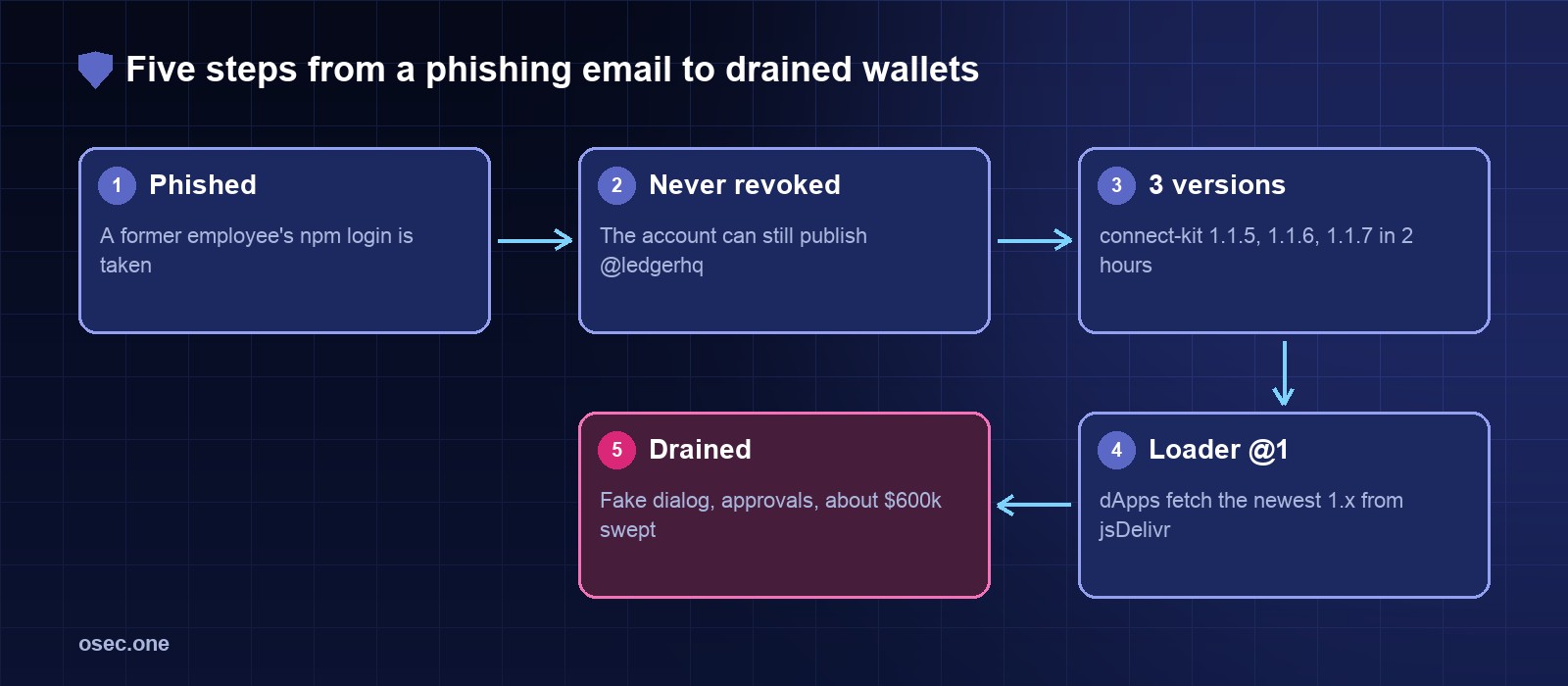
Five steps from a phishing email to drained wallets. No dApp shipped a new build.
\n
The timeline, from the registry
\n
The publish times below come from the npm registry's time field for @ledgerhq/connect-kit (UTC, to the second). Ledger's incident report gives the same events in CET (UTC+1).
\n
\n
14 Dec 2023, UTC
Event
Source
\n
6, 12, 13 Dec
An npm package with a random name, 2e6d5f64604be31, is published three times (1.0.0-1.0.2); 1.1.5 and 1.1.6 later pull the drainer from it
npm registry, Sonatype
\n
morning
Former employee phished; attacker gets into their npm account
Ledger
\n
08:49:04
connect-kit 1.1.5 published
npm registry
\n
09:44:57
1.1.6 published
npm registry
\n
10:37:24
1.1.7 published, drainer embedded
npm registry
\n
10:43
Blockaid's scanner flags hey.xyz (vendor's own account)
Blockaid
\n
11:00-13:00
The window in which Revoke.cash users could have been hit
Revoke.cash
\n
12:28
Blockaid posts publicly, after telling Ledger
Blockaid
\n
12:45
Ledger aware
Ledger
\n
13:18:35
1.1.8 (clean) published by a Ledger developer account
npm registry
\n
13:55
Tether freezes the attacker's USDT
Ledger
\n
15:17
GitHub advisory GHSA-g9hp-hq3h-h6hx (malware, critical) for >=1.1.5, <=1.1.7
GitHub
\n
15 Dec, 10:18
connect-kit-loader 1.1.8 pins @1.1.8 instead of @1
npm registry
\n
\n
The arithmetic:
• First malicious publish to clean release: 08:49:04 → 13:18:35 = 4 h 29 min on npm. • Ledger aware to clean release: 12:45 → 13:18 = 33 min (Ledger says "within 40 minutes"). • Drainer embedded (1.1.7) to the first outside alert: 10:37 → 10:43 = 6 min. Alert to Ledger being aware: about 2 h, the slowest link in the chain. • Add CDN caching after 13:18 and Ledger's "about 5 hours" ends around 13:49 UTC. Ledger estimates active draining at under two hours in total.
\n
Step 1: an npm account that outlived the job
\n
Ledger's report says internal access is removed automatically when someone leaves, but outside services such as npm "must be handled manually with an employee offboarding checklist", and "in this individual case, the access was not manually revoked". The account had two-factor authentication. Ledger's report gives two explanations for getting past it: the timeline says a session token was used, the root-cause section says an API key tied to the account. Either way, npm accepted a credential that did not need a second factor at publish time.
\n
What breaks this step:
1. Remove leavers from the npm organisation on their last day. npm's documentation: when a user loses access to a package or org, their granular access tokens lose it too. Removing the member from @ledgerhq would have killed the key. 2. Put npm, PyPI, GitHub, the CDN and DNS on the offboarding checklist, by name, with a second person ticking them. 3. Set the package to "Require two-factor authentication and disallow tokens". This blocks every token, including granular tokens flagged to bypass 2FA, so a stolen token can't publish. 4. Review who can publish every quarter: npm access list collaborators @scope/pkg and the org's member list. Anyone who hasn't published in a year doesn't need the right.
\n
Step 2: three versions, two ways to load the drainer
\n
Sonatype's analysis found that 1.1.5 and 1.1.6 fetched the payload from the separate random-named package, while 1.1.7 carried it inline (SlowMist describes 1.1.5 as a test-like message, so the two accounts differ on the first version). The payload replaced the real connect dialog with a fake one. Once a visitor connected a wallet, it asked for:
• token approvals and permit signatures for ERC-20 tokens and NFTs, which let the attacker's contract move them later; • a fake "claim" transaction or plain transfers for native coins.
The funds went through a rogue WalletConnect project to a drainer contract that split proceeds 85% to the attacker, 15% to the drainer-kit operator. Ledger and Blockaid name the kit as Angel Drainer; SlowMist pointed to the string "Inferno" in the code.
\n
Step 3: why sites that pin dependencies were hit
\n
DeFi sites didn't install connect-kit directly. They installed @ledgerhq/connect-kit-loader, usually pulled in by wallet libraries such as Wagmi. The loader's own version was pinned in each site's lockfile. But the loader (1.1.2, August 2023) did one thing at runtime: it added a script tag pointing at jsDelivr with a major-version range and no integrity hash.
\n
html
<!-- what connect-kit-loader 1.1.2 injected (Aug 2023) -->\n<script src="https://cdn.jsdelivr.net/npm/@ledgerhq/connect-kit@1"></script>\n\n<!-- what loader 1.1.8 injected after the incident (15 Dec 2023) -->\n<script src="https://cdn.jsdelivr.net/npm/@ledgerhq/connect-kit@1.1.8"></script>
\n
@1 means "the newest 1.x.y on npm". Ledger described the design as a feature: dApps "always have the most recent version ... without the need to manually update package versions and release new builds". Revoke.cash, which pins its dependencies, wrote afterwards that it "failed to realise that the ledger-connect-kit library was not pinnable". Its lockfile was correct; the code its visitors ran was not in the lockfile at all.
\n
How jsDelivr treats the two URLs (from its README; headers we fetched on 28 Oct 2026, not the 2023 values):
\n
\n
URL form
CDN cache
Cache-Control we saw
Can a new npm publish change it?
\n
connect-kit@1 (range)
7 days, purgeable by request
max-age=604800, s-maxage=43200 (7 days browser, 12 h edge)
Yes, on the next cache refresh
\n
connect-kit@1.1.8 (exact)
\"effectively forever\"
max-age=31536000, immutable
No. npm doesn't allow republishing a version number
\n
\n
The range URL is also why the fix took longer than the npm publish: a purge clears jsDelivr's caches, but a browser that fetched the bad file keeps it as long as its own max-age allows.
\n
Step 4: who served it
\n
Sonatype counted the loader as a dependency of more than 20,454 GitHub repositories; Blockaid estimated over 100 live front-ends affected.
\n
\n
Site
What happened
Source
\n
Revoke.cash
Served the drainer (via Wagmi); locked the site behind auth, removed the dependency, redeployed in about 1 h
Revoke.cash retrospective
\n
SushiSwap
Served the drainer; its CTO told users not to use any dApp
Blockaid, The Block
\n
Zapper
Served the drainer
Blockaid
\n
hey.xyz (Lens)
Served the drainer; where Blockaid's first alert fired
Blockaid
\n
Kyber
Switched its front-end off
The Block
\n
Lido
Switched front-ends off as a precaution (not reported compromised)
Cointelegraph
\n
Balancer, Phantom
Reported affected by Cointelegraph; no first-party statement found
Cointelegraph
\n
\n
The money
\n
\n
Figure
Who
When
\n
about $150,000 in the first couple of hours
Blockaid, via The Block
14 Dec
\n
about $483,000 received by the attacker address, $44,000 of it USDT
DeBank, via The Block
14 Dec
\n
at least $484,000
Lookonchain, via CoinDesk and Cointelegraph
14 Dec
\n
about $600,000 in assets impacted
Ledger
20 Dec
\n
\n
Tether froze the attacker's USDT at 13:55 UTC; neither Ledger nor Tether published the amount, and DeBank showed $44,000 in USDT at the address. On 20 December Ledger promised to make every victim whole, customers or not, by the end of February 2024. We found no published figure for what was actually paid. No reliable victim count exists either: the "180" that circulated refers to incidents linked to the drainer contract's creator, not to wallets drained in this attack.
\n
What Ledger changed
\n
• 14 Dec: connect-kit developers on npm set to read-only; GitHub publishing secrets rotated; developers told to wait 24 hours before using Connect Kit again. • 20 Dec report: an audit of access to internal and external tools, external tools added to offboarding, code signing "when relevant", more controls at the deployment stage, a third-party audit of access and distribution in early 2024, an end to blind signing. • In the registry: every release from 1.1.9 (January 2024) on is published by a CI account, not a person. None of them carries npm provenance.
\n
Controls for your own sites and packages
\n
\n
Step in this attack
Control
Would it have stopped it?
\n
Ex-employee still had publish rights
Remove from the npm org on the last day (kills their granular tokens); external services on the offboarding checklist
Yes, outright
\n
A token or session got past 2FA
Package setting \"Require 2FA and disallow tokens\"; publish only through trusted publishing (OIDC from CI, npm CLI 11.5.1+)
Yes: no long-lived credential to steal
\n
A person published from a laptop
Trusted publishing plus provenance, and a policy that consumers check it
Only if real releases carry provenance and someone checks it; Ledger's releases had none, before or after
\n
Loader fetched @1 at runtime
Bundle the library at build time, or load an exact version with an integrity hash
Yes: a changed file fails SRI and the browser refuses to run it
\n
Drainer asked for approvals
Wallets that decode and show what a signature allows (Ledger ended blind signing)
Reduces losses; doesn't stop the injection
\n
2 h between first alert and vendor awareness
A security contact on the package (security.txt, npm/GitHub security policy) that someone watches
Shortens the window
\n
\n
SRI is the browser-side control: <script src="https://cdn.jsdelivr.net/npm/pkg@1.2.3/dist/x.js" integrity="sha384-..." crossorigin="anonymous">. It only works on an exact version, which is the point: a range URL can't carry a hash because its content changes with every release. The free osec SRI check reads a page's script and stylesheet tags, flags third-party files without integrity and URLs whose content changes under the same address (no version in the path), and gives you the attribute to paste. It only sees tags in the HTML, so a loader like this one, which adds its tag at runtime, needs a look at the bundle too: search your built JavaScript for cdn.jsdelivr.net, unpkg.com and @latest.
\n
How it differs from the other npm cases
\n
• event-stream (2018): the author handed publish rights to a stranger who asked for them; the trust was given, not stolen, and the payload sat for about two months. • Shai-Hulud (2025): a worm that stole tokens from developers and CI and republished hundreds of packages by itself. • Ledger (2023): one forgotten credential, used once, no worm. The reach came from runtime loading of a version range, the same trust-the-URL problem as Polyfill.io, where the domain itself changed hands.
\n
Paste a page URL and see every script and stylesheet it loads from other origins: which carry an integrity hash, which change under the same address, and the integrity attribute to add. Free, no account.
Ledger Connect Kit 2023: a former employee's npm account and five hours of wallet drainers on DeFi sites
On the morning of 14 December 2023 someone phished a former Ledger employee. That person's npm account could still publish @ledgerhq/connect-kit, the library that shows the "connect your Ledger" dialog on decentralised-finance (DeFi) websites. Within two hours the attacker had published three malicious versions. Nobody at those websites deployed anything: a small loader in their pages fetched the newest 1.x version from a public CDN every time a visitor opened the page, so the wallet drainer arrived by itself.
Ad
Ledger puts the impact at about $600,000 in user assets, says the malicious file was removed within 40 minutes of Ledger learning of it, and counts about five hours from the npm compromise to full resolution because of CDN caching. This write-up rebuilds the timeline from the npm registry's own publish times, explains why sites that "pin their dependencies" were hit anyway, and maps each step to the control that would have stopped it.
Five steps from a phishing email to drained wallets. No dApp shipped a new build.
The timeline, from the registry
The publish times below come from the npm registry's time field for @ledgerhq/connect-kit (UTC, to the second). Ledger's incident report gives the same events in CET (UTC+1).
14 Dec 2023, UTC
Event
Source
6, 12, 13 Dec
An npm package with a random name, 2e6d5f64604be31, is published three times (1.0.0-1.0.2); 1.1.5 and 1.1.6 later pull the drainer from it
npm registry, Sonatype
morning
Former employee phished; attacker gets into their npm account
Ledger
08:49:04
connect-kit 1.1.5 published
npm registry
09:44:57
1.1.6 published
npm registry
10:37:24
1.1.7 published, drainer embedded
npm registry
10:43
Blockaid's scanner flags hey.xyz (vendor's own account)
Blockaid
11:00-13:00
The window in which Revoke.cash users could have been hit
Revoke.cash
12:28
Blockaid posts publicly, after telling Ledger
Blockaid
12:45
Ledger aware
Ledger
13:18:35
1.1.8 (clean) published by a Ledger developer account
npm registry
13:55
Tether freezes the attacker's USDT
Ledger
15:17
GitHub advisory GHSA-g9hp-hq3h-h6hx (malware, critical) for >=1.1.5, <=1.1.7
GitHub
15 Dec, 10:18
connect-kit-loader 1.1.8 pins @1.1.8 instead of @1
npm registry
The arithmetic:
• First malicious publish to clean release: 08:49:04 → 13:18:35 = 4 h 29 min on npm. • Ledger aware to clean release: 12:45 → 13:18 = 33 min (Ledger says "within 40 minutes"). • Drainer embedded (1.1.7) to the first outside alert: 10:37 → 10:43 = 6 min. Alert to Ledger being aware: about 2 h, the slowest link in the chain. • Add CDN caching after 13:18 and Ledger's "about 5 hours" ends around 13:49 UTC. Ledger estimates active draining at under two hours in total.
Step 1: an npm account that outlived the job
Ledger's report says internal access is removed automatically when someone leaves, but outside services such as npm "must be handled manually with an employee offboarding checklist", and "in this individual case, the access was not manually revoked". The account had two-factor authentication. Ledger's report gives two explanations for getting past it: the timeline says a session token was used, the root-cause section says an API key tied to the account. Either way, npm accepted a credential that did not need a second factor at publish time.
What breaks this step:
1. Remove leavers from the npm organisation on their last day. npm's documentation: when a user loses access to a package or org, their granular access tokens lose it too. Removing the member from @ledgerhq would have killed the key. 2. Put npm, PyPI, GitHub, the CDN and DNS on the offboarding checklist, by name, with a second person ticking them. 3. Set the package to "Require two-factor authentication and disallow tokens". This blocks every token, including granular tokens flagged to bypass 2FA, so a stolen token can't publish. 4. Review who can publish every quarter: npm access list collaborators @scope/pkg and the org's member list. Anyone who hasn't published in a year doesn't need the right.
Step 2: three versions, two ways to load the drainer
Sonatype's analysis found that 1.1.5 and 1.1.6 fetched the payload from the separate random-named package, while 1.1.7 carried it inline (SlowMist describes 1.1.5 as a test-like message, so the two accounts differ on the first version). The payload replaced the real connect dialog with a fake one. Once a visitor connected a wallet, it asked for:
• token approvals and permit signatures for ERC-20 tokens and NFTs, which let the attacker's contract move them later; • a fake "claim" transaction or plain transfers for native coins.
The funds went through a rogue WalletConnect project to a drainer contract that split proceeds 85% to the attacker, 15% to the drainer-kit operator. Ledger and Blockaid name the kit as Angel Drainer; SlowMist pointed to the string "Inferno" in the code.
Step 3: why sites that pin dependencies were hit
DeFi sites didn't install connect-kit directly. They installed @ledgerhq/connect-kit-loader, usually pulled in by wallet libraries such as Wagmi. The loader's own version was pinned in each site's lockfile. But the loader (1.1.2, August 2023) did one thing at runtime: it added a script tag pointing at jsDelivr with a major-version range and no integrity hash.
html
<!-- what connect-kit-loader 1.1.2 injected (Aug 2023) -->
<script src="https://cdn.jsdelivr.net/npm/@ledgerhq/connect-kit@1"></script>

<!-- what loader 1.1.8 injected after the incident (15 Dec 2023) -->
<script src="https://cdn.jsdelivr.net/npm/@ledgerhq/connect-kit@1.1.8"></script>
@1 means "the newest 1.x.y on npm". Ledger described the design as a feature: dApps "always have the most recent version ... without the need to manually update package versions and release new builds". Revoke.cash, which pins its dependencies, wrote afterwards that it "failed to realise that the ledger-connect-kit library was not pinnable". Its lockfile was correct; the code its visitors ran was not in the lockfile at all.
How jsDelivr treats the two URLs (from its README; headers we fetched on 28 Oct 2026, not the 2023 values):
URL form
CDN cache
Cache-Control we saw
Can a new npm publish change it?
connect-kit@1 (range)
7 days, purgeable by request
max-age=604800, s-maxage=43200 (7 days browser, 12 h edge)
Yes, on the next cache refresh
connect-kit@1.1.8 (exact)
"effectively forever"
max-age=31536000, immutable
No. npm doesn't allow republishing a version number
The range URL is also why the fix took longer than the npm publish: a purge clears jsDelivr's caches, but a browser that fetched the bad file keeps it as long as its own max-age allows.
Step 4: who served it
Sonatype counted the loader as a dependency of more than 20,454 GitHub repositories; Blockaid estimated over 100 live front-ends affected.
Site
What happened
Source
Revoke.cash
Served the drainer (via Wagmi); locked the site behind auth, removed the dependency, redeployed in about 1 h
Revoke.cash retrospective
SushiSwap
Served the drainer; its CTO told users not to use any dApp
Blockaid, The Block
Zapper
Served the drainer
Blockaid
hey.xyz (Lens)
Served the drainer; where Blockaid's first alert fired
Blockaid
Kyber
Switched its front-end off
The Block
Lido
Switched front-ends off as a precaution (not reported compromised)
Cointelegraph
Balancer, Phantom
Reported affected by Cointelegraph; no first-party statement found
Cointelegraph
The money
Figure
Who
When
about $150,000 in the first couple of hours
Blockaid, via The Block
14 Dec
about $483,000 received by the attacker address, $44,000 of it USDT
DeBank, via The Block
14 Dec
at least $484,000
Lookonchain, via CoinDesk and Cointelegraph
14 Dec
about $600,000 in assets impacted
Ledger
20 Dec
Tether froze the attacker's USDT at 13:55 UTC; neither Ledger nor Tether published the amount, and DeBank showed $44,000 in USDT at the address. On 20 December Ledger promised to make every victim whole, customers or not, by the end of February 2024. We found no published figure for what was actually paid. No reliable victim count exists either: the "180" that circulated refers to incidents linked to the drainer contract's creator, not to wallets drained in this attack.
What Ledger changed
• 14 Dec: connect-kit developers on npm set to read-only; GitHub publishing secrets rotated; developers told to wait 24 hours before using Connect Kit again. • 20 Dec report: an audit of access to internal and external tools, external tools added to offboarding, code signing "when relevant", more controls at the deployment stage, a third-party audit of access and distribution in early 2024, an end to blind signing. • In the registry: every release from 1.1.9 (January 2024) on is published by a CI account, not a person. None of them carries npm provenance.
Controls for your own sites and packages
Step in this attack
Control
Would it have stopped it?
Ex-employee still had publish rights
Remove from the npm org on the last day (kills their granular tokens); external services on the offboarding checklist
Yes, outright
A token or session got past 2FA
Package setting "Require 2FA and disallow tokens"; publish only through trusted publishing (OIDC from CI, npm CLI 11.5.1+)
Yes: no long-lived credential to steal
A person published from a laptop
Trusted publishing plus provenance, and a policy that consumers check it
Only if real releases carry provenance and someone checks it; Ledger's releases had none, before or after
Loader fetched @1 at runtime
Bundle the library at build time, or load an exact version with an integrity hash
Yes: a changed file fails SRI and the browser refuses to run it
Drainer asked for approvals
Wallets that decode and show what a signature allows (Ledger ended blind signing)
Reduces losses; doesn't stop the injection
2 h between first alert and vendor awareness
A security contact on the package (security.txt, npm/GitHub security policy) that someone watches
Shortens the window
SRI is the browser-side control: <script src="https://cdn.jsdelivr.net/npm/pkg@1.2.3/dist/x.js" integrity="sha384-..." crossorigin="anonymous">. It only works on an exact version, which is the point: a range URL can't carry a hash because its content changes with every release. The free osec SRI check reads a page's script and stylesheet tags, flags third-party files without integrity and URLs whose content changes under the same address (no version in the path), and gives you the attribute to paste. It only sees tags in the HTML, so a loader like this one, which adds its tag at runtime, needs a look at the bundle too: search your built JavaScript for cdn.jsdelivr.net, unpkg.com and @latest.
How it differs from the other npm cases
• event-stream (2018): the author handed publish rights to a stranger who asked for them; the trust was given, not stolen, and the payload sat for about two months. • Shai-Hulud (2025): a worm that stole tokens from developers and CI and republished hundreds of packages by itself. • Ledger (2023): one forgotten credential, used once, no worm. The reach came from runtime loading of a version range, the same trust-the-URL problem as Polyfill.io, where the domain itself changed hands.
Paste a page URL and see every script and stylesheet it loads from other origins: which carry an integrity hash, which change under the same address, and the integrity attribute to add. Free, no account.