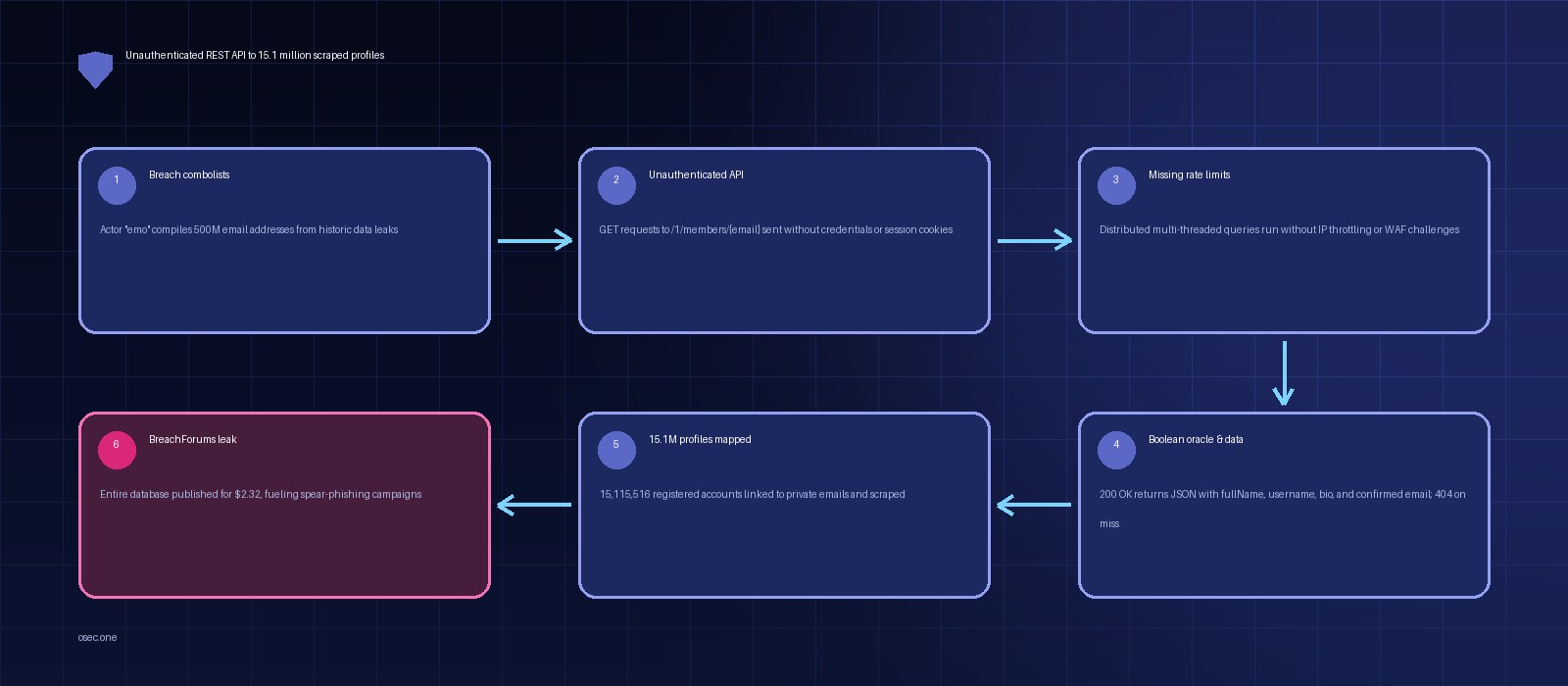
In January 2024, a cybercrime actor known as "emo" began running automated queries against a public, unauthenticated REST API endpoint hosted on Trello (https://trello.com/1/members/). By feeding a compiled list of roughly 500 million email addresses sourced from historical third-party data breaches into the endpoint, the attacker confirmed and scraped the profile details of 15,115,516 registered Trello users. Six months later, on 16 July 2024, the full 15.1-million-row database was published on BreachForums for 8 forum credits—roughly $2.32.
The incident did not involve a zero-day exploit, broken cryptography, or compromised database servers. Atlassian, which acquired Trello in 2017, confirmed that internal corporate systems were never breached. Instead, the incident was an unauthenticated API data enumeration attack. The API performed exactly as written: it accepted an email address and returned public profile information. The catastrophic failure lay in exposing a user-search capability without authentication, tenant scoping, or rate limiting.
The numbers behind the scrape
The scale and operational parameters of the attack illustrate how efficient mass enumeration can be when public endpoints lack rate limiting and bot mitigation.
| Metric | Recorded Value | Architectural Significance |
|---|---|---|
| Seed emails tested | 500,000,000 | Aggregated breach combolists compiled from historical third-party leaks |
| Accounts scraped | 15,115,516 | Unique Trello member records extracted with complete public profile attributes |
| Hit rate | 3.02% | Percentage of arbitrary email addresses successfully mapped to registered accounts |
| Authentication required | None (unauthenticated) | Standard public GET request; no session cookie, token, or API key needed |
| Endpoint target | GET /1/members/{email} | Intended for email auto-complete invitation dialogs across public boards |
| Public leak price | 8 BreachForums credits (~$2.32) | Negligible barrier to entry for downstream spear-phishing and credential stuffing |
Anatomy of the leaky REST endpoint
Trello's REST API v1 provided a members resource intended to retrieve profile details by internal identifier or username. To support collaboration workflows—such as inviting colleagues to a board by email—the endpoint was designed to accept an email address as the resource identifier in the URL path:
When queried with an email address registered on the platform, the server responded with HTTP 200 OK and a comprehensive JSON payload containing the member's profile:
When queried with an email address not registered with Trello, the server responded with HTTP 404 Not Found and a plain text body model not found. This created an unauthenticated boolean oracle: a binary signal that instantly verified whether any email address in the world held an active Trello account.
Why standard web application firewalls failed
Security operations teams frequently wonder why a 500-million-request enumeration campaign goes unnoticed. The attacker avoided triggering perimeter alarm thresholds through three deliberate operational tactics:
- Distributed residential proxy rotation: Queries were distributed across thousands of residential IPs, keeping requests per IP below standard volumetric threshold triggers (such as 100 requests per minute).
- Valid HTTP semantics: Every request was a syntactically valid HTTP GET request. There were no SQL injection characters, path traversal tokens, or malicious payloads that signature-based WAFs inspect for.
- Legitimate API usage emulation: The endpoint was publicly documented. The headers and query parameters resembled legitimate background polling from mobile apps and browser integrations.
The de-anonymization and spear-phishing risk
While passwords and payment card numbers were never exposed, linking 15.1 million email addresses to full names and usernames created substantial security risks:
- Cross-platform de-anonymization: Many users register on forums and discussion platforms using pseudonymous handles. Scraped Trello profiles connected real enterprise and personal email addresses directly to known usernames.
- Contextual spear-phishing: Threat actors gained verified corporate affiliations, department details (from public bios), and workspace names (idOrganizations), enabling highly convincing phishing lures impersonating internal project boards or Atlassian admin notices.
- Targeted credential stuffing: Knowing that an email address belongs to an active technical professional allows attackers to narrow credential stuffing lists to high-value accounts rather than spraying dead mailboxes.
Atlassian's remediation: what changed
In January 2024, following reports from researchers and dark web monitoring, Atlassian quietly updated the /1/members/{id} endpoint with two critical authorization gates:
- Mandatory authentication for email resolution: Querying /1/members/{email} now strictly requires an authenticated API session (API key and user token). Unauthenticated requests with an email address receive HTTP 401 Unauthorized.
- Tenant boundary scoping: Even when authenticated, an API user cannot query arbitrary external emails. The endpoint only resolves email addresses for members who belong to the caller's shared organization, team, or workspace.
How to build enumeration-proof APIs
Protecting public-facing applications from mass scraping requires defense in depth across authorization, response timing, and rate limiting.
1. Never resolve user identity from unauthenticated endpoints
Public profiles should be queried only by opaque, internal UUIDs or public handles—never by sensitive identity identifiers such as email addresses or phone numbers. If an application must support an 'Invite by email' feature, the resolution should occur server-side within the context of an established workspace membership.
2. Subnet-aware rate limiting with exponential backoff
Traditional IP rate limiting is trivially bypassed using residential proxy pools. Modern API gateways must group requests by IP subnet (/24 for IPv4, /48 for IPv6) and enforce composite limits across request velocity and failure ratios (e.g. tracking consecutive 404 responses).
3. Deploy transparent bot gates on public endpoints
Automated scrapers rely on programmatic HTTP libraries (such as Python requests, Go net/http, or curl). A behavioral bot gate intercepts unauthenticated traffic and requires client-side proof-of-work or browser verification before granting access to API resources.
For a similar case where an unauthenticated API endpoint confirmed 33 million telephone numbers, read our case study on Authy 2024: an open API endpoint that confirmed 33 million phone numbers.
Sources
- BleepingComputer (18 July 2024): Hacker leaks 15 million Trello user records scraped via public API.
- Dark Reading (19 July 2024): Scraped Trello API Yields 15M User Records on BreachForums.
- Have I Been Pwned (17 July 2024): Trello Scraping Incident Data Ingestion.
- Atlassian Customer Advisory (January 2024): Trello REST API Member Resolution Permissions Update.
- CybelAngel Threat Research (July 2024): Analysis of the Emo 15.1M Trello Scraping Dump.