CISA answered with Emergency Directive ED 25-03 on 25 September 2025 and an update in April 2026. This write-up goes through each campaign, the implants and how they hid, the directive's steps, which models can't be cleaned at all, and what a company with one ASA at the edge should check this week.
"},{"id":145160,"block_type":"screenshot","html":"Each round answered the previous round's clean-up advice."},{"id":145161,"block_type":"heading_h2","html":"
The timeline
"},{"id":145162,"block_type":"code","html":"
text
ArcaneDoor / UAT4356, 2023-2026 (Cisco Talos, Cisco PSIRT, NCSC UK, CISA)\n\nJul 2023 capability being tested and developed (Talos)\nNov 2023 earliest attacker-controlled infrastructure\nDec 2023-Jan 2024 most of the first campaign's activity\nearly 2024 a customer reports a suspicious ASA to Cisco\n24 Apr 2024 Talos "ArcaneDoor" post; CVE-2024-20353 and -20359 published\n and added to CISA KEV\nMay 2025 government responders bring Cisco attacks on ASA 5500-X\n with VPN web services enabled\n25 Sep 2025 CVE-2025-20333, -20362 (in KEV, federal due date next day)\n and -20363; CISA ED 25-03; Canada's Cyber Centre alert\n29 Sep 2025 Shadowserver: >48,800 vulnerable ASA/FTD on the internet\nOct 2025 NCSC UK analysis of RayInitiator and LINE VIPER\n5 Nov 2025 Cisco: a new attack variant makes unpatched devices reload\n12 Nov 2025 CISA: agencies marked devices "patched" on builds that\n weren't; minimum versions published\n23 Apr 2026 Talos: FIRESTARTER; Cisco persistence advisory; ED 25-03\n updated: patch by 24 Apr, unplug the power by 30 Apr\n19 May 2026 Cisco's final fixed-release table for the persistence fix
2024: Line Dancer in memory, Line Runner on the disk
"},{"id":145164,"block_type":"paragraph","html":"
Talos never found how the attackers first got in during 2024. It did find two implants:
"},{"id":145165,"block_type":"code","html":"
text
Implant Where it lived What it did (Talos, 24 Apr 2024)\nLine Dancer memory only shellcode sent in an unauthenticated POST to\n the VPN's host-scan handler; it could switch\n off syslog, run show configuration and CLI\n commands, take packet captures, hook\n authentication to accept a "magic number",\n and hook crash dumps so the box rebooted\n instead of writing one. Gone after a reboot.\nLine Runner disk0: (flash) abused a legacy VPN client preload feature\n (CVE-2024-20359): at boot the ASA unzipped a\n client_bundle*.zip and ran the Lua inside,\n which served the attacker's commands through\n a web endpoint; a shutdown hook wrote the zip\n back. Survived reboots and upgrades.
"},{"id":145166,"block_type":"paragraph","html":"
CVE-2024-20353 (CVSS 8.6) let the attacker force a reload, which is how Line Runner got started without waiting for a maintenance window. Talos's checks were concrete: show memory region | include lina showing more than one executable (r-xp) region for lina, especially one of exactly 0x1000 bytes, and an unexpected zip on disk0:. Its advice if you suspected a compromise: don't reboot and don't take a core dump yourself.
2025: two VPN bugs, LINE VIPER and a bootkit in ROM
"},{"id":145168,"block_type":"paragraph","html":"
The 2025 campaign started from two bugs in the ASA's VPN web server, chained:
"},{"id":145169,"block_type":"code","html":"
text
CVE What it is CVSS CISA KEV\nCVE-2025-20362 VPN web server: some URLs that should 6.5 25 Sep 2025\n need a login don't\nCVE-2025-20333 VPN web server buffer overflow: root code 9.9 25 Sep 2025\n execution with valid VPN credentials\n (none needed when chained with 20362)\nCVE-2025-20363 HTTP server code execution (also IOS, 9.0 not listed\n IOS XE, IOS XR)
"},{"id":145170,"block_type":"paragraph","html":"
On top came LINE VIPER, a shellcode loader that the UK's NCSC took apart. It ran CLI commands at the highest privilege, captured packets, let the attacker's devices skip authentication, suppressed chosen syslog messages and recorded admins' CLI commands. Its defences were aimed squarely at the 2024 clean-up advice:
"},{"id":145171,"block_type":"paragraph","html":"
1. A core dump triggered an immediate reboot, which wiped the in-memory evidence Talos had told people to collect. 2. copy system:/text triggered a reboot and verify returned the legitimate hash of the running code. 3. It fixed the split lina memory region, so the 2024 show memory region check came back clean on an infected box. 4. It could schedule a reboot 1 to 10 hours out, unless the operator set a flag to stop it.
"},{"id":145172,"block_type":"paragraph","html":"
NCSC analysed it on ASA 9.12(4)67 and 9.14(4)24, which were fully patched at the time. Under it sat RayInitiator, a multi-stage GRUB bootkit that NCSC says was "flashed to" the device and Cisco calls a ROMMON modification. ROMMON is the code that starts before the ASA software. RayInitiator patched the kernel during boot and installed a handler in lina, so it came back after reboots and after a full software upgrade.
RayInitiator was seen only on ASA 5500-X models that have no Secure Boot, so nothing checks ROMMON before it runs. Cisco's list, and the dates support ended:
"},{"id":145175,"block_type":"code","html":"
text
Model Secure Boot Last day of support 2025 status\n5512-X, 5515-X no 31 Aug 2022 compromised\n5585-X no 31 May 2023 compromised\n5525-X, 5545-X, 5555-X no 30 Sep 2025 compromised\n5506-X, 5506H-X, 5506W-X, yes 31 Aug 2026 nothing seen;\n5508-X, 5516-X support ends soon\nFirepower / Secure Firewall Secure Boot + no ROM persistence seen in 2025\n Trust Anchor (but see FIRESTARTER, 2026)
"},{"id":145176,"block_type":"paragraph","html":"
Count the days for an owner on 25 September 2025: a 5525-X, 5545-X or 5555-X had 5 days of support left; a 5512-X or 5515-X had been out of support for 1,121 days. A box whose boot ROM may hold an implant, and that gets no more firmware, can't be proven clean. ED 25-03 told agencies to permanently disconnect every model whose support ended on or before 30 September 2025, by that date.
The directive bound US federal agencies, but its steps are the best public checklist for anyone with an ASA:
"},{"id":145179,"block_type":"code","html":"
text
Deadline (EDT) Step\n26 Sep 2025, 23:59 inventory every ASA (hardware, ASA-SM, ASAv); for each\n public-facing one, run the core dump and hunt steps\n and upload to CISA's Malware Next Gen\n compromised: disconnect from the network, don't power\n off, report to CISA\n not compromised, model on 31 Aug 2026 support or ASAv:\n patch, then every later update within 48 hours\n30 Sep 2025 permanently disconnect models out of support on or\n before 30 Sep 2025\n2 Oct 2025, 23:59 inventory report to CISA\n12 Nov 2025 minimum versions published; all ASA and Firepower\n devices, not just public-facing ones\n24 Apr 2026, 23:59 Firepower / Secure Firewall: core dumps uploaded, patch\n including the persistence fix\n30 Apr 2026 hard reset: unplug the power\n1 May 2026 inventory report
"},{"id":145180,"block_type":"paragraph","html":"
The 12 November note is the uncomfortable one: agencies had reported devices as patched while running builds that were still vulnerable, so CISA published minimum versions. In early October Shadowserver still counted over 45,000 vulnerable devices, and around 13 November over 30,000, down from 48,800 on 29 September.
On 23 April 2026 Talos described FIRESTARTER, found on a US federal civilian agency's Firepower device after LINE VIPER. It lives inside lina, overwrites a WebVPN XML handler and runs shellcode sent with a magic-byte prefix. To survive, it edits the boot mount list when the device goes through a graceful reboot, so a reload puts it back. It survived upgrades to the September 2025 fixes. A cold power pull, where the device shuts down without the graceful path, removes it, which is why the updated directive ordered agencies to unplug the power by 30 April.
"},{"id":145183,"block_type":"paragraph","html":"
FIRESTARTER affects Firepower 1000/2100/4100/9300 and Secure Firewall 1200/3100/4200, the hardware that has Secure Boot. It does not affect ASA 5500-X, Secure Firewall 200 or 6100, ASAv, ISA3000 or FTDv. Cisco recommends reimaging over the power pull, which can corrupt the disk.
The osec Firmware branch check takes an ASA version and lists each known-exploited Cisco ASA CVE that still applies to it, with the fixed release on the same train.
1. show version: write down the model and release. If the model is in the no-Secure-Boot rows above, plan the replacement now; checks can't clear it. 2. show running-config webvpn and look for enable <interface> on the outside interface, and show running-config crypto ikev2 | include client-services. Either one means the VPN web server the 2025 bugs live in is reachable. 3. Until you can patch, Cisco's temporary mitigation is removing client-services from IKEv2 or no webvpn. The latter ends all SSL VPN, so plan it with users.
These are the steps from CISA's core dump and hunt instructions and Cisco's detection guide. Run them before any reboot; on a confirmed hit, disconnect the box but leave it powered and call Cisco TAC.
1. show checkheaps, then again five minutes later. The run counter should go up by about one a minute; if it doesn't move, treat it as compromised. 2. more /binary system:/text | grep 55534154 41554156 41575756 488bb3a0. Any output is an indicator of compromise. 3. show kernel process | include lina_cs (2026 check). Any output means FIRESTARTER; rule out a false positive with verify disk0:/asdm.bin. 4. dir disk0: for a client_bundle zip you didn't put there (2024). 5. During the upgrade, watch the console for "Bootloader/ROMMON verification succeeded". A "failed at address" message, or a firmware_update.log on disk0: after moving to 9.12.4.72 or 9.14.4.28, means a TAC case. 6. Don't use tab completion while you run them; CISA warns it may crash the device.
LINE VIPER suppressed specific syslog IDs, so look for what's missing in a syslog server's copy: 302013/302014 (connection built and torn down) and, if you log at debug, 609002/710005. Then look for what's there: VPN logins from impossible places (716002, 722029-722031), packet captures you didn't start that target TACACS+, RADIUS, LDAP or SMB traffic, and scans from the firewall into the LAN on TCP 443 or LDAP.
4. If anything matched, or the box is a 5500-X without Secure Boot
"},{"id":145195,"block_type":"paragraph","html":"
1. Treat the configuration as untrusted: rebuild it from scratch with configure factory-default (or write erase and reload) or a reimage, not by restoring the old file. 2. Rotate every secret the firewall held: local and enable passwords, VPN pre-shared keys, the LDAP/RADIUS/TACACS+ shared secrets, and every certificate whose private key was on the box. 3. On FIRESTARTER-affected Firepower and Secure Firewall models, patch to the persistence fix, then reimage, or at least cold-boot by pulling the power. 4. On a 5500-X model without Secure Boot, replace the hardware. Cisco has no way to verify its ROM.
"},{"id":145196,"block_type":"paragraph","html":"
Edge-device persistence that outlives the patch is a pattern on this site: FortiGate 2025 kept attackers reading files through a symlink after the fix, and Ivanti Connect Secure 2024 needed a factory reset rather than a patch. ArcaneDoor is the furthest down that line so far: below the operating system, and on the oldest boxes, below anything the owner can check.
"},{"id":145197,"block_type":"cta","html":"
Type your ASA version and see which known-exploited Cisco ASA CVEs still apply, with the fixed release on your train. Save it as a watch and get one email when a new one starts applying.
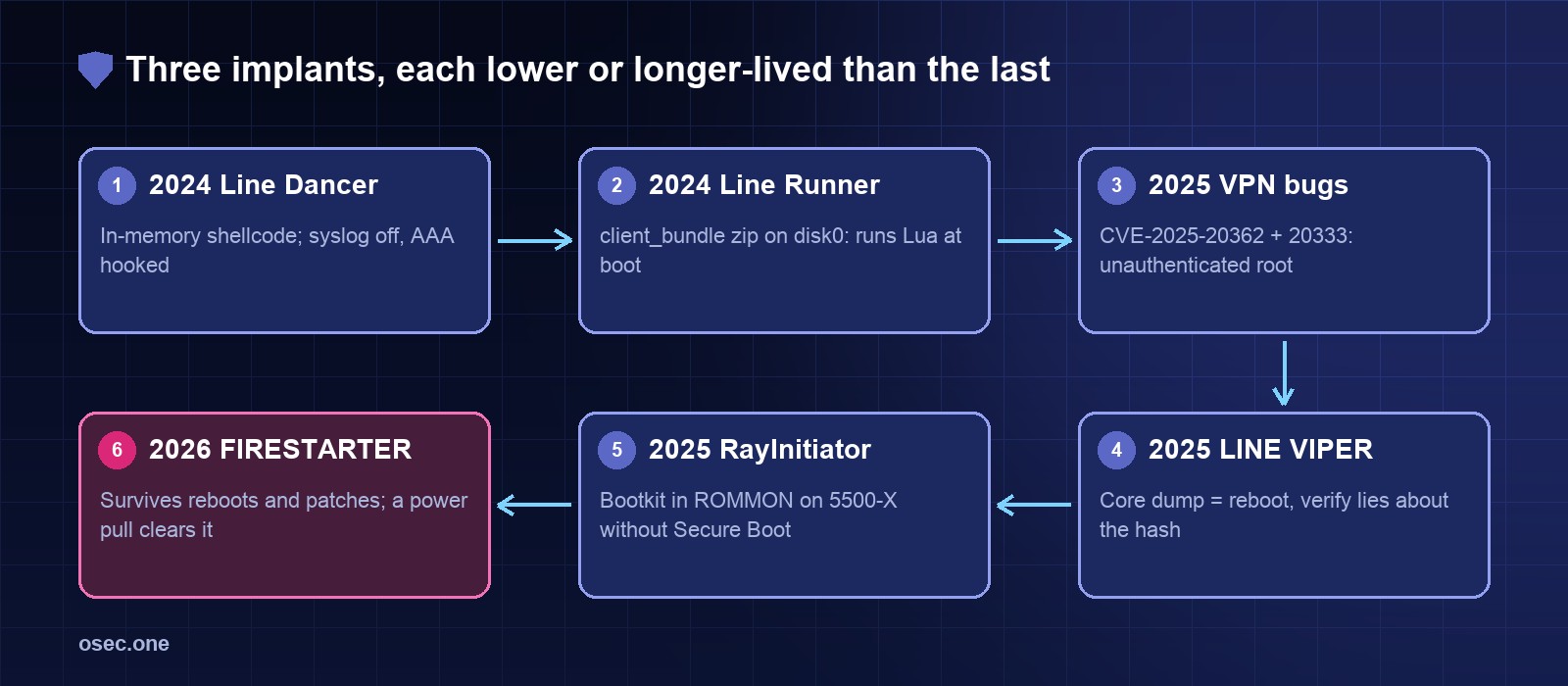
One state-sponsored group, which Cisco Talos tracks as UAT4356 and Microsoft as STORM-1849, has gone after Cisco's ASA and Firepower firewalls three times. Each time its implant sat a level lower or lasted longer than the time before. In 2024 it was a Lua script that ran at every boot from the firewall's flash disk. In 2025 it was RayInitiator, a bootkit written into the boot ROM of old ASA 5500-X boxes, with a loader that rebooted the firewall when someone tried to take a memory dump. In April 2026 it was FIRESTARTER, which survived reboots and the September 2025 patches on newer Firepower hardware and went away only when someone pulled the power cable.
\n
Ad
\n
CISA answered with Emergency Directive ED 25-03 on 25 September 2025 and an update in April 2026. This write-up goes through each campaign, the implants and how they hid, the directive's steps, which models can't be cleaned at all, and what a company with one ASA at the edge should check this week.
\n
Each round answered the previous round's clean-up advice.
\n
The timeline
\n
text
ArcaneDoor / UAT4356, 2023-2026 (Cisco Talos, Cisco PSIRT, NCSC UK, CISA)\n\nJul 2023 capability being tested and developed (Talos)\nNov 2023 earliest attacker-controlled infrastructure\nDec 2023-Jan 2024 most of the first campaign's activity\nearly 2024 a customer reports a suspicious ASA to Cisco\n24 Apr 2024 Talos "ArcaneDoor" post; CVE-2024-20353 and -20359 published\n and added to CISA KEV\nMay 2025 government responders bring Cisco attacks on ASA 5500-X\n with VPN web services enabled\n25 Sep 2025 CVE-2025-20333, -20362 (in KEV, federal due date next day)\n and -20363; CISA ED 25-03; Canada's Cyber Centre alert\n29 Sep 2025 Shadowserver: >48,800 vulnerable ASA/FTD on the internet\nOct 2025 NCSC UK analysis of RayInitiator and LINE VIPER\n5 Nov 2025 Cisco: a new attack variant makes unpatched devices reload\n12 Nov 2025 CISA: agencies marked devices "patched" on builds that\n weren't; minimum versions published\n23 Apr 2026 Talos: FIRESTARTER; Cisco persistence advisory; ED 25-03\n updated: patch by 24 Apr, unplug the power by 30 Apr\n19 May 2026 Cisco's final fixed-release table for the persistence fix
\n
2024: Line Dancer in memory, Line Runner on the disk
\n
Talos never found how the attackers first got in during 2024. It did find two implants:
\n
text
Implant Where it lived What it did (Talos, 24 Apr 2024)\nLine Dancer memory only shellcode sent in an unauthenticated POST to\n the VPN's host-scan handler; it could switch\n off syslog, run show configuration and CLI\n commands, take packet captures, hook\n authentication to accept a "magic number",\n and hook crash dumps so the box rebooted\n instead of writing one. Gone after a reboot.\nLine Runner disk0: (flash) abused a legacy VPN client preload feature\n (CVE-2024-20359): at boot the ASA unzipped a\n client_bundle*.zip and ran the Lua inside,\n which served the attacker's commands through\n a web endpoint; a shutdown hook wrote the zip\n back. Survived reboots and upgrades.
\n
CVE-2024-20353 (CVSS 8.6) let the attacker force a reload, which is how Line Runner got started without waiting for a maintenance window. Talos's checks were concrete: show memory region | include lina showing more than one executable (r-xp) region for lina, especially one of exactly 0x1000 bytes, and an unexpected zip on disk0:. Its advice if you suspected a compromise: don't reboot and don't take a core dump yourself.
\n
2025: two VPN bugs, LINE VIPER and a bootkit in ROM
\n
The 2025 campaign started from two bugs in the ASA's VPN web server, chained:
\n
text
CVE What it is CVSS CISA KEV\nCVE-2025-20362 VPN web server: some URLs that should 6.5 25 Sep 2025\n need a login don't\nCVE-2025-20333 VPN web server buffer overflow: root code 9.9 25 Sep 2025\n execution with valid VPN credentials\n (none needed when chained with 20362)\nCVE-2025-20363 HTTP server code execution (also IOS, 9.0 not listed\n IOS XE, IOS XR)
\n
On top came LINE VIPER, a shellcode loader that the UK's NCSC took apart. It ran CLI commands at the highest privilege, captured packets, let the attacker's devices skip authentication, suppressed chosen syslog messages and recorded admins' CLI commands. Its defences were aimed squarely at the 2024 clean-up advice:
\n
1. A core dump triggered an immediate reboot, which wiped the in-memory evidence Talos had told people to collect. 2. copy system:/text triggered a reboot and verify returned the legitimate hash of the running code. 3. It fixed the split lina memory region, so the 2024 show memory region check came back clean on an infected box. 4. It could schedule a reboot 1 to 10 hours out, unless the operator set a flag to stop it.
\n
NCSC analysed it on ASA 9.12(4)67 and 9.14(4)24, which were fully patched at the time. Under it sat RayInitiator, a multi-stage GRUB bootkit that NCSC says was "flashed to" the device and Cisco calls a ROMMON modification. ROMMON is the code that starts before the ASA software. RayInitiator patched the kernel during boot and installed a handler in lina, so it came back after reboots and after a full software upgrade.
\n
Which models can't be cleaned
\n
RayInitiator was seen only on ASA 5500-X models that have no Secure Boot, so nothing checks ROMMON before it runs. Cisco's list, and the dates support ended:
\n
text
Model Secure Boot Last day of support 2025 status\n5512-X, 5515-X no 31 Aug 2022 compromised\n5585-X no 31 May 2023 compromised\n5525-X, 5545-X, 5555-X no 30 Sep 2025 compromised\n5506-X, 5506H-X, 5506W-X, yes 31 Aug 2026 nothing seen;\n5508-X, 5516-X support ends soon\nFirepower / Secure Firewall Secure Boot + no ROM persistence seen in 2025\n Trust Anchor (but see FIRESTARTER, 2026)
\n
Count the days for an owner on 25 September 2025: a 5525-X, 5545-X or 5555-X had 5 days of support left; a 5512-X or 5515-X had been out of support for 1,121 days. A box whose boot ROM may hold an implant, and that gets no more firmware, can't be proven clean. ED 25-03 told agencies to permanently disconnect every model whose support ended on or before 30 September 2025, by that date.
\n
CISA ED 25-03: what agencies had to do
\n
The directive bound US federal agencies, but its steps are the best public checklist for anyone with an ASA:
\n
text
Deadline (EDT) Step\n26 Sep 2025, 23:59 inventory every ASA (hardware, ASA-SM, ASAv); for each\n public-facing one, run the core dump and hunt steps\n and upload to CISA's Malware Next Gen\n compromised: disconnect from the network, don't power\n off, report to CISA\n not compromised, model on 31 Aug 2026 support or ASAv:\n patch, then every later update within 48 hours\n30 Sep 2025 permanently disconnect models out of support on or\n before 30 Sep 2025\n2 Oct 2025, 23:59 inventory report to CISA\n12 Nov 2025 minimum versions published; all ASA and Firepower\n devices, not just public-facing ones\n24 Apr 2026, 23:59 Firepower / Secure Firewall: core dumps uploaded, patch\n including the persistence fix\n30 Apr 2026 hard reset: unplug the power\n1 May 2026 inventory report
\n
The 12 November note is the uncomfortable one: agencies had reported devices as patched while running builds that were still vulnerable, so CISA published minimum versions. In early October Shadowserver still counted over 45,000 vulnerable devices, and around 13 November over 30,000, down from 48,800 on 29 September.
\n
2026: FIRESTARTER and the power cable
\n
On 23 April 2026 Talos described FIRESTARTER, found on a US federal civilian agency's Firepower device after LINE VIPER. It lives inside lina, overwrites a WebVPN XML handler and runs shellcode sent with a magic-byte prefix. To survive, it edits the boot mount list when the device goes through a graceful reboot, so a reload puts it back. It survived upgrades to the September 2025 fixes. A cold power pull, where the device shuts down without the graceful path, removes it, which is why the updated directive ordered agencies to unplug the power by 30 April.
\n
FIRESTARTER affects Firepower 1000/2100/4100/9300 and Secure Firewall 1200/3100/4200, the hardware that has Secure Boot. It does not affect ASA 5500-X, Secure Firewall 200 or 6100, ASAv, ISA3000 or FTDv. Cisco recommends reimaging over the power pull, which can corrupt the disk.
The osec Firmware branch check takes an ASA version and lists each known-exploited Cisco ASA CVE that still applies to it, with the fixed release on the same train.
\n
A company with one ASA: what to check
\n
1. Is the risky part switched on?
\n
1. show version: write down the model and release. If the model is in the no-Secure-Boot rows above, plan the replacement now; checks can't clear it. 2. show running-config webvpn and look for enable <interface> on the outside interface, and show running-config crypto ikev2 | include client-services. Either one means the VPN web server the 2025 bugs live in is reachable. 3. Until you can patch, Cisco's temporary mitigation is removing client-services from IKEv2 or no webvpn. The latter ends all SSL VPN, so plan it with users.
\n
2. Look for the implants
\n
These are the steps from CISA's core dump and hunt instructions and Cisco's detection guide. Run them before any reboot; on a confirmed hit, disconnect the box but leave it powered and call Cisco TAC.
1. show checkheaps, then again five minutes later. The run counter should go up by about one a minute; if it doesn't move, treat it as compromised. 2. more /binary system:/text | grep 55534154 41554156 41575756 488bb3a0. Any output is an indicator of compromise. 3. show kernel process | include lina_cs (2026 check). Any output means FIRESTARTER; rule out a false positive with verify disk0:/asdm.bin. 4. dir disk0: for a client_bundle zip you didn't put there (2024). 5. During the upgrade, watch the console for "Bootloader/ROMMON verification succeeded". A "failed at address" message, or a firmware_update.log on disk0: after moving to 9.12.4.72 or 9.14.4.28, means a TAC case. 6. Don't use tab completion while you run them; CISA warns it may crash the device.
\n
3. Read the logs you kept elsewhere
\n
LINE VIPER suppressed specific syslog IDs, so look for what's missing in a syslog server's copy: 302013/302014 (connection built and torn down) and, if you log at debug, 609002/710005. Then look for what's there: VPN logins from impossible places (716002, 722029-722031), packet captures you didn't start that target TACACS+, RADIUS, LDAP or SMB traffic, and scans from the firewall into the LAN on TCP 443 or LDAP.
\n
4. If anything matched, or the box is a 5500-X without Secure Boot
\n
1. Treat the configuration as untrusted: rebuild it from scratch with configure factory-default (or write erase and reload) or a reimage, not by restoring the old file. 2. Rotate every secret the firewall held: local and enable passwords, VPN pre-shared keys, the LDAP/RADIUS/TACACS+ shared secrets, and every certificate whose private key was on the box. 3. On FIRESTARTER-affected Firepower and Secure Firewall models, patch to the persistence fix, then reimage, or at least cold-boot by pulling the power. 4. On a 5500-X model without Secure Boot, replace the hardware. Cisco has no way to verify its ROM.
\n
Edge-device persistence that outlives the patch is a pattern on this site: FortiGate 2025 kept attackers reading files through a symlink after the fix, and Ivanti Connect Secure 2024 needed a factory reset rather than a patch. ArcaneDoor is the furthest down that line so far: below the operating system, and on the oldest boxes, below anything the owner can check.
\n
Type your ASA version and see which known-exploited Cisco ASA CVEs still apply, with the fixed release on your train. Save it as a watch and get one email when a new one starts applying.
ArcaneDoor: Cisco firewalls backdoored below the operating system, three times
One state-sponsored group, which Cisco Talos tracks as UAT4356 and Microsoft as STORM-1849, has gone after Cisco's ASA and Firepower firewalls three times. Each time its implant sat a level lower or lasted longer than the time before. In 2024 it was a Lua script that ran at every boot from the firewall's flash disk. In 2025 it was RayInitiator, a bootkit written into the boot ROM of old ASA 5500-X boxes, with a loader that rebooted the firewall when someone tried to take a memory dump. In April 2026 it was FIRESTARTER, which survived reboots and the September 2025 patches on newer Firepower hardware and went away only when someone pulled the power cable.
Ad
CISA answered with Emergency Directive ED 25-03 on 25 September 2025 and an update in April 2026. This write-up goes through each campaign, the implants and how they hid, the directive's steps, which models can't be cleaned at all, and what a company with one ASA at the edge should check this week.
Each round answered the previous round's clean-up advice.
The timeline
text
ArcaneDoor / UAT4356, 2023-2026 (Cisco Talos, Cisco PSIRT, NCSC UK, CISA)

Jul 2023       capability being tested and developed (Talos)
Nov 2023       earliest attacker-controlled infrastructure
Dec 2023-Jan 2024  most of the first campaign's activity
early 2024     a customer reports a suspicious ASA to Cisco
24 Apr 2024    Talos "ArcaneDoor" post; CVE-2024-20353 and -20359 published
               and added to CISA KEV
May 2025       government responders bring Cisco attacks on ASA 5500-X
               with VPN web services enabled
25 Sep 2025    CVE-2025-20333, -20362 (in KEV, federal due date next day)
               and -20363; CISA ED 25-03; Canada's Cyber Centre alert
29 Sep 2025    Shadowserver: >48,800 vulnerable ASA/FTD on the internet
Oct 2025       NCSC UK analysis of RayInitiator and LINE VIPER
5 Nov 2025     Cisco: a new attack variant makes unpatched devices reload
12 Nov 2025    CISA: agencies marked devices "patched" on builds that
               weren't; minimum versions published
23 Apr 2026    Talos: FIRESTARTER; Cisco persistence advisory; ED 25-03
               updated: patch by 24 Apr, unplug the power by 30 Apr
19 May 2026    Cisco's final fixed-release table for the persistence fix
2024: Line Dancer in memory, Line Runner on the disk
Talos never found how the attackers first got in during 2024. It did find two implants:
text
Implant       Where it lived        What it did (Talos, 24 Apr 2024)
Line Dancer   memory only           shellcode sent in an unauthenticated POST to
                                    the VPN's host-scan handler; it could switch
                                    off syslog, run show configuration and CLI
                                    commands, take packet captures, hook
                                    authentication to accept a "magic number",
                                    and hook crash dumps so the box rebooted
                                    instead of writing one. Gone after a reboot.
Line Runner   disk0: (flash)        abused a legacy VPN client preload feature
                                    (CVE-2024-20359): at boot the ASA unzipped a
                                    client_bundle*.zip and ran the Lua inside,
                                    which served the attacker's commands through
                                    a web endpoint; a shutdown hook wrote the zip
                                    back. Survived reboots and upgrades.
CVE-2024-20353 (CVSS 8.6) let the attacker force a reload, which is how Line Runner got started without waiting for a maintenance window. Talos's checks were concrete: show memory region | include lina showing more than one executable (r-xp) region for lina, especially one of exactly 0x1000 bytes, and an unexpected zip on disk0:. Its advice if you suspected a compromise: don't reboot and don't take a core dump yourself.
2025: two VPN bugs, LINE VIPER and a bootkit in ROM
The 2025 campaign started from two bugs in the ASA's VPN web server, chained:
text
CVE              What it is                                 CVSS   CISA KEV
CVE-2025-20362   VPN web server: some URLs that should      6.5    25 Sep 2025
                 need a login don't
CVE-2025-20333   VPN web server buffer overflow: root code  9.9    25 Sep 2025
                 execution with valid VPN credentials
                 (none needed when chained with 20362)
CVE-2025-20363   HTTP server code execution (also IOS,      9.0    not listed
                 IOS XE, IOS XR)
On top came LINE VIPER, a shellcode loader that the UK's NCSC took apart. It ran CLI commands at the highest privilege, captured packets, let the attacker's devices skip authentication, suppressed chosen syslog messages and recorded admins' CLI commands. Its defences were aimed squarely at the 2024 clean-up advice:
1. A core dump triggered an immediate reboot, which wiped the in-memory evidence Talos had told people to collect. 2. copy system:/text triggered a reboot and verify returned the legitimate hash of the running code. 3. It fixed the split lina memory region, so the 2024 show memory region check came back clean on an infected box. 4. It could schedule a reboot 1 to 10 hours out, unless the operator set a flag to stop it.
NCSC analysed it on ASA 9.12(4)67 and 9.14(4)24, which were fully patched at the time. Under it sat RayInitiator, a multi-stage GRUB bootkit that NCSC says was "flashed to" the device and Cisco calls a ROMMON modification. ROMMON is the code that starts before the ASA software. RayInitiator patched the kernel during boot and installed a handler in lina, so it came back after reboots and after a full software upgrade.
Which models can't be cleaned
RayInitiator was seen only on ASA 5500-X models that have no Secure Boot, so nothing checks ROMMON before it runs. Cisco's list, and the dates support ended:
text
Model                         Secure Boot   Last day of support   2025 status
5512-X, 5515-X                no            31 Aug 2022           compromised
5585-X                        no            31 May 2023           compromised
5525-X, 5545-X, 5555-X        no            30 Sep 2025           compromised
5506-X, 5506H-X, 5506W-X,     yes           31 Aug 2026           nothing seen;
5508-X, 5516-X                                                    support ends soon
Firepower / Secure Firewall   Secure Boot + no ROM persistence seen in 2025
                              Trust Anchor  (but see FIRESTARTER, 2026)
Count the days for an owner on 25 September 2025: a 5525-X, 5545-X or 5555-X had 5 days of support left; a 5512-X or 5515-X had been out of support for 1,121 days. A box whose boot ROM may hold an implant, and that gets no more firmware, can't be proven clean. ED 25-03 told agencies to permanently disconnect every model whose support ended on or before 30 September 2025, by that date.
CISA ED 25-03: what agencies had to do
The directive bound US federal agencies, but its steps are the best public checklist for anyone with an ASA:
text
Deadline (EDT)          Step
26 Sep 2025, 23:59      inventory every ASA (hardware, ASA-SM, ASAv); for each
                        public-facing one, run the core dump and hunt steps
                        and upload to CISA's Malware Next Gen
                        compromised: disconnect from the network, don't power
                        off, report to CISA
                        not compromised, model on 31 Aug 2026 support or ASAv:
                        patch, then every later update within 48 hours
30 Sep 2025             permanently disconnect models out of support on or
                        before 30 Sep 2025
2 Oct 2025, 23:59       inventory report to CISA
12 Nov 2025             minimum versions published; all ASA and Firepower
                        devices, not just public-facing ones
24 Apr 2026, 23:59      Firepower / Secure Firewall: core dumps uploaded, patch
                        including the persistence fix
30 Apr 2026             hard reset: unplug the power
1 May 2026              inventory report
The 12 November note is the uncomfortable one: agencies had reported devices as patched while running builds that were still vulnerable, so CISA published minimum versions. In early October Shadowserver still counted over 45,000 vulnerable devices, and around 13 November over 30,000, down from 48,800 on 29 September.
2026: FIRESTARTER and the power cable
On 23 April 2026 Talos described FIRESTARTER, found on a US federal civilian agency's Firepower device after LINE VIPER. It lives inside lina, overwrites a WebVPN XML handler and runs shellcode sent with a magic-byte prefix. To survive, it edits the boot mount list when the device goes through a graceful reboot, so a reload puts it back. It survived upgrades to the September 2025 fixes. A cold power pull, where the device shuts down without the graceful path, removes it, which is why the updated directive ordered agencies to unplug the power by 30 April.
FIRESTARTER affects Firepower 1000/2100/4100/9300 and Secure Firewall 1200/3100/4200, the hardware that has Secure Boot. It does not affect ASA 5500-X, Secure Firewall 200 or 6100, ASAv, ISA3000 or FTDv. Cisco recommends reimaging over the power pull, which can corrupt the disk.
The osec Firmware branch check takes an ASA version and lists each known-exploited Cisco ASA CVE that still applies to it, with the fixed release on the same train.
A company with one ASA: what to check
1. Is the risky part switched on?
1. show version: write down the model and release. If the model is in the no-Secure-Boot rows above, plan the replacement now; checks can't clear it. 2. show running-config webvpn and look for enable <interface> on the outside interface, and show running-config crypto ikev2 | include client-services. Either one means the VPN web server the 2025 bugs live in is reachable. 3. Until you can patch, Cisco's temporary mitigation is removing client-services from IKEv2 or no webvpn. The latter ends all SSL VPN, so plan it with users.
2. Look for the implants
These are the steps from CISA's core dump and hunt instructions and Cisco's detection guide. Run them before any reboot; on a confirmed hit, disconnect the box but leave it powered and call Cisco TAC.
1. show checkheaps, then again five minutes later. The run counter should go up by about one a minute; if it doesn't move, treat it as compromised. 2. more /binary system:/text | grep 55534154 41554156 41575756 488bb3a0. Any output is an indicator of compromise. 3. show kernel process | include lina_cs (2026 check). Any output means FIRESTARTER; rule out a false positive with verify disk0:/asdm.bin. 4. dir disk0: for a client_bundle zip you didn't put there (2024). 5. During the upgrade, watch the console for "Bootloader/ROMMON verification succeeded". A "failed at address" message, or a firmware_update.log on disk0: after moving to 9.12.4.72 or 9.14.4.28, means a TAC case. 6. Don't use tab completion while you run them; CISA warns it may crash the device.
3. Read the logs you kept elsewhere
LINE VIPER suppressed specific syslog IDs, so look for what's missing in a syslog server's copy: 302013/302014 (connection built and torn down) and, if you log at debug, 609002/710005. Then look for what's there: VPN logins from impossible places (716002, 722029-722031), packet captures you didn't start that target TACACS+, RADIUS, LDAP or SMB traffic, and scans from the firewall into the LAN on TCP 443 or LDAP.
4. If anything matched, or the box is a 5500-X without Secure Boot
1. Treat the configuration as untrusted: rebuild it from scratch with configure factory-default (or write erase and reload) or a reimage, not by restoring the old file. 2. Rotate every secret the firewall held: local and enable passwords, VPN pre-shared keys, the LDAP/RADIUS/TACACS+ shared secrets, and every certificate whose private key was on the box. 3. On FIRESTARTER-affected Firepower and Secure Firewall models, patch to the persistence fix, then reimage, or at least cold-boot by pulling the power. 4. On a 5500-X model without Secure Boot, replace the hardware. Cisco has no way to verify its ROM.
Edge-device persistence that outlives the patch is a pattern on this site: FortiGate 2025 kept attackers reading files through a symlink after the fix, and Ivanti Connect Secure 2024 needed a factory reset rather than a patch. ArcaneDoor is the furthest down that line so far: below the operating system, and on the oldest boxes, below anything the owner can check.
Type your ASA version and see which known-exploited Cisco ASA CVEs still apply, with the fixed release on your train. Save it as a watch and get one email when a new one starts applying.