Coinbase refused, published the demand on 15 May, offered a $20 million reward for information leading to arrests, and estimated the cost at $180 to $400 million. By the end of 2025 it had paid out $311.2 million. Almost none of that was for the data itself. It was for what the data was used for: phone calls from "Coinbase security" that talked customers into moving their own money.
"},{"id":145661,"block_type":"paragraph","html":"
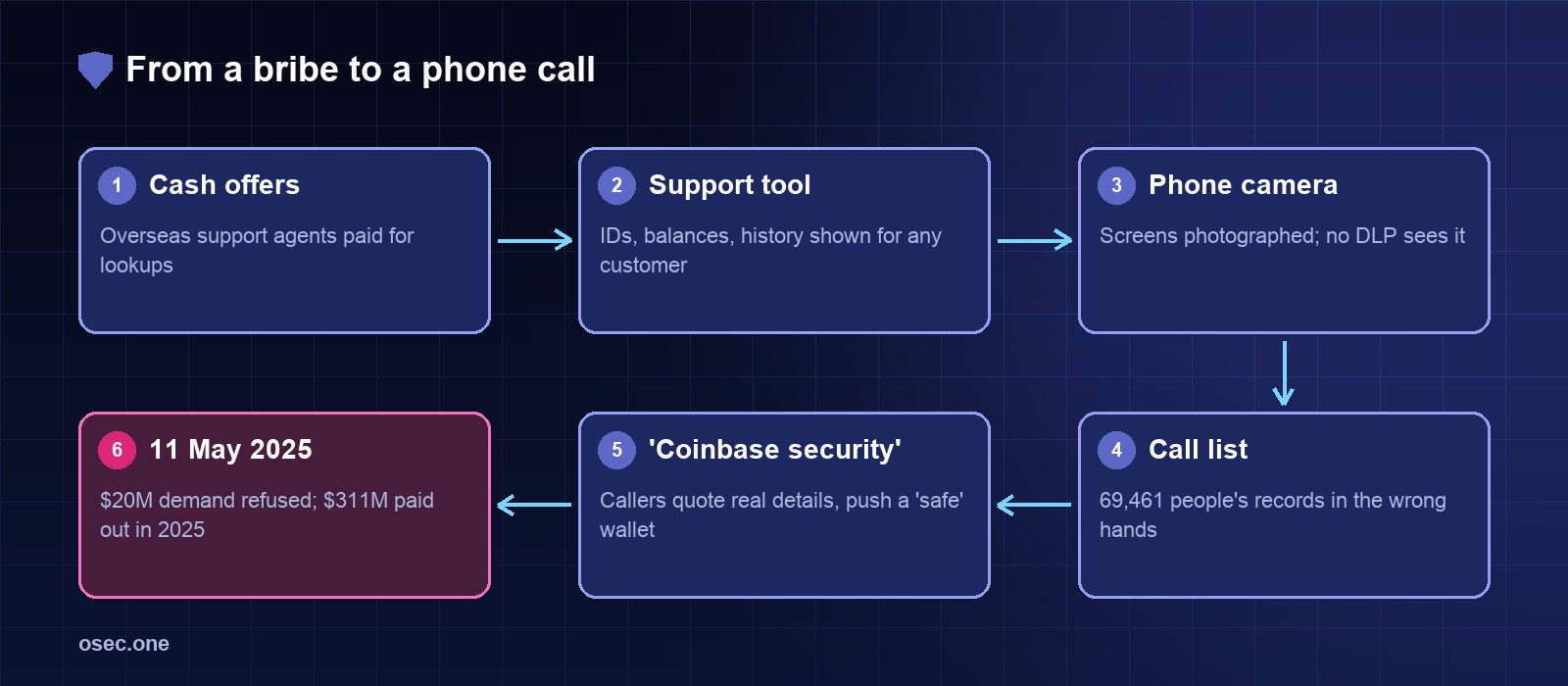
This case analysis follows the chain from a bribe to a phone call, and looks at why the customers' passwords and two-factor codes didn't matter. It sits next to Mailchimp 2023, where phished staff logins opened the same kind of support tool, and MGM and Caesars 2023, where the help desk was talked into resetting MFA. Here nobody was tricked inside the company. The insiders were paid.
"},{"id":145662,"block_type":"screenshot","html":"The support tool did what it was built to do. The loss happened on the phone, with the customers' own sign-in intact."},{"id":145663,"block_type":"heading_h2","html":"
What was taken, and what wasn't
"},{"id":145664,"block_type":"code","html":"
text
Coinbase, disclosed 15 May 2025 (blog post and SEC 8-K)\n\ntaken not taken\nname, address, phone, email passwords, sign-in credentials\nlast 4 digits of social security number 2FA codes\nmasked bank account numbers + some IDs private keys\ngovernment ID images (licence, passport) access to move or reach funds\naccount balance snapshots Coinbase Prime accounts\ntransaction history hot or cold wallets\nsome corporate documents, training material,\n support agents' communications
"},{"id":145665,"block_type":"paragraph","html":"
Coinbase said under 1% of monthly transacting users were affected. Its filing with the Maine attorney general put the number at 69,461 people, with notices sent around 30 May 2025 and 12 months of identity monitoring offered.
Coinbase support data, 2024-2026\n\nSep 2024 alleged start of selling records (class action complaint, not proven)\n26 Dec 2024 breach start date in Coinbase's Maine filing\nDec 24 - Jan 25 ZachXBT counts about $65M lost to Coinbase impersonators in two months\nJan 2025 TaskUs agent in Indore seen photographing her screen with her phone;\n TaskUs fires two employees and ends Coinbase work in Indore (226 staff)\n3 Feb 2025 ZachXBT estimates $300M+ a year lost to Coinbase impersonation scams\n11 May 2025 extortion email: $20M for the data\n15 May 2025 Coinbase refuses, discloses, $20M reward fund, cost estimate $180-400M\n30 May 2025 notices to 69,461 people (Maine AG filing)\n2 Jun 2025 Reuters: Coinbase knew of a leak as early as January 2025\n16 Sep 2025 amended class action against TaskUs (Estrada v. TaskUs, SDNY)\nDec 2025 Coinbase CEO: Hyderabad police arrested a former support agent\nFY 2025 $311.2M paid (reimbursements + legal); $345.2M losses recorded\n28 Jul 2026 court lets part of the TaskUs class action go ahead
"},{"id":145668,"block_type":"paragraph","html":"
The dates don't line up neatly, and that matters. A support agent was caught photographing her screen in January 2025; the extortion email came in May. In between, the data was being used for calls. Insider theft is often noticed as a single act by a single person, closed, and only later understood as a pipeline.
The insiders were support agents employed by an outsourcing firm. Reuters reported that a TaskUs employee in Indore, India, was seen photographing her work screen with her personal phone, and that she and a suspected accomplice were paid by an outside party. The class action against TaskUs alleges more: that selling started in September 2024, that up to 200 records a day were photographed at about $200 each, that more than 10,000 customers' records were taken by one agent, and that supervisors were recruited. Those are allegations, not findings, but the economics are the point. At the alleged $200 a record, 200 records come to $40,000 a day: money on that scale dwarfs any support salary.
"},{"id":145671,"block_type":"paragraph","html":"
Control: you can't fully stop someone from being offered money. You can make what they sell smaller and the selling traceable: see steps 2 and 3.
A support agent opening a customer's account saw identity documents, bank details, balances and the transaction history. Most support tickets need far less. Here is a typical crypto exchange support queue and what each kind of ticket actually needs to see:
"},{"id":145674,"block_type":"code","html":"
text
ticket type name/email phone balance tx history ID images bank details\ncan't sign in yes last 2 no no no no\ndeposit not showing yes no no that tx no last 4\nwithdrawal stuck yes no no that tx no last 4\nverification rejected yes no no no yes no\naccount closure yes no yes no no last 4\nwhat Coinbase's tool showed yes yes yes all yes masked
"},{"id":145675,"block_type":"paragraph","html":"
Only one ticket type in that list needs the ID images; none needs a full history. A tool that shows each field only when the ticket type calls for it, and masks the rest until the agent clicks "reveal" (logged, with a reason), cuts what a bribed agent can photograph per lookup to a fraction.
Worked example: how much an alert would have limited
"},{"id":145677,"block_type":"paragraph","html":"
Take the alleged rate of 200 records a day. If an agent normally handles about 40 tickets a day (5 an hour over 8 hours), 200 lookups is 5 times their normal volume. An alert at 2x an agent's own 30-day average, or on any lookup of an account with no open ticket, fires on day one. With reveal-on-click for ID images and bank details, the agent also leaves a log line per sensitive field. Even if the agent keeps under the threshold at 60 a day, that is 1,800 records a month instead of 6,000, each tied to a reveal.
"},{"id":145678,"block_type":"code","html":"
sql
-- support_access(agent, account_id, ticket_id, field, at): one row per account opened or field revealed\nSELECT a.agent,\n count(DISTINCT a.account_id) AS accounts_today,\n count(DISTINCT a.account_id) FILTER (WHERE a.ticket_id IS NULL) AS without_ticket,\n count(*) FILTER (WHERE a.field IN ('id_image', 'bank', 'ssn4')) AS sensitive_reveals,\n b.avg_daily\nFROM support_access a\nJOIN (SELECT agent, count(DISTINCT account_id)::numeric / 30 AS avg_daily\n FROM support_access WHERE at > now() - interval '30 days' GROUP BY agent) b USING (agent)\nWHERE a.at > date_trunc('day', now())\nGROUP BY a.agent, b.avg_daily\nHAVING count(DISTINCT a.account_id) > 2 * b.avg_daily\n OR count(DISTINCT a.account_id) FILTER (WHERE a.ticket_id IS NULL) > 0;
Data loss prevention software watches copy, paste, print, screenshots and uploads. It can't see a phone held up to a monitor. That is how the Indore agent was caught: by a person who saw it. What does work against photographs is making each screen traceable: a faint watermark with the agent's ID and the time across the support tool's screen, so any photo that surfaces later names its source. Combined with step 2's reveal log, a leaked photo becomes a lookup in your own database, not a mystery.
"},{"id":145681,"block_type":"paragraph","html":"
Controls: visible watermarks in the support tool; clean-desk and no-personal-phone rules on the support floor, enforced by supervisors; and a contract that requires the outsourcing firm to report any suspected data theft within days, not months.
What do you do with a customer's name, phone number, balance and last transactions? You call them. The attackers' records answered the questions a careful customer would ask ("what's my address?", "what was my last transaction?"), so the call sounded like the bank's fraud desk. ZachXBT, an independent investigator, had already counted about $65 million lost to Coinbase impersonators in December 2024 and January 2025 alone, and estimated $300 million a year, before anyone knew where some of the callers' data came from.
"},{"id":145684,"block_type":"paragraph","html":"
The script, reconstructed from victims' reports: a call from a spoofed number about an "unauthorised login"; a follow-up email that looks like Coinbase's, with a case number; then the ask: your account is compromised, move your funds to a new safe wallet we'll help you set up. The new wallet is a Coinbase Wallet created with a recovery phrase the caller supplies, so the caller already has the keys.
Step 5: why the customer's own sign-in factor didn't matter
"},{"id":145686,"block_type":"paragraph","html":"
None of this needed the customer's password or 2FA code. The customer signed in themselves, passed their own two-factor check, and sent the money. Every security control on the account worked as designed, because the attacker never touched the account. That's the key difference from account takeover: hardware keys and passkeys, the best defence against phishing pages that relay codes, don't stop a person who has been persuaded to act.
"},{"id":145687,"block_type":"paragraph","html":"
What does help is on the platform's side, at the moment money leaves:
"},{"id":145688,"block_type":"paragraph","html":"
1. Withdrawal allow-lists with a delay: a new destination address can't receive funds for 24 to 48 hours, and the customer is told by email and in the app. 2. Friction scaled to risk: a first withdrawal of most of a balance to a brand-new address gets a warning written for this scam ("Coinbase will never ask you to move funds to a safe wallet"), a second confirmation, or a hold. 3. Flag the leaked accounts: once you know which customers' records were taken, treat those accounts as high risk: extra ID checks on large withdrawals and scam warnings, which is what Coinbase announced on 15 May. 4. Tell customers what support will never do, in every channel, before the calls start.
Coinbase, cost of the support data theft (SEC filings)\n\n8-K estimate, 15 May 2025 $180M - $400M (remediation + voluntary reimbursements)\nQ2 2025 losses recorded $306.7M\nFY 2025 losses recorded $345.2M\nFY 2025 cash paid $311.2M\nH1 2026 net recoveries $25.2M (Q2 2026: $33.9M)\n\nper affected person (69,461) $311.2M / 69,461 = about $4,480 paid\nextortion demand $20M (refused)
"},{"id":145691,"block_type":"paragraph","html":"
Refusing a $20 million demand and paying about $311 million looks like the wrong trade only if paying would have ended it. It wouldn't have: the data was already out and already being used, and a payment buys a promise from the people who took the bribes. The number that matters for anyone running a support team is the second one: about $4,480 per customer whose record was seen. That's the budget a field-level reveal log and a lookup alert compete against.
1. Show fields by ticket type. Mask ID images, bank details and history by default; reveal with a reason, logged per field. 2. No lookups without a ticket. Accounts without an open ticket need a second person. 3. Alert on volume against the agent's own baseline, not a fixed number: 2x the 30-day average, and any lookup outside a ticket. 4. Watermark the screen with agent ID and time. 5. Contracts with outsourcers: report suspected data theft within 72 hours, give you the access logs, and let you audit. 6. When records leak, flag those customers and slow down large withdrawals to new destinations. 7. Publish what you'll never ask for: moving funds, recovery phrases, passwords, sign-in codes.
"},{"id":145694,"block_type":"cta","html":"
osec Auth gives your app passwordless sign-in with email codes, Google and Apple: no password for a caller to ask for, and no Google or Apple OAuth setup on your side. Free for small sites.
On 11 May 2025 Coinbase got an email asking for $20 million. The sender had customer records: names, addresses, phone numbers, the last four digits of social security numbers, masked bank details, photos of passports and driving licences, balances and transaction histories. They hadn't hacked anything. They had paid people who worked in Coinbase's customer support, outside the US, to look customers up and copy what the support tool showed.
\n
Ad
\n
Coinbase refused, published the demand on 15 May, offered a $20 million reward for information leading to arrests, and estimated the cost at $180 to $400 million. By the end of 2025 it had paid out $311.2 million. Almost none of that was for the data itself. It was for what the data was used for: phone calls from "Coinbase security" that talked customers into moving their own money.
\n
This case analysis follows the chain from a bribe to a phone call, and looks at why the customers' passwords and two-factor codes didn't matter. It sits next to Mailchimp 2023, where phished staff logins opened the same kind of support tool, and MGM and Caesars 2023, where the help desk was talked into resetting MFA. Here nobody was tricked inside the company. The insiders were paid.
\n
The support tool did what it was built to do. The loss happened on the phone, with the customers' own sign-in intact.
\n
What was taken, and what wasn't
\n
text
Coinbase, disclosed 15 May 2025 (blog post and SEC 8-K)\n\ntaken not taken\nname, address, phone, email passwords, sign-in credentials\nlast 4 digits of social security number 2FA codes\nmasked bank account numbers + some IDs private keys\ngovernment ID images (licence, passport) access to move or reach funds\naccount balance snapshots Coinbase Prime accounts\ntransaction history hot or cold wallets\nsome corporate documents, training material,\n support agents' communications
\n
Coinbase said under 1% of monthly transacting users were affected. Its filing with the Maine attorney general put the number at 69,461 people, with notices sent around 30 May 2025 and 12 months of identity monitoring offered.
\n
The timeline
\n
text
Coinbase support data, 2024-2026\n\nSep 2024 alleged start of selling records (class action complaint, not proven)\n26 Dec 2024 breach start date in Coinbase's Maine filing\nDec 24 - Jan 25 ZachXBT counts about $65M lost to Coinbase impersonators in two months\nJan 2025 TaskUs agent in Indore seen photographing her screen with her phone;\n TaskUs fires two employees and ends Coinbase work in Indore (226 staff)\n3 Feb 2025 ZachXBT estimates $300M+ a year lost to Coinbase impersonation scams\n11 May 2025 extortion email: $20M for the data\n15 May 2025 Coinbase refuses, discloses, $20M reward fund, cost estimate $180-400M\n30 May 2025 notices to 69,461 people (Maine AG filing)\n2 Jun 2025 Reuters: Coinbase knew of a leak as early as January 2025\n16 Sep 2025 amended class action against TaskUs (Estrada v. TaskUs, SDNY)\nDec 2025 Coinbase CEO: Hyderabad police arrested a former support agent\nFY 2025 $311.2M paid (reimbursements + legal); $345.2M losses recorded\n28 Jul 2026 court lets part of the TaskUs class action go ahead
\n
The dates don't line up neatly, and that matters. A support agent was caught photographing her screen in January 2025; the extortion email came in May. In between, the data was being used for calls. Insider theft is often noticed as a single act by a single person, closed, and only later understood as a pipeline.
\n
Step 1: the bribe
\n
The insiders were support agents employed by an outsourcing firm. Reuters reported that a TaskUs employee in Indore, India, was seen photographing her work screen with her personal phone, and that she and a suspected accomplice were paid by an outside party. The class action against TaskUs alleges more: that selling started in September 2024, that up to 200 records a day were photographed at about $200 each, that more than 10,000 customers' records were taken by one agent, and that supervisors were recruited. Those are allegations, not findings, but the economics are the point. At the alleged $200 a record, 200 records come to $40,000 a day: money on that scale dwarfs any support salary.
\n
Control: you can't fully stop someone from being offered money. You can make what they sell smaller and the selling traceable: see steps 2 and 3.
\n
Step 2: a support tool that shows everything
\n
A support agent opening a customer's account saw identity documents, bank details, balances and the transaction history. Most support tickets need far less. Here is a typical crypto exchange support queue and what each kind of ticket actually needs to see:
\n
text
ticket type name/email phone balance tx history ID images bank details\ncan't sign in yes last 2 no no no no\ndeposit not showing yes no no that tx no last 4\nwithdrawal stuck yes no no that tx no last 4\nverification rejected yes no no no yes no\naccount closure yes no yes no no last 4\nwhat Coinbase's tool showed yes yes yes all yes masked
\n
Only one ticket type in that list needs the ID images; none needs a full history. A tool that shows each field only when the ticket type calls for it, and masks the rest until the agent clicks "reveal" (logged, with a reason), cuts what a bribed agent can photograph per lookup to a fraction.
\n
Worked example: how much an alert would have limited
\n
Take the alleged rate of 200 records a day. If an agent normally handles about 40 tickets a day (5 an hour over 8 hours), 200 lookups is 5 times their normal volume. An alert at 2x an agent's own 30-day average, or on any lookup of an account with no open ticket, fires on day one. With reveal-on-click for ID images and bank details, the agent also leaves a log line per sensitive field. Even if the agent keeps under the threshold at 60 a day, that is 1,800 records a month instead of 6,000, each tied to a reveal.
\n
sql
-- support_access(agent, account_id, ticket_id, field, at): one row per account opened or field revealed\nSELECT a.agent,\n count(DISTINCT a.account_id) AS accounts_today,\n count(DISTINCT a.account_id) FILTER (WHERE a.ticket_id IS NULL) AS without_ticket,\n count(*) FILTER (WHERE a.field IN ('id_image', 'bank', 'ssn4')) AS sensitive_reveals,\n b.avg_daily\nFROM support_access a\nJOIN (SELECT agent, count(DISTINCT account_id)::numeric / 30 AS avg_daily\n FROM support_access WHERE at > now() - interval '30 days' GROUP BY agent) b USING (agent)\nWHERE a.at > date_trunc('day', now())\nGROUP BY a.agent, b.avg_daily\nHAVING count(DISTINCT a.account_id) > 2 * b.avg_daily\n OR count(DISTINCT a.account_id) FILTER (WHERE a.ticket_id IS NULL) > 0;
\n
Step 3: the camera nobody can block
\n
Data loss prevention software watches copy, paste, print, screenshots and uploads. It can't see a phone held up to a monitor. That is how the Indore agent was caught: by a person who saw it. What does work against photographs is making each screen traceable: a faint watermark with the agent's ID and the time across the support tool's screen, so any photo that surfaces later names its source. Combined with step 2's reveal log, a leaked photo becomes a lookup in your own database, not a mystery.
\n
Controls: visible watermarks in the support tool; clean-desk and no-personal-phone rules on the support floor, enforced by supervisors; and a contract that requires the outsourcing firm to report any suspected data theft within days, not months.
\n
Step 4: the call list
\n
What do you do with a customer's name, phone number, balance and last transactions? You call them. The attackers' records answered the questions a careful customer would ask ("what's my address?", "what was my last transaction?"), so the call sounded like the bank's fraud desk. ZachXBT, an independent investigator, had already counted about $65 million lost to Coinbase impersonators in December 2024 and January 2025 alone, and estimated $300 million a year, before anyone knew where some of the callers' data came from.
\n
The script, reconstructed from victims' reports: a call from a spoofed number about an "unauthorised login"; a follow-up email that looks like Coinbase's, with a case number; then the ask: your account is compromised, move your funds to a new safe wallet we'll help you set up. The new wallet is a Coinbase Wallet created with a recovery phrase the caller supplies, so the caller already has the keys.
\n
Step 5: why the customer's own sign-in factor didn't matter
\n
None of this needed the customer's password or 2FA code. The customer signed in themselves, passed their own two-factor check, and sent the money. Every security control on the account worked as designed, because the attacker never touched the account. That's the key difference from account takeover: hardware keys and passkeys, the best defence against phishing pages that relay codes, don't stop a person who has been persuaded to act.
\n
What does help is on the platform's side, at the moment money leaves:
\n
1. Withdrawal allow-lists with a delay: a new destination address can't receive funds for 24 to 48 hours, and the customer is told by email and in the app. 2. Friction scaled to risk: a first withdrawal of most of a balance to a brand-new address gets a warning written for this scam ("Coinbase will never ask you to move funds to a safe wallet"), a second confirmation, or a hold. 3. Flag the leaked accounts: once you know which customers' records were taken, treat those accounts as high risk: extra ID checks on large withdrawals and scam warnings, which is what Coinbase announced on 15 May. 4. Tell customers what support will never do, in every channel, before the calls start.
\n
Step 6: what it cost
\n
text
Coinbase, cost of the support data theft (SEC filings)\n\n8-K estimate, 15 May 2025 $180M - $400M (remediation + voluntary reimbursements)\nQ2 2025 losses recorded $306.7M\nFY 2025 losses recorded $345.2M\nFY 2025 cash paid $311.2M\nH1 2026 net recoveries $25.2M (Q2 2026: $33.9M)\n\nper affected person (69,461) $311.2M / 69,461 = about $4,480 paid\nextortion demand $20M (refused)
\n
Refusing a $20 million demand and paying about $311 million looks like the wrong trade only if paying would have ended it. It wouldn't have: the data was already out and already being used, and a payment buys a promise from the people who took the bribes. The number that matters for anyone running a support team is the second one: about $4,480 per customer whose record was seen. That's the budget a field-level reveal log and a lookup alert compete against.
\n
If you run support for anything with money in it
\n
1. Show fields by ticket type. Mask ID images, bank details and history by default; reveal with a reason, logged per field. 2. No lookups without a ticket. Accounts without an open ticket need a second person. 3. Alert on volume against the agent's own baseline, not a fixed number: 2x the 30-day average, and any lookup outside a ticket. 4. Watermark the screen with agent ID and time. 5. Contracts with outsourcers: report suspected data theft within 72 hours, give you the access logs, and let you audit. 6. When records leak, flag those customers and slow down large withdrawals to new destinations. 7. Publish what you'll never ask for: moving funds, recovery phrases, passwords, sign-in codes.
\n
osec Auth gives your app passwordless sign-in with email codes, Google and Apple: no password for a caller to ask for, and no Google or Apple OAuth setup on your side. Free for small sites.
Coinbase 2025: support agents paid to look up customers, then the 'Coinbase security' phone calls
On 11 May 2025 Coinbase got an email asking for $20 million. The sender had customer records: names, addresses, phone numbers, the last four digits of social security numbers, masked bank details, photos of passports and driving licences, balances and transaction histories. They hadn't hacked anything. They had paid people who worked in Coinbase's customer support, outside the US, to look customers up and copy what the support tool showed.
Ad
Coinbase refused, published the demand on 15 May, offered a $20 million reward for information leading to arrests, and estimated the cost at $180 to $400 million. By the end of 2025 it had paid out $311.2 million. Almost none of that was for the data itself. It was for what the data was used for: phone calls from "Coinbase security" that talked customers into moving their own money.
This case analysis follows the chain from a bribe to a phone call, and looks at why the customers' passwords and two-factor codes didn't matter. It sits next to Mailchimp 2023, where phished staff logins opened the same kind of support tool, and MGM and Caesars 2023, where the help desk was talked into resetting MFA. Here nobody was tricked inside the company. The insiders were paid.
The support tool did what it was built to do. The loss happened on the phone, with the customers' own sign-in intact.
What was taken, and what wasn't
text
Coinbase, disclosed 15 May 2025 (blog post and SEC 8-K)

taken                                         not taken
name, address, phone, email                   passwords, sign-in credentials
last 4 digits of social security number       2FA codes
masked bank account numbers + some IDs         private keys
government ID images (licence, passport)       access to move or reach funds
account balance snapshots                      Coinbase Prime accounts
transaction history                            hot or cold wallets
some corporate documents, training material,
  support agents' communications
Coinbase said under 1% of monthly transacting users were affected. Its filing with the Maine attorney general put the number at 69,461 people, with notices sent around 30 May 2025 and 12 months of identity monitoring offered.
The timeline
text
Coinbase support data, 2024-2026

Sep 2024         alleged start of selling records (class action complaint, not proven)
26 Dec 2024      breach start date in Coinbase's Maine filing
Dec 24 - Jan 25  ZachXBT counts about $65M lost to Coinbase impersonators in two months
Jan 2025         TaskUs agent in Indore seen photographing her screen with her phone;
                 TaskUs fires two employees and ends Coinbase work in Indore (226 staff)
3 Feb 2025       ZachXBT estimates $300M+ a year lost to Coinbase impersonation scams
11 May 2025      extortion email: $20M for the data
15 May 2025      Coinbase refuses, discloses, $20M reward fund, cost estimate $180-400M
30 May 2025      notices to 69,461 people (Maine AG filing)
2 Jun 2025       Reuters: Coinbase knew of a leak as early as January 2025
16 Sep 2025      amended class action against TaskUs (Estrada v. TaskUs, SDNY)
Dec 2025         Coinbase CEO: Hyderabad police arrested a former support agent
FY 2025          $311.2M paid (reimbursements + legal); $345.2M losses recorded
28 Jul 2026      court lets part of the TaskUs class action go ahead
The dates don't line up neatly, and that matters. A support agent was caught photographing her screen in January 2025; the extortion email came in May. In between, the data was being used for calls. Insider theft is often noticed as a single act by a single person, closed, and only later understood as a pipeline.
Step 1: the bribe
The insiders were support agents employed by an outsourcing firm. Reuters reported that a TaskUs employee in Indore, India, was seen photographing her work screen with her personal phone, and that she and a suspected accomplice were paid by an outside party. The class action against TaskUs alleges more: that selling started in September 2024, that up to 200 records a day were photographed at about $200 each, that more than 10,000 customers' records were taken by one agent, and that supervisors were recruited. Those are allegations, not findings, but the economics are the point. At the alleged $200 a record, 200 records come to $40,000 a day: money on that scale dwarfs any support salary.
Control: you can't fully stop someone from being offered money. You can make what they sell smaller and the selling traceable: see steps 2 and 3.
Step 2: a support tool that shows everything
A support agent opening a customer's account saw identity documents, bank details, balances and the transaction history. Most support tickets need far less. Here is a typical crypto exchange support queue and what each kind of ticket actually needs to see:
text
ticket type                  name/email  phone  balance  tx history  ID images  bank details
can't sign in                yes         last 2  no       no          no         no
deposit not showing          yes         no      no       that tx     no         last 4
withdrawal stuck             yes         no      no       that tx     no         last 4
verification rejected        yes         no      no       no          yes        no
account closure              yes         no      yes      no          no         last 4
what Coinbase's tool showed  yes         yes     yes      all         yes        masked
Only one ticket type in that list needs the ID images; none needs a full history. A tool that shows each field only when the ticket type calls for it, and masks the rest until the agent clicks "reveal" (logged, with a reason), cuts what a bribed agent can photograph per lookup to a fraction.
Worked example: how much an alert would have limited
Take the alleged rate of 200 records a day. If an agent normally handles about 40 tickets a day (5 an hour over 8 hours), 200 lookups is 5 times their normal volume. An alert at 2x an agent's own 30-day average, or on any lookup of an account with no open ticket, fires on day one. With reveal-on-click for ID images and bank details, the agent also leaves a log line per sensitive field. Even if the agent keeps under the threshold at 60 a day, that is 1,800 records a month instead of 6,000, each tied to a reveal.
sql
-- support_access(agent, account_id, ticket_id, field, at): one row per account opened or field revealed
SELECT a.agent,
       count(DISTINCT a.account_id)                                     AS accounts_today,
       count(DISTINCT a.account_id) FILTER (WHERE a.ticket_id IS NULL)  AS without_ticket,
       count(*) FILTER (WHERE a.field IN ('id_image', 'bank', 'ssn4'))  AS sensitive_reveals,
       b.avg_daily
FROM support_access a
JOIN (SELECT agent, count(DISTINCT account_id)::numeric / 30 AS avg_daily
      FROM support_access WHERE at > now() - interval '30 days' GROUP BY agent) b USING (agent)
WHERE a.at > date_trunc('day', now())
GROUP BY a.agent, b.avg_daily
HAVING count(DISTINCT a.account_id) > 2 * b.avg_daily
    OR count(DISTINCT a.account_id) FILTER (WHERE a.ticket_id IS NULL) > 0;
Step 3: the camera nobody can block
Data loss prevention software watches copy, paste, print, screenshots and uploads. It can't see a phone held up to a monitor. That is how the Indore agent was caught: by a person who saw it. What does work against photographs is making each screen traceable: a faint watermark with the agent's ID and the time across the support tool's screen, so any photo that surfaces later names its source. Combined with step 2's reveal log, a leaked photo becomes a lookup in your own database, not a mystery.
Controls: visible watermarks in the support tool; clean-desk and no-personal-phone rules on the support floor, enforced by supervisors; and a contract that requires the outsourcing firm to report any suspected data theft within days, not months.
Step 4: the call list
What do you do with a customer's name, phone number, balance and last transactions? You call them. The attackers' records answered the questions a careful customer would ask ("what's my address?", "what was my last transaction?"), so the call sounded like the bank's fraud desk. ZachXBT, an independent investigator, had already counted about $65 million lost to Coinbase impersonators in December 2024 and January 2025 alone, and estimated $300 million a year, before anyone knew where some of the callers' data came from.
The script, reconstructed from victims' reports: a call from a spoofed number about an "unauthorised login"; a follow-up email that looks like Coinbase's, with a case number; then the ask: your account is compromised, move your funds to a new safe wallet we'll help you set up. The new wallet is a Coinbase Wallet created with a recovery phrase the caller supplies, so the caller already has the keys.
Step 5: why the customer's own sign-in factor didn't matter
None of this needed the customer's password or 2FA code. The customer signed in themselves, passed their own two-factor check, and sent the money. Every security control on the account worked as designed, because the attacker never touched the account. That's the key difference from account takeover: hardware keys and passkeys, the best defence against phishing pages that relay codes, don't stop a person who has been persuaded to act.
What does help is on the platform's side, at the moment money leaves:
1. Withdrawal allow-lists with a delay: a new destination address can't receive funds for 24 to 48 hours, and the customer is told by email and in the app. 2. Friction scaled to risk: a first withdrawal of most of a balance to a brand-new address gets a warning written for this scam ("Coinbase will never ask you to move funds to a safe wallet"), a second confirmation, or a hold. 3. Flag the leaked accounts: once you know which customers' records were taken, treat those accounts as high risk: extra ID checks on large withdrawals and scam warnings, which is what Coinbase announced on 15 May. 4. Tell customers what support will never do, in every channel, before the calls start.
Step 6: what it cost
text
Coinbase, cost of the support data theft (SEC filings)

8-K estimate, 15 May 2025         $180M - $400M (remediation + voluntary reimbursements)
Q2 2025 losses recorded           $306.7M
FY 2025 losses recorded           $345.2M
FY 2025 cash paid                 $311.2M
H1 2026 net recoveries            $25.2M (Q2 2026: $33.9M)

per affected person (69,461)      $311.2M / 69,461 = about $4,480 paid
extortion demand                  $20M (refused)
Refusing a $20 million demand and paying about $311 million looks like the wrong trade only if paying would have ended it. It wouldn't have: the data was already out and already being used, and a payment buys a promise from the people who took the bribes. The number that matters for anyone running a support team is the second one: about $4,480 per customer whose record was seen. That's the budget a field-level reveal log and a lookup alert compete against.
If you run support for anything with money in it
1. Show fields by ticket type. Mask ID images, bank details and history by default; reveal with a reason, logged per field. 2. No lookups without a ticket. Accounts without an open ticket need a second person. 3. Alert on volume against the agent's own baseline, not a fixed number: 2x the 30-day average, and any lookup outside a ticket. 4. Watermark the screen with agent ID and time. 5. Contracts with outsourcers: report suspected data theft within 72 hours, give you the access logs, and let you audit. 6. When records leak, flag those customers and slow down large withdrawals to new destinations. 7. Publish what you'll never ask for: moving funds, recovery phrases, passwords, sign-in codes.
osec Auth gives your app passwordless sign-in with email codes, Google and Apple: no password for a caller to ask for, and no Google or Apple OAuth setup on your side. Free for small sites.