It was the third time in ten months. In March 2022 and again in August 2022, attackers had phished Mailchimp staff and used the same kind of internal tool to look into accounts of crypto and finance companies, then phished those companies' own customers with the mailing lists. This case analysis looks at all three, at why a support tool is the most valuable thing to phish at a SaaS company, and at how to limit what one support login can see, whether you run the tool or rely on someone else's.
"},{"id":146694,"block_type":"paragraph","html":"
The August 2022 incident is usually linked to 0ktapus, the text-message phishing campaign that hit Twilio and 130 other companies. This article is about what happened after the login: the support tool.
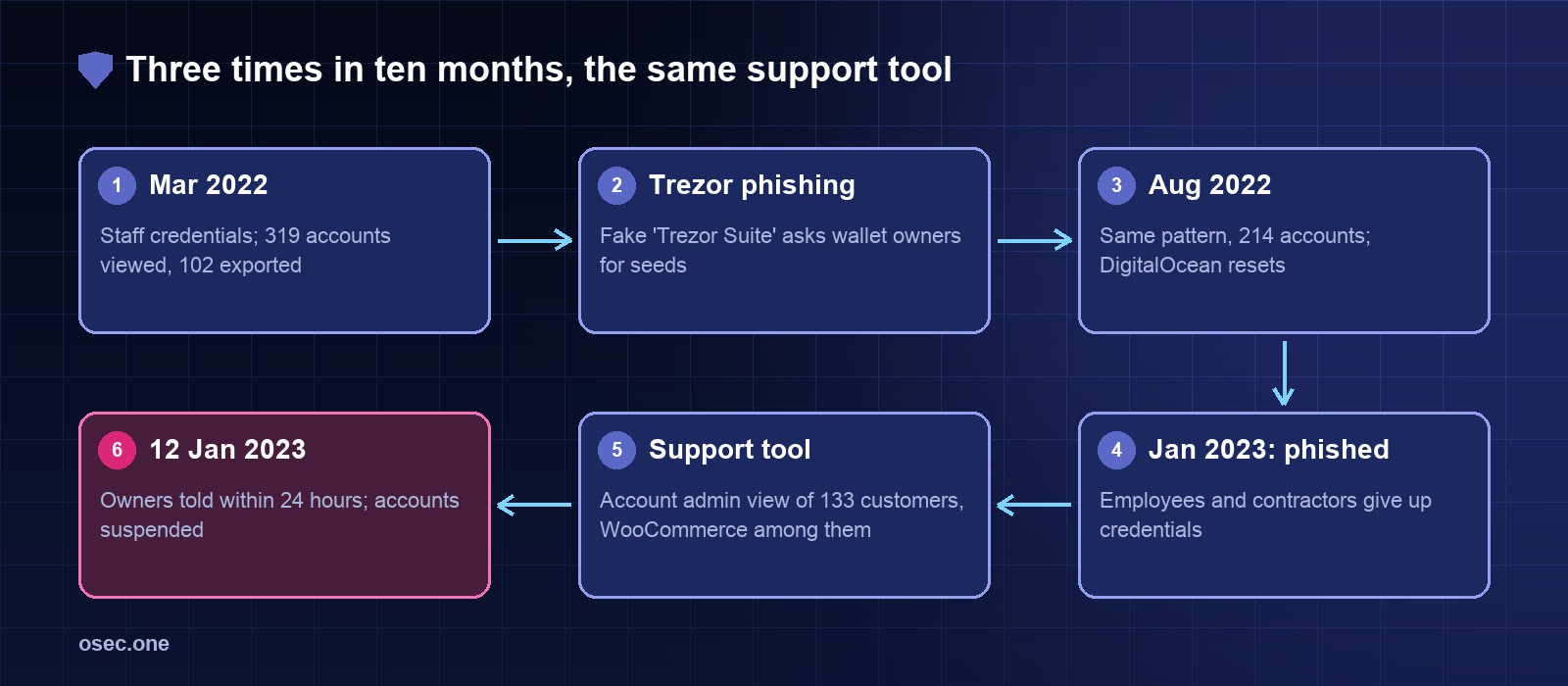
Mailchimp internal support / account-admin tool, reached with phished staff credentials\n\n Mar-Apr 2022 Aug 2022 Jan 2023\ndetected 26 Mar 2022 8 Aug 2022 11 Jan 2023\nhow in social engineering of social engineering of social engineering of\n employees, credentials employees, credentials employees and contractors\naccounts reached 319 viewed 214 133\ndata taken audience data exported not detailed not detailed (WooCommerce:\n from 102; API keys for names, store URLs,\n some accounts addresses, emails)\ntargets named crypto and finance crypto and finance none named\nowners told (disclosed 4 Apr) 10 Aug 12 Jan, within 24 hours\nfollow-on harm Trezor phishing with DigitalOcean: password none reported\n a fake app resets, 2FA held\nMailchimp on controls disabled exposed API "enhanced security "not publicly commenting\n keys, urged 2FA measures" (unnamed) on actions we are taking"
"},{"id":146698,"block_type":"paragraph","html":"
Across ten months that is 666 customer accounts reached through one internal tool, by three rounds of the same method. Mailchimp never published what it changed in the tool's access controls; in January 2023 it said it would not comment "for operational security reasons".
Each time the way in was a person. In March 2022 Mailchimp's CISO described "an external actor" who ran social engineering against employees and compromised their credentials. In August 2022 the attack fits the 0ktapus pattern Group-IB documented: text messages pointing staff to a fake sign-in page that relayed username, password and one-time code in real time; Group-IB counted 136 organisations and 9,931 captured credentials in that campaign. Mailchimp itself never confirmed the method beyond social engineering. In January 2023 contractors were named alongside employees.
"},{"id":146701,"block_type":"paragraph","html":"
Control: one-time codes typed into a page (SMS, authenticator apps) can be relayed by a phishing proxy. Security keys and passkeys can't, because the browser binds them to the real domain; that is why Cloudflare's staff, sent the same 0ktapus texts, weren't compromised. For a support tool that can see every customer, phishing-resistant sign-in is the first control, and it has to cover contractors too.
A support tool exists to open any customer's account quickly: see their settings, lists, campaigns, billing, and act for them. That is the job. It also means one phished support login equals read access to every customer, without any customer's password or MFA. In March 2022 the attacker viewed 319 accounts and exported audience data from 102. A support agent working normally opens accounts one ticket at a time; 319 accounts in one session is not what support work looks like.
Worked example: what a view-count alert would have caught
"},{"id":146705,"block_type":"paragraph","html":"
Say a support team of 20 handles 600 tickets a day, about 30 accounts per agent per day, or about 4 an hour in an 8-hour shift. Busy agents might reach 10 an hour. An alert at 3x the busiest agent's normal hour (30 accounts in an hour), or on any audience export by a support login, fires early in a session like March 2022's. If the tool logs each account view, the query is short:
"},{"id":146706,"block_type":"code","html":"
sql
-- support_audit(agent, account_id, action, at): one row per account opened or exported\nSELECT agent,\n count(DISTINCT account_id) AS accounts_last_hour,\n count(*) FILTER (WHERE action = 'export') AS exports_last_hour\nFROM support_audit\nWHERE at > now() - interval '1 hour'\nGROUP BY agent\nHAVING count(DISTINCT account_id) > 30\n OR count(*) FILTER (WHERE action = 'export') > 0;
"},{"id":146707,"block_type":"paragraph","html":"
Set the number from your own log: take each agent's accounts-per-hour over a month and put the threshold well above the 99th percentile. A real attacker who goes slowly gets under it, but slow is exactly what these intruders weren't: they had a session that could be cut at any moment.
The data in an email platform is a list of people who trust a sender. In March 2022 that turned into the Trezor phishing: Trezor's customers got emails at the addresses they had registered with Trezor, linking to a fake "Trezor Suite" app (trezor[.]us, and a lookalike domain with a non-Latin character) that asked for the wallet's recovery seed. A seed is the wallet. One US customer later sued Intuit and Mailchimp, saying he lost about $82,000 to $87,000 in crypto to that phishing.
"},{"id":146710,"block_type":"paragraph","html":"
API keys were the other prize. In March 2022 keys for some accounts were exposed; an API key lets someone send campaigns from the customer's account without logging in, from the customer's own domain with valid SPF and DKIM. Mailchimp disabled those keys and blocked them from being re-enabled.
"},{"id":146711,"block_type":"paragraph","html":"
Controls: on the tool side, mask list contents by default (a support agent rarely needs every subscriber's address) and never show API keys in full. On the customer side, see below.
Step 4: the downstream customer that noticed first
"},{"id":146713,"block_type":"paragraph","html":"
DigitalOcean's write-up of August 2022 is the best record of what this looks like from a customer's seat. On 7 August an unknown address appeared on the recipient list of one of its Mailchimp emails. On 8 August at 15:30 ET its transactional email stopped arriving: Mailchimp had suspended its account. The same day a DigitalOcean customer reported a password reset they hadn't asked for. One attacker IP had started password resets against a limited set of DigitalOcean accounts and changed at least one password, but two-factor authentication blocked the login. DigitalOcean moved its critical email to another provider by 23:00 ET on 9 August, and heard formally from Mailchimp on 10 August.
"},{"id":146714,"block_type":"paragraph","html":"
Two lessons sit in that timeline. Customer email addresses from a provider's breach become password-reset and phishing attempts against your users within hours. And a single email provider for password resets and sign-in codes is a single point of failure: when it was suspended, DigitalOcean's users couldn't get those emails at all.
In January 2023 Mailchimp told the primary contacts of affected accounts on 12 January, "less than 24 hours after initial discovery", and temporarily suspended accounts showing suspicious activity. That part went better than in Okta's 2022 case, where customers heard two months late. What is still missing in all three Mailchimp notices is how long the intruder was inside and exactly what was viewed per account.
Support-tool cases how in reach\nTwitter, Jul 2020 phone spear-phishing of staff 130 accounts targeted, 45 tweeted\n from, 36 DM inboxes, 7 data downloads\nMailchimp, Mar 2022 phished staff credentials 319 viewed, 102 exported\nMailchimp, Aug 2022 phished staff credentials 214\nMailchimp, Jan 2023 phished staff and contractors 133\nCoinbase, Dec 2024 - May 2025 support contractors PAID for 69,461 people notified; $20M ransom\n customer data demand refused; $180-400M cost estimate
Most SaaS products, including small ones, grow an internal admin page that can open any customer account. These are the controls that would have shrunk each Mailchimp incident, roughly in order of value for effort:
"},{"id":146721,"block_type":"paragraph","html":"
1. Phishing-resistant sign-in for the admin tool (security keys or passkeys), for employees and contractors alike, with no SMS fallback. 2. Access per ticket. An agent opens an account from a ticket, not from a search box; the tool records the ticket ID with every view. Accounts without an open ticket need a second person. 3. Masked by default. Subscriber lists, payment details and API keys hidden until the agent clicks reveal, which is logged and rate-limited. 4. No exports from the support role. Exports belong to the customer; if support must export, it needs approval. 5. The view-count alert above, plus an alert on any support login from a new device or country. 6. Short sessions. An 8-hour support session that dies at the end of a shift limits how long a phished session lasts. 7. Show the customer. List support access in the customer's own activity log, so they can spot it too.
1. Turn on 2FA for every user of the account, with a security key where offered. 2. Treat API keys as secrets: one per integration, delete unused ones, and rotate them after any provider incident notice. 3. Don't keep sending password resets and sign-in codes through your marketing platform. Put transactional email on a separate provider or at least a separate account, so a suspension or breach of one doesn't stop the other. 4. Assume your list is public after a provider breach. Warn your users that you will never ask for a seed phrase, password or code by email, and expect password-reset attempts against them. 5. Watch your sending domain's DMARC reports. Mail sent with a stolen API key passes SPF and DKIM, so DMARC won't block it, but the aggregate reports show volumes you didn't send.
"},{"id":146724,"block_type":"paragraph","html":"
The thread through all of this is sign-in. A phished password plus a relayed code was enough three times; a security key would have stopped each one at step 1. For your own users, a reset flow that needs the second factor is what saved DigitalOcean's accounts.
"},{"id":146725,"block_type":"cta","html":"
osec Login Protection adds sign-in rules to your app that count by email address and by wrong codes, not just by IP, so password-reset and code-guessing waves against your users get stopped early. No DNS move.
On 11 January 2023 Mailchimp found someone using one of its internal tools: the one its customer-facing teams use for support and account administration. The intruder had got in with employee credentials, obtained by social engineering Mailchimp employees and contractors. 133 customer accounts were reached; WooCommerce was one of them. The owners were told the next day.
\n
Ad
\n
It was the third time in ten months. In March 2022 and again in August 2022, attackers had phished Mailchimp staff and used the same kind of internal tool to look into accounts of crypto and finance companies, then phished those companies' own customers with the mailing lists. This case analysis looks at all three, at why a support tool is the most valuable thing to phish at a SaaS company, and at how to limit what one support login can see, whether you run the tool or rely on someone else's.
\n
The August 2022 incident is usually linked to 0ktapus, the text-message phishing campaign that hit Twilio and 130 other companies. This article is about what happened after the login: the support tool.
\n
\n
Three incidents, one tool
\n
text
Mailchimp internal support / account-admin tool, reached with phished staff credentials\n\n Mar-Apr 2022 Aug 2022 Jan 2023\ndetected 26 Mar 2022 8 Aug 2022 11 Jan 2023\nhow in social engineering of social engineering of social engineering of\n employees, credentials employees, credentials employees and contractors\naccounts reached 319 viewed 214 133\ndata taken audience data exported not detailed not detailed (WooCommerce:\n from 102; API keys for names, store URLs,\n some accounts addresses, emails)\ntargets named crypto and finance crypto and finance none named\nowners told (disclosed 4 Apr) 10 Aug 12 Jan, within 24 hours\nfollow-on harm Trezor phishing with DigitalOcean: password none reported\n a fake app resets, 2FA held\nMailchimp on controls disabled exposed API "enhanced security "not publicly commenting\n keys, urged 2FA measures" (unnamed) on actions we are taking"
\n
Across ten months that is 666 customer accounts reached through one internal tool, by three rounds of the same method. Mailchimp never published what it changed in the tool's access controls; in January 2023 it said it would not comment "for operational security reasons".
\n
Step 1: phishing the people with the tool
\n
Each time the way in was a person. In March 2022 Mailchimp's CISO described "an external actor" who ran social engineering against employees and compromised their credentials. In August 2022 the attack fits the 0ktapus pattern Group-IB documented: text messages pointing staff to a fake sign-in page that relayed username, password and one-time code in real time; Group-IB counted 136 organisations and 9,931 captured credentials in that campaign. Mailchimp itself never confirmed the method beyond social engineering. In January 2023 contractors were named alongside employees.
\n
Control: one-time codes typed into a page (SMS, authenticator apps) can be relayed by a phishing proxy. Security keys and passkeys can't, because the browser binds them to the real domain; that is why Cloudflare's staff, sent the same 0ktapus texts, weren't compromised. For a support tool that can see every customer, phishing-resistant sign-in is the first control, and it has to cover contractors too.
\n
Step 2: a tool built to see any account
\n
A support tool exists to open any customer's account quickly: see their settings, lists, campaigns, billing, and act for them. That is the job. It also means one phished support login equals read access to every customer, without any customer's password or MFA. In March 2022 the attacker viewed 319 accounts and exported audience data from 102. A support agent working normally opens accounts one ticket at a time; 319 accounts in one session is not what support work looks like.
\n
Worked example: what a view-count alert would have caught
\n
Say a support team of 20 handles 600 tickets a day, about 30 accounts per agent per day, or about 4 an hour in an 8-hour shift. Busy agents might reach 10 an hour. An alert at 3x the busiest agent's normal hour (30 accounts in an hour), or on any audience export by a support login, fires early in a session like March 2022's. If the tool logs each account view, the query is short:
\n
sql
-- support_audit(agent, account_id, action, at): one row per account opened or exported\nSELECT agent,\n count(DISTINCT account_id) AS accounts_last_hour,\n count(*) FILTER (WHERE action = 'export') AS exports_last_hour\nFROM support_audit\nWHERE at > now() - interval '1 hour'\nGROUP BY agent\nHAVING count(DISTINCT account_id) > 30\n OR count(*) FILTER (WHERE action = 'export') > 0;
\n
Set the number from your own log: take each agent's accounts-per-hour over a month and put the threshold well above the 99th percentile. A real attacker who goes slowly gets under it, but slow is exactly what these intruders weren't: they had a session that could be cut at any moment.
\n
Step 3: what they took, and what it was worth
\n
The data in an email platform is a list of people who trust a sender. In March 2022 that turned into the Trezor phishing: Trezor's customers got emails at the addresses they had registered with Trezor, linking to a fake "Trezor Suite" app (trezor[.]us, and a lookalike domain with a non-Latin character) that asked for the wallet's recovery seed. A seed is the wallet. One US customer later sued Intuit and Mailchimp, saying he lost about $82,000 to $87,000 in crypto to that phishing.
\n
API keys were the other prize. In March 2022 keys for some accounts were exposed; an API key lets someone send campaigns from the customer's account without logging in, from the customer's own domain with valid SPF and DKIM. Mailchimp disabled those keys and blocked them from being re-enabled.
\n
Controls: on the tool side, mask list contents by default (a support agent rarely needs every subscriber's address) and never show API keys in full. On the customer side, see below.
\n
Step 4: the downstream customer that noticed first
\n
DigitalOcean's write-up of August 2022 is the best record of what this looks like from a customer's seat. On 7 August an unknown address appeared on the recipient list of one of its Mailchimp emails. On 8 August at 15:30 ET its transactional email stopped arriving: Mailchimp had suspended its account. The same day a DigitalOcean customer reported a password reset they hadn't asked for. One attacker IP had started password resets against a limited set of DigitalOcean accounts and changed at least one password, but two-factor authentication blocked the login. DigitalOcean moved its critical email to another provider by 23:00 ET on 9 August, and heard formally from Mailchimp on 10 August.
\n
Two lessons sit in that timeline. Customer email addresses from a provider's breach become password-reset and phishing attempts against your users within hours. And a single email provider for password resets and sign-in codes is a single point of failure: when it was suspended, DigitalOcean's users couldn't get those emails at all.
\n
Step 5: how fast customers heard
\n
In January 2023 Mailchimp told the primary contacts of affected accounts on 12 January, "less than 24 hours after initial discovery", and temporarily suspended accounts showing suspicious activity. That part went better than in Okta's 2022 case, where customers heard two months late. What is still missing in all three Mailchimp notices is how long the intruder was inside and exactly what was viewed per account.
\n
The same pattern elsewhere
\n
text
Support-tool cases how in reach\nTwitter, Jul 2020 phone spear-phishing of staff 130 accounts targeted, 45 tweeted\n from, 36 DM inboxes, 7 data downloads\nMailchimp, Mar 2022 phished staff credentials 319 viewed, 102 exported\nMailchimp, Aug 2022 phished staff credentials 214\nMailchimp, Jan 2023 phished staff and contractors 133\nCoinbase, Dec 2024 - May 2025 support contractors PAID for 69,461 people notified; $20M ransom\n customer data demand refused; $180-400M cost estimate
\n
If you run a support or admin tool
\n
Most SaaS products, including small ones, grow an internal admin page that can open any customer account. These are the controls that would have shrunk each Mailchimp incident, roughly in order of value for effort:
\n
1. Phishing-resistant sign-in for the admin tool (security keys or passkeys), for employees and contractors alike, with no SMS fallback. 2. Access per ticket. An agent opens an account from a ticket, not from a search box; the tool records the ticket ID with every view. Accounts without an open ticket need a second person. 3. Masked by default. Subscriber lists, payment details and API keys hidden until the agent clicks reveal, which is logged and rate-limited. 4. No exports from the support role. Exports belong to the customer; if support must export, it needs approval. 5. The view-count alert above, plus an alert on any support login from a new device or country. 6. Short sessions. An 8-hour support session that dies at the end of a shift limits how long a phished session lasts. 7. Show the customer. List support access in the customer's own activity log, so they can spot it too.
\n
If you are the customer of an email platform
\n
1. Turn on 2FA for every user of the account, with a security key where offered. 2. Treat API keys as secrets: one per integration, delete unused ones, and rotate them after any provider incident notice. 3. Don't keep sending password resets and sign-in codes through your marketing platform. Put transactional email on a separate provider or at least a separate account, so a suspension or breach of one doesn't stop the other. 4. Assume your list is public after a provider breach. Warn your users that you will never ask for a seed phrase, password or code by email, and expect password-reset attempts against them. 5. Watch your sending domain's DMARC reports. Mail sent with a stolen API key passes SPF and DKIM, so DMARC won't block it, but the aggregate reports show volumes you didn't send.
\n
The thread through all of this is sign-in. A phished password plus a relayed code was enough three times; a security key would have stopped each one at step 1. For your own users, a reset flow that needs the second factor is what saved DigitalOcean's accounts.
\n
osec Login Protection adds sign-in rules to your app that count by email address and by wrong codes, not just by IP, so password-reset and code-guessing waves against your users get stopped early. No DNS move.
Mailchimp 2023: staff tricked into giving credentials, an internal admin tool and 133 customer accounts
On 11 January 2023 Mailchimp found someone using one of its internal tools: the one its customer-facing teams use for support and account administration. The intruder had got in with employee credentials, obtained by social engineering Mailchimp employees and contractors. 133 customer accounts were reached; WooCommerce was one of them. The owners were told the next day.
Ad
It was the third time in ten months. In March 2022 and again in August 2022, attackers had phished Mailchimp staff and used the same kind of internal tool to look into accounts of crypto and finance companies, then phished those companies' own customers with the mailing lists. This case analysis looks at all three, at why a support tool is the most valuable thing to phish at a SaaS company, and at how to limit what one support login can see, whether you run the tool or rely on someone else's.
The August 2022 incident is usually linked to 0ktapus, the text-message phishing campaign that hit Twilio and 130 other companies. This article is about what happened after the login: the support tool.
Three incidents, one tool
text
Mailchimp internal support / account-admin tool, reached with phished staff credentials

                         Mar-Apr 2022            Aug 2022                Jan 2023
detected                 26 Mar 2022             8 Aug 2022              11 Jan 2023
how in                   social engineering of   social engineering of   social engineering of
                         employees, credentials  employees, credentials  employees and contractors
accounts reached         319 viewed              214                     133
data taken               audience data exported  not detailed            not detailed (WooCommerce:
                         from 102; API keys for                          names, store URLs,
                         some accounts                                   addresses, emails)
targets named            crypto and finance      crypto and finance      none named
owners told              (disclosed 4 Apr)       10 Aug                  12 Jan, within 24 hours
follow-on harm           Trezor phishing with    DigitalOcean: password  none reported
                         a fake app              resets, 2FA held
Mailchimp on controls    disabled exposed API    "enhanced security      "not publicly commenting
                         keys, urged 2FA         measures" (unnamed)     on actions we are taking"
Across ten months that is 666 customer accounts reached through one internal tool, by three rounds of the same method. Mailchimp never published what it changed in the tool's access controls; in January 2023 it said it would not comment "for operational security reasons".
Step 1: phishing the people with the tool
Each time the way in was a person. In March 2022 Mailchimp's CISO described "an external actor" who ran social engineering against employees and compromised their credentials. In August 2022 the attack fits the 0ktapus pattern Group-IB documented: text messages pointing staff to a fake sign-in page that relayed username, password and one-time code in real time; Group-IB counted 136 organisations and 9,931 captured credentials in that campaign. Mailchimp itself never confirmed the method beyond social engineering. In January 2023 contractors were named alongside employees.
Control: one-time codes typed into a page (SMS, authenticator apps) can be relayed by a phishing proxy. Security keys and passkeys can't, because the browser binds them to the real domain; that is why Cloudflare's staff, sent the same 0ktapus texts, weren't compromised. For a support tool that can see every customer, phishing-resistant sign-in is the first control, and it has to cover contractors too.
Step 2: a tool built to see any account
A support tool exists to open any customer's account quickly: see their settings, lists, campaigns, billing, and act for them. That is the job. It also means one phished support login equals read access to every customer, without any customer's password or MFA. In March 2022 the attacker viewed 319 accounts and exported audience data from 102. A support agent working normally opens accounts one ticket at a time; 319 accounts in one session is not what support work looks like.
Worked example: what a view-count alert would have caught
Say a support team of 20 handles 600 tickets a day, about 30 accounts per agent per day, or about 4 an hour in an 8-hour shift. Busy agents might reach 10 an hour. An alert at 3x the busiest agent's normal hour (30 accounts in an hour), or on any audience export by a support login, fires early in a session like March 2022's. If the tool logs each account view, the query is short:
sql
-- support_audit(agent, account_id, action, at): one row per account opened or exported
SELECT agent,
       count(DISTINCT account_id)                       AS accounts_last_hour,
       count(*) FILTER (WHERE action = 'export')       AS exports_last_hour
FROM support_audit
WHERE at > now() - interval '1 hour'
GROUP BY agent
HAVING count(DISTINCT account_id) > 30
    OR count(*) FILTER (WHERE action = 'export') > 0;
Set the number from your own log: take each agent's accounts-per-hour over a month and put the threshold well above the 99th percentile. A real attacker who goes slowly gets under it, but slow is exactly what these intruders weren't: they had a session that could be cut at any moment.
Step 3: what they took, and what it was worth
The data in an email platform is a list of people who trust a sender. In March 2022 that turned into the Trezor phishing: Trezor's customers got emails at the addresses they had registered with Trezor, linking to a fake "Trezor Suite" app (trezor[.]us, and a lookalike domain with a non-Latin character) that asked for the wallet's recovery seed. A seed is the wallet. One US customer later sued Intuit and Mailchimp, saying he lost about $82,000 to $87,000 in crypto to that phishing.
API keys were the other prize. In March 2022 keys for some accounts were exposed; an API key lets someone send campaigns from the customer's account without logging in, from the customer's own domain with valid SPF and DKIM. Mailchimp disabled those keys and blocked them from being re-enabled.
Controls: on the tool side, mask list contents by default (a support agent rarely needs every subscriber's address) and never show API keys in full. On the customer side, see below.
Step 4: the downstream customer that noticed first
DigitalOcean's write-up of August 2022 is the best record of what this looks like from a customer's seat. On 7 August an unknown address appeared on the recipient list of one of its Mailchimp emails. On 8 August at 15:30 ET its transactional email stopped arriving: Mailchimp had suspended its account. The same day a DigitalOcean customer reported a password reset they hadn't asked for. One attacker IP had started password resets against a limited set of DigitalOcean accounts and changed at least one password, but two-factor authentication blocked the login. DigitalOcean moved its critical email to another provider by 23:00 ET on 9 August, and heard formally from Mailchimp on 10 August.
Two lessons sit in that timeline. Customer email addresses from a provider's breach become password-reset and phishing attempts against your users within hours. And a single email provider for password resets and sign-in codes is a single point of failure: when it was suspended, DigitalOcean's users couldn't get those emails at all.
Step 5: how fast customers heard
In January 2023 Mailchimp told the primary contacts of affected accounts on 12 January, "less than 24 hours after initial discovery", and temporarily suspended accounts showing suspicious activity. That part went better than in Okta's 2022 case, where customers heard two months late. What is still missing in all three Mailchimp notices is how long the intruder was inside and exactly what was viewed per account.
The same pattern elsewhere
text
Support-tool cases                 how in                          reach
Twitter, Jul 2020                  phone spear-phishing of staff   130 accounts targeted, 45 tweeted
                                                                   from, 36 DM inboxes, 7 data downloads
Mailchimp, Mar 2022                phished staff credentials       319 viewed, 102 exported
Mailchimp, Aug 2022                phished staff credentials       214
Mailchimp, Jan 2023                phished staff and contractors   133
Coinbase, Dec 2024 - May 2025      support contractors PAID for    69,461 people notified; $20M ransom
                                   customer data                   demand refused; $180-400M cost estimate
If you run a support or admin tool
Most SaaS products, including small ones, grow an internal admin page that can open any customer account. These are the controls that would have shrunk each Mailchimp incident, roughly in order of value for effort:
1. Phishing-resistant sign-in for the admin tool (security keys or passkeys), for employees and contractors alike, with no SMS fallback. 2. Access per ticket. An agent opens an account from a ticket, not from a search box; the tool records the ticket ID with every view. Accounts without an open ticket need a second person. 3. Masked by default. Subscriber lists, payment details and API keys hidden until the agent clicks reveal, which is logged and rate-limited. 4. No exports from the support role. Exports belong to the customer; if support must export, it needs approval. 5. The view-count alert above, plus an alert on any support login from a new device or country. 6. Short sessions. An 8-hour support session that dies at the end of a shift limits how long a phished session lasts. 7. Show the customer. List support access in the customer's own activity log, so they can spot it too.
If you are the customer of an email platform
1. Turn on 2FA for every user of the account, with a security key where offered. 2. Treat API keys as secrets: one per integration, delete unused ones, and rotate them after any provider incident notice. 3. Don't keep sending password resets and sign-in codes through your marketing platform. Put transactional email on a separate provider or at least a separate account, so a suspension or breach of one doesn't stop the other. 4. Assume your list is public after a provider breach. Warn your users that you will never ask for a seed phrase, password or code by email, and expect password-reset attempts against them. 5. Watch your sending domain's DMARC reports. Mail sent with a stolen API key passes SPF and DKIM, so DMARC won't block it, but the aggregate reports show volumes you didn't send.
The thread through all of this is sign-in. A phished password plus a relayed code was enough three times; a security key would have stopped each one at step 1. For your own users, a reset flow that needs the second factor is what saved DigitalOcean's accounts.
osec Login Protection adds sign-in rules to your app that count by email address and by wrong codes, not just by IP, so password-reset and code-guessing waves against your users get stopped early. No DNS move.