The screenshots were two months old. They came from the laptop of a support engineer who didn't work for Okta but for Sitel (formerly Sykes), a company Okta paid to answer customer tickets. The attacker had remote access to that laptop for five days in January, while it was signed in to Okta. This is how a vendor's vendor ends up holding a key to your admin console, step by step, and the contract and access questions a small company can ask of anyone who does its support.
"},{"id":147107,"block_type":"paragraph","html":"
This is a different case from the Okta support breach of 2023, where customers' HAR files in Okta's own support system leaked session tokens, and from 0ktapus, which phished Okta logins at Twilio and 130 other companies by text message.
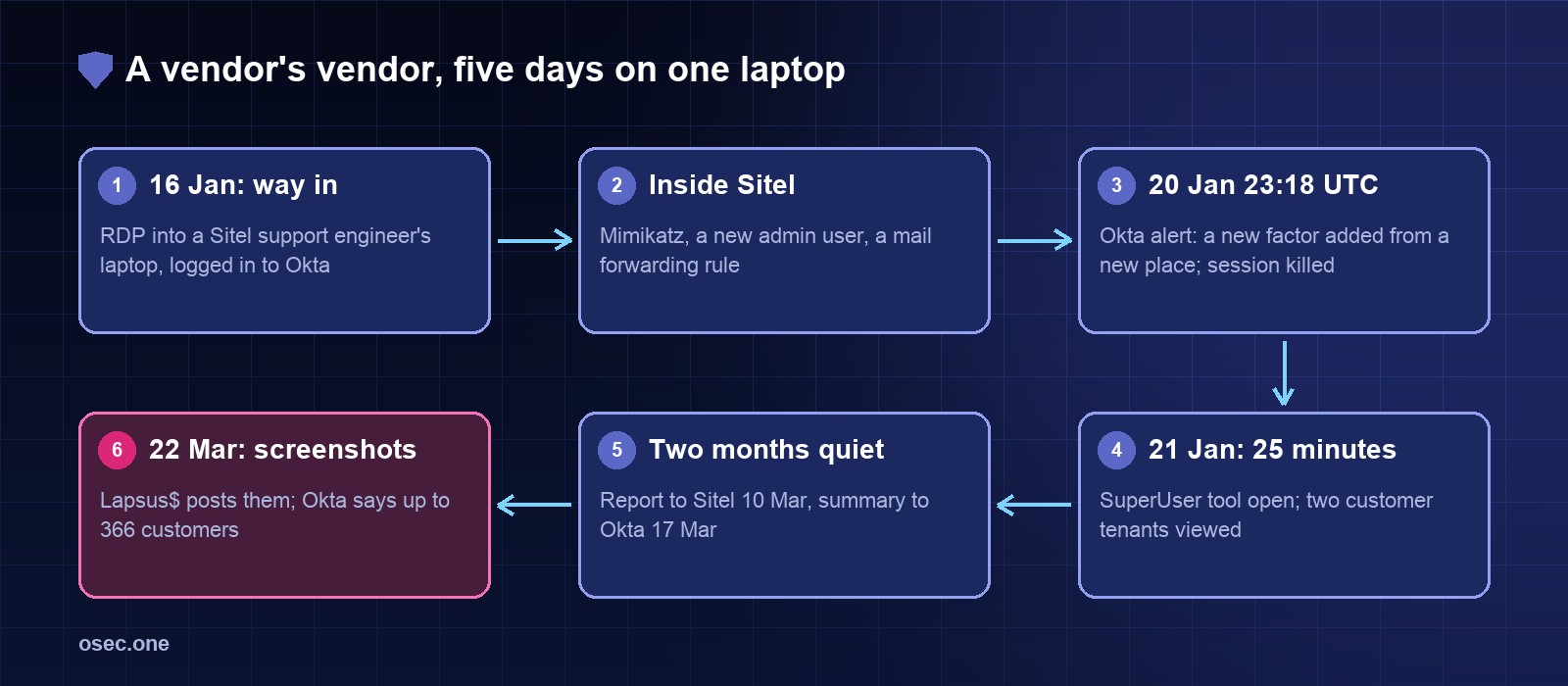
Okta / Sitel / Lapsus$ (2022, times UTC unless marked; Okta's posts of 22 Mar, 24 Mar, 20 Apr)\n\n16 Jan attacker has remote access (RDP) to a Sitel support engineer's laptop,\n owned and managed by Sitel and signed in to Okta; window: 16-21 Jan\n19 Jan reconnaissance on the host; first RDP session as the engineer (leaked timeline)\n20 Jan 23:18 Okta alert: a new factor (a password) added to the Sitel engineer's Okta\n account from a new location; the MFA challenge is not passed\n20 Jan 23:46 alert becomes an incident\n21 Jan 00:28 Okta ends the engineer's sessions and suspends the account\n21 Jan attacker controls the workstation for 25 consecutive minutes; SuperUser\n open, two customer tenants viewed (Okta's final finding, 20 Apr)\n21 Jan 18:00 Okta gives Sitel indicators of compromise; Sitel hires a forensic firm\n25 Jan Sitel informs its own customers\nto 28 Feb forensic investigation\n10 Mar forensic report delivered to Sitel\n17 Mar Okta receives Sitel's summary report\n22 Mar 03:30 Lapsus$ posts the screenshots\n22 Mar 12:27 Okta receives the full report\n22 Mar Okta: "The Okta service has not been breached"; later that day,\n about 2.5% of customers (366) potentially affected\n25-27 Mar Okta FAQ: "we made a mistake"; Okta shares down almost 20% in a week\n20 Apr final result: 2 tenants, limited Slack and Jira data viewed, no\n configuration changes, no MFA or password resets; Okta ends its\n relationship with Sykes/Sitel
"},{"id":147111,"block_type":"paragraph","html":"
Two numbers are easy to mix up. 366 was the worst case: every customer tenant a support engineer could have opened in that five-day window. 2 was what Okta found after reviewing more than 125,000 log entries. Okta also said it should have "more actively and forcefully compelled information from Sitel", because it sat on a summary for five days and the full report arrived only after the screenshots were public.
The laptop belonged to Sitel, ran Sitel's software and sat on Sitel's network. Okta's own controls (its MFA, its device policies) applied to the Okta account, not to the machine. The attacker didn't need to beat Okta's sign-in: the engineer was already signed in, and the attacker drove the session over Remote Desktop. Microsoft's report on Lapsus$ (DEV-0537), published the same day as the screenshots, lists how the group usually got that kind of access: credentials and session tokens bought from infostealer markets, employees or suppliers paid to approve an MFA prompt or install AnyDesk, SIM swaps, MFA push spam and calls to help desks.
"},{"id":147114,"block_type":"paragraph","html":"
Control: a support vendor's devices are part of your attack surface. Ask that any device used to reach your systems is managed and passes a device check at sign-in, and that remote-access tools (RDP open to the internet, AnyDesk, TeamViewer) are blocked or alerted on.
A leaked copy of the forensic timeline, published by researcher Bill Demirkapi on 28 March and not confirmed by Mandiant or Sitel, shows what happened inside Sitel. The attacker downloaded Process Explorer and Process Hacker and stopped the FireEye endpoint agent, then fetched Mimikatz from its official repository to pull passwords from memory. They opened a file called DomAdmins-LastPass.xlsx (Sitel said it held account names, not passwords), created a new user and added it to a tenant administrators group, and set a mail rule that forwarded all mail to an attacker account. The compromise reached the VPN gateways of the legacy Sykes network and Sitel's Azure.
"},{"id":147117,"block_type":"paragraph","html":"
Control: none of these steps happened at Okta, and Okta couldn't see them. The only thing a customer of a vendor can do is ask: do you alert when an endpoint agent stops, when a new admin account appears, when a mail forwarding rule is created? Each of those is a standard alert in Microsoft 365 and any EDR; if the vendor can't show them, assume it won't notice.
The one control that fired was Okta's: at 23:18 UTC on 20 January a new factor appeared on the Sitel engineer's Okta account from a new location, the challenge wasn't passed, and within 70 minutes the sessions were ended and the account suspended. That alert is why the window closed. What it didn't do was trigger a look at what that account had done in the previous four days, or at the 25 minutes on 21 January in which the attacker still had a live screen.
"},{"id":147120,"block_type":"paragraph","html":"
Control: alert on factor changes for any account with admin or support rights, and when one fires, treat the whole account as compromised for the period before it: review its sessions and every action it took.
Okta describes SuperUser as a tool for basic management of customer tenants, "not god-like access". A support engineer could:
"},{"id":147123,"block_type":"code","html":"
text
SuperUser, as described by Okta (22 Mar 2022)\ncould could not\nhelp reset a user's password or MFA factors see the password itself\nsee Jira tickets and lists of users create or delete users\nopen a customer's tenant for support work download customer databases\n access Okta's source code
"},{"id":147124,"block_type":"paragraph","html":"
"Reset a user's MFA factors" is the important line. In an identity provider that is how you take over a user: reset their factor, enrol your own, sign in. Okta says no resets happened in the two tenants that were opened. Cloudflare, one of the customers, didn't wait to find out: it checked every employee whose password or MFA had changed since 1 December 2021, forced resets for 144 of them, and re-verified each person by video call. Okta confirmed to Cloudflare at 07:57 UTC on 22 March that it saw no malicious events in Cloudflare's tenant.
"},{"id":147125,"block_type":"paragraph","html":"
Okta's own follow-up was to limit what support engineers can see and to show SuperUser actions in the customer's System Log, so a customer can see what Okta's support did in its tenant. Both should have been true before.
Sitel knew on 21 January. Okta had a summary on 17 March. Customers learned on 22 March from Telegram. In the contract between Okta and Sitel, nothing forced a faster flow of information, and in Okta's contracts with its customers nothing told them a subcontractor existed with that access. The US Cyber Safety Review Board, reviewing Lapsus$ in 2023, wrote that many organisations leave outsourcers and third parties out of their risk programmes, and found the group paid up to $20,000 a week for access to a telecom provider's platform for SIM swaps and abused Active Directory weaknesses in up to 60% of its attacks. Its main recommendation was to move to passwordless, phishing-resistant sign-in and stop using SMS as a second factor.
"},{"id":147128,"block_type":"paragraph","html":"
For scale: Verizon's 2025 Data Breach Investigations Report found a third party involved in 30% of the 12,195 confirmed breaches it studied, double the year before (its count includes software supply chain, not only vendor access).
If you outsource support: the contract and access questions
"},{"id":147130,"block_type":"paragraph","html":"
A small company outsourcing first-line support, IT or bookkeeping is in Okta's position, usually with less leverage. These are the questions that would have changed this case, and what a good answer looks like:
"},{"id":147131,"block_type":"code","html":"
text
Question to the vendor Good answer\nWho exactly can reach our systems? Any Named people or a named team; subcontractors\nsubcontractors? listed in the contract, and new ones need consent\nWhat can one support login do in our admin? A role made for support: no password/MFA resets\n without a second person or our approval; no\n exports; read-only where possible\nWhich devices do they use? Vendor-managed, disk encryption, EDR, no\n remote-access tools; device check at sign-in\nHow do they sign in to us? Our SSO with phishing-resistant MFA (security\n key or passkey); no shared accounts\nCan we see what they did? Every support action in our own audit log,\n with the person's name, kept 12 months+\nHow fast do they tell us? Notice within 24-72 hours of suspecting a\n compromise of any person or device with our\n access, before the investigation ends\nCan we turn their access off? Yes, ourselves, in minutes (a toggle, a group,\n or a time-limited grant per ticket)
1. Give support its own accounts and role. Never share an admin login with a vendor. In Microsoft 365, Google Workspace or your own app, create a support role without password-reset, MFA-reset or export rights, and add those rights only for a named, time-limited ticket. 2. Make resets need a second person. A password or MFA reset for an admin should need approval from someone at your company. That one rule breaks the path from a stolen support session to an account takeover. 3. Grant access per ticket, with an expiry. Some consoles have this built in (Microsoft 365's Customer Lockbox makes Microsoft's own engineers ask you first); for your own vendors, add their account to the support group when a ticket opens and remove it when it closes, instead of a standing account. 4. Alert on the four events that mattered here: a new factor on an admin or support account, a new admin account, a mail forwarding rule to an outside address, and sign-ins from a new device or country for the vendor's accounts. 5. Write the 72-hour notice into the contract. The two months between Sitel's discovery and Okta's customers hearing of it were a contract gap more than a technical one.
Support staff need broad access to help customers quickly, they work in shifts at a lower cost than the core team, and they often sit at a different company. That makes them the cheapest way in, which is why the same pattern turns up at MGM and Caesars (help desk resets) and, in 2023, at Okta again. The strongest single control in every one of these cases is sign-in that a stolen session or a phone call can't reproduce: phishing-resistant factors for staff, and fewer passwords to reset in the first place.
"},{"id":147136,"block_type":"cta","html":"
osec Auth gives your app passwordless sign-in with email codes, Google and Apple: no passwords for a support desk to reset, no Google or Apple OAuth setup on your side, and free.
On 22 March 2022 the Lapsus$ group posted screenshots on Telegram that looked like the inside of Okta: its Slack, its Jira, and an internal tool called SuperUser with customer tenants open. Okta, whose sign-in service sits in front of thousands of companies' email, cloud and VPN, first said the service had not been breached, then that up to 366 customers might be affected, and a month later that the real number was two.
\n
Ad
\n
The screenshots were two months old. They came from the laptop of a support engineer who didn't work for Okta but for Sitel (formerly Sykes), a company Okta paid to answer customer tickets. The attacker had remote access to that laptop for five days in January, while it was signed in to Okta. This is how a vendor's vendor ends up holding a key to your admin console, step by step, and the contract and access questions a small company can ask of anyone who does its support.
\n
This is a different case from the Okta support breach of 2023, where customers' HAR files in Okta's own support system leaked session tokens, and from 0ktapus, which phished Okta logins at Twilio and 130 other companies by text message.
\n
\n
The timeline
\n
text
Okta / Sitel / Lapsus$ (2022, times UTC unless marked; Okta's posts of 22 Mar, 24 Mar, 20 Apr)\n\n16 Jan attacker has remote access (RDP) to a Sitel support engineer's laptop,\n owned and managed by Sitel and signed in to Okta; window: 16-21 Jan\n19 Jan reconnaissance on the host; first RDP session as the engineer (leaked timeline)\n20 Jan 23:18 Okta alert: a new factor (a password) added to the Sitel engineer's Okta\n account from a new location; the MFA challenge is not passed\n20 Jan 23:46 alert becomes an incident\n21 Jan 00:28 Okta ends the engineer's sessions and suspends the account\n21 Jan attacker controls the workstation for 25 consecutive minutes; SuperUser\n open, two customer tenants viewed (Okta's final finding, 20 Apr)\n21 Jan 18:00 Okta gives Sitel indicators of compromise; Sitel hires a forensic firm\n25 Jan Sitel informs its own customers\nto 28 Feb forensic investigation\n10 Mar forensic report delivered to Sitel\n17 Mar Okta receives Sitel's summary report\n22 Mar 03:30 Lapsus$ posts the screenshots\n22 Mar 12:27 Okta receives the full report\n22 Mar Okta: "The Okta service has not been breached"; later that day,\n about 2.5% of customers (366) potentially affected\n25-27 Mar Okta FAQ: "we made a mistake"; Okta shares down almost 20% in a week\n20 Apr final result: 2 tenants, limited Slack and Jira data viewed, no\n configuration changes, no MFA or password resets; Okta ends its\n relationship with Sykes/Sitel
\n
Two numbers are easy to mix up. 366 was the worst case: every customer tenant a support engineer could have opened in that five-day window. 2 was what Okta found after reviewing more than 125,000 log entries. Okta also said it should have "more actively and forcefully compelled information from Sitel", because it sat on a summary for five days and the full report arrived only after the screenshots were public.
\n
Step 1: a laptop that someone else managed
\n
The laptop belonged to Sitel, ran Sitel's software and sat on Sitel's network. Okta's own controls (its MFA, its device policies) applied to the Okta account, not to the machine. The attacker didn't need to beat Okta's sign-in: the engineer was already signed in, and the attacker drove the session over Remote Desktop. Microsoft's report on Lapsus$ (DEV-0537), published the same day as the screenshots, lists how the group usually got that kind of access: credentials and session tokens bought from infostealer markets, employees or suppliers paid to approve an MFA prompt or install AnyDesk, SIM swaps, MFA push spam and calls to help desks.
\n
Control: a support vendor's devices are part of your attack surface. Ask that any device used to reach your systems is managed and passes a device check at sign-in, and that remote-access tools (RDP open to the internet, AnyDesk, TeamViewer) are blocked or alerted on.
\n
Step 2: owning the vendor first
\n
A leaked copy of the forensic timeline, published by researcher Bill Demirkapi on 28 March and not confirmed by Mandiant or Sitel, shows what happened inside Sitel. The attacker downloaded Process Explorer and Process Hacker and stopped the FireEye endpoint agent, then fetched Mimikatz from its official repository to pull passwords from memory. They opened a file called DomAdmins-LastPass.xlsx (Sitel said it held account names, not passwords), created a new user and added it to a tenant administrators group, and set a mail rule that forwarded all mail to an attacker account. The compromise reached the VPN gateways of the legacy Sykes network and Sitel's Azure.
\n
Control: none of these steps happened at Okta, and Okta couldn't see them. The only thing a customer of a vendor can do is ask: do you alert when an endpoint agent stops, when a new admin account appears, when a mail forwarding rule is created? Each of those is a standard alert in Microsoft 365 and any EDR; if the vendor can't show them, assume it won't notice.
\n
Step 3: one alert that worked
\n
The one control that fired was Okta's: at 23:18 UTC on 20 January a new factor appeared on the Sitel engineer's Okta account from a new location, the challenge wasn't passed, and within 70 minutes the sessions were ended and the account suspended. That alert is why the window closed. What it didn't do was trigger a look at what that account had done in the previous four days, or at the 25 minutes on 21 January in which the attacker still had a live screen.
\n
Control: alert on factor changes for any account with admin or support rights, and when one fires, treat the whole account as compromised for the period before it: review its sessions and every action it took.
\n
Step 4: what a support login could do
\n
Okta describes SuperUser as a tool for basic management of customer tenants, "not god-like access". A support engineer could:
\n
text
SuperUser, as described by Okta (22 Mar 2022)\ncould could not\nhelp reset a user's password or MFA factors see the password itself\nsee Jira tickets and lists of users create or delete users\nopen a customer's tenant for support work download customer databases\n access Okta's source code
\n
"Reset a user's MFA factors" is the important line. In an identity provider that is how you take over a user: reset their factor, enrol your own, sign in. Okta says no resets happened in the two tenants that were opened. Cloudflare, one of the customers, didn't wait to find out: it checked every employee whose password or MFA had changed since 1 December 2021, forced resets for 144 of them, and re-verified each person by video call. Okta confirmed to Cloudflare at 07:57 UTC on 22 March that it saw no malicious events in Cloudflare's tenant.
\n
Okta's own follow-up was to limit what support engineers can see and to show SuperUser actions in the customer's System Log, so a customer can see what Okta's support did in its tenant. Both should have been true before.
\n
Step 5: two months of silence
\n
Sitel knew on 21 January. Okta had a summary on 17 March. Customers learned on 22 March from Telegram. In the contract between Okta and Sitel, nothing forced a faster flow of information, and in Okta's contracts with its customers nothing told them a subcontractor existed with that access. The US Cyber Safety Review Board, reviewing Lapsus$ in 2023, wrote that many organisations leave outsourcers and third parties out of their risk programmes, and found the group paid up to $20,000 a week for access to a telecom provider's platform for SIM swaps and abused Active Directory weaknesses in up to 60% of its attacks. Its main recommendation was to move to passwordless, phishing-resistant sign-in and stop using SMS as a second factor.
\n
For scale: Verizon's 2025 Data Breach Investigations Report found a third party involved in 30% of the 12,195 confirmed breaches it studied, double the year before (its count includes software supply chain, not only vendor access).
\n
If you outsource support: the contract and access questions
\n
A small company outsourcing first-line support, IT or bookkeeping is in Okta's position, usually with less leverage. These are the questions that would have changed this case, and what a good answer looks like:
\n
text
Question to the vendor Good answer\nWho exactly can reach our systems? Any Named people or a named team; subcontractors\nsubcontractors? listed in the contract, and new ones need consent\nWhat can one support login do in our admin? A role made for support: no password/MFA resets\n without a second person or our approval; no\n exports; read-only where possible\nWhich devices do they use? Vendor-managed, disk encryption, EDR, no\n remote-access tools; device check at sign-in\nHow do they sign in to us? Our SSO with phishing-resistant MFA (security\n key or passkey); no shared accounts\nCan we see what they did? Every support action in our own audit log,\n with the person's name, kept 12 months+\nHow fast do they tell us? Notice within 24-72 hours of suspecting a\n compromise of any person or device with our\n access, before the investigation ends\nCan we turn their access off? Yes, ourselves, in minutes (a toggle, a group,\n or a time-limited grant per ticket)
\n
Settings you control without asking anyone
\n
1. Give support its own accounts and role. Never share an admin login with a vendor. In Microsoft 365, Google Workspace or your own app, create a support role without password-reset, MFA-reset or export rights, and add those rights only for a named, time-limited ticket. 2. Make resets need a second person. A password or MFA reset for an admin should need approval from someone at your company. That one rule breaks the path from a stolen support session to an account takeover. 3. Grant access per ticket, with an expiry. Some consoles have this built in (Microsoft 365's Customer Lockbox makes Microsoft's own engineers ask you first); for your own vendors, add their account to the support group when a ticket opens and remove it when it closes, instead of a standing account. 4. Alert on the four events that mattered here: a new factor on an admin or support account, a new admin account, a mail forwarding rule to an outside address, and sign-ins from a new device or country for the vendor's accounts. 5. Write the 72-hour notice into the contract. The two months between Sitel's discovery and Okta's customers hearing of it were a contract gap more than a technical one.
\n
Why it keeps happening
\n
Support staff need broad access to help customers quickly, they work in shifts at a lower cost than the core team, and they often sit at a different company. That makes them the cheapest way in, which is why the same pattern turns up at MGM and Caesars (help desk resets) and, in 2023, at Okta again. The strongest single control in every one of these cases is sign-in that a stolen session or a phone call can't reproduce: phishing-resistant factors for staff, and fewer passwords to reset in the first place.
\n
osec Auth gives your app passwordless sign-in with email codes, Google and Apple: no passwords for a support desk to reset, no Google or Apple OAuth setup on your side, and free.
Okta and Lapsus$ 2022: a support contractor's laptop and five days of remote access
On 22 March 2022 the Lapsus$ group posted screenshots on Telegram that looked like the inside of Okta: its Slack, its Jira, and an internal tool called SuperUser with customer tenants open. Okta, whose sign-in service sits in front of thousands of companies' email, cloud and VPN, first said the service had not been breached, then that up to 366 customers might be affected, and a month later that the real number was two.
Ad
The screenshots were two months old. They came from the laptop of a support engineer who didn't work for Okta but for Sitel (formerly Sykes), a company Okta paid to answer customer tickets. The attacker had remote access to that laptop for five days in January, while it was signed in to Okta. This is how a vendor's vendor ends up holding a key to your admin console, step by step, and the contract and access questions a small company can ask of anyone who does its support.
This is a different case from the Okta support breach of 2023, where customers' HAR files in Okta's own support system leaked session tokens, and from 0ktapus, which phished Okta logins at Twilio and 130 other companies by text message.
The timeline
text
Okta / Sitel / Lapsus$ (2022, times UTC unless marked; Okta's posts of 22 Mar, 24 Mar, 20 Apr)

16 Jan        attacker has remote access (RDP) to a Sitel support engineer's laptop,
              owned and managed by Sitel and signed in to Okta; window: 16-21 Jan
19 Jan        reconnaissance on the host; first RDP session as the engineer (leaked timeline)
20 Jan 23:18  Okta alert: a new factor (a password) added to the Sitel engineer's Okta
              account from a new location; the MFA challenge is not passed
20 Jan 23:46  alert becomes an incident
21 Jan 00:28  Okta ends the engineer's sessions and suspends the account
21 Jan        attacker controls the workstation for 25 consecutive minutes; SuperUser
              open, two customer tenants viewed (Okta's final finding, 20 Apr)
21 Jan 18:00  Okta gives Sitel indicators of compromise; Sitel hires a forensic firm
25 Jan        Sitel informs its own customers
to 28 Feb     forensic investigation
10 Mar        forensic report delivered to Sitel
17 Mar        Okta receives Sitel's summary report
22 Mar 03:30  Lapsus$ posts the screenshots
22 Mar 12:27  Okta receives the full report
22 Mar        Okta: "The Okta service has not been breached"; later that day,
              about 2.5% of customers (366) potentially affected
25-27 Mar     Okta FAQ: "we made a mistake"; Okta shares down almost 20% in a week
20 Apr        final result: 2 tenants, limited Slack and Jira data viewed, no
              configuration changes, no MFA or password resets; Okta ends its
              relationship with Sykes/Sitel
Two numbers are easy to mix up. 366 was the worst case: every customer tenant a support engineer could have opened in that five-day window. 2 was what Okta found after reviewing more than 125,000 log entries. Okta also said it should have "more actively and forcefully compelled information from Sitel", because it sat on a summary for five days and the full report arrived only after the screenshots were public.
Step 1: a laptop that someone else managed
The laptop belonged to Sitel, ran Sitel's software and sat on Sitel's network. Okta's own controls (its MFA, its device policies) applied to the Okta account, not to the machine. The attacker didn't need to beat Okta's sign-in: the engineer was already signed in, and the attacker drove the session over Remote Desktop. Microsoft's report on Lapsus$ (DEV-0537), published the same day as the screenshots, lists how the group usually got that kind of access: credentials and session tokens bought from infostealer markets, employees or suppliers paid to approve an MFA prompt or install AnyDesk, SIM swaps, MFA push spam and calls to help desks.
Control: a support vendor's devices are part of your attack surface. Ask that any device used to reach your systems is managed and passes a device check at sign-in, and that remote-access tools (RDP open to the internet, AnyDesk, TeamViewer) are blocked or alerted on.
Step 2: owning the vendor first
A leaked copy of the forensic timeline, published by researcher Bill Demirkapi on 28 March and not confirmed by Mandiant or Sitel, shows what happened inside Sitel. The attacker downloaded Process Explorer and Process Hacker and stopped the FireEye endpoint agent, then fetched Mimikatz from its official repository to pull passwords from memory. They opened a file called DomAdmins-LastPass.xlsx (Sitel said it held account names, not passwords), created a new user and added it to a tenant administrators group, and set a mail rule that forwarded all mail to an attacker account. The compromise reached the VPN gateways of the legacy Sykes network and Sitel's Azure.
Control: none of these steps happened at Okta, and Okta couldn't see them. The only thing a customer of a vendor can do is ask: do you alert when an endpoint agent stops, when a new admin account appears, when a mail forwarding rule is created? Each of those is a standard alert in Microsoft 365 and any EDR; if the vendor can't show them, assume it won't notice.
Step 3: one alert that worked
The one control that fired was Okta's: at 23:18 UTC on 20 January a new factor appeared on the Sitel engineer's Okta account from a new location, the challenge wasn't passed, and within 70 minutes the sessions were ended and the account suspended. That alert is why the window closed. What it didn't do was trigger a look at what that account had done in the previous four days, or at the 25 minutes on 21 January in which the attacker still had a live screen.
Control: alert on factor changes for any account with admin or support rights, and when one fires, treat the whole account as compromised for the period before it: review its sessions and every action it took.
Step 4: what a support login could do
Okta describes SuperUser as a tool for basic management of customer tenants, "not god-like access". A support engineer could:
text
SuperUser, as described by Okta (22 Mar 2022)
could                                          could not
help reset a user's password or MFA factors    see the password itself
see Jira tickets and lists of users            create or delete users
open a customer's tenant for support work      download customer databases
                                               access Okta's source code
"Reset a user's MFA factors" is the important line. In an identity provider that is how you take over a user: reset their factor, enrol your own, sign in. Okta says no resets happened in the two tenants that were opened. Cloudflare, one of the customers, didn't wait to find out: it checked every employee whose password or MFA had changed since 1 December 2021, forced resets for 144 of them, and re-verified each person by video call. Okta confirmed to Cloudflare at 07:57 UTC on 22 March that it saw no malicious events in Cloudflare's tenant.
Okta's own follow-up was to limit what support engineers can see and to show SuperUser actions in the customer's System Log, so a customer can see what Okta's support did in its tenant. Both should have been true before.
Step 5: two months of silence
Sitel knew on 21 January. Okta had a summary on 17 March. Customers learned on 22 March from Telegram. In the contract between Okta and Sitel, nothing forced a faster flow of information, and in Okta's contracts with its customers nothing told them a subcontractor existed with that access. The US Cyber Safety Review Board, reviewing Lapsus$ in 2023, wrote that many organisations leave outsourcers and third parties out of their risk programmes, and found the group paid up to $20,000 a week for access to a telecom provider's platform for SIM swaps and abused Active Directory weaknesses in up to 60% of its attacks. Its main recommendation was to move to passwordless, phishing-resistant sign-in and stop using SMS as a second factor.
For scale: Verizon's 2025 Data Breach Investigations Report found a third party involved in 30% of the 12,195 confirmed breaches it studied, double the year before (its count includes software supply chain, not only vendor access).
If you outsource support: the contract and access questions
A small company outsourcing first-line support, IT or bookkeeping is in Okta's position, usually with less leverage. These are the questions that would have changed this case, and what a good answer looks like:
text
Question to the vendor                              Good answer
Who exactly can reach our systems? Any              Named people or a named team; subcontractors
subcontractors?                                     listed in the contract, and new ones need consent
What can one support login do in our admin?         A role made for support: no password/MFA resets
                                                    without a second person or our approval; no
                                                    exports; read-only where possible
Which devices do they use?                          Vendor-managed, disk encryption, EDR, no
                                                    remote-access tools; device check at sign-in
How do they sign in to us?                          Our SSO with phishing-resistant MFA (security
                                                    key or passkey); no shared accounts
Can we see what they did?                           Every support action in our own audit log,
                                                    with the person's name, kept 12 months+
How fast do they tell us?                           Notice within 24-72 hours of suspecting a
                                                    compromise of any person or device with our
                                                    access, before the investigation ends
Can we turn their access off?                       Yes, ourselves, in minutes (a toggle, a group,
                                                    or a time-limited grant per ticket)
Settings you control without asking anyone
1. Give support its own accounts and role. Never share an admin login with a vendor. In Microsoft 365, Google Workspace or your own app, create a support role without password-reset, MFA-reset or export rights, and add those rights only for a named, time-limited ticket. 2. Make resets need a second person. A password or MFA reset for an admin should need approval from someone at your company. That one rule breaks the path from a stolen support session to an account takeover. 3. Grant access per ticket, with an expiry. Some consoles have this built in (Microsoft 365's Customer Lockbox makes Microsoft's own engineers ask you first); for your own vendors, add their account to the support group when a ticket opens and remove it when it closes, instead of a standing account. 4. Alert on the four events that mattered here: a new factor on an admin or support account, a new admin account, a mail forwarding rule to an outside address, and sign-ins from a new device or country for the vendor's accounts. 5. Write the 72-hour notice into the contract. The two months between Sitel's discovery and Okta's customers hearing of it were a contract gap more than a technical one.
Why it keeps happening
Support staff need broad access to help customers quickly, they work in shifts at a lower cost than the core team, and they often sit at a different company. That makes them the cheapest way in, which is why the same pattern turns up at MGM and Caesars (help desk resets) and, in 2023, at Okta again. The strongest single control in every one of these cases is sign-in that a stolen session or a phone call can't reproduce: phishing-resistant factors for staff, and fewer passwords to reset in the first place.
osec Auth gives your app passwordless sign-in with email codes, Google and Apple: no passwords for a support desk to reset, no Google or Apple OAuth setup on your side, and free.