On Friday 19 September 2025 passengers at Heathrow, Brussels, Berlin and Dublin found the same thing: the self-service check-in kiosks were dead and staff were writing boarding passes by hand. None of the four airports had been hacked. They all rented the same check-in software from one vendor, Collins Aerospace (owned by RTX), and that vendor had ransomware.
A quick correction to a common assumption: this was not an aircraft or avionics hack. Nothing in the flight systems was touched. It was the ground software that checks passengers in, prints bag tags and opens boarding. That makes it a cleaner case study for ordinary companies, because the failure is one every business with a critical vendor can have.
What MUSE is, and why one fault hit four airports
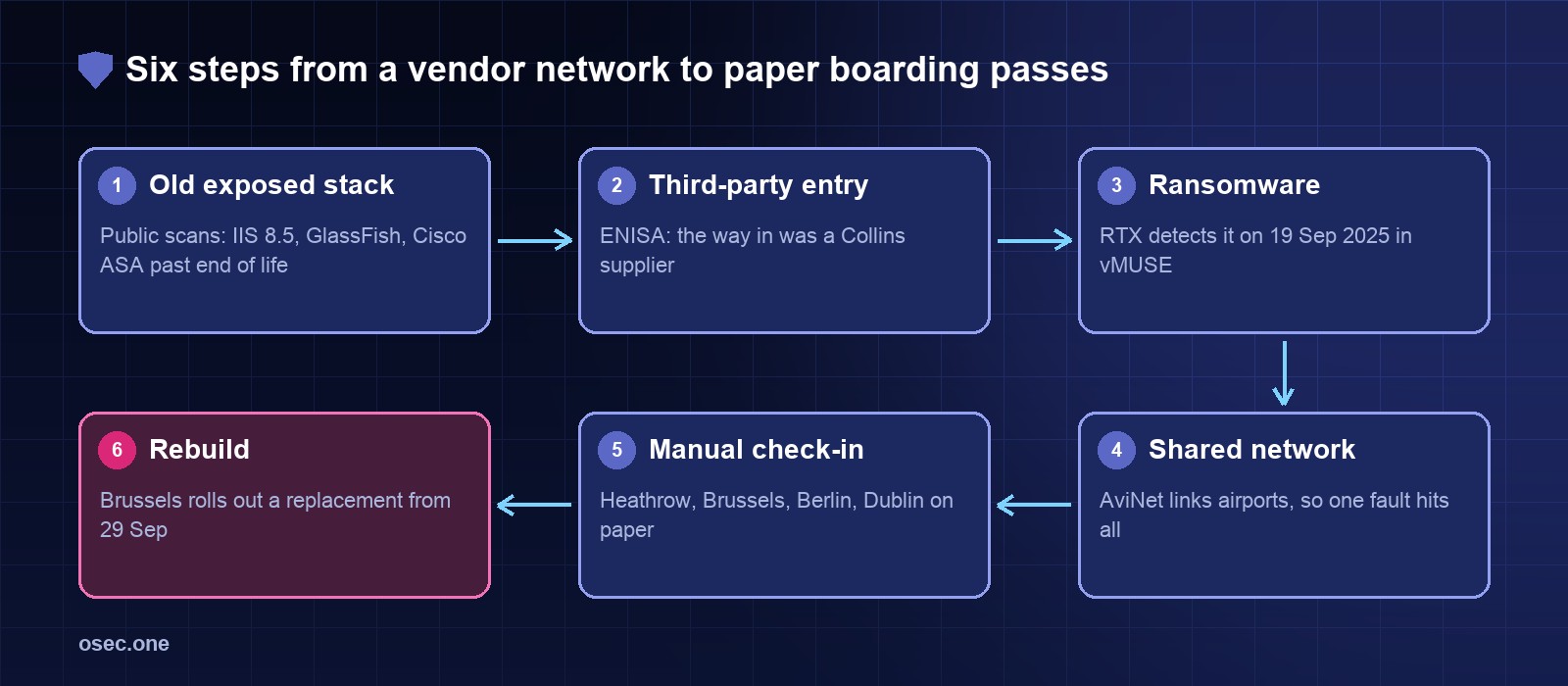
• MUSE (Multi-User System Environment) is a common-use passenger processing system. Several airlines share the same desks, kiosks and gates, and the software decides which airline's check-in screen shows up where. It also tracks baggage.
• The part named in the reports is vMUSE, the self-service version.
• Airports connect to it over ARINC AviNet, a private Collins network that works like a dedicated VPN. ARINC ran separately until 2018, then became part of Collins.
• UpGuard's reading: several airports failing at the same moment points to the central or shared layer, not four separate break-ins.
• RTX's filing says MUSE runs on customer-specific networks outside the RTX enterprise network. That is true and also the problem for the customer: your network can be separate from the vendor's and still go down with it.
Timeline, with dates
| Date (2025) | What happened |
|---|---|
| Fri 19 Sep | Brussels Airport switches to manual check-in and boarding; Berlin reports long queues; RTX says it is aware of a "cyber-related disruption" at select airports. RTX later says it became aware of the ransomware incident this day |
| Sat 20 Sep | Heathrow reports delays; British Airways runs on a backup system; the UK NCSC starts working with Collins |
| Sun 21 Sep | Dublin's Terminal 2 has a second day of check-in and baggage disruption |
| Mon 22 Sep | ENISA confirms ransomware and says it has identified the type; Dublin disruption in its third day; Collins says it is in the "final stages" of restoring systems |
| Tue 23 Sep | Dublin Airport operator daa has no fix date; Ireland's NCSC says investigators know the strain and believe they know the group |
| Wed 24 Sep | UK National Crime Agency announces the arrest of a man in his forties from West Sussex under the Computer Misuse Act; released on conditional bail, no charges reported |
| Mon 29 Sep | Brussels Airport starts rolling out a replacement Collins check-in system |
| 17 Oct | Everest extortion group claims on its leak site to have hacked MUSE infrastructure and says it used no encryption malware (a claim, unverified) |
Numbers that were reported, and how far to trust them: UpGuard counted 217 flight cancellations across the affected hubs. Reports for Brussels on Monday 22 September said the airport asked airlines to cancel 140 of 276 scheduled outbound flights, which works out to 140 ÷ 276 = 50.7% (other outlets counted 60 to 63 actual cancellations that day, so different counts clearly measured different things). Brussels was still cancelling around 10% of flights in the days before its replacement system started on 29 September. No source gave a verified total of passengers affected.
How the attackers got in: what is known and what is not
• Known: ENISA said it was ransomware and that the initial access was through a third-party provider of Collins.
• Known: RTX detected it on 19 September and notified law enforcement; it told investors it did not expect a material effect on finances.
• Not known publicly: the exact vulnerability or credential used, and the ransomware family. One researcher named HardBit; Ireland's NCSC described the actor as an affiliate and customer of a ransomware family without naming it; Everest later claimed the intrusion but said it used no encryption. Treat each of these as unconfirmed.
• Not known: whether any data was taken. RTX's statements do not say.
What UpGuard did show, from public internet scans, is how old some of the exposed pieces were:
| Seen in public scans (UpGuard, 24 Sep 2025) | Why it matters |
|---|---|
| Microsoft IIS 8.5 | End of support in October 2023: no security fixes for two years |
| A GlassFish application server from about 2014 | Eleven-year-old release line |
| Oracle Communications Messaging Server last updated in 2015 | Ten years without patches |
| About half of the company's Cisco ASA VPN appliances past end of life | Edge devices that attackers scan for first |
UpGuard's own caveat: these are public observations, and the intrusion route was still under investigation. ENISA's statement was that the first foothold was a third-party provider of Collins, not Collins itself.
Where each step could have been stopped
Using only the facts above, here is the chain and the control that breaks each link. This is the part to copy for your own vendors.
1. A supplier's account or system is the way in. Control: ask critical vendors who their critical suppliers are, and require MFA that cannot be phished (passkeys or security keys) on every remote and admin path into the product.
2. End-of-life software faces the internet. Control: an inventory with end-of-support dates, and a rule that anything past support is either isolated behind a gateway or replaced. IIS 8.5 and Cisco ASAs past end of life are exactly what internet scanners list first.
3. A shared network turns one fault into many. Control: contractually require segmentation between customers' environments and ask whether one outage can take everyone down (here, it did).
4. Detection to disclosure took a day or less, but recovery took more than a week. Control: agree recovery time targets with the vendor, and test the fallback before you need it.
5. The fallback was paper, and it worked. Heathrow said the vast majority of flights still operated; British Airways' backup system kept its passengers moving. That is the measure of a good plan: the business degrades, it does not stop.
What a small company can take from this
You probably don't run airports, but you do have a vendor whose outage stops you: payments, email, booking, CRM, support. A one-hour exercise:
1. List your top five vendors whose failure stops revenue.
2. For each, write the manual fallback in one line (paper, a spreadsheet, a second provider). If you can't, that is your finding.
3. Write down how each vendor signs you in and whether your staff's logins to it use phishing-resistant MFA.
4. Ask each vendor three questions: what do you run past end of support, how do you separate customers from each other, and how fast will you tell me?
5. Keep a printed contact sheet for the vendor's incident line. During an outage the portal that normally holds it may be down too.
Two related vendor-outage cases on this site: Change Healthcare 2024, a Citrix portal with no MFA and a ransom and CDK Global 2024, the dealership system that stopped 15,000 dealers.
Sign-in is the first door a vendor outage or a stolen password goes through. osec Auth gives your site email-code, Google and Apple sign-in with no passwords to leak: free, and you paste a snippet instead of building it.
Try osec AuthSources: Wikipedia: Collins Aerospace cyberattack (timeline, with its cited news sources); UpGuard: Grounded, the ARINC vMUSE attack (24 September 2025); Cybersecurity Dive: RTX confirms ransomware in boarding software (26 September 2025); The Record: UK arrest over the airport disruption (24 September 2025); The Register: aviation technology problems (22 September 2025); BBC: EU cyber agency says airport software held to ransom (22 September 2025). Flight counts differ between outlets and are attributed in the text; attribution of the attackers is unconfirmed.