The important lesson is not the header syntax. It is that a public file-transfer endpoint was allowed to choose an authentication implementation, and an error path treated an identity as authenticated. Four months later, CVE-2025-54309 gave attackers another route to administrator access through HTTPS on older builds that did not use CrushFTP's DMZ proxy. File-transfer products hold the files, account names and workflow credentials other systems need; they deserve the same exposure discipline as an identity gateway.
That makes the requested Firmware branch check example concrete: CrushFTP 11.3.0 is in range for both 2025 issues. It is below 11.3.1, the March fixed 11.x release, and below 11.3.4_23, the July threshold. A version check alone cannot establish compromise; it tells the operator which emergency branch applies.
What the March bypass did — without reproducing it
"},{"id":145751,"block_type":"paragraph","html":"
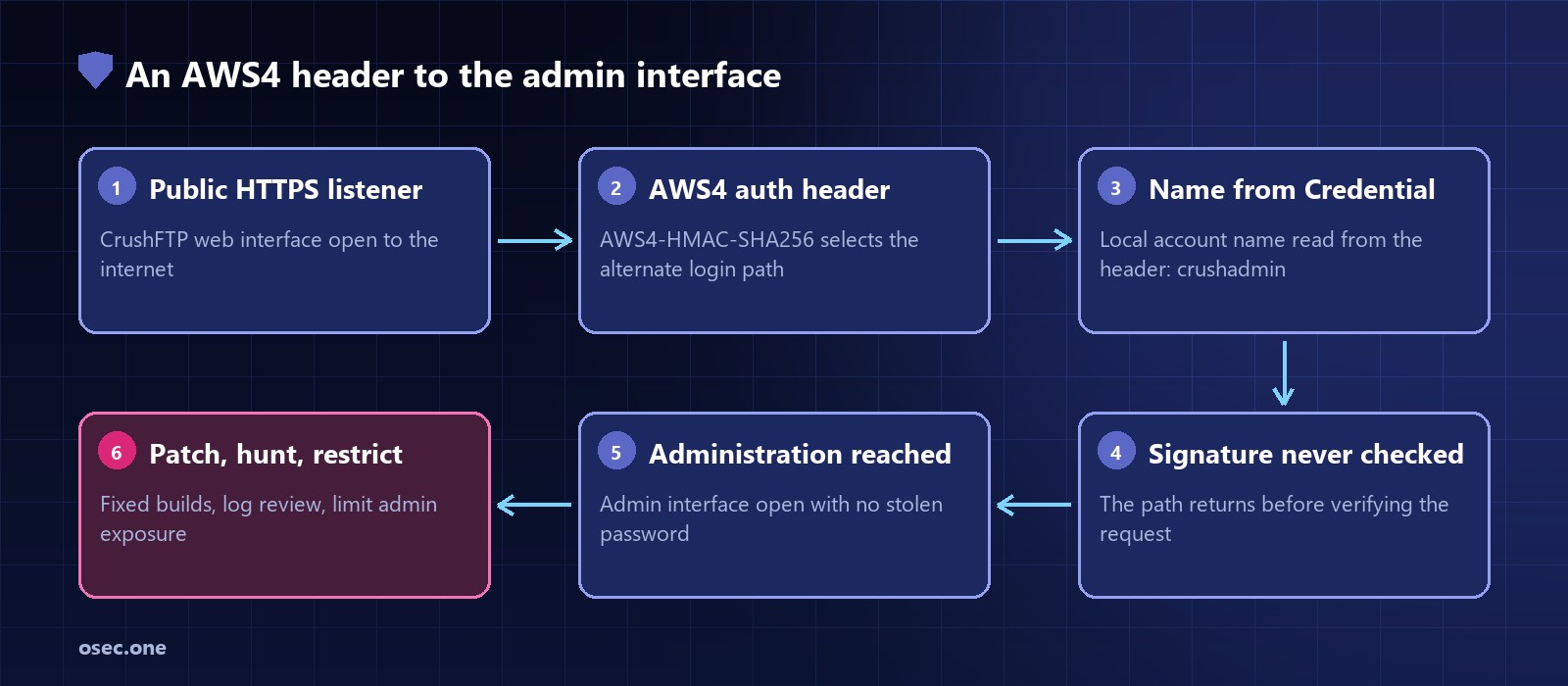
S3-compatible services commonly accept an AWS Signature Version 4 Authorization header. CrushFTP recognized that prefix and entered an S3-specific authentication route. Huntress documented the key condition: the code trusted the username-looking component of Credential= after the prefix, and malformed or incomplete signature handling could avoid the normal password validation. The result was an authenticated application context for a chosen valid local user, including the default administrative name in installations that still had it.
"},{"id":145752,"block_type":"html","html":"
Attack step
What failed
Control that breaks it
Reach HTTPS service
Administrative web interface reachable from any address
VPN or IP allowlist for administration; separate public transfer and admin listeners
Select S3 handler
Header prefix chooses a second auth path
Patch; disable unused S3-compatible access where product configuration permits
Name a local account
Identity parsed before proof of possession
Patch; remove or rename unused default accounts; least-privilege admin accounts
Obtain session
Invalid signature path accepts rather than rejects
Patch and hunt for unusual successful web admin sessions
Use admin access
Server and transfer data become a high-value foothold
Rotate service credentials and inspect jobs, users, events and configuration changes
The July issue was different, but the operating failure was familiar
"},{"id":145754,"block_type":"paragraph","html":"
CVE-2025-54309 was not a repeat of the AWS4 parser issue. CERT-EU and NHS England describe it as an AS2 validation problem: versions before 10.8.5 and 11.3.4_23, when the DMZ proxy feature was not used, could let a remote HTTPS attacker obtain administrator access. CrushFTP reported active exploitation from 18 July and said the vulnerable code was in builds from before roughly 1 July. The vendor said an enterprise DMZ instance in front of the main server was not believed affected. That is an isolation layer, not a reason to defer the update.
1. Remove public administration first. Restrict the management web UI to the VPN or named operator IPs. Keep a public transfer service only where it is genuinely required. 2. Record the exact build and update. For the two 2025 thresholds, do not stop at ‘11.3’. Install the vendor's current supported build, then record the version and time. 3. Preserve and search access logs. Look for AWS4 or AWS4-HMAC-SHA256, unexpected successful admin sessions, newly created users, changed permissions and transfers outside the normal schedule. The presence of AWS4 is a triage signal, not by itself proof of compromise. 4. Review the server as an identity boundary. Check scheduled jobs, event actions, plugins, user home directories, SSH/SFTP keys and external storage credentials. Rotate secrets that the server could read. 5. Rebuild trust. Reset administrator passwords, remove unneeded accounts, require MFA if the deployed edition and access path support it, and keep admin access off the transfer listener.
"},{"id":145757,"block_type":"paragraph","html":"
If your team keeps appliance and file-transfer versions in a spreadsheet, use the Firmware branch check to record whether a named branch is still inside a known-exploited range, then verify the result against the vendor advisory before scheduling work.
CrushFTP is a file-transfer perimeter problem, not a web-login story in isolation. Compare the public-facing application exposure here with Citrix Bleed 2023, where patching did not invalidate stolen sessions, and GoAnywhere MFT 2025, where a management component became ransomware access.
In March 2025, a request header associated with Amazon S3 authentication became a login shortcut in CrushFTP. CVE-2025-31161 did not need a stolen password: when the web server saw an AWS4-HMAC-SHA256 Authorization header, its alternate authentication path extracted a local account name from the Credential field and could return before verifying the request signature. Public analysis showed that a name such as crushadmin/… was enough to reach the administration interface on vulnerable servers. CISA added the issue to its Known Exploited Vulnerabilities catalog on 7 April.
\n
Ad
\n
The important lesson is not the header syntax. It is that a public file-transfer endpoint was allowed to choose an authentication implementation, and an error path treated an identity as authenticated. Four months later, CVE-2025-54309 gave attackers another route to administrator access through HTTPS on older builds that did not use CrushFTP's DMZ proxy. File-transfer products hold the files, account names and workflow credentials other systems need; they deserve the same exposure discipline as an identity gateway.
\n
\n
Two 2025 incidents, and where version 11.3.0 sits
\n
Date
Event
Practical meaning
21 Mar 2025
CrushFTP publishes 10.8.4 and 11.3.1 for CVE-2025-31161
11.3.0 is below the first fixed 11.x release.
7 Apr 2025
CISA adds CVE-2025-31161 to KEV
Treat it as an exploitation-response item, not ordinary patch debt.
About 1 Jul 2025
CrushFTP says the later AS2-related issue was fixed in current builds
Version numbers matter, not an assumption that March's patch covers July.
18 Jul 2025, 09:00 CST
Vendor first observes exploitation of CVE-2025-54309
Older HTTPS instances without a DMZ proxy need an incident review.
That makes the requested Firmware branch check example concrete: CrushFTP 11.3.0 is in range for both 2025 issues. It is below 11.3.1, the March fixed 11.x release, and below 11.3.4_23, the July threshold. A version check alone cannot establish compromise; it tells the operator which emergency branch applies.
\n
What the March bypass did — without reproducing it
\n
S3-compatible services commonly accept an AWS Signature Version 4 Authorization header. CrushFTP recognized that prefix and entered an S3-specific authentication route. Huntress documented the key condition: the code trusted the username-looking component of Credential= after the prefix, and malformed or incomplete signature handling could avoid the normal password validation. The result was an authenticated application context for a chosen valid local user, including the default administrative name in installations that still had it.
\n
Attack step
What failed
Control that breaks it
Reach HTTPS service
Administrative web interface reachable from any address
VPN or IP allowlist for administration; separate public transfer and admin listeners
Select S3 handler
Header prefix chooses a second auth path
Patch; disable unused S3-compatible access where product configuration permits
Name a local account
Identity parsed before proof of possession
Patch; remove or rename unused default accounts; least-privilege admin accounts
Obtain session
Invalid signature path accepts rather than rejects
Patch and hunt for unusual successful web admin sessions
Use admin access
Server and transfer data become a high-value foothold
Rotate service credentials and inspect jobs, users, events and configuration changes
\n
The July issue was different, but the operating failure was familiar
\n
CVE-2025-54309 was not a repeat of the AWS4 parser issue. CERT-EU and NHS England describe it as an AS2 validation problem: versions before 10.8.5 and 11.3.4_23, when the DMZ proxy feature was not used, could let a remote HTTPS attacker obtain administrator access. CrushFTP reported active exploitation from 18 July and said the vulnerable code was in builds from before roughly 1 July. The vendor said an enterprise DMZ instance in front of the main server was not believed affected. That is an isolation layer, not a reason to defer the update.
\n
A 60-minute response for an exposed server
\n
1. Remove public administration first. Restrict the management web UI to the VPN or named operator IPs. Keep a public transfer service only where it is genuinely required. 2. Record the exact build and update. For the two 2025 thresholds, do not stop at ‘11.3’. Install the vendor's current supported build, then record the version and time. 3. Preserve and search access logs. Look for AWS4 or AWS4-HMAC-SHA256, unexpected successful admin sessions, newly created users, changed permissions and transfers outside the normal schedule. The presence of AWS4 is a triage signal, not by itself proof of compromise. 4. Review the server as an identity boundary. Check scheduled jobs, event actions, plugins, user home directories, SSH/SFTP keys and external storage credentials. Rotate secrets that the server could read. 5. Rebuild trust. Reset administrator passwords, remove unneeded accounts, require MFA if the deployed edition and access path support it, and keep admin access off the transfer listener.
\n
If your team keeps appliance and file-transfer versions in a spreadsheet, use the Firmware branch check to record whether a named branch is still inside a known-exploited range, then verify the result against the vendor advisory before scheduling work.
\n
Related cases
\n
CrushFTP is a file-transfer perimeter problem, not a web-login story in isolation. Compare the public-facing application exposure here with Citrix Bleed 2023, where patching did not invalidate stolen sessions, and GoAnywhere MFT 2025, where a management component became ransomware access.
CrushFTP 2025: an S3 authorization header that logged attackers in as crushadmin
In March 2025, a request header associated with Amazon S3 authentication became a login shortcut in CrushFTP. CVE-2025-31161 did not need a stolen password: when the web server saw an AWS4-HMAC-SHA256 Authorization header, its alternate authentication path extracted a local account name from the Credential field and could return before verifying the request signature. Public analysis showed that a name such as crushadmin/… was enough to reach the administration interface on vulnerable servers. CISA added the issue to its Known Exploited Vulnerabilities catalog on 7 April.
Ad
The important lesson is not the header syntax. It is that a public file-transfer endpoint was allowed to choose an authentication implementation, and an error path treated an identity as authenticated. Four months later, CVE-2025-54309 gave attackers another route to administrator access through HTTPS on older builds that did not use CrushFTP's DMZ proxy. File-transfer products hold the files, account names and workflow credentials other systems need; they deserve the same exposure discipline as an identity gateway.
Two 2025 incidents, and where version 11.3.0 sits
Date
Event
Practical meaning
21 Mar 2025
CrushFTP publishes 10.8.4 and 11.3.1 for CVE-2025-31161
11.3.0 is below the first fixed 11.x release.
7 Apr 2025
CISA adds CVE-2025-31161 to KEV
Treat it as an exploitation-response item, not ordinary patch debt.
About 1 Jul 2025
CrushFTP says the later AS2-related issue was fixed in current builds
Version numbers matter, not an assumption that March's patch covers July.
18 Jul 2025, 09:00 CST
Vendor first observes exploitation of CVE-2025-54309
Older HTTPS instances without a DMZ proxy need an incident review.
That makes the requested Firmware branch check example concrete: CrushFTP 11.3.0 is in range for both 2025 issues. It is below 11.3.1, the March fixed 11.x release, and below 11.3.4_23, the July threshold. A version check alone cannot establish compromise; it tells the operator which emergency branch applies.
What the March bypass did — without reproducing it
S3-compatible services commonly accept an AWS Signature Version 4 Authorization header. CrushFTP recognized that prefix and entered an S3-specific authentication route. Huntress documented the key condition: the code trusted the username-looking component of Credential= after the prefix, and malformed or incomplete signature handling could avoid the normal password validation. The result was an authenticated application context for a chosen valid local user, including the default administrative name in installations that still had it.
Attack step
What failed
Control that breaks it
Reach HTTPS service
Administrative web interface reachable from any address
VPN or IP allowlist for administration; separate public transfer and admin listeners
Select S3 handler
Header prefix chooses a second auth path
Patch; disable unused S3-compatible access where product configuration permits
Name a local account
Identity parsed before proof of possession
Patch; remove or rename unused default accounts; least-privilege admin accounts
Obtain session
Invalid signature path accepts rather than rejects
Patch and hunt for unusual successful web admin sessions
Use admin access
Server and transfer data become a high-value foothold
Rotate service credentials and inspect jobs, users, events and configuration changes
The July issue was different, but the operating failure was familiar
CVE-2025-54309 was not a repeat of the AWS4 parser issue. CERT-EU and NHS England describe it as an AS2 validation problem: versions before 10.8.5 and 11.3.4_23, when the DMZ proxy feature was not used, could let a remote HTTPS attacker obtain administrator access. CrushFTP reported active exploitation from 18 July and said the vulnerable code was in builds from before roughly 1 July. The vendor said an enterprise DMZ instance in front of the main server was not believed affected. That is an isolation layer, not a reason to defer the update.
A 60-minute response for an exposed server
1. Remove public administration first. Restrict the management web UI to the VPN or named operator IPs. Keep a public transfer service only where it is genuinely required. 2. Record the exact build and update. For the two 2025 thresholds, do not stop at ‘11.3’. Install the vendor's current supported build, then record the version and time. 3. Preserve and search access logs. Look for AWS4 or AWS4-HMAC-SHA256, unexpected successful admin sessions, newly created users, changed permissions and transfers outside the normal schedule. The presence of AWS4 is a triage signal, not by itself proof of compromise. 4. Review the server as an identity boundary. Check scheduled jobs, event actions, plugins, user home directories, SSH/SFTP keys and external storage credentials. Rotate secrets that the server could read. 5. Rebuild trust. Reset administrator passwords, remove unneeded accounts, require MFA if the deployed edition and access path support it, and keep admin access off the transfer listener.
If your team keeps appliance and file-transfer versions in a spreadsheet, use the Firmware branch check to record whether a named branch is still inside a known-exploited range, then verify the result against the vendor advisory before scheduling work.
Related cases
CrushFTP is a file-transfer perimeter problem, not a web-login story in isolation. Compare the public-facing application exposure here with Citrix Bleed 2023, where patching did not invalidate stolen sessions, and GoAnywhere MFT 2025, where a management component became ransomware access.