The case is a useful correction to an easy assumption: an MFT server is not merely an encrypted mailbox. It often has a public listener, an administration layer, service accounts, automated jobs and reach into partner or internal storage. When an unauthenticated management bug becomes code execution, the MFT host must be handled as an internet-facing application server and a potential identity pivot.
Why a forged license response became code execution
"},{"id":146320,"block_type":"paragraph","html":"
Licensing systems commonly receive a signed object and verify it before reading its contents. The defect reversed the trust boundary: a forged signature could pass the License Servlet's validation stage, and the server then deserialized an object supplied by the requester. Java deserialization is risky because object construction can invoke application or library behavior during the read. The public advisories describe the result as command injection and potential remote code execution; this article deliberately does not provide an exploit payload or construction sequence.
"},{"id":146321,"block_type":"html","html":"
Layer
What Storm-1175 did
Defender check
Initial access
Exploited the License Servlet deserialization flaw
Confirm every console is on the vendor-fixed version and not internet-reachable unless unavoidable
Persistence
Dropped SimpleHelp and MeshAgent beneath the GoAnywhere MFT process; created JSP files
Baseline MFT directories; alert on new JSPs and RMM binaries executed by its service account
Discovery
Ran user/system commands and netscan
Look for command-shell children, netscan and unusual account/group enumeration
Movement and C2
Used mstsc.exe, RMM and a Cloudflare tunnel
Review new remote tools, services, scheduled tasks and outbound tunnelling destinations
Exfiltration/objective
Used Rclone in at least one victim; Medusa in one observed environment
Review archive creation, Rclone config/processes and large unusual outbound transfers
The first day: patching is necessary, not a clean bill of health
"},{"id":146323,"block_type":"paragraph","html":"
Microsoft explicitly notes that upgrading does not address prior exploitation. Treat the following as a contained incident workflow for a vulnerable, exposed system: 1. Preserve evidence and isolate deliberately. Save application, web and endpoint logs before rotating or rebuilding. Restrict the administration interface to a management network or VPN while transfer dependencies are mapped. 2. Upgrade to Fortra's current fixed release. Verify the installed build afterwards from the product's own console or package inventory, not only a change ticket. 3. Hunt the product tree and service context. Look for JSP files added in GoAnywhere directories, RMM binaries (Microsoft names SimpleHelp and MeshAgent), unfamiliar services and scheduled tasks. 4. Follow the observed path outward. Search endpoint telemetry for netscan, mstsc.exe, Rclone, newly created local administrators and tunnel tooling around the MFT service account's activity window. 5. Rotate what the MFT server could read. This includes local administrators, database/storage credentials, SFTP keys, partner credentials and any secrets in automated workflows. Rebuild the host if integrity cannot be established.
Partners may need a public transfer endpoint; they do not normally need a public administration console. Put transfer and management on separate interfaces or reverse-proxy rules, permit management only from a small allowlist, and inventory every hostname that can lead to the product. The osec Site protection scan is a harmless outside check for the WAF/CDN and header posture in front of a public hostname; it cannot prove an MFT console is safe or discover a private management address.
CrushFTP 2025 shows an authentication mistake turning a public file-transfer service into administration access. MOVEit Transfer 2023 is the larger reminder that automated transfer servers aggregate valuable partner data. The common defense is not one brand-specific setting: minimise exposed management surfaces, patch on an exploitation timeline, and assume the service account's reachable secrets are part of the blast radius.
"},{"id":146328,"block_type":"cta","html":"
Check what protection and security headers a public hostname actually exposes, without installing an agent or changing DNS.
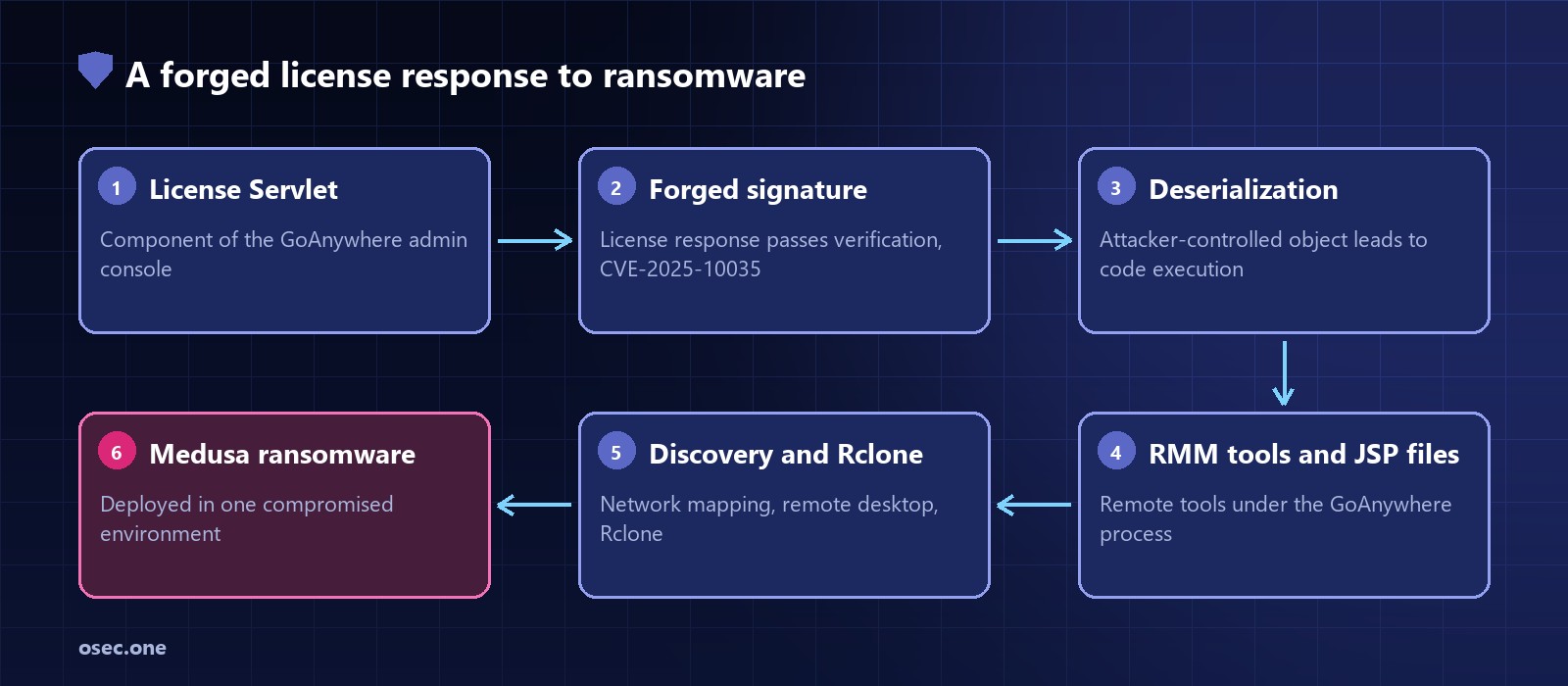
GoAnywhere MFT's 2025 incident began in a component that looks operational rather than dangerous: the License Servlet in its administration console. CVE-2025-10035, scored 10.0, allowed a forged license-response signature to bypass verification and reach deserialization of an attacker-controlled object. Microsoft says Storm-1175 was exploiting the zero-day on 11 September 2025; Fortra disclosed it on 18 September. Microsoft observed the group use the access to place remote-management tools under the GoAnywhere process, create JSP files, map networks, use remote desktop and Rclone, and deploy Medusa ransomware in one compromised environment.
\n
Ad
\n
The case is a useful correction to an easy assumption: an MFT server is not merely an encrypted mailbox. It often has a public listener, an administration layer, service accounts, automated jobs and reach into partner or internal storage. When an unauthenticated management bug becomes code execution, the MFT host must be handled as an internet-facing application server and a potential identity pivot.
\n
\n
What happened, dated
\n
When
Observed or published event
Why it matters
11 Sep 2025
Microsoft observes related activity
The exploitation preceded the public advisory by 7 days.
18 Sep 2025
Fortra publishes its advisory for CVE-2025-10035
Customers get the patch signal after the zero-day window.
6 Oct 2025
Microsoft publishes the Storm-1175 investigation
It records a full intrusion path rather than only a theoretical CVE impact.
2026 follow-up
Microsoft says Storm-1175 used CVE-2025-10035 one week before disclosure
External inventory and fast containment matter when a perimeter product is newly disclosed.
\n
Why a forged license response became code execution
\n
Licensing systems commonly receive a signed object and verify it before reading its contents. The defect reversed the trust boundary: a forged signature could pass the License Servlet's validation stage, and the server then deserialized an object supplied by the requester. Java deserialization is risky because object construction can invoke application or library behavior during the read. The public advisories describe the result as command injection and potential remote code execution; this article deliberately does not provide an exploit payload or construction sequence.
\n
Layer
What Storm-1175 did
Defender check
Initial access
Exploited the License Servlet deserialization flaw
Confirm every console is on the vendor-fixed version and not internet-reachable unless unavoidable
Persistence
Dropped SimpleHelp and MeshAgent beneath the GoAnywhere MFT process; created JSP files
Baseline MFT directories; alert on new JSPs and RMM binaries executed by its service account
Discovery
Ran user/system commands and netscan
Look for command-shell children, netscan and unusual account/group enumeration
Movement and C2
Used mstsc.exe, RMM and a Cloudflare tunnel
Review new remote tools, services, scheduled tasks and outbound tunnelling destinations
Exfiltration/objective
Used Rclone in at least one victim; Medusa in one observed environment
Review archive creation, Rclone config/processes and large unusual outbound transfers
\n
The first day: patching is necessary, not a clean bill of health
\n
Microsoft explicitly notes that upgrading does not address prior exploitation. Treat the following as a contained incident workflow for a vulnerable, exposed system: 1. Preserve evidence and isolate deliberately. Save application, web and endpoint logs before rotating or rebuilding. Restrict the administration interface to a management network or VPN while transfer dependencies are mapped. 2. Upgrade to Fortra's current fixed release. Verify the installed build afterwards from the product's own console or package inventory, not only a change ticket. 3. Hunt the product tree and service context. Look for JSP files added in GoAnywhere directories, RMM binaries (Microsoft names SimpleHelp and MeshAgent), unfamiliar services and scheduled tasks. 4. Follow the observed path outward. Search endpoint telemetry for netscan, mstsc.exe, Rclone, newly created local administrators and tunnel tooling around the MFT service account's activity window. 5. Rotate what the MFT server could read. This includes local administrators, database/storage credentials, SFTP keys, partner credentials and any secrets in automated workflows. Rebuild the host if integrity cannot be established.
\n
Exposure is an architectural decision
\n
Partners may need a public transfer endpoint; they do not normally need a public administration console. Put transfer and management on separate interfaces or reverse-proxy rules, permit management only from a small allowlist, and inventory every hostname that can lead to the product. The osec Site protection scan is a harmless outside check for the WAF/CDN and header posture in front of a public hostname; it cannot prove an MFT console is safe or discover a private management address.
\n
Why this belongs with the file-transfer cases
\n
CrushFTP 2025 shows an authentication mistake turning a public file-transfer service into administration access. MOVEit Transfer 2023 is the larger reminder that automated transfer servers aggregate valuable partner data. The common defense is not one brand-specific setting: minimise exposed management surfaces, patch on an exploitation timeline, and assume the service account's reachable secrets are part of the blast radius.
\n
Check what protection and security headers a public hostname actually exposes, without installing an agent or changing DNS.
GoAnywhere MFT 2025: a forged license response and Medusa ransomware
GoAnywhere MFT's 2025 incident began in a component that looks operational rather than dangerous: the License Servlet in its administration console. CVE-2025-10035, scored 10.0, allowed a forged license-response signature to bypass verification and reach deserialization of an attacker-controlled object. Microsoft says Storm-1175 was exploiting the zero-day on 11 September 2025; Fortra disclosed it on 18 September. Microsoft observed the group use the access to place remote-management tools under the GoAnywhere process, create JSP files, map networks, use remote desktop and Rclone, and deploy Medusa ransomware in one compromised environment.
Ad
The case is a useful correction to an easy assumption: an MFT server is not merely an encrypted mailbox. It often has a public listener, an administration layer, service accounts, automated jobs and reach into partner or internal storage. When an unauthenticated management bug becomes code execution, the MFT host must be handled as an internet-facing application server and a potential identity pivot.
What happened, dated
When
Observed or published event
Why it matters
11 Sep 2025
Microsoft observes related activity
The exploitation preceded the public advisory by 7 days.
18 Sep 2025
Fortra publishes its advisory for CVE-2025-10035
Customers get the patch signal after the zero-day window.
6 Oct 2025
Microsoft publishes the Storm-1175 investigation
It records a full intrusion path rather than only a theoretical CVE impact.
2026 follow-up
Microsoft says Storm-1175 used CVE-2025-10035 one week before disclosure
External inventory and fast containment matter when a perimeter product is newly disclosed.
Why a forged license response became code execution
Licensing systems commonly receive a signed object and verify it before reading its contents. The defect reversed the trust boundary: a forged signature could pass the License Servlet's validation stage, and the server then deserialized an object supplied by the requester. Java deserialization is risky because object construction can invoke application or library behavior during the read. The public advisories describe the result as command injection and potential remote code execution; this article deliberately does not provide an exploit payload or construction sequence.
Layer
What Storm-1175 did
Defender check
Initial access
Exploited the License Servlet deserialization flaw
Confirm every console is on the vendor-fixed version and not internet-reachable unless unavoidable
Persistence
Dropped SimpleHelp and MeshAgent beneath the GoAnywhere MFT process; created JSP files
Baseline MFT directories; alert on new JSPs and RMM binaries executed by its service account
Discovery
Ran user/system commands and netscan
Look for command-shell children, netscan and unusual account/group enumeration
Movement and C2
Used mstsc.exe, RMM and a Cloudflare tunnel
Review new remote tools, services, scheduled tasks and outbound tunnelling destinations
Exfiltration/objective
Used Rclone in at least one victim; Medusa in one observed environment
Review archive creation, Rclone config/processes and large unusual outbound transfers
The first day: patching is necessary, not a clean bill of health
Microsoft explicitly notes that upgrading does not address prior exploitation. Treat the following as a contained incident workflow for a vulnerable, exposed system: 1. Preserve evidence and isolate deliberately. Save application, web and endpoint logs before rotating or rebuilding. Restrict the administration interface to a management network or VPN while transfer dependencies are mapped. 2. Upgrade to Fortra's current fixed release. Verify the installed build afterwards from the product's own console or package inventory, not only a change ticket. 3. Hunt the product tree and service context. Look for JSP files added in GoAnywhere directories, RMM binaries (Microsoft names SimpleHelp and MeshAgent), unfamiliar services and scheduled tasks. 4. Follow the observed path outward. Search endpoint telemetry for netscan, mstsc.exe, Rclone, newly created local administrators and tunnel tooling around the MFT service account's activity window. 5. Rotate what the MFT server could read. This includes local administrators, database/storage credentials, SFTP keys, partner credentials and any secrets in automated workflows. Rebuild the host if integrity cannot be established.
Exposure is an architectural decision
Partners may need a public transfer endpoint; they do not normally need a public administration console. Put transfer and management on separate interfaces or reverse-proxy rules, permit management only from a small allowlist, and inventory every hostname that can lead to the product. The osec Site protection scan is a harmless outside check for the WAF/CDN and header posture in front of a public hostname; it cannot prove an MFT console is safe or discover a private management address.
Why this belongs with the file-transfer cases
CrushFTP 2025 shows an authentication mistake turning a public file-transfer service into administration access. MOVEit Transfer 2023 is the larger reminder that automated transfer servers aggregate valuable partner data. The common defense is not one brand-specific setting: minimise exposed management surfaces, patch on an exploitation timeline, and assume the service account's reachable secrets are part of the blast radius.
Check what protection and security headers a public hostname actually exposes, without installing an agent or changing DNS.