

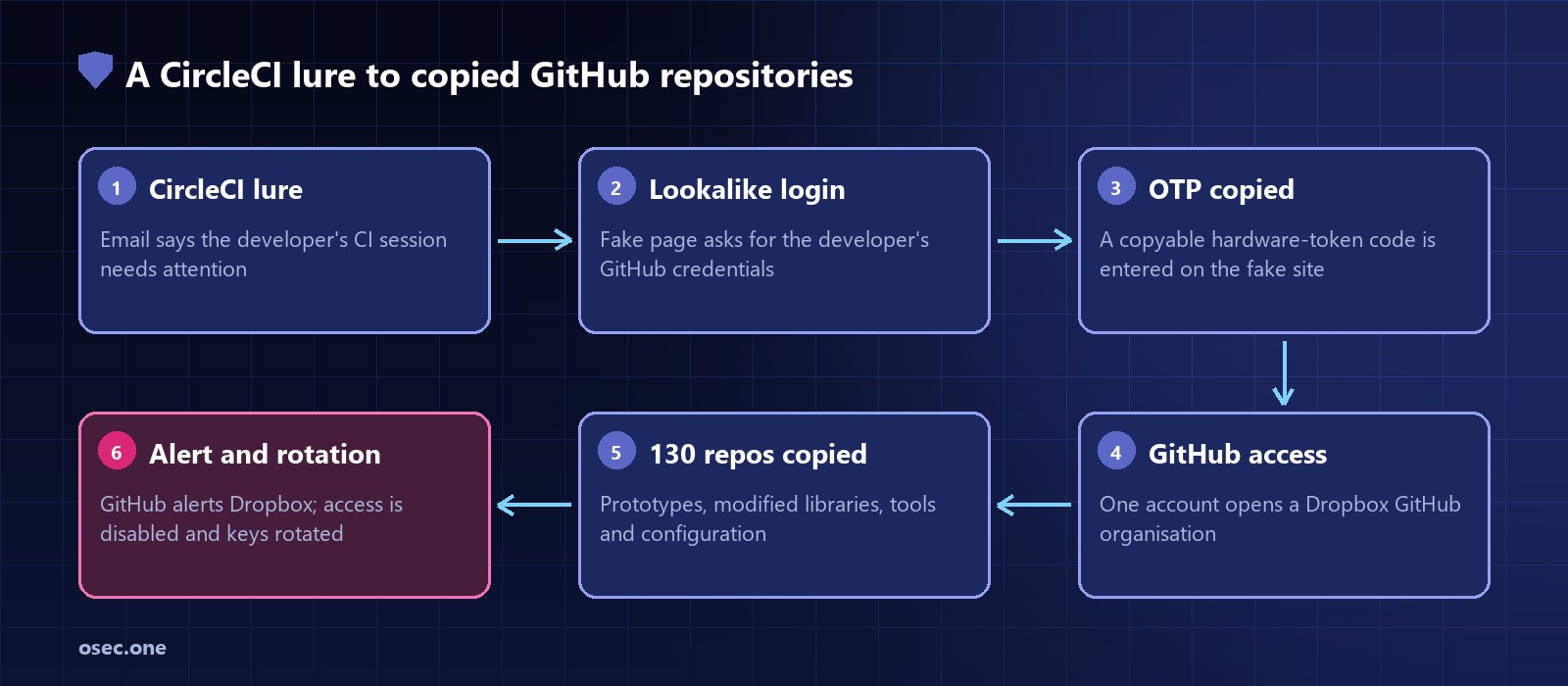
On 13 October 2022, someone got into a Dropbox developer's GitHub account after a phishing email pretended to come from CircleCI. The fake page collected the developer's GitHub password and a one-time code. The attacker then opened one Dropbox GitHub organisation and copied 130 repositories.
This was not the January 2023 CircleCI breach. CircleCI itself was not breached here. Its name was the bait: developers already expected GitHub and CircleCI to connect, so a request to sign back in looked ordinary.
What happened, dated
| When (2022) | What happened | What we know |
|---|---|---|
| 16 Sep | GitHub learns of a CircleCI-themed phishing campaign | It targets GitHub passwords and two-factor codes across multiple organisations |
| Early Oct | Several Dropbox employees receive the lure | Some messages are quarantined; others reach inboxes |
| 13 Oct | Suspicious activity begins | A phished account reaches one Dropbox GitHub organisation |
| 14 Oct | GitHub alerts Dropbox | Dropbox disables the attacker's access that day and starts rotating exposed developer credentials |
| 1 Nov | Dropbox publishes its incident account | 130 repositories copied; no Dropbox user files, passwords or payment details reached |
The public dates give a detection window of no more than about one day at date resolution: activity on 13 October, alert on 14 October. Exact times were not published, so a more precise number would be invented.
The login trick
- The email looked as if it came from CircleCI. GitHub's warning showed versions claiming that a CircleCI session had expired.
- The link opened a lookalike login and asked for GitHub credentials. That made sense to the victim because GitHub accounts could be used to sign in to CircleCI.
- The page then asked for a one-time password from a hardware authentication key. Dropbox described a copyable OTP, not a WebAuthn assertion.
- The attacker used the password and fresh code before it expired, then used the victim's existing repository access.
A hardware token is not automatically phishing-resistant
| Second factor | What the user gives the site | Can a lookalike relay it? |
|---|---|---|
| OTP hardware token | A short number the user can copy | Yes. The attacker can submit the same fresh number to GitHub |
| Authenticator-app TOTP | A short number the user can copy | Yes. GitHub documented real-time relay in this campaign |
| WebAuthn / FIDO2 key or passkey | A signature bound to the real site's origin | No for this lookalike-domain flow. A signature for the fake origin is rejected by GitHub |
That distinction explains what can look like a contradiction. Dropbox said a hardware key was used, but also moved faster toward WebAuthn after the incident. The old flow produced a code a person could type anywhere. WebAuthn makes the browser and key check the site name.
What 130 repositories exposed — and what they did not
| Reached | Not reached, according to Dropbox |
|---|---|
| 130 repositories in one GitHub organisation | Dropbox user file contents |
| Modified copies of third-party libraries | Customer passwords |
| Internal prototypes | Payment information |
| Security-team tools and configuration | Core app and infrastructure source repositories |
| Developer credentials, mainly API keys | Evidence that exposed credentials were successfully abused |
| A few thousand names and email addresses across employees, customers, leads and vendors | An exact affected-person count; Dropbox did not publish one |
The 130 is a count of repositories copied. Dropbox did not publish its total repository count, so it cannot honestly be turned into a percentage. It also said only “a few thousand” names and email addresses; reports that turn that into a precise number go beyond the primary disclosure.
The control that breaks each step
| Attack step | Control | What to verify |
|---|---|---|
| CircleCI-themed email reaches a developer | Mail filtering plus an in-product notice for real account changes | CircleCI mail links only to circleci.com subdomains and does not ask for login to review terms |
| Password entered on a lookalike | Password-manager autofill restricted to the saved origin | No autofill on an unfamiliar domain is a stop signal, not a reason to paste manually |
| OTP relayed | Require WebAuthn/passkeys for GitHub organisation access | Remove SMS, TOTP and copyable hardware OTP as fallback paths where policy allows |
| Account opened | Alert on new PATs, OAuth grants, SSH keys and unusual repository cloning | Audit the account immediately; GitHub saw attackers add durable credentials in this campaign |
| Repositories copied | Least privilege and separate organisations for high-impact code | A normal developer account cannot read every private repository |
| Keys found in code | Keep secrets out of git; use short-lived workload identity | Secret scanning is clean and every exposed key has an owner and rotation runbook |
If a developer entered credentials on a suspicious page
1. Disable or suspend the account first. Do not wait for a password reset to finish while repository access remains live.
2. Reset the password and recovery codes. Enrol a WebAuthn key or passkey before restoring access.
3. Remove persistence. Review personal access tokens, OAuth applications, SSH and GPG keys, email addresses and organisation membership.
4. Check the audit trail. Look for private-repository clones, archive downloads, new credentials and access from VPN or proxy addresses.
5. Rotate what the repositories contained. Start with production-capable API keys, deploy keys, signing material and CI credentials. Treat git history as exposed, not just the current branch.
6. Split the blast radius. Remove repository access the person does not need and move high-impact release paths behind separate approval.
Repository access is only half the supply-chain path. Paste a public GitHub repository into the osec Workflow risk check to find dangerous pull-request triggers, write-wide permissions and unpinned actions before they reach a release.
Check a GitHub workflowRelated cases
- CircleCI 2023: a session cookie from an engineer's laptop, and every customer told to rotate every secret — malware stole a valid employee session inside CircleCI itself.
- 0ktapus 2022: text-message phishing that collected Okta logins and codes at Twilio, and why Cloudflare's security keys held — the same lesson about copyable codes versus origin-bound WebAuthn.
Sources: Dropbox Security Team: How we handled a recent phishing incident that targeted Dropbox (1 November 2022); GitHub Security: Security alert — new phishing campaign targets GitHub users (21 September 2022, updated 29 September); CircleCI: CircleCI remains secure; be vigilant and aware of phishing attempts for your credentials (31 October 2022).