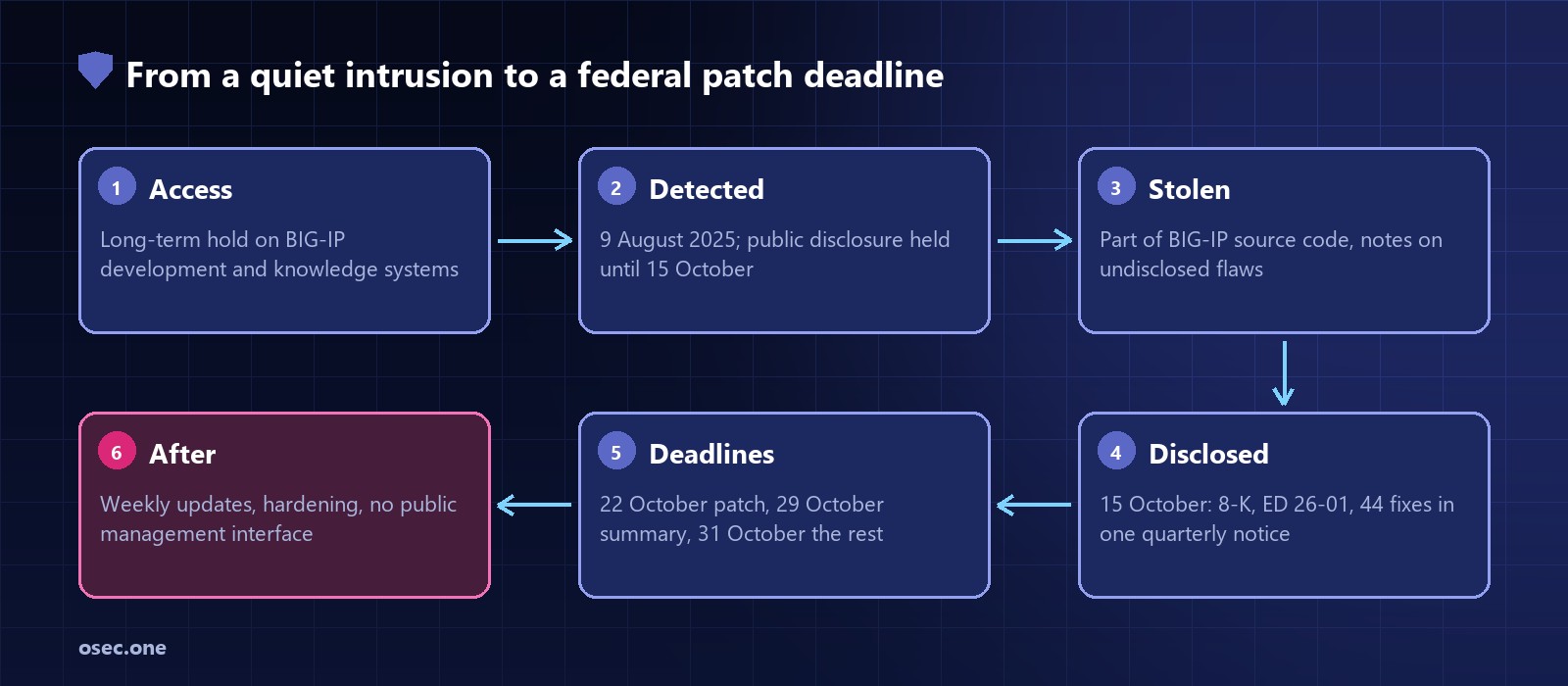
On 15 October 2025, F5 told the world that a nation-state hacker had been inside its network for a long time and had walked out with part of the BIG-IP source code and notes on flaws F5 had not yet fixed. F5 had known since 9 August. The same day, CISA put out Emergency Directive 26-01, which gave US federal agencies 7 days to patch every F5 device they ran. The 7 days are the useful bit: they show what a vendor breach costs the people who bought the product.
This is the case in dates and numbers: what F5 says was taken, what it says was not touched, what the directive asked for and by when, which of the October fixes were the headline ones, and a checklist you can follow if you run a BIG-IP, or any appliance that sits at the edge of your network. No exploit built from the stolen data had been reported when this was written, so this is not an exploit story. It is a story about a gap in time.
The dated timeline
| Date | Event | Source |
|---|---|---|
| Before 9 August 2025 | The intruder is in F5's network. Press reports (Bloomberg, via The Hacker News) say for at least 12 months. F5 itself says only "long-term, persistent access". | The Hacker News; Zscaler |
| 9 August 2025 | F5 detects the activity. | F5 8-K as quoted by Zscaler and The Hacker News |
| 12 September 2025 | The US Department of Justice decides a public delay is warranted (one secondary source gives this date; the 8-K itself was not read). | Safeguard |
| 25 September 2025 | Google's Mandiant publishes its BRICKSTORM report on the same kind of intruder: an average of 393 days undetected, aimed at appliances that cannot run endpoint detection. It does not mention F5. | Google Cloud / GTIG |
| 15 October 2025 | F5 files its 8-K and publishes the disclosure and its Quarterly Security Notification. CISA publishes ED 26-01. | CISA; Lowenstein; Bitsight |
| 22 October 2025 | Deadline to update F5OS, BIG-IP TMOS, BIG-IQ and BNK/CNF. | CISA ED 26-01 |
| 29 October 2025, 23:59 ET | Deadline to report a summary of F5 products in scope to CISA. | CISA ED 26-01 |
| 31 October 2025 | Deadline to update everything else and apply F5's hardening guidance. | CISA ED 26-01 |
| 3 December 2025, 23:59 ET | Deadline for a detailed inventory of every instance. | CISA ED 26-01 |
| 1 March 2026 | CISA reports status across agencies to the Secretary of Homeland Security, the National Cyber Director, OMB and the federal CIO and CISO. | CISA ED 26-01 |
The 8-K wording and F5's own incident pages could not be read for this article (the F5 pages needed a browser session). F5 facts below are what CISA's directive says, plus what several security firms and a law firm quoted from F5. Where they disagree, we say so.
The numbers: how long each window was
| Interval | Days | Why it matters |
|---|---|---|
| 9 August (detected) to 15 October (disclosed) | 67 | Customers did not know for over two months. F5 says the delay followed a request from the US Department of Justice. |
| 15 October to 22 October (first patch deadline) | 7 | A federal agency had one week to find every F5 device and move it to a current release. |
| 15 October to 29 October (summary report) | 14 | Two weeks to know what you own. |
| 15 October to 31 October (everything else) | 16 | Hardening guidance applied to the rest. |
| 15 October to 3 December (detailed inventory) | 49 | Seven weeks to list every instance. |
| Fixes in the quarterly notice: 6 the quarter before, 44 on 15 October | 7.3x | About seven times the previous quarter (Zscaler gives 44 and 6; Unit 42 counted 45). |
The day counts are our arithmetic from the dates above. One thing to notice in the 7-day window: the patch deadline is before the inventory deadline. Agencies were told to patch what they knew about and finish counting later. If you do not know what you run, you cannot be inside that window.
What F5 says was stolen, and what it says was not
| Taken (per F5 and CISA) | Not accessed or not changed (per F5 and the reviewers) |
|---|---|
| Files from the BIG-IP product development environment and an engineering knowledge system | CRM, financial and support case management systems, and iHealth |
| Portions of BIG-IP source code | No evidence of changes to the source repositories, the build and release pipelines or the supply chain (reviews by NCC Group and IOActive, as reported by Zscaler; scope and method not published in anything we read) |
| Information about vulnerabilities F5 had found but not yet disclosed | NGINX source and development environment; F5 Distributed Cloud Services and Silverline (Zscaler, Safeguard) |
| Configuration or implementation data for "a small percentage of customers" (later described by F5's CISO as mostly internal notes about customer conversations, per Safeguard) | Customer databases (Lowenstein) |
CISA's own text is shorter: a nation-state affiliated actor "compromised F5's systems and exfiltrated files, which included a portion of its BIG-IP source code and vulnerability information." F5 has not named a country or a group. Bloomberg-sourced reporting points to UNC5221 and the BRICKSTORM backdoor, but that link comes from the press, not from F5. Treat it as a likely guess.
Why source code and bug notes matter more than a stolen database
- The attacker can read, not guess. With the code, finding a flaw is reading, not fuzzing. Mandiant's own description of this actor's habit is stealing source code from tech companies to find exploitable bugs in their products.
- The notes are a shortcut. A list of known-but-unfixed bugs is a to-do list. Each one becomes a patch F5 must ship, and each patch is a hint to everybody else about where to look.
- The product is built to face the internet. A BIG-IP terminates TLS, load-balances and often does the sign-in for the apps behind it. A flaw in it is a flaw in front of everything.
- It cannot run endpoint security. Mandiant's BRICKSTORM report says this actor targets "appliances that do not support traditional endpoint detection and response (EDR) tools". There is no agent on the BIG-IP to tell you.
What F5 shipped on 15 October
F5's Quarterly Security Notification that day carried 44 new vulnerabilities across products (Unit 42 counted 45), against 6 in the quarter before. We could not read the full list. These are the named ones that the sources agree on:
| CVE | CVSS | Product and issue | Source |
|---|---|---|---|
| CVE-2025-53868 | 8.7 | BIG-IP SCP and SFTP authentication bypass | Lowenstein; Zscaler |
| CVE-2025-61955 | 8.8 | F5OS privilege escalation | Lowenstein; Zscaler |
| CVE-2025-57780 | 8.8 | F5OS privilege escalation | Lowenstein; Zscaler |
| CVE-2025-60016 | 8.7 | BIG-IP SSL/TLS information leak (fixed from 17.1.2); Zscaler links it to CISA's "cookie leakage" wording, which is Zscaler's inference | Zscaler |
| CVE-2025-48008 | 8.7 | MPTCP denial of service | Zscaler |
No source we read said any of these came from the stolen notes, and F5 has not said so. Do not read the table as a list of "the leaked bugs". It is the list of the loudest fixes in the same notice.
A year later one more fix shows why the rule is "update on release, not on rumour". Safeguard reports that in late March 2026 F5 changed CVE-2025-53521, a BIG-IP APM bug fixed in October 2025, from a denial of service (CVSS 7.5) to remote code execution (9.8), and that it was then added to CISA's known-exploited list after exploitation. The same source says no public report ties it to the stolen data. We include it as a lesson about re-scoring, not as proof of a link.
What the directive asked agencies to do
ED 26-01 binds only US federal civilian agencies. For everybody else it is a very good checklist, because CISA wrote down the order of work:
1. Inventory first. Find every BIG-IP hardware box (iSeries, rSeries and anything out of support) and every instance of F5OS, TMOS, Virtual Edition, BIG-IP Next, BIG-IQ and BNK/CNF.
2. Find the public management interfaces. For each device, is the management interface reachable from the internet? If yes, treat it as an exposure and report it.
3. Check the download first. Validate F5's published MD5 checksums before installing an update.
4. Patch by 22 October for F5OS, TMOS, BIG-IQ and BNK/CNF, and by 31 October for the rest, together with F5's hardening guidance.
5. Keep up. After that, apply every new vendor release within one week.
6. Retire the old. Public-facing devices that are past end of support are to be disconnected and decommissioned. If one is mission-critical, report it and write a decommissioning plan.
7. Expect cookie follow-up. CISA said it would tell agencies if session cookie leakage needed extra mitigation.
Checklist if you run a BIG-IP or any edge appliance
1. List what you have. Model, software version, where it sits, who patches it, whether its end-of-support date has passed. A spreadsheet is fine. If it takes you more than a day, you have found the real problem.
2. Take the management interface off the internet. Put it on a management network or behind a VPN or jump host. This was the one thing CISA asked every agency to check, and it is the cheapest control on the page.
3. Update to a current release on a supported branch. Safeguard lists F5's fixed releases as 17.5.1.3, 17.1.3, 16.1.6.1 and 15.1.10.8 and calls them a floor, so read F5's own advisory for your branch, not a table from a third party.
4. Run F5's hardening checks. F5 pointed customers to its hardening guidance and to automated checks in iHealth on a fresh QKView. A QKView is the support snapshot of the box and holds config, so share it only with F5 support.
5. Send the logs somewhere else. Turn on event streaming to a SIEM or a syslog server, then alert on admin logins, failed authentications and configuration changes. Lowenstein and Safeguard give the same three categories. If the box is quietly owned, local logs are the first thing an intruder tidies.
6. Hunt, since there is no EDR. Mandiant's BRICKSTORM post suggests: start from an asset inventory, scan files and backups with its YARA rules or its scanner script for *nix appliances, look at the appliance's own outbound traffic to the internet, and look for appliance-to-Windows logins and new local accounts or SSH being turned on. A load balancer that opens connections to the internet on its own is worth an hour.
7. Rotate what the box holds. Certificate private keys, service-account passwords for LDAP and APM, API tokens. This is the step people skip, and some customers' config details were in the stolen data.
8. Set the update clock. CISA's rule was one week from vendor release. A small team may not hit that every time. Pick a number (for example 7 days for critical or exploited, 30 for the rest), write it down, and measure the last three updates against it.
Controls that break each step
| Step the attacker needs | Control | How to check it |
|---|---|---|
| Reach the management interface | Management on a private network or VPN only | Probe your public addresses on the management port from outside; it must not answer |
| Use a bug found in the code | Update within a week of release; supported branch only | Compare the running version with F5's advisory for your branch |
| Stay hidden on a box with no EDR | Off-box logs, outbound allow-list for the appliance, periodic scanner run | Does the SIEM show the admin login from yesterday? Does the box have an internet route it does not need? |
| Use stolen config details | Rotate keys, passwords and tokens held on the box | Date of the last rotation per item |
| Rely on an unsupported box | Decommission or isolate end-of-support hardware | Inventory column: end-of-support date, with an owner |
The same pattern is behind ArcaneDoor on Cisco firewalls and CitrixBleed 2: a device at the edge, no agent on it, and a customer who finds out from somebody else. The F5 case adds that the warning can come before the exploit. For what a visitor sees in front of your own public web tier, the free osec site protection check shows it from the outside. The osec Firmware branch check does not cover F5 products yet, so use F5's own advisory pages for BIG-IP.
Key takeaways
1. The most useful 7 days in the story are the ones CISA gave. Know what you run, because you will not get long.
2. A vendor breach is your incident too. 67 days passed between F5 finding the intrusion and customers being told; a list of what you run turns that into a work plan instead of a scramble.
3. No agent on the box means you watch it from outside. Logs elsewhere, outbound limits, a hunt now and then.
4. Do not wait for the exploit. The directive moved before any exploit built from the theft was reported.
Edge devices fall when a login is stolen or a bug is found. osec.one gives your own apps passwordless sign-in with email codes and Apple/Google, so there is no password on your side to steal and replay.
See passwordless sign-inSources: CISA: ED 26-01, Mitigate Vulnerabilities in F5 Devices (15 October 2025); The Hacker News: F5 breach exposes BIG-IP source code; Lowenstein Sandler client alert (21 October 2025); Zscaler: F5 security incident advisory; Bitsight: source code theft at F5; Safeguard: F5 breach, one year on (22 October 2026); Google Cloud / GTIG: Another BRICKSTORM (25 September 2025). F5's own incident pages and the 8-K were not readable when this was written, so figures attributed to them come from the sources above. Day counts are our arithmetic.