The proposed way in needs the same care. Hudson Rock said an infostealer infected the computer of a person employed at retail analytics vendor Robling, and that it held credentials for Hot Topic and Torrid services on Snowflake and Looker. The attacker separately claimed the way in was a Snowflake account without MFA. Hudson Rock said its evidence does not conclusively prove how the companies were hacked, and Hot Topic did not publicly confirm a root cause in the contemporaneous reports. This analysis therefore keeps three labels throughout: validated dataset, reported path, and attacker claim.
"},{"id":146364,"block_type":"screenshot","html":"The first two steps are Hudson Rock's reporting; the login and the 350 million figure are attacker claims; the final email count was validated by HIBP."},{"id":146365,"block_type":"heading_h2","html":"
What is supported, and at what level
"},{"id":146366,"block_type":"paragraph","html":"
| Evidence level | Finding | What it does not prove | |---|---|---| | Validated dataset | HIBP added 56,904,909 unique email addresses on 11 November 2024 and listed names, physical addresses, phone numbers, purchases, genders, dates of birth, salutations and partial payment-card data. | It is not a count of rows, purchases or necessarily distinct people. | | Reported path | Hudson Rock said a person employed at Robling was infected on 12 September 2024, with Hot Topic and Torrid credentials for Snowflake and Looker on the computer. The actor sent WIRED/404 Media a developer's Snowflake credentials; Hudson Rock said it received the same set. | It is not a company-confirmed forensic root cause, and no source says the computer was personal or unmanaged or names the stealer. | | Attacker claim | The actor advertised 350 million records covering Hot Topic, BoxLunch and Torrid, initially for $20,000, and reportedly demanded $100,000 to withhold the data. The actor also said they logged in on 20 October and told Hudson Rock a Snowflake account lacked MFA. | It does not establish 350 million customers, accounts or people, or that the login or the missing MFA happened as described. |
A six-to-one mismatch, not six records per customer
"},{"id":146368,"block_type":"paragraph","html":"
A mechanical comparison gives 350,000,000 ÷ 56,904,909 = 6.15 claimed rows for each validated unique email address. That calculation is useful only because it shows why the labels matter. It is not an estimate of records per customer: one person can use several email addresses, one email can occur in purchases and address records many times, and the 350 million numerator was never independently validated.
Rows, accounts, email addresses and people answer different questions. A large database can contain many rows about one person; a deduplicated email count can still contain more than one address for that person.
• 12 September 2024 — reported infection: Hudson Rock dates the infection of the Robling-employed person's computer to this day. • 19 October — validated-dataset date: HIBP dates the breach to 19 October. • 20 October — attacker claim: the actor told WIRED/404 Media they logged in to a server and took the data. • 21 October — attacker listing: the dataset was advertised on a breach forum as 350 million records. • 23 October — reported path published: Hudson Rock published the Robling attribution and the actor's no-MFA claim. • 4 November — credentials reported: WIRED/404 Media reported the actor's developer credentials in a wider investigation of the infostealer trade. • 11 November — validation milestone: HIBP added 56,904,909 unique email addresses and began notifying subscribers. • 13 November — follow-up reporting: TechCrunch reported the dataset fields, Hudson Rock's infostealer theory and a later $3,500 sale listing.
HIBP's entry lists email addresses, names, physical addresses, phone numbers, purchases, genders, dates of birth and salutations. It also lists partial card data: card type, expiry and the last four digits. Partial card details cannot normally authorize a payment by themselves, but combined with a name, address, purchase history and date of birth they make a convincing customer-service or delivery-themed phishing call.
"},{"id":146374,"block_type":"paragraph","html":"
The breach therefore created two problems. The direct one is privacy loss across contact, demographic and purchase data. The secondary one is impersonation: a caller can quote a real recent purchase and the last four digits, then ask the customer to 'verify' the rest. Incident notices should warn about that exact script, not just advise people to change a password that may not have been in this dataset.
How the reported vendor path fits the wider Snowflake campaign
"},{"id":146376,"block_type":"paragraph","html":"
The Hot Topic-specific path is attributed reporting, but the control failure is independently plausible. In June 2024 Mandiant described UNC5537 intrusions into Snowflake customer instances using credentials previously stolen by infostealers. Some infections were on contractor systems used for both work and personal activity; many accounts lacked MFA and network policies. Snowflake's joint update said the campaign relied on compromised customer credentials rather than a vulnerability or breach of the Snowflake platform.
"},{"id":146377,"block_type":"paragraph","html":"
Our overall Snowflake case analysis follows that campaign across 165 potentially exposed organisations. The Hot Topic evidence narrows the question: what should a company do when a vendor identity can reach production data? The Okta/Lapsus$ contractor case shows the same blast-radius problem from a different route: the customer owns the data, but a third party owns the endpoint and support workflow.
| Attack step | Control that breaks it | Evidence to retain | |---|---|---| | A vendor worker's computer is infected | Issue a managed work device or hardened VDI; keep production administration out of personal browser profiles. | EDR events, device compliance and software inventory | | A reusable password leaves the device | Put human Snowflake users behind federated SSO and phishing-resistant MFA; disable password-only local users. | Identity-provider sign-ins and factor changes | | Stolen credentials work from anywhere | Restrict warehouse access to contractor VPN or VDI egress addresses with network policies. | Source IP, client and network-policy decisions | | One vendor identity reaches too much | Give every contractor an individual, least-privilege, time-bounded identity; mask payment fields and limit views. | Role grants, query history and entitlement reviews | | Large exports look like normal analyst work | Alert on new countries, unfamiliar clients, unusual query volume, new stages and bulk downloads. | Login, query, stage and object-access history | | Malware is removed but stolen data remains usable | Rotate passwords, revoke sessions and tokens, and scope every system the identity could access. | Revocation time, credential versions and downstream audit logs |
1. Inventory the access before the person starts. Name the warehouse, role, datasets, expiry date, manager and vendor. 2. Provide the path, not just a policy. A managed laptop or VDI is enforceable; a PDF saying 'do not install games' is not. 3. Separate the browser profile and identity. Work SSO should exist only inside the managed environment. 4. Require SSO, phishing-resistant MFA and known egress addresses together. Each control covers a different failure. 5. Review access quarterly and at every contract change. Remove dormant local users and shared vendor accounts. 6. Treat an infostealer alert as credential compromise. Isolate the device, but also revoke sessions and rotate every credential present on it. 7. Preserve logs before disabling the identity. Login, query and export history are what define the affected data. 8. Rehearse vendor offboarding. Contract end should trigger identity expiry, device return, token revocation and an access review on the same day.
"},{"id":146382,"block_type":"paragraph","html":"
If your own site signs people in with osec Auth, Login Protection can limit sign-in codes per email and per IP, limit wrong codes per IP, and restrict IP addresses and email domains. It does not secure Snowflake, inspect vendor computers or replace SSO, MFA and network policy. Its place is the website login at the edge of this story, not the data warehouse.
"},{"id":146383,"block_type":"cta","html":"
Set sign-in limits and IP or email-domain rules for your own site with osec Login Protection. For data warehouses, use the managed-device, SSO, MFA and network-policy controls above.
Three numbers circulated after the Hot Topic breach in October 2024: 350 million records, 57 million people, and 56,904,909 unique email addresses. They are not interchangeable. The first was an attacker's claim about database rows. The last is the count Have I Been Pwned (HIBP) says it found after processing the dataset. Calling all 350 million rows customers would turn an unverified sales pitch into a fact.
\n
Ad
\n
The proposed way in needs the same care. Hudson Rock said an infostealer infected the computer of a person employed at retail analytics vendor Robling, and that it held credentials for Hot Topic and Torrid services on Snowflake and Looker. The attacker separately claimed the way in was a Snowflake account without MFA. Hudson Rock said its evidence does not conclusively prove how the companies were hacked, and Hot Topic did not publicly confirm a root cause in the contemporaneous reports. This analysis therefore keeps three labels throughout: validated dataset, reported path, and attacker claim.
\n
The first two steps are Hudson Rock's reporting; the login and the 350 million figure are attacker claims; the final email count was validated by HIBP.
\n
What is supported, and at what level
\n
| Evidence level | Finding | What it does not prove | |---|---|---| | Validated dataset | HIBP added 56,904,909 unique email addresses on 11 November 2024 and listed names, physical addresses, phone numbers, purchases, genders, dates of birth, salutations and partial payment-card data. | It is not a count of rows, purchases or necessarily distinct people. | | Reported path | Hudson Rock said a person employed at Robling was infected on 12 September 2024, with Hot Topic and Torrid credentials for Snowflake and Looker on the computer. The actor sent WIRED/404 Media a developer's Snowflake credentials; Hudson Rock said it received the same set. | It is not a company-confirmed forensic root cause, and no source says the computer was personal or unmanaged or names the stealer. | | Attacker claim | The actor advertised 350 million records covering Hot Topic, BoxLunch and Torrid, initially for $20,000, and reportedly demanded $100,000 to withhold the data. The actor also said they logged in on 20 October and told Hudson Rock a Snowflake account lacked MFA. | It does not establish 350 million customers, accounts or people, or that the login or the missing MFA happened as described. |
\n
A six-to-one mismatch, not six records per customer
\n
A mechanical comparison gives 350,000,000 ÷ 56,904,909 = 6.15 claimed rows for each validated unique email address. That calculation is useful only because it shows why the labels matter. It is not an estimate of records per customer: one person can use several email addresses, one email can occur in purchases and address records many times, and the 350 million numerator was never independently validated.
\n
Rows, accounts, email addresses and people answer different questions. A large database can contain many rows about one person; a deduplicated email count can still contain more than one address for that person.
\n
The dated sequence
\n
• 12 September 2024 — reported infection: Hudson Rock dates the infection of the Robling-employed person's computer to this day. • 19 October — validated-dataset date: HIBP dates the breach to 19 October. • 20 October — attacker claim: the actor told WIRED/404 Media they logged in to a server and took the data. • 21 October — attacker listing: the dataset was advertised on a breach forum as 350 million records. • 23 October — reported path published: Hudson Rock published the Robling attribution and the actor's no-MFA claim. • 4 November — credentials reported: WIRED/404 Media reported the actor's developer credentials in a wider investigation of the infostealer trade. • 11 November — validation milestone: HIBP added 56,904,909 unique email addresses and began notifying subscribers. • 13 November — follow-up reporting: TechCrunch reported the dataset fields, Hudson Rock's infostealer theory and a later $3,500 sale listing.
\n
What the dataset exposed
\n
HIBP's entry lists email addresses, names, physical addresses, phone numbers, purchases, genders, dates of birth and salutations. It also lists partial card data: card type, expiry and the last four digits. Partial card details cannot normally authorize a payment by themselves, but combined with a name, address, purchase history and date of birth they make a convincing customer-service or delivery-themed phishing call.
\n
The breach therefore created two problems. The direct one is privacy loss across contact, demographic and purchase data. The secondary one is impersonation: a caller can quote a real recent purchase and the last four digits, then ask the customer to 'verify' the rest. Incident notices should warn about that exact script, not just advise people to change a password that may not have been in this dataset.
\n
How the reported vendor path fits the wider Snowflake campaign
\n
The Hot Topic-specific path is attributed reporting, but the control failure is independently plausible. In June 2024 Mandiant described UNC5537 intrusions into Snowflake customer instances using credentials previously stolen by infostealers. Some infections were on contractor systems used for both work and personal activity; many accounts lacked MFA and network policies. Snowflake's joint update said the campaign relied on compromised customer credentials rather than a vulnerability or breach of the Snowflake platform.
\n
Our overall Snowflake case analysis follows that campaign across 165 potentially exposed organisations. The Hot Topic evidence narrows the question: what should a company do when a vendor identity can reach production data? The Okta/Lapsus$ contractor case shows the same blast-radius problem from a different route: the customer owns the data, but a third party owns the endpoint and support workflow.
\n
Break the chain at every step
\n
| Attack step | Control that breaks it | Evidence to retain | |---|---|---| | A vendor worker's computer is infected | Issue a managed work device or hardened VDI; keep production administration out of personal browser profiles. | EDR events, device compliance and software inventory | | A reusable password leaves the device | Put human Snowflake users behind federated SSO and phishing-resistant MFA; disable password-only local users. | Identity-provider sign-ins and factor changes | | Stolen credentials work from anywhere | Restrict warehouse access to contractor VPN or VDI egress addresses with network policies. | Source IP, client and network-policy decisions | | One vendor identity reaches too much | Give every contractor an individual, least-privilege, time-bounded identity; mask payment fields and limit views. | Role grants, query history and entitlement reviews | | Large exports look like normal analyst work | Alert on new countries, unfamiliar clients, unusual query volume, new stages and bulk downloads. | Login, query, stage and object-access history | | Malware is removed but stolen data remains usable | Rotate passwords, revoke sessions and tokens, and scope every system the identity could access. | Revocation time, credential versions and downstream audit logs |
\n
A contractor endpoint checklist
\n
1. Inventory the access before the person starts. Name the warehouse, role, datasets, expiry date, manager and vendor. 2. Provide the path, not just a policy. A managed laptop or VDI is enforceable; a PDF saying 'do not install games' is not. 3. Separate the browser profile and identity. Work SSO should exist only inside the managed environment. 4. Require SSO, phishing-resistant MFA and known egress addresses together. Each control covers a different failure. 5. Review access quarterly and at every contract change. Remove dormant local users and shared vendor accounts. 6. Treat an infostealer alert as credential compromise. Isolate the device, but also revoke sessions and rotate every credential present on it. 7. Preserve logs before disabling the identity. Login, query and export history are what define the affected data. 8. Rehearse vendor offboarding. Contract end should trigger identity expiry, device return, token revocation and an access review on the same day.
\n
If your own site signs people in with osec Auth, Login Protection can limit sign-in codes per email and per IP, limit wrong codes per IP, and restrict IP addresses and email domains. It does not secure Snowflake, inspect vendor computers or replace SSO, MFA and network policy. Its place is the website login at the edge of this story, not the data warehouse.
\n
Set sign-in limits and IP or email-domain rules for your own site with osec Login Protection. For data warehouses, use the managed-device, SSO, MFA and network-policy controls above.
Hot Topic 2024: a reported vendor infection, a claimed Snowflake login and 57 million exposed email addresses
Three numbers circulated after the Hot Topic breach in October 2024: 350 million records, 57 million people, and 56,904,909 unique email addresses. They are not interchangeable. The first was an attacker's claim about database rows. The last is the count Have I Been Pwned (HIBP) says it found after processing the dataset. Calling all 350 million rows customers would turn an unverified sales pitch into a fact.
Ad
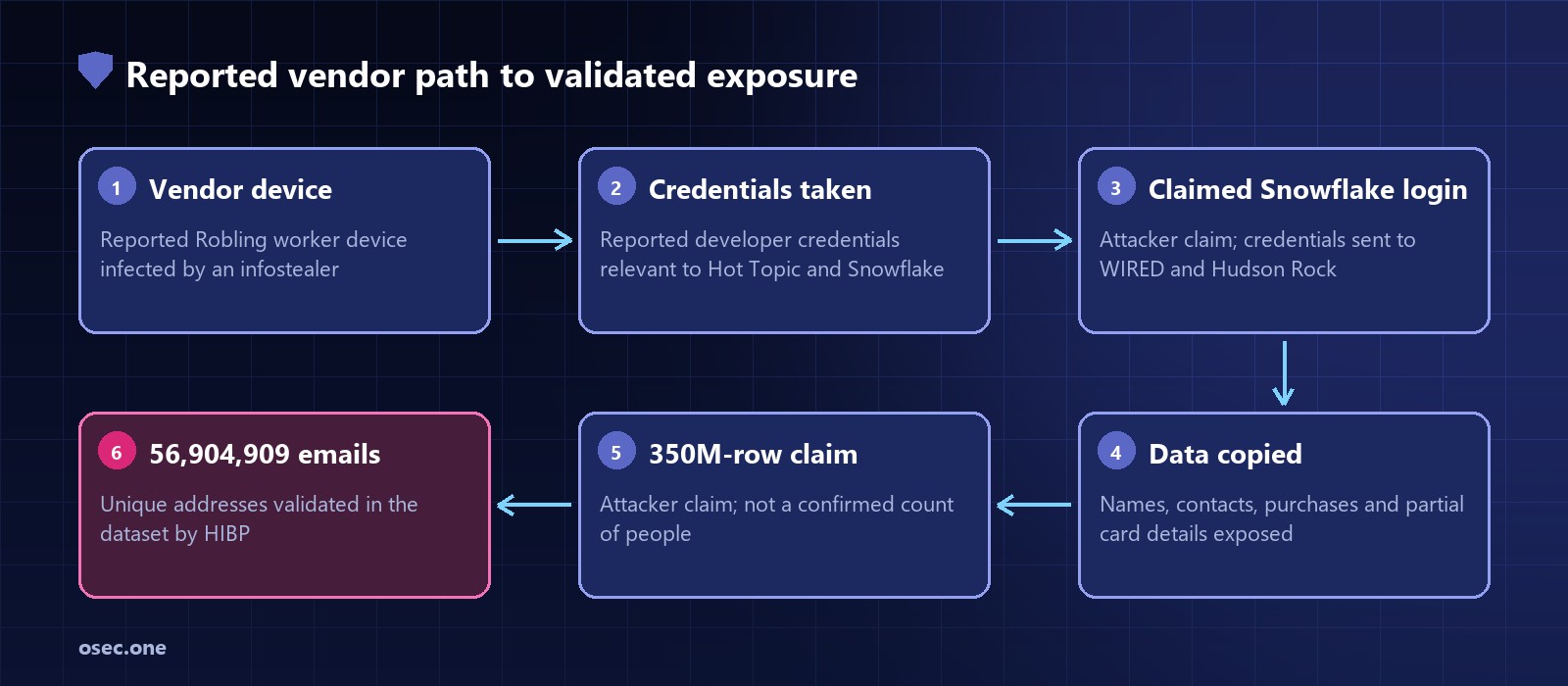
The proposed way in needs the same care. Hudson Rock said an infostealer infected the computer of a person employed at retail analytics vendor Robling, and that it held credentials for Hot Topic and Torrid services on Snowflake and Looker. The attacker separately claimed the way in was a Snowflake account without MFA. Hudson Rock said its evidence does not conclusively prove how the companies were hacked, and Hot Topic did not publicly confirm a root cause in the contemporaneous reports. This analysis therefore keeps three labels throughout: validated dataset, reported path, and attacker claim.
The first two steps are Hudson Rock's reporting; the login and the 350 million figure are attacker claims; the final email count was validated by HIBP.
What is supported, and at what level
| Evidence level | Finding | What it does not prove | |---|---|---| | Validated dataset | HIBP added 56,904,909 unique email addresses on 11 November 2024 and listed names, physical addresses, phone numbers, purchases, genders, dates of birth, salutations and partial payment-card data. | It is not a count of rows, purchases or necessarily distinct people. | | Reported path | Hudson Rock said a person employed at Robling was infected on 12 September 2024, with Hot Topic and Torrid credentials for Snowflake and Looker on the computer. The actor sent WIRED/404 Media a developer's Snowflake credentials; Hudson Rock said it received the same set. | It is not a company-confirmed forensic root cause, and no source says the computer was personal or unmanaged or names the stealer. | | Attacker claim | The actor advertised 350 million records covering Hot Topic, BoxLunch and Torrid, initially for $20,000, and reportedly demanded $100,000 to withhold the data. The actor also said they logged in on 20 October and told Hudson Rock a Snowflake account lacked MFA. | It does not establish 350 million customers, accounts or people, or that the login or the missing MFA happened as described. |
A six-to-one mismatch, not six records per customer
A mechanical comparison gives 350,000,000 ÷ 56,904,909 = 6.15 claimed rows for each validated unique email address. That calculation is useful only because it shows why the labels matter. It is not an estimate of records per customer: one person can use several email addresses, one email can occur in purchases and address records many times, and the 350 million numerator was never independently validated.
Rows, accounts, email addresses and people answer different questions. A large database can contain many rows about one person; a deduplicated email count can still contain more than one address for that person.
The dated sequence
• 12 September 2024 — reported infection: Hudson Rock dates the infection of the Robling-employed person's computer to this day. • 19 October — validated-dataset date: HIBP dates the breach to 19 October. • 20 October — attacker claim: the actor told WIRED/404 Media they logged in to a server and took the data. • 21 October — attacker listing: the dataset was advertised on a breach forum as 350 million records. • 23 October — reported path published: Hudson Rock published the Robling attribution and the actor's no-MFA claim. • 4 November — credentials reported: WIRED/404 Media reported the actor's developer credentials in a wider investigation of the infostealer trade. • 11 November — validation milestone: HIBP added 56,904,909 unique email addresses and began notifying subscribers. • 13 November — follow-up reporting: TechCrunch reported the dataset fields, Hudson Rock's infostealer theory and a later $3,500 sale listing.
What the dataset exposed
HIBP's entry lists email addresses, names, physical addresses, phone numbers, purchases, genders, dates of birth and salutations. It also lists partial card data: card type, expiry and the last four digits. Partial card details cannot normally authorize a payment by themselves, but combined with a name, address, purchase history and date of birth they make a convincing customer-service or delivery-themed phishing call.
The breach therefore created two problems. The direct one is privacy loss across contact, demographic and purchase data. The secondary one is impersonation: a caller can quote a real recent purchase and the last four digits, then ask the customer to 'verify' the rest. Incident notices should warn about that exact script, not just advise people to change a password that may not have been in this dataset.
How the reported vendor path fits the wider Snowflake campaign
The Hot Topic-specific path is attributed reporting, but the control failure is independently plausible. In June 2024 Mandiant described UNC5537 intrusions into Snowflake customer instances using credentials previously stolen by infostealers. Some infections were on contractor systems used for both work and personal activity; many accounts lacked MFA and network policies. Snowflake's joint update said the campaign relied on compromised customer credentials rather than a vulnerability or breach of the Snowflake platform.
Our overall Snowflake case analysis follows that campaign across 165 potentially exposed organisations. The Hot Topic evidence narrows the question: what should a company do when a vendor identity can reach production data? The Okta/Lapsus$ contractor case shows the same blast-radius problem from a different route: the customer owns the data, but a third party owns the endpoint and support workflow.
Break the chain at every step
| Attack step | Control that breaks it | Evidence to retain | |---|---|---| | A vendor worker's computer is infected | Issue a managed work device or hardened VDI; keep production administration out of personal browser profiles. | EDR events, device compliance and software inventory | | A reusable password leaves the device | Put human Snowflake users behind federated SSO and phishing-resistant MFA; disable password-only local users. | Identity-provider sign-ins and factor changes | | Stolen credentials work from anywhere | Restrict warehouse access to contractor VPN or VDI egress addresses with network policies. | Source IP, client and network-policy decisions | | One vendor identity reaches too much | Give every contractor an individual, least-privilege, time-bounded identity; mask payment fields and limit views. | Role grants, query history and entitlement reviews | | Large exports look like normal analyst work | Alert on new countries, unfamiliar clients, unusual query volume, new stages and bulk downloads. | Login, query, stage and object-access history | | Malware is removed but stolen data remains usable | Rotate passwords, revoke sessions and tokens, and scope every system the identity could access. | Revocation time, credential versions and downstream audit logs |
A contractor endpoint checklist
1. Inventory the access before the person starts. Name the warehouse, role, datasets, expiry date, manager and vendor. 2. Provide the path, not just a policy. A managed laptop or VDI is enforceable; a PDF saying 'do not install games' is not. 3. Separate the browser profile and identity. Work SSO should exist only inside the managed environment. 4. Require SSO, phishing-resistant MFA and known egress addresses together. Each control covers a different failure. 5. Review access quarterly and at every contract change. Remove dormant local users and shared vendor accounts. 6. Treat an infostealer alert as credential compromise. Isolate the device, but also revoke sessions and rotate every credential present on it. 7. Preserve logs before disabling the identity. Login, query and export history are what define the affected data. 8. Rehearse vendor offboarding. Contract end should trigger identity expiry, device return, token revocation and an access review on the same day.
If your own site signs people in with osec Auth, Login Protection can limit sign-in codes per email and per IP, limit wrong codes per IP, and restrict IP addresses and email domains. It does not secure Snowflake, inspect vendor computers or replace SSO, MFA and network policy. Its place is the website login at the edge of this story, not the data warehouse.
Set sign-in limits and IP or email-domain rules for your own site with osec Login Protection. For data warehouses, use the managed-device, SSO, MFA and network-policy controls above.