Ivanti Endpoint Manager Mobile (EPMM, formerly MobileIron Core) is the server that tells a company's phones what they may do: which apps, which Wi-Fi, which certificates. It has to be reachable from the internet so phones can check in. In May 2025 two flaws in it were chained into a request that ran code without any sign-in, and a few months later CISA published what one victim's server looked like afterwards.
This is a case about the gap between two sentences: "we installed the update" and "we checked nobody was already inside". The update fixes the code path. It does not remove a Java class an intruder has already loaded into the running web server. The public record is thin in places, so this article says what the primary sources show and marks what they don't.
What this article does not claim. CISA's report does not name the organisation that was compromised or the group behind it. Swedish and Dutch authorities (CERT-SE and the NCSC) published warnings for their own countries; those are defensive notices, not disclosures of victims. Nothing below says a Swedish or Dutch government body was breached through these two bugs.
Dates and versions
• 13 May 2025: Ivanti discloses and patches the two flaws. Its advisory already said a very limited number of customers had been exploited.
• 15 May: CISA's analysed intrusion starts, "around May 15, 2025, following publication of a proof of concept".
• 19 May: CISA adds both CVEs to its Known Exploited Vulnerabilities catalog.
• 3 June: CERT-SE updates its warning: exploitation attempts are widespread, and even patched systems should be checked because exploitation may have started before the disclosure.
• 18 September 2025: CISA publishes report AR25-261A (MAR-251126), Malicious Listener for Ivanti Endpoint Mobile Management Systems.
• Affected: 11.12.0.4, 12.3.0.1, 12.4.0.1, 12.5.0.0 and earlier.
• Fixed (per the Dutch NCSC advisory): 11.12.0.5, 12.3.0.2, 12.4.0.2, 12.5.0.1.
Two dates matter for you. The first is 13 May, when the patch existed. The second is whenever you actually installed it. Anything that happened in between is not undone by the install.
Step 1: two bugs that make one request
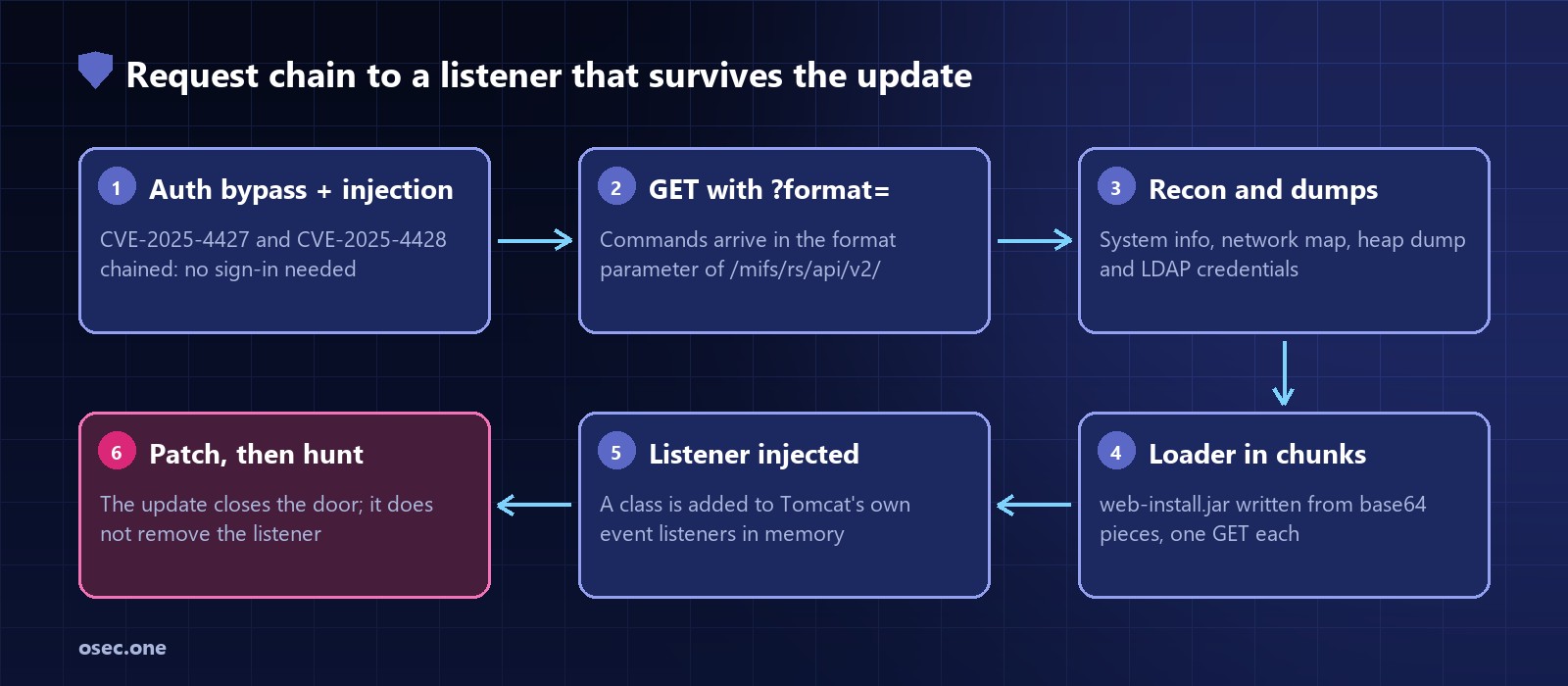
• CVE-2025-4427 is an authentication bypass (CWE-288): a protected API path answers without a valid session.
• CVE-2025-4428 is a code injection: a value that should be data is evaluated as a Java expression.
• Together they give unauthenticated remote code execution. CERT-EU's advisory notes that researchers disputed whether two CVEs were even needed, so don't rely on "we only block one" reasoning.
• In CISA's case the request was a plain HTTP GET to /mifs/rs/api/v2/ with the commands inside the format parameter.
Step 2: what the intruders did first
CISA describes the first activity in general terms, with no literal commands:
• collected system information and downloaded files;
• listed the root directory and mapped the network;
• ran scripts to make a heap dump, a copy of the server process's memory that can contain secrets;
• dumped LDAP credentials, the account the MDM server uses to look up your directory;
• staged malware in /tmp.
The heap dump and the LDAP account are the part to think about. An MDM server holds a directory login, device certificates and a list of every managed phone. Treat what it could read as what was read.
Step 3: a loader written one base64 piece at a time
A Java file is too big for one tidy request, so the intruders split each loader into several base64 segments. Each segment went in its own GET, using Java Expression Language injection. The first request created the file and wrote the first piece, and later ones appended with a FileOutputStream in append mode. CISA says the splitting helps evade "signature-based detection and size limitations". The loader was named web-install.jar.
For a defender this means no single log line contains the malware. You see many near-identical requests to /mifs/rs/api/v2/featureusage with long format values, and the file only exists once the last one lands.
Step 4: two sets of malware, both listeners
CISA found five files in two sets. Both loaders add a listener to Tomcat, the Java web server EPMM runs on. A listener is code that sees every request. Once one is registered in memory, the intruder no longer needs the original bug: a request that carries the right secret is answered by their class.
Set 1: web-install.jar, ReflectUtil.class, SecurityHandlerWanListener.class
• web-install.jar (30,996 bytes) contains and loads ReflectUtil.class, disguised as part of the org.apache.http package.
• ReflectUtil gets around Java module restrictions, loads the listener under the name org.junit.SecurityHandlerWanListener (a name that looks like test code), then gets the application's current event listeners, adds the new one and writes the list back. It checks it hasn't already injected itself.
• The listener only reacts when three things match: a fixed pass string, a Referer header and one specific Referer value. It then reads one line of the request body, decodes it, decrypts it with AES and defines a new Java class from the result, so the intruder can run anything later.
Set 2: web-install.jar and WebAndroidAppInstaller.class
• This web-install.jar (8,728 bytes) is smaller and its class is disguised as part of the com.mobileiron.service package, which is where a real MobileIron file would sit.
• WebAndroidAppInstaller.class needs an application/x-www-form-urlencoded content type, base64-decodes and AES-decrypts a password parameter with a hard-coded key, runs the class inside, then encrypts the output and wraps it with part of an MD5 hash.
• The reply therefore looks like noise to anyone watching the wire.
CISA's report does not explain how the second loader registers itself in Tomcat, so don't assume the first set's method applies. Both sets share the useful property: after the loader runs, the class lives in memory.
What the patch removes and what it can't
• Removes: the way in. A fixed server no longer answers the crafted request.
• Doesn't remove: files in /tmp and the application folders, credentials that were dumped, or anything done with them from other machines. A restart for the update may clear a listener held only in memory, but not files that load it again.
• Unknown: how many servers were hit before 13 May. Ivanti said a very limited number; CERT-SE said exploitation may predate disclosure. Nobody has published a count.
That gap is why CERT-SE told people to check patched systems. If your install date is after 15 May, treat the question "was I hit?" as open until you've looked.
The first 30 minutes: preserve, then hunt
Order matters, because the most useful evidence is in memory and logs that a reboot or log rotation will remove.
Preserve (first 10 minutes)
1. Don't reboot or update the live server yet, if you can avoid it. Take a snapshot of the virtual machine, including memory if your hypervisor allows it.
2. Copy the web and access logs off the server before rotation. Note the time zone.
3. Write down the EPMM version, the date you patched and who has admin access.
Hunt (next 20 minutes)
1. Search the HTTP logs for unexpected format values. CERT-EU recommends looking at requests to featureusage and featureusage_history: only csv and json are expected. A long expression, getRuntime, FileOutputStream, Base64 or /tmp there is not a user.
2. Look for many requests in a row to the same /api/v2/ path from one address, from 13 May onward.
3. Check for the files CISA names: web-install.jar, ReflectUtil.class, SecurityHandlerWanListener.class, WebAndroidAppInstaller.class, and paths such as /mi/tomcat/webapps/mifs/401.jsp, session.jsp, baseURL.jsp.
4. Run CISA's YARA and SIGMA rules (five YARA rules, CISA_251126_01 to _05, and one SIGMA rule, plus a STIX file of indicators). They match the strings above.
5. Check outbound connections from the EPMM server to anything you don't recognise, and compare the 12 addresses in CISA's report with your firewall logs.
If you find something
CISA's guidance: take the host offline, capture a full disk image, reimage rather than clean, rotate credentials (including the LDAP account), hunt for lateral movement if the intruder got further, and report to CISA or your national CERT. Treat every credential and certificate that the server could read as exposed until replaced.
Controls that would have shortened this
• Keep EPMM's admin and API paths off the open internet where you can. Phones need an entry point, but admins and the API don't. Put a reverse proxy in front that exposes only what devices use.
• Log every request path and query string and keep them 90 days. You can't search for a long format value in logs you don't keep.
• Record your patch date for edge servers, not just the version. "Patched" without a date can't answer "was I exposed first?"
• Give the directory account the MDM server uses only the rights it needs, and rotate it after any suspected exposure.
• Treat MDM as a high-value asset. CISA's own recommendation is to put MDM systems in that class, with extra restrictions, monitoring and phishing-resistant MFA.
Related cases
The pattern repeats across edge products. Ivanti Connect Secure 2024 had a checker that the intruders taught to look away. SharePoint ToolShell 2025 is another case where the update did not undo access already taken. CitrixBleed 2 shows the same shape with a memory leak.
osec Scan checks a host for exposed remote-access, MDM and file-transfer login pages and lists the flaws CISA says are being exploited in each. It shows what's exposed; it can't tell you whether a patched server was already compromised, so keep the hunt steps above.
Scan a hostSources: CISA: Malicious Listener for Ivanti Endpoint Mobile Management Systems, AR25-261A (18 September 2025); CERT-EU Security Advisory 2025-018 (15 May 2025); CERT-SE, Sårbarheter i Ivanti EPMM (13 May 2025, updated 3 June 2025); Dutch NCSC advisory NCSC-2025-0152 (13 May 2025); NHS England Cyber Alert CC-4655; DIVD case DIVD-2025-00017. Version numbers, dates and file names come from these sources; the article makes no claim about who the victim or the actor was.