In late September 2025, executives at dozens of companies got the same kind of email: the sender said they had broken into the company's Oracle E-Business Suite (EBS), the ERP that holds finance, HR and supply-chain records, and attached real file listings as proof. The messages came from hundreds of compromised third-party mailboxes, but the contact addresses pointed to the Clop extortion brand. Google's threat intelligence group (GTIG) and Mandiant tied the campaign to the break-ins, and Oracle shipped an emergency fix for CVE-2025-61882 on 4 October.
This is the case in dates and artefacts: what was exploited when, what the attackers left behind, and the checks you can run today on an EBS server that is reachable from the internet. No exploit code here, only what a defender needs to look for.
The dated timeline
| Date (2025) | Event | Source |
|---|---|---|
| 10 July | Suspicious requests from 200.107.207.26 against the Configurator UiServlet, before Oracle's July patch release | Google GTIG |
| July | Activity against /OA_HTML/configurator/UiServlet; some requests timed out | Google GTIG |
| 9 August | Earliest known exploitation of CVE-2025-61882 as a zero-day | Google GTIG |
| August | Exploitation moves to /OA_HTML/SyncServlet | Google GTIG |
| Mid-August | Earliest data in the file listings later shown to victims | Google GTIG |
| 29 September | High-volume extortion email campaign starts | Google GTIG |
| 2 October | Oracle advisory: attackers may have used flaws already fixed in the July update | Oracle, via press |
| 3 October | A leaked exploit appears in a Telegram group of "Scattered Lapsus$ Hunters" | Google GTIG |
| 4 October | Oracle publishes the emergency fix for CVE-2025-61882 (CVSS 9.8, pre-authentication remote code execution) | Oracle |
| 10 October | GTIG and Mandiant publish their analysis | Google GTIG |
| 11 October | Oracle fixes a second flaw, CVE-2025-61884 (CVSS 7.5, Configurator Runtime UI, unauthenticated data access) | Oracle, BleepingComputer |
| 20 October | CISA adds CVE-2025-61884 to its Known Exploited Vulnerabilities list; federal deadline 10 November | SecurityWeek |
| 10 November | 29 alleged victims named on the Clop leak site, data published for 18 | SecurityWeek |
The numbers: how long the window was
| Interval | Days | Why it matters |
|---|---|---|
| 10 July to 4 October (first odd traffic to patch) | 86 | Anyone patched only on Oracle's July schedule was still open; only the 4 October fix covered the zero-day |
| 9 August to 4 October (known zero-day use to patch) | 56 | Eight weeks of exploitation with no vendor fix |
| 9 August to 29 September (zero-day use to extortion emails) | 51 | The first message a victim saw arrived about seven weeks after the data left |
| 4 October to 11 October (first fix to second fix) | 7 | One patch was not the end: a second flaw followed within a week |
| 20 October to 10 November (KEV listing to federal deadline) | 21 | The time US agencies were given for CVE-2025-61884 |
| Victims with data leaked / named on 10 November | 18 of 29 (62%) | Part of the list was pressure, not proven theft |
The 51-day gap is the lesson. There was no ransomware, no encrypted server and nothing for monitoring to flag as an outage. The first signal many victims got was an email. So the useful question is not "are we being attacked" but "what was our EBS server doing in August", and that needs logs that go back that far.
How the attack worked, step by step
Google describes two exploit variants. Reporting differs on exactly how they map to the two CVEs (Google itself says it is unclear which July activity matches CVE-2025-61882), so treat the labels below as the observed behaviour, not Oracle's root cause.
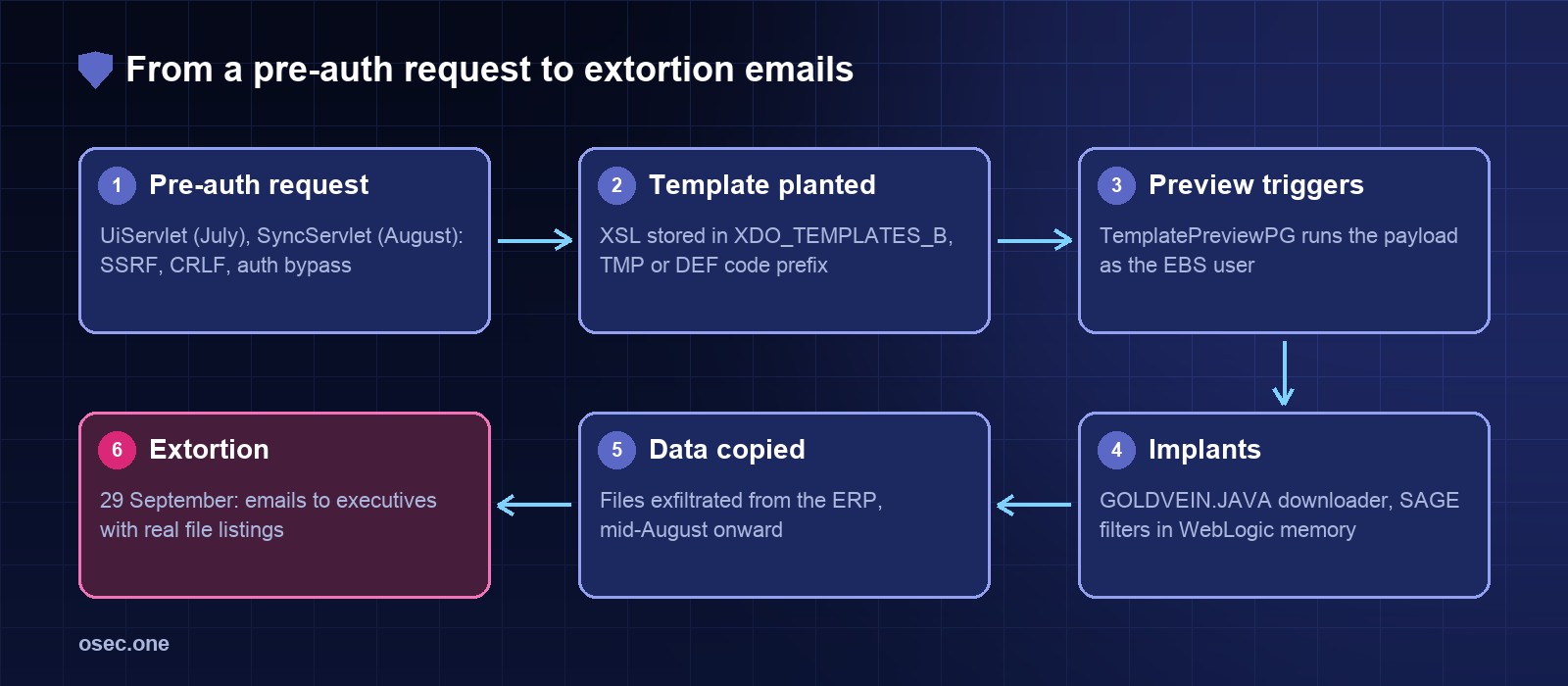
1. The UiServlet chain (July). Requests to the Configurator servlet chained a server-side request forgery, a CRLF injection, an authentication bypass and an XSL template injection into code execution without logging in. Commands ran through <code>sh</code> on Linux or <code>cmd.exe</code> on Windows.
2. The SyncServlet chain (August). A request to <code>/OA_HTML/SyncServlet</code> gave access to the XML Publisher (XDO) Template Manager, where a template was created in the EBS database. A second request to the template preview page then made the server run it:
/OA_HTML/OA.jsp?page=/oracle/apps/xdo/oa/template/webui/TemplatePreviewPG
  &TemplateCode=TMP<16 random hex>   (or DEF<16 random hex>)
  &TemplateType=XSL-TEXT                (or XML)
The template body was an XSL stylesheet that decoded a Base64 blob and handed it to a JavaScript engine inside the Java process. That is why the request log is such a strong indicator: a legitimate template preview rarely uses a machine-generated <code>TMP</code> or <code>DEF</code> code with 16 random hex characters. The payload lives in the tables <code>XDO_TEMPLATES_B</code> and <code>XDO_LOBS</code>.
3. What ran afterwards. Commands executed as the <code>applmgr</code> OS user: <code>cat /etc/fstab</code>, <code>cat /etc/hosts</code>, <code>df -h</code>, <code>ip addr</code>, <code>cat /proc/net/arp</code>, <code>arp -a</code>, <code>ifconfig</code>, <code>netstat -an</code>, <code>ps -aux</code>, <code>ping 8.8.8.8 -c 2</code>, and an interactive <code>bash -i</code> reverse shell to port 53 on 200.107.207.26. That is the usual "where am I and can I reach out" sequence.
4. Implants. GTIG names a Java downloader, GOLDVEIN.JAVA (a port of the PowerShell GOLDVEIN seen in the Cleo attacks of December 2024), that beacons over port 443 and returns results inside an HTML comment, and a chain called SAGE: a reflective loader (SAGEGIFT), an in-memory dropper (SAGELEAF) and a malicious WebLogic servlet filter (SAGEWAVE). Most of it never touches disk, so a clean file scan proves little.
Indicators to search for
| Type | Indicator | What it was |
|---|---|---|
| IP | 200.107.207.26 | Requests to UiServlet and SyncServlet; reverse shell target on port 53 |
| IP | 161.97.99.49 | Likely exploitation attempts against UiServlet |
| C2 | 162.55.17.215:443 and 104.194.11.200:443 | GOLDVEIN.JAVA command servers |
| URL | /OA_HTML/configurator/UiServlet, /OA_HTML/SyncServlet | Entry points seen in July and August |
| URL | TemplatePreviewPG with TemplateCode=TMP… or DEF… | Payload trigger (GTIG calls it high fidelity) |
| Path substring | /help/state/content/destination./navId.1/navvSetId.iHelp/, same under /support/state/… | SAGEWAVE servlet filter paths |
| Process | bash -i as a child of the EBS Java process, user applmgr | Reverse shell |
| support@pubstorm.com, support@pubstorm.net | Contact addresses in the extortion emails (on the Clop leak site since at least May 2025) |
IP addresses age fast and were only the ones published in October; use them for searching old logs, not for deciding a server is clean.
What the extortion emails looked like
These points come from GTIG's description of the campaign:
- Sent in bulk to company executives from hundreds or thousands of compromised third-party accounts, probably taken from infostealer logs (see our Lumma Stealer analysis).
- They claim the sender breached the company's Oracle EBS application and copied documents.
- Proof is a genuine listing of files from that company's EBS environment.
- They offer to withhold the data for payment, with no amount or method in the first message.
- The contact addresses match the Clop leak site, which is why the campaign was attributed to Clop, tracked by Google as FIN11-linked.
A mail like this is a reason to start the checks below the same day, but a listing can also be a bluff or reused from another victim, so verify against your own database and logs before replying to anyone. Do not answer from the executive's mailbox.
Checks to run on an internet-facing EBS server
1. Version and patch state. The flaw affects EBS 12.2.3 through 12.2.14. Confirm the 4 October fix for CVE-2025-61882 and the 11 October fix for CVE-2025-61884 are both installed, and read the prerequisites listed in Oracle's alert before applying them. Patch first, then hunt: the leaked exploit made the bug usable by anyone from early October.
2. Look for planted templates. Run these read-only queries on the EBS database, newest first (GTIG's suggestion), and flag any template code starting with <code>TMP</code> or <code>DEF</code> that no one on your team created:
SELECT * FROM XDO_TEMPLATES_B ORDER BY CREATION_DATE DESC;
SELECT * FROM XDO_LOBS        ORDER BY CREATION_DATE DESC;
3. Search web logs back to July. Grep the Apache/OHS access logs for <code>TemplatePreviewPG</code> with a <code>TemplateCode=TMP</code> or <code>DEF</code>, and for any request to <code>UiServlet</code> or <code>SyncServlet</code> from an address you do not know. If your retention is shorter than 120 days you cannot rule out the July start; say so in your incident notes instead of guessing.
4. Look at processes and connections. A Java process of EBS spawning <code>bash -i</code>, or anything running as <code>applmgr</code> that you did not start, is a finding. Check established outbound connections from the application tier against the C2 addresses above.
5. Memory, not just disk. The SAGE filters and GOLDVEIN.JAVA run inside the Java process. If you suspect a hit, take the memory image and logs before restarting the server; a restart wipes the in-memory implants and the best evidence.
6. Shrink the exposure. Ask whether the application tier needs to be reachable from the whole internet. If only suppliers or recruits need a few modules, publish only those paths through a reverse proxy and keep the rest internal; test that before blocking any servlet your users depend on. Block outbound connections from the EBS servers except what they truly need, which breaks the reverse shell and the C2 beacon even when the entry bug is unknown.
7. Rotate what was stored there. Treat database credentials, integration accounts, SFTP keys and any API tokens an EBS server could read as exposed if it was reachable and unpatched in August to early October.
Controls that break each step
| Step | Control | How to verify |
|---|---|---|
| Pre-auth request reaches EBS | Reverse proxy that publishes only the needed modules; patched within days of an alert | External scan lists only the paths you intend |
| Template stored in the database | Alert on new rows in XDO_TEMPLATES_B outside change windows | Test: create a template as admin and confirm the alert fires |
| Payload runs in the Java process | Least-privilege OS user, no shell for the service where practical | bash -i child of Java triggers an EDR or auditd rule |
| Outbound C2 and exfiltration | Egress allow-list for the application tier | Try a request to a random public host from the server: it must fail |
| Months before anyone noticed | Keep web and OS logs at least 180 days, off the server | Pick a date 150 days ago and pull its access log |
| Extortion email | Verify claims internally; one named contact owns the reply | Run a tabletop with an invented file listing |
The pattern repeats across the Clop file-transfer and ERP campaigns: a pre-authentication bug in a product that has to face outsiders, quiet data theft, and an extortion note weeks later. We went through the same shape in MOVEit 2023 and GoAnywhere MFT 2025; for the exposed-gateway patching problem see Citrix Bleed.
To see what a visitor sees in front of your own public web tier, the free osec site protection scan shows which WAF or CDN answers for a domain and whether an attack-looking request is blocked. It checks only public responses; it cannot tell you whether an ERP behind it is patched.
Key takeaways
1. A zero-day window of 56 days (9 August to 4 October) is long enough that patching after the alert is only half the job: you must also check what happened before it.
2. The indicator is in your own database and logs: new <code>TMP</code>/<code>DEF</code> templates and <code>TemplatePreviewPG</code> requests, not a ransomware note.
3. Implants lived in memory, so preserve a memory image before restarting.
4. Not every name on the leak site is a proven breach: 18 of 29 had data published on 10 November. Check your own evidence.
5. Reduce what an ERP exposes and what it may call outward; both cut the next campaign's chances.
Stolen passwords from infostealer logs are what fuel mass extortion mail. osec.one gives your own apps passwordless sign-in with email codes and Apple/Google, so there is no password to steal and replay.
See passwordless sign-inSources: Google Cloud / Mandiant: Oracle E-Business Suite zero-day exploitation (10 October 2025); Oligo Security: CVE-2025-61882 exploited in Clop extortion campaigns; SecurityWeek: Nearly 30 alleged victims of Oracle EBS hack named on Cl0p site (10 November 2025); SecurityWeek: CISA confirms exploitation of latest Oracle EBS vulnerability (21 October 2025); BleepingComputer: Oracle releases emergency patch for new E-Business Suite flaw; Oracle Security Alert for CVE-2025-61882 (oracle.com/security-alerts). Day counts are our arithmetic from these dates.