This is deliberately not another article about CVE-2024-3400. That April 2024 issue affected the GlobalProtect feature and involved a telemetry job. Lunar Peek's pair was about the management plane: the interface operators use to configure the firewall. The fix is therefore not ‘turn off remote access’ in general; it is to ensure that the management interface is reachable only from trusted administration networks, while the VPN/data-plane service has its own tightly defined exposure.
Anyone on the internet can reach an operator interface
Dedicated management network, VPN/jump host, source-IP allowlist; no management profile on an untrusted data-plane interface
CVE-2024-0012
No credentials to PAN-OS administrator privileges
Vendor patch plus elimination of untrusted network reachability
CVE-2024-9474
Authenticated management context to command injection / root impact
Vendor patch; investigate any device exposed before patching
Web shell and payloads
Firewall becomes a persistent compute point inside a trusted boundary
IOC review, configuration comparison, support-guided forensic/recovery procedure
Trusted network position
Rules, VPN settings and credentials may guide later intrusion
Rotate relevant secrets; review configuration/admin changes and downstream authentication logs
"},{"id":147191,"block_type":"paragraph","html":"
Palo Alto Networks gave CVE-2024-0012 a CVSS 9.3 and marked its exploit maturity as ‘attacked’. The number is useful for sorting, but its precondition matters more in a real environment: the attacker needs network access to the management web interface. A management port reachable only from a dedicated administrator subnet is a materially different target from one published to the internet. This is why exposure inventory is part of the patch decision, not a separate hygiene exercise.
1. Classify the interfaces. For each PA-Series, VM-Series, CN-Series and Panorama system, write down the management IP/port, the GlobalProtect portal/gateway address, and any data-plane interface with a management profile. Do not infer this from a public DNS name. 2. Remove untrusted management reachability. Permit HTTPS/SSH administration only from a named management subnet, VPN or jump host. Keep the change reversible: preserve a tested out-of-band route before narrowing access. 3. Patch the exact supported branch. Use the advisory's affected-version table, not a generic ‘latest’ assumption. CVE-2024-0012 and CVE-2024-9474 both need remediation. 4. Review the period before containment. Unit 42 lists a PHP web-shell hash and an observed user-agent; use the current threat brief and advisory IOC material in your own logging/EDR workflow. Also investigate unfamiliar administrators, scheduled tasks, configuration exports and rule changes. 5. Re-establish trust. Rotate management credentials and secrets exposed in configuration exports as appropriate, compare the running configuration with a known-good backup, and involve vendor support/incident response where root compromise is plausible.
It does not mean the firewall cannot provide an internet-facing service. It means the service that routes traffic (or the GlobalProtect gateway, where configured) is not also an administrator's control panel. A useful architecture has three separate statements: users may reach the VPN, the internet may reach protected applications, and only operator networks may reach management HTTPS/SSH. Any firewall policy or interface-management profile that turns those into one statement reintroduces the same class of risk.
"},{"id":147196,"block_type":"paragraph","html":"
If an external hostname must remain public, osec Scan can identify several exposed login portals and cross-reference supported products against the known-exploited catalog. It is an outside signal, not a replacement for checking PAN-OS interface and management-profile configuration.
PAN-OS 2024: CVE-2024-3400 covers the different GlobalProtect telemetry chain. ArcaneDoor shows why an edge firewall compromise may persist below the ordinary configuration and reboot cycle. The shared rule is simple: management interfaces are high-value systems, not an extra convenience feature on the internet edge.
"},{"id":147199,"block_type":"cta","html":"
Check a public login page for recognized edge-device portals and known-exploited matches. It uses only the public page you provide.
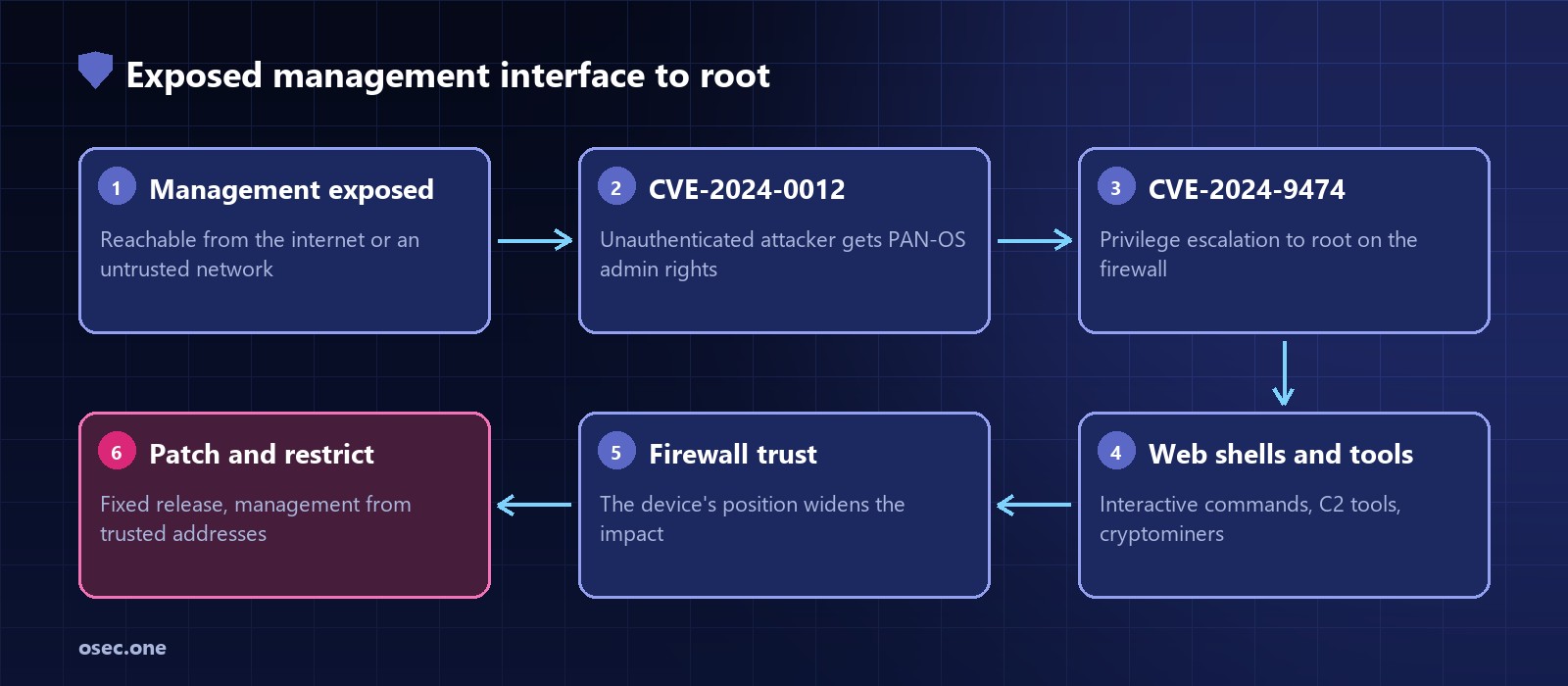
In November 2024, Palo Alto Networks tracked attacks it named Operation Lunar Peek against a small number of PAN-OS firewalls whose management web interfaces were reachable from the internet or another untrusted network. CVE-2024-0012 let an unauthenticated network attacker obtain PAN-OS administrator privileges. Chained with CVE-2024-9474, an authenticated privilege-escalation issue in the web management interface, the result could be command execution as root on the firewall. Unit 42 later observed interactive commands, web shells, open-source C2 tools and cryptominers after public technical details spread.
\n
Ad
\n
This is deliberately not another article about CVE-2024-3400. That April 2024 issue affected the GlobalProtect feature and involved a telemetry job. Lunar Peek's pair was about the management plane: the interface operators use to configure the firewall. The fix is therefore not ‘turn off remote access’ in general; it is to ensure that the management interface is reachable only from trusted administration networks, while the VPN/data-plane service has its own tightly defined exposure.
\n
\n
A compact timeline
\n
Date
What Palo Alto Networks reported
Defensive consequence
8 Nov 2024
Initial PAN-SA-2024-0015 publication
Identify whether the management plane is exposed before waiting for the next change window.
14 Nov 2024
Severity raised after observed threat activity
Move from vulnerability management to incident-response prioritisation.
Apply the vendor-fixed release for the affected branch.
19 Nov 2024
Public technical insights/artifacts spread; Unit 42 reports a rise in scans
Review management logs and exposures, not just patch status.
22 Nov 2024
Unit 42 says it sees broader payloads including C2 tools and miners
Hunt for compromise artifacts on previously exposed systems.
23 Nov 2024
Advisory clarifies GlobalProtect portals/gateways are not impacted by CVE-2024-0012
Do not confuse a management-plane exposure with the VPN portal service.
\n
Why the pair was worse than either label suggests
\n
Link
Security boundary crossed
What stops it
Public management HTTPS
Anyone on the internet can reach an operator interface
Dedicated management network, VPN/jump host, source-IP allowlist; no management profile on an untrusted data-plane interface
CVE-2024-0012
No credentials to PAN-OS administrator privileges
Vendor patch plus elimination of untrusted network reachability
CVE-2024-9474
Authenticated management context to command injection / root impact
Vendor patch; investigate any device exposed before patching
Web shell and payloads
Firewall becomes a persistent compute point inside a trusted boundary
IOC review, configuration comparison, support-guided forensic/recovery procedure
Trusted network position
Rules, VPN settings and credentials may guide later intrusion
Rotate relevant secrets; review configuration/admin changes and downstream authentication logs
\n
Palo Alto Networks gave CVE-2024-0012 a CVSS 9.3 and marked its exploit maturity as ‘attacked’. The number is useful for sorting, but its precondition matters more in a real environment: the attacker needs network access to the management web interface. A management port reachable only from a dedicated administrator subnet is a materially different target from one published to the internet. This is why exposure inventory is part of the patch decision, not a separate hygiene exercise.
\n
One firewall at a time: remediation and evidence
\n
1. Classify the interfaces. For each PA-Series, VM-Series, CN-Series and Panorama system, write down the management IP/port, the GlobalProtect portal/gateway address, and any data-plane interface with a management profile. Do not infer this from a public DNS name. 2. Remove untrusted management reachability. Permit HTTPS/SSH administration only from a named management subnet, VPN or jump host. Keep the change reversible: preserve a tested out-of-band route before narrowing access. 3. Patch the exact supported branch. Use the advisory's affected-version table, not a generic ‘latest’ assumption. CVE-2024-0012 and CVE-2024-9474 both need remediation. 4. Review the period before containment. Unit 42 lists a PHP web-shell hash and an observed user-agent; use the current threat brief and advisory IOC material in your own logging/EDR workflow. Also investigate unfamiliar administrators, scheduled tasks, configuration exports and rule changes. 5. Re-establish trust. Rotate management credentials and secrets exposed in configuration exports as appropriate, compare the running configuration with a known-good backup, and involve vendor support/incident response where root compromise is plausible.
\n
What ‘never face the internet’ means in practice
\n
It does not mean the firewall cannot provide an internet-facing service. It means the service that routes traffic (or the GlobalProtect gateway, where configured) is not also an administrator's control panel. A useful architecture has three separate statements: users may reach the VPN, the internet may reach protected applications, and only operator networks may reach management HTTPS/SSH. Any firewall policy or interface-management profile that turns those into one statement reintroduces the same class of risk.
\n
If an external hostname must remain public, osec Scan can identify several exposed login portals and cross-reference supported products against the known-exploited catalog. It is an outside signal, not a replacement for checking PAN-OS interface and management-profile configuration.
\n
Related cases
\n
PAN-OS 2024: CVE-2024-3400 covers the different GlobalProtect telemetry chain. ArcaneDoor shows why an edge firewall compromise may persist below the ordinary configuration and reboot cycle. The shared rule is simple: management interfaces are high-value systems, not an extra convenience feature on the internet edge.
\n
Check a public login page for recognized edge-device portals and known-exploited matches. It uses only the public page you provide.
PAN-OS management interface 2024: an authentication bypass chained to root
In November 2024, Palo Alto Networks tracked attacks it named Operation Lunar Peek against a small number of PAN-OS firewalls whose management web interfaces were reachable from the internet or another untrusted network. CVE-2024-0012 let an unauthenticated network attacker obtain PAN-OS administrator privileges. Chained with CVE-2024-9474, an authenticated privilege-escalation issue in the web management interface, the result could be command execution as root on the firewall. Unit 42 later observed interactive commands, web shells, open-source C2 tools and cryptominers after public technical details spread.
Ad
This is deliberately not another article about CVE-2024-3400. That April 2024 issue affected the GlobalProtect feature and involved a telemetry job. Lunar Peek's pair was about the management plane: the interface operators use to configure the firewall. The fix is therefore not ‘turn off remote access’ in general; it is to ensure that the management interface is reachable only from trusted administration networks, while the VPN/data-plane service has its own tightly defined exposure.
A compact timeline
Date
What Palo Alto Networks reported
Defensive consequence
8 Nov 2024
Initial PAN-SA-2024-0015 publication
Identify whether the management plane is exposed before waiting for the next change window.
14 Nov 2024
Severity raised after observed threat activity
Move from vulnerability management to incident-response prioritisation.
Apply the vendor-fixed release for the affected branch.
19 Nov 2024
Public technical insights/artifacts spread; Unit 42 reports a rise in scans
Review management logs and exposures, not just patch status.
22 Nov 2024
Unit 42 says it sees broader payloads including C2 tools and miners
Hunt for compromise artifacts on previously exposed systems.
23 Nov 2024
Advisory clarifies GlobalProtect portals/gateways are not impacted by CVE-2024-0012
Do not confuse a management-plane exposure with the VPN portal service.
Why the pair was worse than either label suggests
Link
Security boundary crossed
What stops it
Public management HTTPS
Anyone on the internet can reach an operator interface
Dedicated management network, VPN/jump host, source-IP allowlist; no management profile on an untrusted data-plane interface
CVE-2024-0012
No credentials to PAN-OS administrator privileges
Vendor patch plus elimination of untrusted network reachability
CVE-2024-9474
Authenticated management context to command injection / root impact
Vendor patch; investigate any device exposed before patching
Web shell and payloads
Firewall becomes a persistent compute point inside a trusted boundary
IOC review, configuration comparison, support-guided forensic/recovery procedure
Trusted network position
Rules, VPN settings and credentials may guide later intrusion
Rotate relevant secrets; review configuration/admin changes and downstream authentication logs
Palo Alto Networks gave CVE-2024-0012 a CVSS 9.3 and marked its exploit maturity as ‘attacked’. The number is useful for sorting, but its precondition matters more in a real environment: the attacker needs network access to the management web interface. A management port reachable only from a dedicated administrator subnet is a materially different target from one published to the internet. This is why exposure inventory is part of the patch decision, not a separate hygiene exercise.
One firewall at a time: remediation and evidence
1. Classify the interfaces. For each PA-Series, VM-Series, CN-Series and Panorama system, write down the management IP/port, the GlobalProtect portal/gateway address, and any data-plane interface with a management profile. Do not infer this from a public DNS name. 2. Remove untrusted management reachability. Permit HTTPS/SSH administration only from a named management subnet, VPN or jump host. Keep the change reversible: preserve a tested out-of-band route before narrowing access. 3. Patch the exact supported branch. Use the advisory's affected-version table, not a generic ‘latest’ assumption. CVE-2024-0012 and CVE-2024-9474 both need remediation. 4. Review the period before containment. Unit 42 lists a PHP web-shell hash and an observed user-agent; use the current threat brief and advisory IOC material in your own logging/EDR workflow. Also investigate unfamiliar administrators, scheduled tasks, configuration exports and rule changes. 5. Re-establish trust. Rotate management credentials and secrets exposed in configuration exports as appropriate, compare the running configuration with a known-good backup, and involve vendor support/incident response where root compromise is plausible.
What ‘never face the internet’ means in practice
It does not mean the firewall cannot provide an internet-facing service. It means the service that routes traffic (or the GlobalProtect gateway, where configured) is not also an administrator's control panel. A useful architecture has three separate statements: users may reach the VPN, the internet may reach protected applications, and only operator networks may reach management HTTPS/SSH. Any firewall policy or interface-management profile that turns those into one statement reintroduces the same class of risk.
If an external hostname must remain public, osec Scan can identify several exposed login portals and cross-reference supported products against the known-exploited catalog. It is an outside signal, not a replacement for checking PAN-OS interface and management-profile configuration.
Related cases
PAN-OS 2024: CVE-2024-3400 covers the different GlobalProtect telemetry chain. ArcaneDoor shows why an edge firewall compromise may persist below the ordinary configuration and reboot cycle. The shared rule is simple: management interfaces are high-value systems, not an extra convenience feature on the internet edge.
Check a public login page for recognized edge-device portals and known-exploited matches. It uses only the public page you provide.