Roku's answer was to turn on two-factor verification for every one of its more than 80 million active accounts, including the ones nobody had touched. This write-up walks through both waves step by step: the tools used, why per-IP limits and a CAPTCHA didn't stop them, the arithmetic on how many login attempts it takes to get 576,000 hits, and the control that breaks each step on a sign-in page of your own.
"},{"id":147538,"block_type":"screenshot","html":"Six steps from a leaked password list to a soundbar shipped to someone else's address. Roku's own systems weren't breached."},{"id":147539,"block_type":"heading_h2","html":"
The two waves in numbers
"},{"id":147540,"block_type":"html","html":"
\n
Wave 1
Wave 2
\n
Accounts taken over
15,363
about 576,000
\n
When the attackers had access
28 Dec 2023 to 21 Feb 2024 (56 days, Maine AG filing)
Not published
\n
Disclosed
8 Mar 2024 (customer notices)
12 Apr 2024 (Roku blog)
\n
How Roku found it
Not stated
\"Ongoing security monitoring\" after wave 1
\n
Fraudulent purchases
Hardware and streaming subscriptions, shown off by buyers on Telegram
\"Less than 400\" cases, refunded
\n
Full card numbers taken
No
No
\n
Two-factor on the web account
Not offered
Turned on for all 80M+ accounts
\n
"},{"id":147541,"block_type":"paragraph","html":"
Combined: 15,363 + 576,000 = 591,363 accounts, about 0.74% of Roku's 80 million active accounts (591,363 / 80,000,000). Small as a share, large as a number.
Credential stuffing starts with "combo lists": email and password pairs from older breaches and infostealer logs, traded and resold in bulk. Nothing on the list came from Roku. It works because people reuse passwords: if your Roku password is the one that leaked from a forum in 2019, the attacker already has it.
BleepingComputer found the first wave was run with OpenBullet 2 and SilverBullet, free automation tools that replay a site's sign-in request for every line of a combo list. Users share "configs" per target site. A researcher told BleepingComputer the Roku config had been in use for months, and that it got past Roku's brute-force limits and CAPTCHA by sending requests to specific URLs and rotating proxies, so each IP address made only a few attempts.
On a hit, the attackers changed the account's password, email address and shipping address. Changing the email does two things at once: the owner can no longer reset the password, and order confirmation emails stop reaching them. Many owners found out from a charge on their card.
Roku accounts often keep a card on file for subscriptions. Attackers used it for streaming subscriptions and Roku hardware: streaming sticks, soundbars, remotes, light strips and cameras. Buyers posted redacted order confirmations on Telegram as proof. Roku counted fewer than 400 fraudulent purchases in wave 2, so most taken-over accounts were never used to buy anything. The resale market is the bigger worry.
BleepingComputer saw hijacked Roku accounts sold for as little as $0.50 each, one listing offering 439 accounts. The buyer gets a working login with a stored card and a delivery address they control.
The arithmetic: how many attempts make 576,000 hits
"},{"id":147554,"block_type":"paragraph","html":"
Roku didn't publish attempt counts, and there is no solid public number for stuffing success rates; industry estimates usually run from about 0.1% to 2% of attempts. Here is the second wave at three rates:
"},{"id":147555,"block_type":"html","html":"
\n
Assumed success rate
Attempts for 576,000 hits
Attempts for both waves (591,363)
\n
2%
28.8 million
29.6 million
\n
1%
57.6 million
59.1 million
\n
0.1%
576 million
591 million
\n
"},{"id":147556,"block_type":"paragraph","html":"
Now spread wave 1 over its 56 known days. At a 1% success rate, 15,363 hits means 1.54 million attempts: about 27,400 a day, or one every 3 seconds. Run through 5,000 rotating proxy IPs, each IP makes about 5.5 attempts a day. A per-IP limit of 5 attempts a minute, a common default, allows 7,200 a day (5 × 1,440 minutes) and never fires: the busiest IP stays about 1,300 times below it.
"},{"id":147557,"block_type":"paragraph","html":"
That's why per-IP rate limits and a CAPTCHA on the login form weren't enough. The signal is in other counts: the share of failed logins across the whole site, how many distinct accounts one network or one browser fingerprint tries, and sign-ins to accounts that have never been used from that region. For scale: Akamai counted 193 billion credential stuffing attempts across its customers in 2020, and Okta found that 34% of Auth0 sign-in traffic in 2022 was credential stuffing.
Roku's fix: two-factor for everyone, by email link
"},{"id":147559,"block_type":"paragraph","html":"
Roku's 2FA isn't an authenticator app or an SMS code. The next time anyone signs in to a Roku account on the web, Roku emails a verification link to the account's address, and the sign-in goes through only after the link is clicked. People who can't reach that mailbox can fall back to entering the last five digits of a device ID linked to the account.
"},{"id":147560,"block_type":"paragraph","html":"
What it fixes and what it doesn't:
"},{"id":147561,"block_type":"paragraph","html":"
• Fixes: a correct password alone no longer opens the account. A stuffing tool would also need the owner's mailbox. • Doesn't fix: accounts where the attacker had already changed the email. On those, the link goes to the attacker, and recovery depends on proving who owned the original address. • Weak spot: the device ID fallback is a short number on hardware in someone's living room. Reviewers called it too basic. • Moves the risk: the account is now only as safe as the email account. If someone reused their Roku password on their email too, the link protects nothing.
Check new and existing passwords against known breached ones (the Pwned Passwords range API takes only the first 5 characters of a SHA-1 hash); force a reset on a match
Removes most of the combo list's hits before they happen
\n
Millions of attempts through proxies
Count failures per account, per device fingerprint and site-wide, not only per IP; slow down or challenge when the site's failure rate jumps
Catches the low-and-slow pattern a per-IP limit misses
\n
Login from a new device
Step-up on new devices: email code or link, passkey, or app approval (what Roku did, months later)
A correct password isn't enough
\n
Email changed
Confirm at the old address with a link that undoes the change; hold the change 24-72 hours; no password reset to the new address in that window
The owner can take the account back
\n
Shipping address changed, then a purchase
Re-authenticate before payment or address changes; a new address plus a hardware order within minutes goes to review
Stops the stored-card purchase
\n
Account resold
Sign out every session after a password or email change; alert when one device uses many accounts
Resold logins stop working
\n
"},{"id":147564,"block_type":"paragraph","html":"
The cheapest control is not to have a password at all. A sign-in with only a one-time email code, or Google or Apple, gives a combo list nothing to try. osec.one's passwordless sign-in does email codes, Google and Apple with no OAuth setup on your side, and it's free. If you keep passwords, sign-in rules that count emails and wrong codes, not just IPs cover the second row of the table.
Both started with reused passwords. In 23andMe's 2023 breach, about 14,000 logins led to data on 6.9 million people, because each account could see its DNA relatives: the damage came from a sharing feature. At Roku, each login was one account, and the damage was money: a stored card and a shipping address field. Different payoffs, same first step, and the same fix for that step: a correct password should never be the only thing between an attacker and an account.
"},{"id":147567,"block_type":"cta","html":"
Sign-ins with email codes, Google and Apple: no password to stuff, no OAuth app to set up on your side. Free.
Roku wasn't hacked in 2024. Roku's statement says there was "no indication that Roku was the source of the account credentials" and no sign its systems were breached. Attackers took email and password pairs leaked by other services and tried them on Roku's sign-in page, millions of times, until hundreds of thousands worked. The first wave took over 15,363 accounts between 28 December 2023 and 21 February 2024. The second, disclosed on 12 April 2024, took over about 576,000. That's roughly 591,000 accounts in all, and fewer than 400 of them were used to buy things with the card the owner had saved.
\n
Ad
\n
Roku's answer was to turn on two-factor verification for every one of its more than 80 million active accounts, including the ones nobody had touched. This write-up walks through both waves step by step: the tools used, why per-IP limits and a CAPTCHA didn't stop them, the arithmetic on how many login attempts it takes to get 576,000 hits, and the control that breaks each step on a sign-in page of your own.
\n
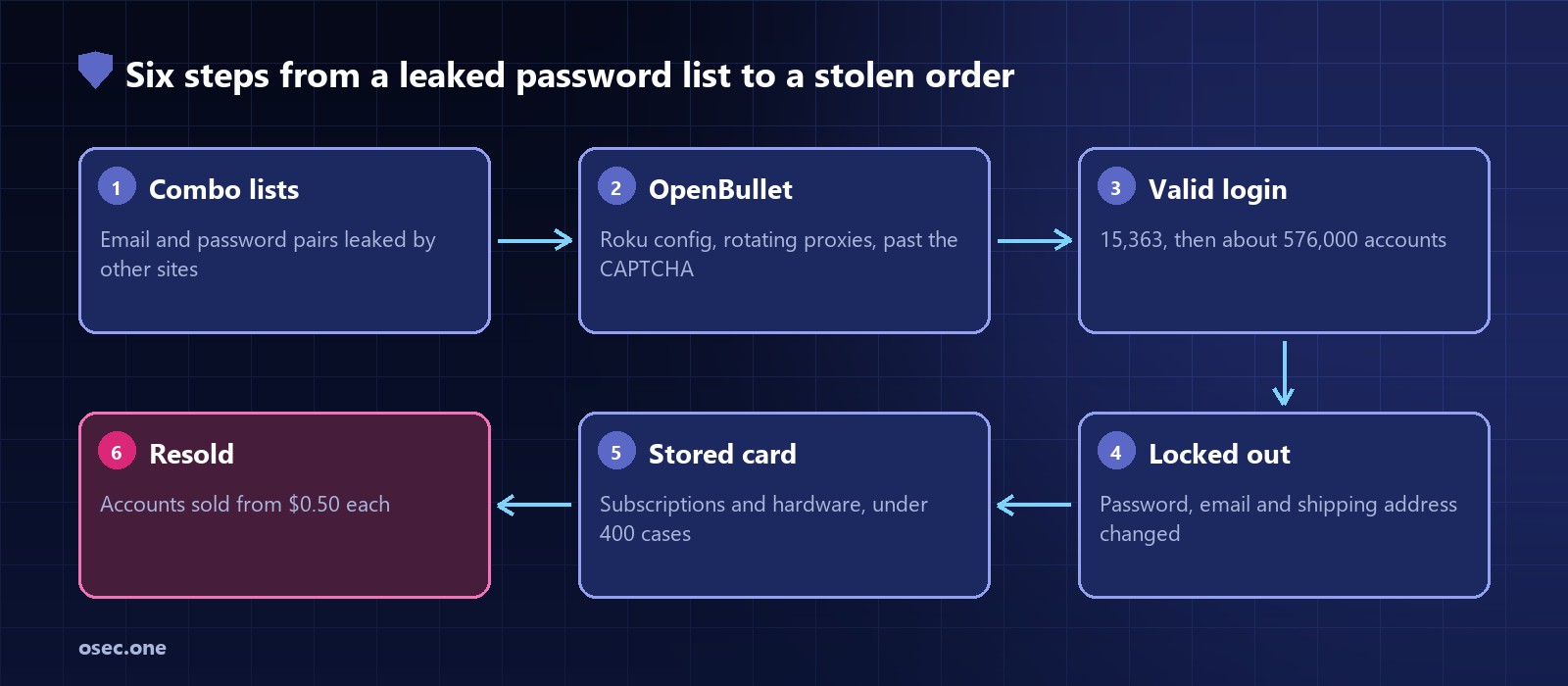
Six steps from a leaked password list to a soundbar shipped to someone else's address. Roku's own systems weren't breached.
\n
The two waves in numbers
\n
\n
Wave 1
Wave 2
\n
Accounts taken over
15,363
about 576,000
\n
When the attackers had access
28 Dec 2023 to 21 Feb 2024 (56 days, Maine AG filing)
Not published
\n
Disclosed
8 Mar 2024 (customer notices)
12 Apr 2024 (Roku blog)
\n
How Roku found it
Not stated
\"Ongoing security monitoring\" after wave 1
\n
Fraudulent purchases
Hardware and streaming subscriptions, shown off by buyers on Telegram
\"Less than 400\" cases, refunded
\n
Full card numbers taken
No
No
\n
Two-factor on the web account
Not offered
Turned on for all 80M+ accounts
\n
\n
Combined: 15,363 + 576,000 = 591,363 accounts, about 0.74% of Roku's 80 million active accounts (591,363 / 80,000,000). Small as a share, large as a number.
\n
How the attack worked, step by step
\n
1. A list of passwords from somewhere else
\n
Credential stuffing starts with "combo lists": email and password pairs from older breaches and infostealer logs, traded and resold in bulk. Nothing on the list came from Roku. It works because people reuse passwords: if your Roku password is the one that leaked from a forum in 2019, the attacker already has it.
\n
2. Off-the-shelf tools with a Roku config
\n
BleepingComputer found the first wave was run with OpenBullet 2 and SilverBullet, free automation tools that replay a site's sign-in request for every line of a combo list. Users share "configs" per target site. A researcher told BleepingComputer the Roku config had been in use for months, and that it got past Roku's brute-force limits and CAPTCHA by sending requests to specific URLs and rotating proxies, so each IP address made only a few attempts.
\n
3. A valid login, then the owner is locked out
\n
On a hit, the attackers changed the account's password, email address and shipping address. Changing the email does two things at once: the owner can no longer reset the password, and order confirmation emails stop reaching them. Many owners found out from a charge on their card.
\n
4. The saved card pays
\n
Roku accounts often keep a card on file for subscriptions. Attackers used it for streaming subscriptions and Roku hardware: streaming sticks, soundbars, remotes, light strips and cameras. Buyers posted redacted order confirmations on Telegram as proof. Roku counted fewer than 400 fraudulent purchases in wave 2, so most taken-over accounts were never used to buy anything. The resale market is the bigger worry.
\n
5. Accounts sold for as little as 50 cents
\n
BleepingComputer saw hijacked Roku accounts sold for as little as $0.50 each, one listing offering 439 accounts. The buyer gets a working login with a stored card and a delivery address they control.
\n
The arithmetic: how many attempts make 576,000 hits
\n
Roku didn't publish attempt counts, and there is no solid public number for stuffing success rates; industry estimates usually run from about 0.1% to 2% of attempts. Here is the second wave at three rates:
\n
\n
Assumed success rate
Attempts for 576,000 hits
Attempts for both waves (591,363)
\n
2%
28.8 million
29.6 million
\n
1%
57.6 million
59.1 million
\n
0.1%
576 million
591 million
\n
\n
Now spread wave 1 over its 56 known days. At a 1% success rate, 15,363 hits means 1.54 million attempts: about 27,400 a day, or one every 3 seconds. Run through 5,000 rotating proxy IPs, each IP makes about 5.5 attempts a day. A per-IP limit of 5 attempts a minute, a common default, allows 7,200 a day (5 × 1,440 minutes) and never fires: the busiest IP stays about 1,300 times below it.
\n
That's why per-IP rate limits and a CAPTCHA on the login form weren't enough. The signal is in other counts: the share of failed logins across the whole site, how many distinct accounts one network or one browser fingerprint tries, and sign-ins to accounts that have never been used from that region. For scale: Akamai counted 193 billion credential stuffing attempts across its customers in 2020, and Okta found that 34% of Auth0 sign-in traffic in 2022 was credential stuffing.
\n
Roku's fix: two-factor for everyone, by email link
\n
Roku's 2FA isn't an authenticator app or an SMS code. The next time anyone signs in to a Roku account on the web, Roku emails a verification link to the account's address, and the sign-in goes through only after the link is clicked. People who can't reach that mailbox can fall back to entering the last five digits of a device ID linked to the account.
\n
What it fixes and what it doesn't:
\n
• Fixes: a correct password alone no longer opens the account. A stuffing tool would also need the owner's mailbox. • Doesn't fix: accounts where the attacker had already changed the email. On those, the link goes to the attacker, and recovery depends on proving who owned the original address. • Weak spot: the device ID fallback is a short number on hardware in someone's living room. Reviewers called it too basic. • Moves the risk: the account is now only as safe as the email account. If someone reused their Roku password on their email too, the link protects nothing.
\n
Controls that break each step
\n
\n
Step
Control on your own sign-in
Effect here
\n
Reused password tried
Check new and existing passwords against known breached ones (the Pwned Passwords range API takes only the first 5 characters of a SHA-1 hash); force a reset on a match
Removes most of the combo list's hits before they happen
\n
Millions of attempts through proxies
Count failures per account, per device fingerprint and site-wide, not only per IP; slow down or challenge when the site's failure rate jumps
Catches the low-and-slow pattern a per-IP limit misses
\n
Login from a new device
Step-up on new devices: email code or link, passkey, or app approval (what Roku did, months later)
A correct password isn't enough
\n
Email changed
Confirm at the old address with a link that undoes the change; hold the change 24-72 hours; no password reset to the new address in that window
The owner can take the account back
\n
Shipping address changed, then a purchase
Re-authenticate before payment or address changes; a new address plus a hardware order within minutes goes to review
Stops the stored-card purchase
\n
Account resold
Sign out every session after a password or email change; alert when one device uses many accounts
Resold logins stop working
\n
\n
The cheapest control is not to have a password at all. A sign-in with only a one-time email code, or Google or Apple, gives a combo list nothing to try. osec.one's passwordless sign-in does email codes, Google and Apple with no OAuth setup on your side, and it's free. If you keep passwords, sign-in rules that count emails and wrong codes, not just IPs cover the second row of the table.
\n
How it differs from 23andMe
\n
Both started with reused passwords. In 23andMe's 2023 breach, about 14,000 logins led to data on 6.9 million people, because each account could see its DNA relatives: the damage came from a sharing feature. At Roku, each login was one account, and the damage was money: a stored card and a shipping address field. Different payoffs, same first step, and the same fix for that step: a correct password should never be the only thing between an attacker and an account.
\n
Sign-ins with email codes, Google and Apple: no password to stuff, no OAuth app to set up on your side. Free.
Roku 2024: two credential stuffing waves, 591,000 accounts and why Roku made two-factor mandatory
Roku wasn't hacked in 2024. Roku's statement says there was "no indication that Roku was the source of the account credentials" and no sign its systems were breached. Attackers took email and password pairs leaked by other services and tried them on Roku's sign-in page, millions of times, until hundreds of thousands worked. The first wave took over 15,363 accounts between 28 December 2023 and 21 February 2024. The second, disclosed on 12 April 2024, took over about 576,000. That's roughly 591,000 accounts in all, and fewer than 400 of them were used to buy things with the card the owner had saved.
Ad
Roku's answer was to turn on two-factor verification for every one of its more than 80 million active accounts, including the ones nobody had touched. This write-up walks through both waves step by step: the tools used, why per-IP limits and a CAPTCHA didn't stop them, the arithmetic on how many login attempts it takes to get 576,000 hits, and the control that breaks each step on a sign-in page of your own.
Six steps from a leaked password list to a soundbar shipped to someone else's address. Roku's own systems weren't breached.
The two waves in numbers
Wave 1
Wave 2
Accounts taken over
15,363
about 576,000
When the attackers had access
28 Dec 2023 to 21 Feb 2024 (56 days, Maine AG filing)
Not published
Disclosed
8 Mar 2024 (customer notices)
12 Apr 2024 (Roku blog)
How Roku found it
Not stated
"Ongoing security monitoring" after wave 1
Fraudulent purchases
Hardware and streaming subscriptions, shown off by buyers on Telegram
"Less than 400" cases, refunded
Full card numbers taken
No
No
Two-factor on the web account
Not offered
Turned on for all 80M+ accounts
Combined: 15,363 + 576,000 = 591,363 accounts, about 0.74% of Roku's 80 million active accounts (591,363 / 80,000,000). Small as a share, large as a number.
How the attack worked, step by step
1. A list of passwords from somewhere else
Credential stuffing starts with "combo lists": email and password pairs from older breaches and infostealer logs, traded and resold in bulk. Nothing on the list came from Roku. It works because people reuse passwords: if your Roku password is the one that leaked from a forum in 2019, the attacker already has it.
2. Off-the-shelf tools with a Roku config
BleepingComputer found the first wave was run with OpenBullet 2 and SilverBullet, free automation tools that replay a site's sign-in request for every line of a combo list. Users share "configs" per target site. A researcher told BleepingComputer the Roku config had been in use for months, and that it got past Roku's brute-force limits and CAPTCHA by sending requests to specific URLs and rotating proxies, so each IP address made only a few attempts.
3. A valid login, then the owner is locked out
On a hit, the attackers changed the account's password, email address and shipping address. Changing the email does two things at once: the owner can no longer reset the password, and order confirmation emails stop reaching them. Many owners found out from a charge on their card.
4. The saved card pays
Roku accounts often keep a card on file for subscriptions. Attackers used it for streaming subscriptions and Roku hardware: streaming sticks, soundbars, remotes, light strips and cameras. Buyers posted redacted order confirmations on Telegram as proof. Roku counted fewer than 400 fraudulent purchases in wave 2, so most taken-over accounts were never used to buy anything. The resale market is the bigger worry.
5. Accounts sold for as little as 50 cents
BleepingComputer saw hijacked Roku accounts sold for as little as $0.50 each, one listing offering 439 accounts. The buyer gets a working login with a stored card and a delivery address they control.
The arithmetic: how many attempts make 576,000 hits
Roku didn't publish attempt counts, and there is no solid public number for stuffing success rates; industry estimates usually run from about 0.1% to 2% of attempts. Here is the second wave at three rates:
Assumed success rate
Attempts for 576,000 hits
Attempts for both waves (591,363)
2%
28.8 million
29.6 million
1%
57.6 million
59.1 million
0.1%
576 million
591 million
Now spread wave 1 over its 56 known days. At a 1% success rate, 15,363 hits means 1.54 million attempts: about 27,400 a day, or one every 3 seconds. Run through 5,000 rotating proxy IPs, each IP makes about 5.5 attempts a day. A per-IP limit of 5 attempts a minute, a common default, allows 7,200 a day (5 × 1,440 minutes) and never fires: the busiest IP stays about 1,300 times below it.
That's why per-IP rate limits and a CAPTCHA on the login form weren't enough. The signal is in other counts: the share of failed logins across the whole site, how many distinct accounts one network or one browser fingerprint tries, and sign-ins to accounts that have never been used from that region. For scale: Akamai counted 193 billion credential stuffing attempts across its customers in 2020, and Okta found that 34% of Auth0 sign-in traffic in 2022 was credential stuffing.
Roku's fix: two-factor for everyone, by email link
Roku's 2FA isn't an authenticator app or an SMS code. The next time anyone signs in to a Roku account on the web, Roku emails a verification link to the account's address, and the sign-in goes through only after the link is clicked. People who can't reach that mailbox can fall back to entering the last five digits of a device ID linked to the account.
What it fixes and what it doesn't:
• Fixes: a correct password alone no longer opens the account. A stuffing tool would also need the owner's mailbox. • Doesn't fix: accounts where the attacker had already changed the email. On those, the link goes to the attacker, and recovery depends on proving who owned the original address. • Weak spot: the device ID fallback is a short number on hardware in someone's living room. Reviewers called it too basic. • Moves the risk: the account is now only as safe as the email account. If someone reused their Roku password on their email too, the link protects nothing.
Controls that break each step
Step
Control on your own sign-in
Effect here
Reused password tried
Check new and existing passwords against known breached ones (the Pwned Passwords range API takes only the first 5 characters of a SHA-1 hash); force a reset on a match
Removes most of the combo list's hits before they happen
Millions of attempts through proxies
Count failures per account, per device fingerprint and site-wide, not only per IP; slow down or challenge when the site's failure rate jumps
Catches the low-and-slow pattern a per-IP limit misses
Login from a new device
Step-up on new devices: email code or link, passkey, or app approval (what Roku did, months later)
A correct password isn't enough
Email changed
Confirm at the old address with a link that undoes the change; hold the change 24-72 hours; no password reset to the new address in that window
The owner can take the account back
Shipping address changed, then a purchase
Re-authenticate before payment or address changes; a new address plus a hardware order within minutes goes to review
Stops the stored-card purchase
Account resold
Sign out every session after a password or email change; alert when one device uses many accounts
Resold logins stop working
The cheapest control is not to have a password at all. A sign-in with only a one-time email code, or Google or Apple, gives a combo list nothing to try. osec.one's passwordless sign-in does email codes, Google and Apple with no OAuth setup on your side, and it's free. If you keep passwords, sign-in rules that count emails and wrong codes, not just IPs cover the second row of the table.
How it differs from 23andMe
Both started with reused passwords. In 23andMe's 2023 breach, about 14,000 logins led to data on 6.9 million people, because each account could see its DNA relatives: the damage came from a sharing feature. At Roku, each login was one account, and the damage was money: a stored card and a shipping address field. Different payoffs, same first step, and the same fix for that step: a correct password should never be the only thing between an attacker and an account.
Sign-ins with email codes, Google and Apple: no password to stuff, no OAuth app to set up on your side. Free.