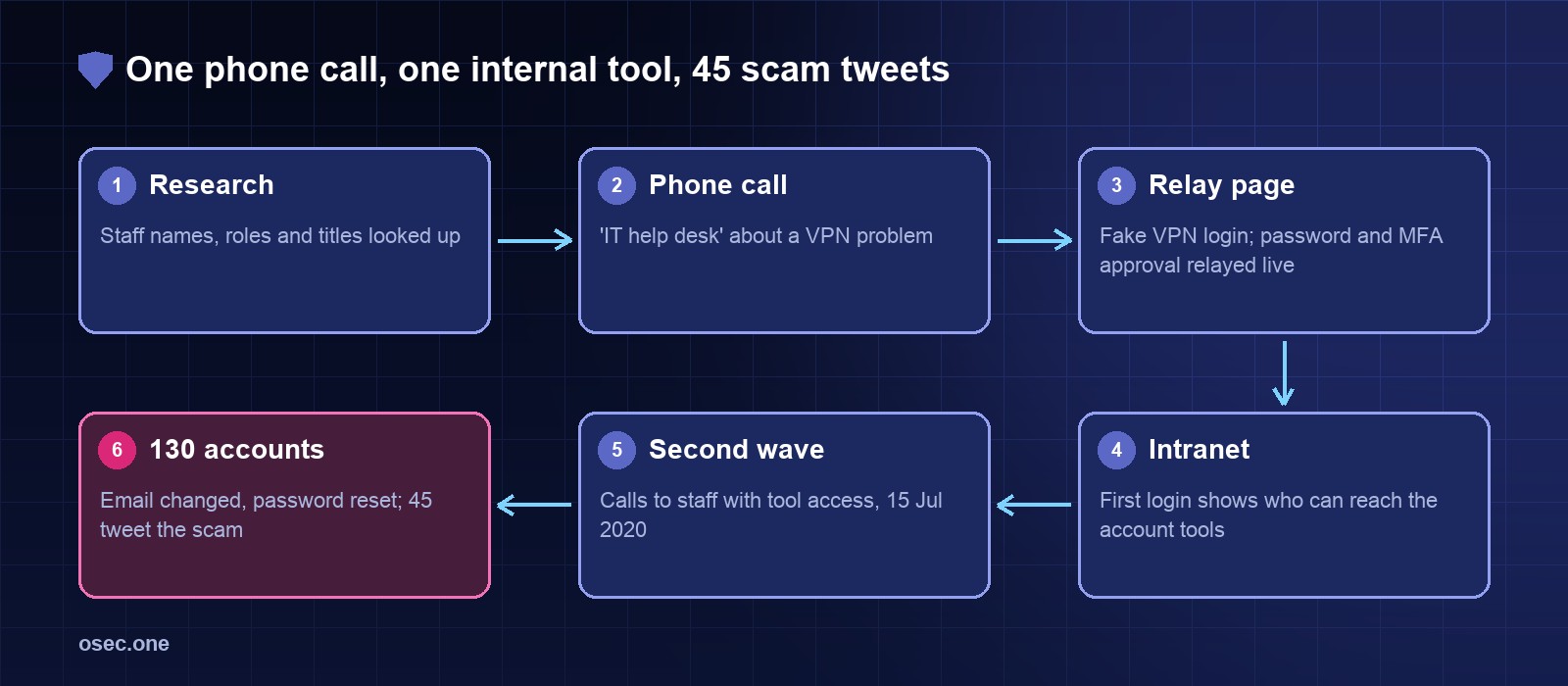
Nobody guessed a password or broke a bug. The attackers, led by a 17-year-old in Tampa, phoned Twitter employees, walked them onto a fake VPN login page, relayed their passwords and MFA prompts into the real one in real time, and then used Twitter's own internal account tool, which more than 1,000 employees could open, to change the email on the accounts they wanted. New York's Department of Financial Services (NYDFS) investigated and wrote: "no malware, no exploits, and no backdoors". This write-up follows each step from that report, the court papers and Twitter's own posts, then lists the controls for any company that runs an internal admin panel.
"},{"id":148107,"block_type":"screenshot","html":"Every step after the phone call used something that worked as designed: a VPN login, an MFA approval, an internal tool."},{"id":148108,"block_type":"heading_h2","html":"
The timeline
"},{"id":148109,"block_type":"code","html":"
text
Twitter, 14-15 July 2020 (Eastern time; NYDFS report, Twitter, DOJ)\n\n14 Jul, afternoon calls to employees: "IT Help Desk, about your VPN"\n15 Jul, 03:00-10:00 chat about taking over and selling short "OG" usernames\n15 Jul, morning several employees report odd log-ins and calls;\n Twitter's incident response starts looking\n~13:55 OG accounts hijacked; screenshots of the internal tool\n posted from them\n~14:16 @AngeloBTC: first bitcoin request\n~15:18 @Binance hijacked\n15:26-16:12 10 crypto company accounts (Coinbase, Gemini, Square...)\n16:17-18:05 Musk, Gates, Kanye West, Kim Kardashian West, Biden,\n Buffett, Mayweather, Uber, Apple (Obama and Bezos also)\n~17:45 @TwitterSupport: "aware of a security incident"\n18:18 verified accounts blocked from tweeting; accounts with a\n password change in the last 30 days locked\n18:59 NYDFS tells crypto firms it regulates to block the addresses\n20:41 most accounts can tweet again\n31 Jul three people charged (DOJ); a fourth arrested 2021
Twitter had sent most staff home in March 2020. VPN trouble was common, and so were calls from IT about it. The attackers looked up employees' names, roles and titles, then called them on 14 July posing as the Twitter IT Help Desk, "responding to a reported problem" with the employee's VPN. The fix they offered was to log in again, on a site they named.
"},{"id":148112,"block_type":"paragraph","html":"
NYDFS found that Twitter "did not implement any significant compensating controls after March 2020" for the move to remote work, and that the company had had no chief information security officer since December 2019. Some employees reported the calls. NYDFS says "at least one" believed them, and doesn't give a count of how many entered credentials.
Step 2: a look-alike VPN page that relayed the MFA prompt
"},{"id":148114,"block_type":"paragraph","html":"
The site was a copy of Twitter's VPN login page on a similar-looking domain. NYDFS describes what happened next: "As the employee entered their credentials into the phishing website, the Hackers would simultaneously enter the information into the real Twitter website." The real site then sent the employee an MFA prompt in an authenticator app, "which some of the employees did" approve.
"},{"id":148115,"block_type":"paragraph","html":"
That is the whole bypass. A push approval or a six-digit code proves the person is present; it doesn't prove which site they are signing in to. The attacker is on the phone, sees the login go through, and asks the employee to confirm. The same relay later reached Okta customers in the 0ktapus 2022 campaign, where text messages did the job of the phone call.
The first employee they got into had no access to the account tools. So the attackers used that login to read the intranet, where pages explained how to reach other internal applications and which teams used them. On 15 July they called again, this time employees who did have access, including people on the teams that handle legal requests and abuse reports.
"},{"id":148118,"block_type":"paragraph","html":"
The lesson for defenders is that the first account didn't need any power. A VPN session plus a readable wiki turned one phished login into a map of who held the keys.
NYDFS lists what Twitter's internal tools could do for an account: show its email address, phone number and the IP of its last login, and update the email, reset the password, and turn MFA on or off. Twitter's own update says that for the 45 accounts that tweeted, the attackers could "initiate a password reset, login to the account, and send Tweets". For the short handle @6, KrebsOnSecurity reported the email was changed and two-factor turned off.
"},{"id":148121,"block_type":"code","html":"
text
What the attackers got (NYDFS report; Twitter update of 30 July 2020)\n\nAccounts targeted 130\nAccounts tweeted from 45\nDirect-message inboxes accessed up to 36 (one a Dutch elected official)\n"Your Twitter Data" downloads 7 (none of them verified accounts)\nEmployees able to use the tools over 1,000
"},{"id":148122,"block_type":"paragraph","html":"
Nothing about the tool was broken. The access model was: any of a thousand-plus people, once signed in, could change the recovery email of any account, alone, without a ticket, and the change took effect immediately.
Step 5: first sell usernames, then the bitcoin scam
"},{"id":148124,"block_type":"paragraph","html":"
The first money came from short "OG" usernames such as @6, @B, @vague and @dark, sold through middlemen on Discord and the OGUsers forum. The complaint quotes the main hacker, posting as Kirk#5270: "I work for Twitter" and "I can claim any name"; a middleman writes "i have a buyer for 50 for 3k". KrebsOnSecurity saw email changes on any account offered for $250 and direct access for $2,000-3,000.
"},{"id":148125,"block_type":"paragraph","html":"
Then came the famous accounts and the "double your bitcoin" tweets. The FBI's count of the main address:
"},{"id":148126,"block_type":"code","html":"
text
Main scam address (complaint against Joseph O'Connor, July 2021)\n\nDeposits in ~415, total 12.86 BTC\nAt $9,133.56 per BTC (16 Jul) 12.86 x 9,133.56 = ~$117,457\nTransfers out 11, moving 12.83 BTC (99.74%)\nLeft in the address $274.01\n\nTwo more addresses ~100 transactions, ~$6,700\nNYDFS headline figure "approximately $118,000"
"},{"id":148127,"block_type":"paragraph","html":"
It could have been more. NYDFS surveyed the crypto firms it regulates once it told them to block the addresses at 18:59: 15 blocked them and 7 did not.
"},{"id":148128,"block_type":"code","html":"
text
Transfers to the scam addresses stopped by the exchange (NYDFS survey)\n\nExchange blocked transfers value\nCoinbase 5,670 ~$1,294,000\nSquare 358 ~$51,000\nGemini 2 ~$1,800\nBitstamp 1 ~$250\n\nCustomer losses that got through at Gemini, Square, Coinbase: ~$22,000
"},{"id":148129,"block_type":"paragraph","html":"
Coinbase's own statement on 20 July gave a different cut of the same event: about 1,100 customers stopped from sending 30.4 BTC (~$280,000), and 14 customers who sent about $3,000 before the block went up.
Person (alias) Outcome\nGraham Ivan Clark, 17, Tampa pleaded guilty 16 Mar 2021 as a youthful\n (Kirk#5270) offender: 3 years in prison, then 3 years'\n probation, credit for ~229 days served\nMason Sheppard, 19, UK (Chaewon) charged 31 Jul 2020: wire fraud conspiracy,\n money laundering conspiracy, intrusion\nNima Fazeli, 22, Orlando (Rolex) charged 31 Jul 2020: aiding and abetting\n computer intrusion\nJoseph O'Connor, UK (PlugwalkJoe) extradited from Spain, pleaded guilty May\n 2023; 5 years in prison (June 2023),\n together with a separate SIM-swap theft
1. That night: every employee, starting with the CEO, reset their password on a video call in front of a supervisor (NYDFS, citing the New York Times). 2. 18 July: internal access revoked and company-wide social-engineering training added. Twitter wrote that the scheme got past "our two-factor protections". 3. 30 July: "significantly limited access to our internal tools", better detection of inappropriate internal access, ongoing phishing exercises. 4. 2021: more than 5,500 employees moved to mandatory FIDO security keys, 100% in under three months, per Twitter's engineering blog. NYDFS had written that hardware keys "would have stopped the Hackers".
This is the part most companies skip, because the panel is "internal". Mailchimp's 2023 incident went the same way: an internal support tool, reached with phished staff credentials. What NYDFS recommended, made concrete:
"},{"id":148137,"block_type":"code","html":"
text
Step the attacker needed Control that breaks it\nany signed-in staff can open it per-role access, reviewed every quarter;\n support staff see accounts only when a\n ticket names them (per-ticket access)\nchange recovery email alone two-person rule: a second employee approves\n email, phone and MFA changes (NYDFS: "require\n certification or approval by a second\n employee before the action can be taken")\nchange takes effect at once hold period on recovery changes for\n high-profile accounts, with a notice to the\n old email and a one-click undo\nturn off MFA from the panel the panel can't remove MFA; the user\n re-enrols through recovery\nnobody watches the panel log every action with the ticket id; alert\n on bulk changes or changes outside a ticket
"},{"id":148138,"block_type":"paragraph","html":"
The arithmetic of a two-person rule is the point: with one approver per change, the attackers would have needed a second phished employee for each of the 130 accounts, or a second insider with the same access sitting next to the first.
1. Phishing-resistant MFA for staff: FIDO2 security keys or passkeys bind the login to the real domain, so a look-alike page gets nothing to relay. A push approval or a typed code doesn't. 2. Tell staff how IT will contact them, and that IT never asks them to sign in from a link given on a phone call. Give them a number to call back. 3. Alert on a new device or a new place for a VPN login followed by intranet browsing of admin-tool documentation. 4. Keep the intranet's "how to reach the tools" pages behind the same roles as the tools.
"},{"id":148141,"block_type":"paragraph","html":"
The help desk works in the other direction too: in MGM and Caesars 2023 the attackers called the help desk and asked it to reset MFA for them, and in Uber 2022 they pushed MFA prompts until a contractor accepted. In all three the weak point was a login that one person could approve, or have reset, on someone else's behalf.
The 130 accounts were taken through a recovery-email change, the same path a password reset uses. On your own site, rules that count recovery and sign-in attempts per email, not just per IP, make a burst of changes visible. osec's Login Protection does that for sign-in codes and wrong guesses, and works without moving your DNS.
"},{"id":148144,"block_type":"cta","html":"
A staff password that can be read out over the phone is one that can be phished. osec Auth signs people in with an email code, Google or Apple: no passwords to give away, no OAuth setup on your side, free.
On 15 July 2020, between about 14:00 and 18:05 Eastern time, tweets went out from the accounts of Barack Obama, Joe Biden, Elon Musk, Bill Gates, Apple, Uber, Coinbase and dozens of others, all saying the same thing: send bitcoin to this address and get double back, "only going on for 30 minutes". About 415 deposits worth 12.86 BTC arrived at the main address. None of it came back.
\n
Ad
\n
Nobody guessed a password or broke a bug. The attackers, led by a 17-year-old in Tampa, phoned Twitter employees, walked them onto a fake VPN login page, relayed their passwords and MFA prompts into the real one in real time, and then used Twitter's own internal account tool, which more than 1,000 employees could open, to change the email on the accounts they wanted. New York's Department of Financial Services (NYDFS) investigated and wrote: "no malware, no exploits, and no backdoors". This write-up follows each step from that report, the court papers and Twitter's own posts, then lists the controls for any company that runs an internal admin panel.
\n
Every step after the phone call used something that worked as designed: a VPN login, an MFA approval, an internal tool.
\n
The timeline
\n
text
Twitter, 14-15 July 2020 (Eastern time; NYDFS report, Twitter, DOJ)\n\n14 Jul, afternoon calls to employees: "IT Help Desk, about your VPN"\n15 Jul, 03:00-10:00 chat about taking over and selling short "OG" usernames\n15 Jul, morning several employees report odd log-ins and calls;\n Twitter's incident response starts looking\n~13:55 OG accounts hijacked; screenshots of the internal tool\n posted from them\n~14:16 @AngeloBTC: first bitcoin request\n~15:18 @Binance hijacked\n15:26-16:12 10 crypto company accounts (Coinbase, Gemini, Square...)\n16:17-18:05 Musk, Gates, Kanye West, Kim Kardashian West, Biden,\n Buffett, Mayweather, Uber, Apple (Obama and Bezos also)\n~17:45 @TwitterSupport: "aware of a security incident"\n18:18 verified accounts blocked from tweeting; accounts with a\n password change in the last 30 days locked\n18:59 NYDFS tells crypto firms it regulates to block the addresses\n20:41 most accounts can tweet again\n31 Jul three people charged (DOJ); a fourth arrested 2021
\n
Step 1: research, then a phone call about the VPN
\n
Twitter had sent most staff home in March 2020. VPN trouble was common, and so were calls from IT about it. The attackers looked up employees' names, roles and titles, then called them on 14 July posing as the Twitter IT Help Desk, "responding to a reported problem" with the employee's VPN. The fix they offered was to log in again, on a site they named.
\n
NYDFS found that Twitter "did not implement any significant compensating controls after March 2020" for the move to remote work, and that the company had had no chief information security officer since December 2019. Some employees reported the calls. NYDFS says "at least one" believed them, and doesn't give a count of how many entered credentials.
\n
Step 2: a look-alike VPN page that relayed the MFA prompt
\n
The site was a copy of Twitter's VPN login page on a similar-looking domain. NYDFS describes what happened next: "As the employee entered their credentials into the phishing website, the Hackers would simultaneously enter the information into the real Twitter website." The real site then sent the employee an MFA prompt in an authenticator app, "which some of the employees did" approve.
\n
That is the whole bypass. A push approval or a six-digit code proves the person is present; it doesn't prove which site they are signing in to. The attacker is on the phone, sees the login go through, and asks the employee to confirm. The same relay later reached Okta customers in the 0ktapus 2022 campaign, where text messages did the job of the phone call.
\n
Step 3: the intranet showed who to call next
\n
The first employee they got into had no access to the account tools. So the attackers used that login to read the intranet, where pages explained how to reach other internal applications and which teams used them. On 15 July they called again, this time employees who did have access, including people on the teams that handle legal requests and abuse reports.
\n
The lesson for defenders is that the first account didn't need any power. A VPN session plus a readable wiki turned one phished login into a map of who held the keys.
\n
Step 4: one internal tool, 130 accounts
\n
NYDFS lists what Twitter's internal tools could do for an account: show its email address, phone number and the IP of its last login, and update the email, reset the password, and turn MFA on or off. Twitter's own update says that for the 45 accounts that tweeted, the attackers could "initiate a password reset, login to the account, and send Tweets". For the short handle @6, KrebsOnSecurity reported the email was changed and two-factor turned off.
\n
text
What the attackers got (NYDFS report; Twitter update of 30 July 2020)\n\nAccounts targeted 130\nAccounts tweeted from 45\nDirect-message inboxes accessed up to 36 (one a Dutch elected official)\n"Your Twitter Data" downloads 7 (none of them verified accounts)\nEmployees able to use the tools over 1,000
\n
Nothing about the tool was broken. The access model was: any of a thousand-plus people, once signed in, could change the recovery email of any account, alone, without a ticket, and the change took effect immediately.
\n
Step 5: first sell usernames, then the bitcoin scam
\n
The first money came from short "OG" usernames such as @6, @B, @vague and @dark, sold through middlemen on Discord and the OGUsers forum. The complaint quotes the main hacker, posting as Kirk#5270: "I work for Twitter" and "I can claim any name"; a middleman writes "i have a buyer for 50 for 3k". KrebsOnSecurity saw email changes on any account offered for $250 and direct access for $2,000-3,000.
\n
Then came the famous accounts and the "double your bitcoin" tweets. The FBI's count of the main address:
\n
text
Main scam address (complaint against Joseph O'Connor, July 2021)\n\nDeposits in ~415, total 12.86 BTC\nAt $9,133.56 per BTC (16 Jul) 12.86 x 9,133.56 = ~$117,457\nTransfers out 11, moving 12.83 BTC (99.74%)\nLeft in the address $274.01\n\nTwo more addresses ~100 transactions, ~$6,700\nNYDFS headline figure "approximately $118,000"
\n
It could have been more. NYDFS surveyed the crypto firms it regulates once it told them to block the addresses at 18:59: 15 blocked them and 7 did not.
\n
text
Transfers to the scam addresses stopped by the exchange (NYDFS survey)\n\nExchange blocked transfers value\nCoinbase 5,670 ~$1,294,000\nSquare 358 ~$51,000\nGemini 2 ~$1,800\nBitstamp 1 ~$250\n\nCustomer losses that got through at Gemini, Square, Coinbase: ~$22,000
\n
Coinbase's own statement on 20 July gave a different cut of the same event: about 1,100 customers stopped from sending 30.4 BTC (~$280,000), and 14 customers who sent about $3,000 before the block went up.
\n
How it ended for the people involved
\n
text
Person (alias) Outcome\nGraham Ivan Clark, 17, Tampa pleaded guilty 16 Mar 2021 as a youthful\n (Kirk#5270) offender: 3 years in prison, then 3 years'\n probation, credit for ~229 days served\nMason Sheppard, 19, UK (Chaewon) charged 31 Jul 2020: wire fraud conspiracy,\n money laundering conspiracy, intrusion\nNima Fazeli, 22, Orlando (Rolex) charged 31 Jul 2020: aiding and abetting\n computer intrusion\nJoseph O'Connor, UK (PlugwalkJoe) extradited from Spain, pleaded guilty May\n 2023; 5 years in prison (June 2023),\n together with a separate SIM-swap theft
\n
What Twitter changed
\n
1. That night: every employee, starting with the CEO, reset their password on a video call in front of a supervisor (NYDFS, citing the New York Times). 2. 18 July: internal access revoked and company-wide social-engineering training added. Twitter wrote that the scheme got past "our two-factor protections". 3. 30 July: "significantly limited access to our internal tools", better detection of inappropriate internal access, ongoing phishing exercises. 4. 2021: more than 5,500 employees moved to mandatory FIDO security keys, 100% in under three months, per Twitter's engineering blog. NYDFS had written that hardware keys "would have stopped the Hackers".
\n
What breaks each step
\n
For the internal admin panel itself
\n
This is the part most companies skip, because the panel is "internal". Mailchimp's 2023 incident went the same way: an internal support tool, reached with phished staff credentials. What NYDFS recommended, made concrete:
\n
text
Step the attacker needed Control that breaks it\nany signed-in staff can open it per-role access, reviewed every quarter;\n support staff see accounts only when a\n ticket names them (per-ticket access)\nchange recovery email alone two-person rule: a second employee approves\n email, phone and MFA changes (NYDFS: "require\n certification or approval by a second\n employee before the action can be taken")\nchange takes effect at once hold period on recovery changes for\n high-profile accounts, with a notice to the\n old email and a one-click undo\nturn off MFA from the panel the panel can't remove MFA; the user\n re-enrols through recovery\nnobody watches the panel log every action with the ticket id; alert\n on bulk changes or changes outside a ticket
\n
The arithmetic of a two-person rule is the point: with one approver per change, the attackers would have needed a second phished employee for each of the 130 accounts, or a second insider with the same access sitting next to the first.
\n
For the sign-in that got them there
\n
1. Phishing-resistant MFA for staff: FIDO2 security keys or passkeys bind the login to the real domain, so a look-alike page gets nothing to relay. A push approval or a typed code doesn't. 2. Tell staff how IT will contact them, and that IT never asks them to sign in from a link given on a phone call. Give them a number to call back. 3. Alert on a new device or a new place for a VPN login followed by intranet browsing of admin-tool documentation. 4. Keep the intranet's "how to reach the tools" pages behind the same roles as the tools.
\n
The help desk works in the other direction too: in MGM and Caesars 2023 the attackers called the help desk and asked it to reset MFA for them, and in Uber 2022 they pushed MFA prompts until a contractor accepted. In all three the weak point was a login that one person could approve, or have reset, on someone else's behalf.
\n
For your own users
\n
The 130 accounts were taken through a recovery-email change, the same path a password reset uses. On your own site, rules that count recovery and sign-in attempts per email, not just per IP, make a burst of changes visible. osec's Login Protection does that for sign-in codes and wrong guesses, and works without moving your DNS.
\n
A staff password that can be read out over the phone is one that can be phished. osec Auth signs people in with an email code, Google or Apple: no passwords to give away, no OAuth setup on your side, free.
Twitter 2020: phone calls to staff, an internal admin panel and 130 famous accounts
On 15 July 2020, between about 14:00 and 18:05 Eastern time, tweets went out from the accounts of Barack Obama, Joe Biden, Elon Musk, Bill Gates, Apple, Uber, Coinbase and dozens of others, all saying the same thing: send bitcoin to this address and get double back, "only going on for 30 minutes". About 415 deposits worth 12.86 BTC arrived at the main address. None of it came back.
Ad
Nobody guessed a password or broke a bug. The attackers, led by a 17-year-old in Tampa, phoned Twitter employees, walked them onto a fake VPN login page, relayed their passwords and MFA prompts into the real one in real time, and then used Twitter's own internal account tool, which more than 1,000 employees could open, to change the email on the accounts they wanted. New York's Department of Financial Services (NYDFS) investigated and wrote: "no malware, no exploits, and no backdoors". This write-up follows each step from that report, the court papers and Twitter's own posts, then lists the controls for any company that runs an internal admin panel.
Every step after the phone call used something that worked as designed: a VPN login, an MFA approval, an internal tool.
The timeline
text
Twitter, 14-15 July 2020 (Eastern time; NYDFS report, Twitter, DOJ)

14 Jul, afternoon   calls to employees: "IT Help Desk, about your VPN"
15 Jul, 03:00-10:00 chat about taking over and selling short "OG" usernames
15 Jul, morning     several employees report odd log-ins and calls;
                    Twitter's incident response starts looking
~13:55              OG accounts hijacked; screenshots of the internal tool
                    posted from them
~14:16              @AngeloBTC: first bitcoin request
~15:18              @Binance hijacked
15:26-16:12         10 crypto company accounts (Coinbase, Gemini, Square...)
16:17-18:05         Musk, Gates, Kanye West, Kim Kardashian West, Biden,
                    Buffett, Mayweather, Uber, Apple (Obama and Bezos also)
~17:45              @TwitterSupport: "aware of a security incident"
18:18               verified accounts blocked from tweeting; accounts with a
                    password change in the last 30 days locked
18:59               NYDFS tells crypto firms it regulates to block the addresses
20:41               most accounts can tweet again
31 Jul              three people charged (DOJ); a fourth arrested 2021
Step 1: research, then a phone call about the VPN
Twitter had sent most staff home in March 2020. VPN trouble was common, and so were calls from IT about it. The attackers looked up employees' names, roles and titles, then called them on 14 July posing as the Twitter IT Help Desk, "responding to a reported problem" with the employee's VPN. The fix they offered was to log in again, on a site they named.
NYDFS found that Twitter "did not implement any significant compensating controls after March 2020" for the move to remote work, and that the company had had no chief information security officer since December 2019. Some employees reported the calls. NYDFS says "at least one" believed them, and doesn't give a count of how many entered credentials.
Step 2: a look-alike VPN page that relayed the MFA prompt
The site was a copy of Twitter's VPN login page on a similar-looking domain. NYDFS describes what happened next: "As the employee entered their credentials into the phishing website, the Hackers would simultaneously enter the information into the real Twitter website." The real site then sent the employee an MFA prompt in an authenticator app, "which some of the employees did" approve.
That is the whole bypass. A push approval or a six-digit code proves the person is present; it doesn't prove which site they are signing in to. The attacker is on the phone, sees the login go through, and asks the employee to confirm. The same relay later reached Okta customers in the 0ktapus 2022 campaign, where text messages did the job of the phone call.
Step 3: the intranet showed who to call next
The first employee they got into had no access to the account tools. So the attackers used that login to read the intranet, where pages explained how to reach other internal applications and which teams used them. On 15 July they called again, this time employees who did have access, including people on the teams that handle legal requests and abuse reports.
The lesson for defenders is that the first account didn't need any power. A VPN session plus a readable wiki turned one phished login into a map of who held the keys.
Step 4: one internal tool, 130 accounts
NYDFS lists what Twitter's internal tools could do for an account: show its email address, phone number and the IP of its last login, and update the email, reset the password, and turn MFA on or off. Twitter's own update says that for the 45 accounts that tweeted, the attackers could "initiate a password reset, login to the account, and send Tweets". For the short handle @6, KrebsOnSecurity reported the email was changed and two-factor turned off.
text
What the attackers got (NYDFS report; Twitter update of 30 July 2020)

Accounts targeted                  130
Accounts tweeted from              45
Direct-message inboxes accessed    up to 36 (one a Dutch elected official)
"Your Twitter Data" downloads       7 (none of them verified accounts)
Employees able to use the tools    over 1,000
Nothing about the tool was broken. The access model was: any of a thousand-plus people, once signed in, could change the recovery email of any account, alone, without a ticket, and the change took effect immediately.
Step 5: first sell usernames, then the bitcoin scam
The first money came from short "OG" usernames such as @6, @B, @vague and @dark, sold through middlemen on Discord and the OGUsers forum. The complaint quotes the main hacker, posting as Kirk#5270: "I work for Twitter" and "I can claim any name"; a middleman writes "i have a buyer for 50 for 3k". KrebsOnSecurity saw email changes on any account offered for $250 and direct access for $2,000-3,000.
Then came the famous accounts and the "double your bitcoin" tweets. The FBI's count of the main address:
text
Main scam address (complaint against Joseph O'Connor, July 2021)

Deposits in                    ~415, total 12.86 BTC
At $9,133.56 per BTC (16 Jul)  12.86 x 9,133.56 = ~$117,457
Transfers out                  11, moving 12.83 BTC (99.74%)
Left in the address            $274.01

Two more addresses             ~100 transactions, ~$6,700
NYDFS headline figure          "approximately $118,000"
It could have been more. NYDFS surveyed the crypto firms it regulates once it told them to block the addresses at 18:59: 15 blocked them and 7 did not.
text
Transfers to the scam addresses stopped by the exchange (NYDFS survey)

Exchange   blocked transfers   value
Coinbase   5,670               ~$1,294,000
Square     358                 ~$51,000
Gemini     2                   ~$1,800
Bitstamp   1                   ~$250

Customer losses that got through at Gemini, Square, Coinbase: ~$22,000
Coinbase's own statement on 20 July gave a different cut of the same event: about 1,100 customers stopped from sending 30.4 BTC (~$280,000), and 14 customers who sent about $3,000 before the block went up.
How it ended for the people involved
text
Person (alias)                        Outcome
Graham Ivan Clark, 17, Tampa          pleaded guilty 16 Mar 2021 as a youthful
  (Kirk#5270)                         offender: 3 years in prison, then 3 years'
                                      probation, credit for ~229 days served
Mason Sheppard, 19, UK (Chaewon)      charged 31 Jul 2020: wire fraud conspiracy,
                                      money laundering conspiracy, intrusion
Nima Fazeli, 22, Orlando (Rolex)      charged 31 Jul 2020: aiding and abetting
                                      computer intrusion
Joseph O'Connor, UK (PlugwalkJoe)     extradited from Spain, pleaded guilty May
                                      2023; 5 years in prison (June 2023),
                                      together with a separate SIM-swap theft
What Twitter changed
1. That night: every employee, starting with the CEO, reset their password on a video call in front of a supervisor (NYDFS, citing the New York Times). 2. 18 July: internal access revoked and company-wide social-engineering training added. Twitter wrote that the scheme got past "our two-factor protections". 3. 30 July: "significantly limited access to our internal tools", better detection of inappropriate internal access, ongoing phishing exercises. 4. 2021: more than 5,500 employees moved to mandatory FIDO security keys, 100% in under three months, per Twitter's engineering blog. NYDFS had written that hardware keys "would have stopped the Hackers".
What breaks each step
For the internal admin panel itself
This is the part most companies skip, because the panel is "internal". Mailchimp's 2023 incident went the same way: an internal support tool, reached with phished staff credentials. What NYDFS recommended, made concrete:
text
Step the attacker needed            Control that breaks it
any signed-in staff can open it     per-role access, reviewed every quarter;
                                    support staff see accounts only when a
                                    ticket names them (per-ticket access)
change recovery email alone         two-person rule: a second employee approves
                                    email, phone and MFA changes (NYDFS: "require
                                    certification or approval by a second
                                    employee before the action can be taken")
change takes effect at once         hold period on recovery changes for
                                    high-profile accounts, with a notice to the
                                    old email and a one-click undo
turn off MFA from the panel         the panel can't remove MFA; the user
                                    re-enrols through recovery
nobody watches the panel            log every action with the ticket id; alert
                                    on bulk changes or changes outside a ticket
The arithmetic of a two-person rule is the point: with one approver per change, the attackers would have needed a second phished employee for each of the 130 accounts, or a second insider with the same access sitting next to the first.
For the sign-in that got them there
1. Phishing-resistant MFA for staff: FIDO2 security keys or passkeys bind the login to the real domain, so a look-alike page gets nothing to relay. A push approval or a typed code doesn't. 2. Tell staff how IT will contact them, and that IT never asks them to sign in from a link given on a phone call. Give them a number to call back. 3. Alert on a new device or a new place for a VPN login followed by intranet browsing of admin-tool documentation. 4. Keep the intranet's "how to reach the tools" pages behind the same roles as the tools.
The help desk works in the other direction too: in MGM and Caesars 2023 the attackers called the help desk and asked it to reset MFA for them, and in Uber 2022 they pushed MFA prompts until a contractor accepted. In all three the weak point was a login that one person could approve, or have reset, on someone else's behalf.
For your own users
The 130 accounts were taken through a recovery-email change, the same path a password reset uses. On your own site, rules that count recovery and sign-in attempts per email, not just per IP, make a burst of changes visible. osec's Login Protection does that for sign-in codes and wrong guesses, and works without moving your DNS.
A staff password that can be read out over the phone is one that can be phished. osec Auth signs people in with an email code, Google or Apple: no passwords to give away, no OAuth setup on your side, free.