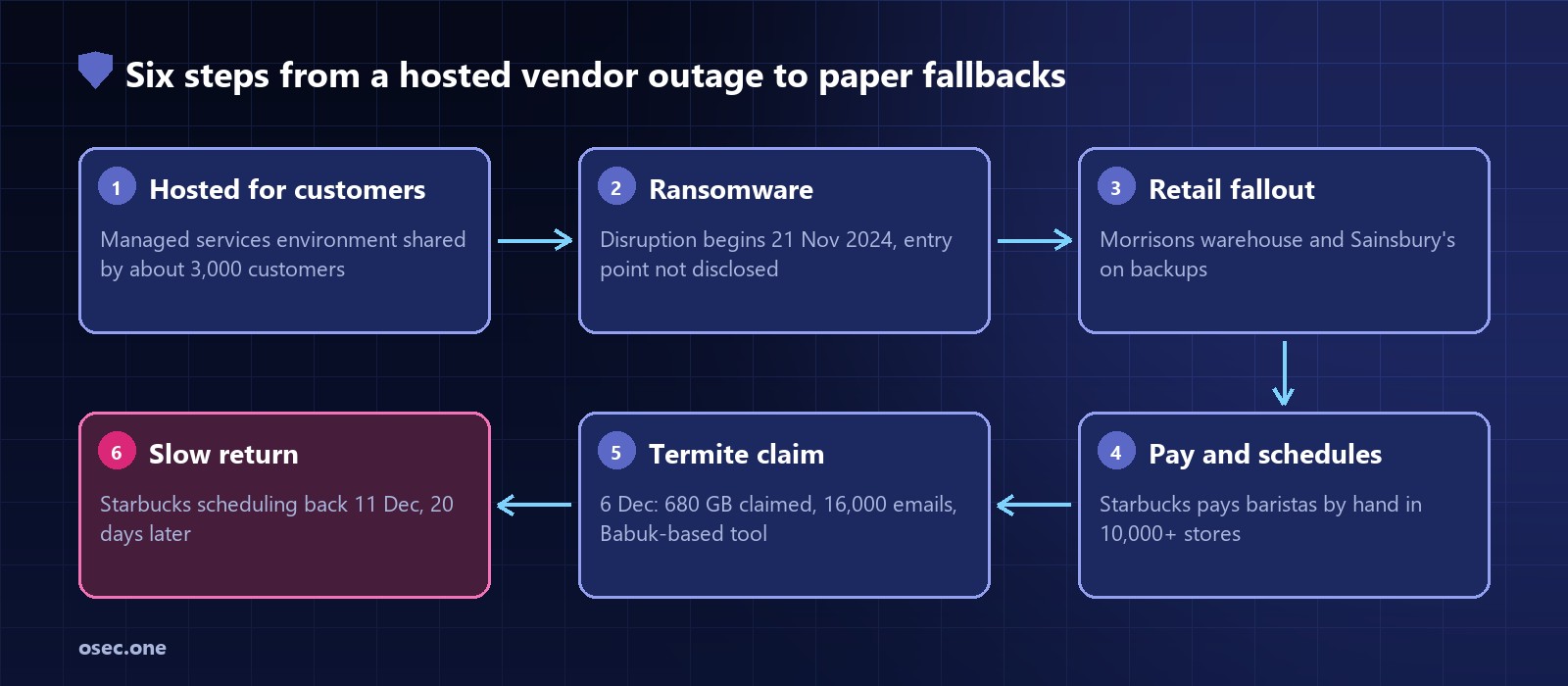
On 21 November 2024 the supply chain software company Blue Yonder said its managed services hosted environment had been hit by ransomware. Two retailers could not run normal operations because of it: Starbucks could not pay baristas or build schedules from its usual system, and the UK grocer Morrisons ran its warehouses on a backup. Neither company was breached. They both rented software that ran in the vendor's hosting, and the vendor went down.
Short version: Blue Yonder never published how the attackers got in, the ransomware group Termite claimed the attack two weeks later, and the clearest lesson is about what each customer could do by hand while the vendor was dark. Everything below is dated and sourced, and where outlets disagreed, the text says so.
Who Blue Yonder is and why one outage reached so many
• Blue Yonder (formerly JDA Software, owned by Panasonic since 2021) sells supply chain planning, warehouse and workforce software.
• Per SecurityWeek it has about 3,000 customers in 76 countries.
• The affected part was the managed services hosted environment: Blue Yonder runs the software for the customer instead of the customer running it. So a customer cannot just restore from its own backup. It waits for the vendor.
• Blue Yonder also said it was monitoring its Azure public cloud environment and had seen no suspicious activity there (ITPro). The incident was in the other, managed hosting side.
Timeline, with dates
| Date (2024) | What happened |
|---|---|
| Thu 21 Nov | Blue Yonder's disruption begins in the managed services hosted environment; the company later says it was a ransomware incident |
| Fri 22 Nov | Per TechCrunch, Blue Yonder posts its statement (SecurityWeek and CyberScoop date the disclosure 21 Nov, so outlets differ by one day) |
| Sun 24 Nov | Update: steady progress, no timeline for restoration |
| Mon 25 Nov | Starbucks says the issue touches about 11,000 North American stores and not customer service (ITPro); Sainsbury's says its services have been restored (TechCrunch) |
| Tue 26 Nov | TechCrunch, SecurityWeek and ITPro report ongoing disruption at Morrisons, Sainsbury's and Starbucks |
| Weekend before 6 Dec | Blue Yonder brings some impacted customers back online (BleepingComputer, no exact date) |
| Fri 6 Dec | Blue Yonder: "an unauthorized third party claims to have taken certain information from our systems". Termite lists the company on its leak site |
| Wed 11 Dec | Starbucks tells Cybersecurity Dive its Blue Yonder scheduling platform is back in service |
From 21 November to 11 December is 20 days for the one customer with a confirmed return date. For the others, none of the sources gives a full-restoration date.
What each customer lost, and what it did by hand
| Customer | What was hit | Fallback |
|---|---|---|
| Starbucks (US, 10,000+ stores) | Pay and schedule tools for store partners (BleepingComputer says over 10,000 stores, ITPro 11,000 in North America) | Managers calculated pay manually; customer service unaffected |
| Morrisons (UK, about 500 stores) | Warehouse management for fresh produce | "We are currently operating on our backup systems"; supplier deliveries and some availability hit; ambient and frozen unaffected |
| Sainsbury's (UK, 2,300+ stores) | Confirmed disruption | Existing procedures to mitigate; TechCrunch reported services restored on 25 Nov, other outlets still described it as ongoing on 26 Nov |
| BIC (France) | Shipping delays, per BleepingComputer citing The Record (not independently checked) | Not stated |
| Tesco, DHL | Said they were not affected | None needed |
| Albertsons, Kroger, Ford, P&G, Anheuser-Busch | Named by CNN as Blue Yonder users; SecurityWeek says it is unclear if they were affected | Unknown |
Blue Yonder did not say how many of its roughly 3,000 customers were disrupted, so the table is a list of those who confirmed it, not a count.
Why the differences? The two UK grocers that depend on Blue Yonder for warehouse flow had a physical-world problem (trucks, pallets, shelves). Starbucks had a paperwork problem (who worked, who gets paid). Both fell back to people and spreadsheets, but the pay fallback is easier to run for a week than a warehouse one.
The Termite claim: what is solid and what is not
• Claim date: Termite posted Blue Yonder on its Tor leak site on 6 December 2024 (BleepingComputer). Blue Yonder said it was investigating the claim and has not confirmed the group.
• Claimed data: 680 GB: database dumps, "email lists for future attacks (over 16000)", "documents (over 200000)" and insurance documents. CyberScoop paraphrases it as over 200,000 insurance documents; the quoted post lists them as separate items, so that figure is ambiguous. All of it is the group's claim, not verified.
• The group: surfaced in mid-October 2024 (Cyjax, via BleepingComputer). BleepingComputer counted seven listed victims at the time; Broadcom listed victims in France, Canada, Germany, Oman and the US.
• The tool: a modified version of Babuk, whose source leaked in September 2021. It adds a .termite extension and drops How To Restore Your Files.txt. Trend Micro called it a work in progress that can stop early because of a flaw.
• Ransom: none of the seven reports gives an amount, deadline or payment.
How they got in: not known
Blue Yonder has not stated a cause. Broadcom said the full way of working was unknown and listed only typical methods (phishing, vulnerabilities, bought credentials, privilege escalation) as possibilities. None of the sources links this to a specific vulnerability. So anything claiming a particular entry point is a guess. What is known is the shape: a vendor-run, multi-customer environment that was reached, and a restoration that took weeks.
Where this sits next to other vendor outages on this site
| Case | Vendor | Customers stopped | Time to recover (from reports) |
|---|---|---|---|
| CDK Global, Jun 2024 | Dealer management system | About 15,000 car dealerships | About two weeks |
| Blue Yonder, Nov 2024 | Hosted supply chain and workforce software | Starbucks, Morrisons, Sainsbury's and others | 20 days for Starbucks scheduling; others undated |
| Collins Aerospace, Sep 2025 | Airport check-in software | Four European airports | Days of disruption, rebuild from 29 Sep |
The pattern is the same each time: the customer had no control over the restore, and the recovery time was set by someone else's queue.
Full write-ups: CDK Global 2024 and Collins Aerospace 2025.
A one-hour vendor check for a small company
1. List the 5 vendors whose outage stops revenue or pay. Payroll, scheduling, warehouse or shipping, payments, email.
2. Write the manual fallback in one line each. Starbucks managers could compute pay by hand, which is why it hurt but did not stop. If you cannot write the line, that vendor is your finding.
3. Ask where the data lives. Hosted for you by the vendor, or in your own account? Hosted means your restore time is theirs.
4. Keep a weekly export of the data you would need on day one: employee list and hours, open orders, supplier contacts. A CSV in your own storage is enough.
5. Ask how each vendor's staff and your staff sign in. Phishing-resistant MFA (passkeys or security keys) on every admin path is the baseline to ask for.
6. Agree who decides to switch to the fallback, and after how many hours. The grocers' backups only helped because they were ready.
Sources: TechCrunch, 26 Nov 2024; SecurityWeek, 26 Nov 2024; ITPro, 26 Nov 2024; BleepingComputer, 6 Dec 2024; The Register, 9 Dec 2024; CyberScoop, 9 Dec 2024; TechRadar, 10 Dec 2024; Starbucks' 11 December return date: Cybersecurity Dive.
A vendor outage and a stolen password both end at a sign-in. osec Auth gives your site email-code, Google and Apple sign-in with no passwords to leak: free, and you paste a snippet instead of building it.
Try osec Auth