SonicWall's message to customers was steady throughout: the passwords and keys in the files are encrypted, but reset them anyway. That sounds contradictory, and many admins treated it as optional. This write-up goes through what a firewall configuration backup holds, what the encryption does and doesn't protect, the cost of breaking each cipher (and why that's the wrong question), and a rotation order that won't lock you out.
"},{"id":146795,"block_type":"screenshot","html":"Six steps from a convenience setting to a target list. Steps 4 to 6 still apply to anyone who hasn't rotated."},{"id":146796,"block_type":"heading_h2","html":"
Timeline
"},{"id":146797,"block_type":"html","html":"
\n
When
What happened
Source
\n
Early Sep 2025
SonicWall detects suspicious downloads of backup configuration files from its cloud
SonicWall via Help Net Security
\n
17 Sep 2025
Notice published: a \"brute-force (not ransomware) attack\" on the backup service, under 5% of firewalls, no known leaks
SonicWall notice
\n
24 Sep 2025
Clarified: credentials stay encrypted, but some configuration details are only encoded
SonicWall notice
\n
4-10 Oct 2025
Huntress sees 100+ SSL VPN accounts at 16 customer organisations logged into with valid credentials; no link to the backups shown
Huntress
\n
8 Oct 2025
Final investigation with Mandiant: backups accessed for all customers who used cloud backup; updated device lists in MySonicWall
SonicWall notice
\n
9 Oct 2025
Notice adds that Gen 6 secrets are encrypted with 3DES, and the \"Last Download Date\" field
SonicWall notice
\n
28 Oct 2025
Offline Credentials Reset Tool and Online Analysis Tool linked
SonicWall notice
\n
4-6 Nov 2025
SonicWall: a state-sponsored actor, access through an API call, limited to the backup service; unrelated to the Akira attacks
SonicWall via Help Net Security
\n
"},{"id":146798,"block_type":"paragraph","html":"
Two things stand out. The first estimate was off by the whole customer base, which is common when a breach is sized from logs before the investigation ends. And the access method changed from "brute force" to "an API call", which SonicWall never explained further. If you sized your own response on the 17 September number, it was too small.
A SonicOS settings export is an .EXP file: a full snapshot meant to restore a device to exactly how it was. SonicWall describes the file as encoded, not encrypted. Decoding it gives back the readable settings. Only the credentials and secrets inside are encrypted, one by one: AES-256 on Gen 7 and newer, 3DES on Gen 6. The cloud copy was encrypted at rest on SonicWall's side, but an API that serves the file back serves it decoded to that same state.
"},{"id":146801,"block_type":"html","html":"
\n
In the file
State
What it gives an attacker
\n
Interfaces, public IPs, internal subnets, VLANs, routes
Readable
A network map before the first packet is sent
\n
Access rules and NAT
Readable
Which internal hosts are reachable from the internet, on which ports
\n
Enabled services: SSL VPN, HTTPS/SSH management on WAN, SNMP
LDAP/RADIUS/TACACS+ server addresses and bind account names
Readable
Which directory account the firewall uses
\n
Firmware version and model
Readable
Which known-exploited CVEs still apply
\n
Local passwords, TOTP seeds, PSKs, RADIUS secrets, LDAP bind password, API keys
Encrypted (AES-256 Gen 7, 3DES Gen 6)
Safe only as long as the encryption key is
\n
"},{"id":146802,"block_type":"paragraph","html":"
The readable part alone is a targeting package. A list of usernames plus the firmware version plus "SSL VPN is on" is what a password-spray or exploit crew pays initial-access brokers for.
The cipher question: what breaking the encryption costs
"},{"id":146804,"block_type":"paragraph","html":"
Admins asked whether 3DES on Gen 6 was weak enough to worry about. Here's the brute-force arithmetic at a generous one trillion (10¹²) keys a second:
"},{"id":146805,"block_type":"html","html":"
\n
Cipher
Effective security (NIST SP 800-57)
Keys to try
Time at 1012/s
\n
3DES, two-key
80 bits
280 ≈ 1.2 × 1024
1.2 × 10¹² s ≈ 38,000 years
\n
3DES, three-key
112 bits
2112 ≈ 5.2 × 1033
≈ 1.6 × 10¹⁴ years
\n
AES-256
256 bits
2256 ≈ 1.2 × 1077
≈ 3.7 × 1057 years
\n
"},{"id":146806,"block_type":"paragraph","html":"
Worked for the two-key row: 2⁸⁰ = 1.21 × 10²⁴ keys ÷ 10¹² per second = 1.21 × 10¹² seconds; ÷ 31.6 million seconds a year ≈ 38,000 years. SonicWall hasn't said which 3DES keying it uses. NIST has disallowed 3DES for new encryption since the end of 2023 (SP 800-131A Rev 2), so it's overdue for replacement, but nobody is brute-forcing it.
"},{"id":146807,"block_type":"paragraph","html":"
That's the wrong question, though. A firewall can't hash a VPN pre-shared key or a RADIUS shared secret the way a website hashes passwords: it has to send the real value to its peer, so the encryption is reversible by design, and the key has to be somewhere the firewall can use it. The protection is only as good as how that key is derived and kept, and SonicWall hasn't published that. An actor able to reach the vendor's backup API is the kind of actor most likely to study it. That's why SonicWall's own guidance doesn't lean on the cipher: it says to reset every service with credentials that was enabled when the backup was taken.
From 4 October 2025 Huntress saw attackers log into more than 100 SonicWall SSL VPN accounts across 16 customer organisations, quickly and across many devices, which points to valid credentials rather than guessing. Some disconnected; others ran network scans and tried local Windows accounts. Huntress said it had no evidence tying this to the backup files, and SonicWall later said the backup breach was unrelated to the Akira campaign. Treat the link as unproven. The defensive lesson is the same either way: on a SonicWall you haven't rotated, a valid VPN login is the cheapest way in.
The rotation checklist, in an order that won't lock you out
"},{"id":146811,"block_type":"paragraph","html":"
SonicWall's Essential Credential Reset guide lists 29 kinds of secret. Do it in this order:
"},{"id":146812,"block_type":"paragraph","html":"
1. Find out whether you're affected. In MySonicWall go to Product Management > Issue List. Each listed serial shows Friendly Name, Last Download Date and Known Impacted Services. Blank backup fields mean that device had no cloud backup. SonicWall says the Impacted Services column is guidance only: review everything with credentials that was enabled at or before the backup. 2. Start with "Active - High Priority" devices (internet-facing services on), then "Active - Lower Priority", then "Inactive" (no contact for 90 days, but they may come back online). 3. Contain first. Restrict or turn off WAN access to HTTP/HTTPS and SSH management, SSL VPN, IPSec VPN, SNMP and NAT'd inbound services until the resets are done. Book a window: remote users will drop. 4. Reset the seven critical items (below). 5. Work through the other 22 at a steady pace. 6. Bring services back one at a time and watch the logs for logins you can't explain. 7. Turn off cloud backup or keep an offline copy you control, and decide whether the convenience is worth it.
"},{"id":146813,"block_type":"html","html":"
\n
Critical item (SonicWall's first seven)
Also change it on
\n
Local user passwords, including SonicOS admins
–
\n
Local user TOTP: remove and re-enrol every binding
Each user's authenticator app
\n
LDAP bind password; RADIUS and TACACS+ shared secrets
The directory or RADIUS server
\n
IPSec pre-shared keys (site-to-site and GroupVPN)
The remote peer (branch, partner, cloud VPN)
\n
L2TP, PPPoE and PPTP WAN interface passwords
Your ISP (coordinate first, or the WAN link drops)
\n
Cloud Secure Edge connector API key
The CSE console
\n
RIP, OSPFv2 and BGP authentication passwords
The neighbouring routers
\n
"},{"id":146814,"block_type":"paragraph","html":"
The other 22 include AWS IAM access keys used for logging or VPN, SNMPv3 users, dynamic DNS and cellular accounts, the email account used for log and OTP mail, FTP/HTTPS export credentials, Wi-Fi passphrases and SonicWave admin passwords, SSO agent secrets, proxy and NTP credentials, passwords saved in SSL VPN bookmarks, and the DPI-SSL re-signing CA. That last one is easy to miss and serious: whoever has that CA's private key can mint certificates your clients trust. Make a new CA, replace it, and push the new one to clients.
"},{"id":146815,"block_type":"paragraph","html":"
Two things the list doesn't say. TOTP re-enrolment matters more than it looks: if seeds are reversible, a second factor stops being a second factor. And the LDAP bind account is a domain account: if it can do more than read the directory, cut its rights while you're changing its password. SonicWall's offline Credentials Reset Tool reads a local export and resets local passwords and TOTP for you, which is the bulk of the work for a VPN with many local users.
No cloud backup, or an encrypted offline copy you hold
Nothing at the vendor to take
\n
Backups taken in bulk
Vendor-side: per-customer encryption keys, API rate limits, alerts on bulk download
Out of your hands, but a question for your next renewal
\n
Readable map and usernames
No management or SSL VPN on the WAN; VPN behind SSO with MFA; disable unused local accounts
The map points at closed doors
\n
Reversible secrets
Rotate everything after any backup exposure; directory accounts with least privilege
Old secrets stop working
\n
Valid VPN login
Phishing-resistant MFA; alert on VPN logins from hosting providers; geo limits
A correct password isn't enough
\n
Known CVEs in the listed firmware
Patch to the fixed release on your branch
The version in the file is no longer useful
\n
"},{"id":146818,"block_type":"paragraph","html":"
For the last row, the osec Firmware branch check takes a SonicOS version and lists every CISA known-exploited CVE that still applies to it, with the fixed release on your branch. It's the same check an attacker would run on the version printed in your backup.
Three 2025 cases, three places the secrets leaked. In SonicWall SMA 100 OVERSTEP, credentials stolen from the appliance itself let attackers put a rootkit back on fully patched boxes. In the FortiGate symlink case, files including configuration stayed readable through the device after the patch. Here nothing touched the device at all: the copy at the vendor was enough. The response is the same in all three: patching fixes the hole, rotation fixes what leaked through it. The same split showed up in CircleCI 2023, where every customer was told to rotate every secret.
"},{"id":146821,"block_type":"cta","html":"
Type your SonicOS version and see which known-exploited CVEs still apply and the fixed release on your branch. Free, nothing to install.
Many SonicWall firewalls had a handy setting: back up the configuration to MySonicWall, the vendor's customer portal, so a dead box can be restored in minutes. In September 2025 SonicWall said someone had downloaded some of those backups. It first put the number at under 5% of firewalls. On 8 October 2025, after an investigation with Mandiant, it changed that to every customer who had ever used the cloud backup service. In November it said a state-sponsored actor had done it through an API call to the backup service.
\n
Ad
\n
SonicWall's message to customers was steady throughout: the passwords and keys in the files are encrypted, but reset them anyway. That sounds contradictory, and many admins treated it as optional. This write-up goes through what a firewall configuration backup holds, what the encryption does and doesn't protect, the cost of breaking each cipher (and why that's the wrong question), and a rotation order that won't lock you out.
\n
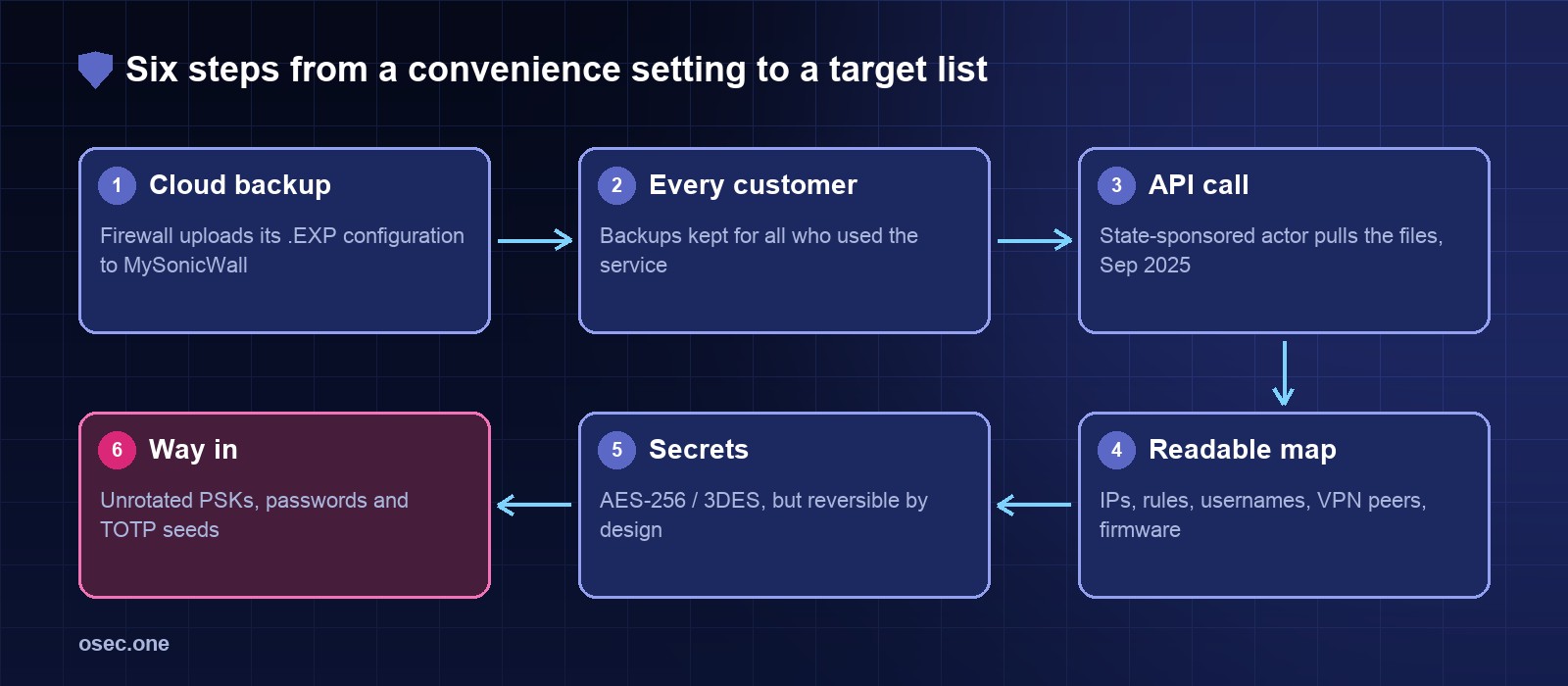
Six steps from a convenience setting to a target list. Steps 4 to 6 still apply to anyone who hasn't rotated.
\n
Timeline
\n
\n
When
What happened
Source
\n
Early Sep 2025
SonicWall detects suspicious downloads of backup configuration files from its cloud
SonicWall via Help Net Security
\n
17 Sep 2025
Notice published: a \"brute-force (not ransomware) attack\" on the backup service, under 5% of firewalls, no known leaks
SonicWall notice
\n
24 Sep 2025
Clarified: credentials stay encrypted, but some configuration details are only encoded
SonicWall notice
\n
4-10 Oct 2025
Huntress sees 100+ SSL VPN accounts at 16 customer organisations logged into with valid credentials; no link to the backups shown
Huntress
\n
8 Oct 2025
Final investigation with Mandiant: backups accessed for all customers who used cloud backup; updated device lists in MySonicWall
SonicWall notice
\n
9 Oct 2025
Notice adds that Gen 6 secrets are encrypted with 3DES, and the \"Last Download Date\" field
SonicWall notice
\n
28 Oct 2025
Offline Credentials Reset Tool and Online Analysis Tool linked
SonicWall notice
\n
4-6 Nov 2025
SonicWall: a state-sponsored actor, access through an API call, limited to the backup service; unrelated to the Akira attacks
SonicWall via Help Net Security
\n
\n
Two things stand out. The first estimate was off by the whole customer base, which is common when a breach is sized from logs before the investigation ends. And the access method changed from "brute force" to "an API call", which SonicWall never explained further. If you sized your own response on the 17 September number, it was too small.
\n
What a firewall configuration backup holds
\n
A SonicOS settings export is an .EXP file: a full snapshot meant to restore a device to exactly how it was. SonicWall describes the file as encoded, not encrypted. Decoding it gives back the readable settings. Only the credentials and secrets inside are encrypted, one by one: AES-256 on Gen 7 and newer, 3DES on Gen 6. The cloud copy was encrypted at rest on SonicWall's side, but an API that serves the file back serves it decoded to that same state.
\n
\n
In the file
State
What it gives an attacker
\n
Interfaces, public IPs, internal subnets, VLANs, routes
Readable
A network map before the first packet is sent
\n
Access rules and NAT
Readable
Which internal hosts are reachable from the internet, on which ports
\n
Enabled services: SSL VPN, HTTPS/SSH management on WAN, SNMP
LDAP/RADIUS/TACACS+ server addresses and bind account names
Readable
Which directory account the firewall uses
\n
Firmware version and model
Readable
Which known-exploited CVEs still apply
\n
Local passwords, TOTP seeds, PSKs, RADIUS secrets, LDAP bind password, API keys
Encrypted (AES-256 Gen 7, 3DES Gen 6)
Safe only as long as the encryption key is
\n
\n
The readable part alone is a targeting package. A list of usernames plus the firmware version plus "SSL VPN is on" is what a password-spray or exploit crew pays initial-access brokers for.
\n
The cipher question: what breaking the encryption costs
\n
Admins asked whether 3DES on Gen 6 was weak enough to worry about. Here's the brute-force arithmetic at a generous one trillion (10¹²) keys a second:
\n
\n
Cipher
Effective security (NIST SP 800-57)
Keys to try
Time at 1012/s
\n
3DES, two-key
80 bits
280 ≈ 1.2 × 1024
1.2 × 10¹² s ≈ 38,000 years
\n
3DES, three-key
112 bits
2112 ≈ 5.2 × 1033
≈ 1.6 × 10¹⁴ years
\n
AES-256
256 bits
2256 ≈ 1.2 × 1077
≈ 3.7 × 1057 years
\n
\n
Worked for the two-key row: 2⁸⁰ = 1.21 × 10²⁴ keys ÷ 10¹² per second = 1.21 × 10¹² seconds; ÷ 31.6 million seconds a year ≈ 38,000 years. SonicWall hasn't said which 3DES keying it uses. NIST has disallowed 3DES for new encryption since the end of 2023 (SP 800-131A Rev 2), so it's overdue for replacement, but nobody is brute-forcing it.
\n
That's the wrong question, though. A firewall can't hash a VPN pre-shared key or a RADIUS shared secret the way a website hashes passwords: it has to send the real value to its peer, so the encryption is reversible by design, and the key has to be somewhere the firewall can use it. The protection is only as good as how that key is derived and kept, and SonicWall hasn't published that. An actor able to reach the vendor's backup API is the kind of actor most likely to study it. That's why SonicWall's own guidance doesn't lean on the cipher: it says to reset every service with credentials that was enabled when the backup was taken.
\n
A separate wave the same week
\n
From 4 October 2025 Huntress saw attackers log into more than 100 SonicWall SSL VPN accounts across 16 customer organisations, quickly and across many devices, which points to valid credentials rather than guessing. Some disconnected; others ran network scans and tried local Windows accounts. Huntress said it had no evidence tying this to the backup files, and SonicWall later said the backup breach was unrelated to the Akira campaign. Treat the link as unproven. The defensive lesson is the same either way: on a SonicWall you haven't rotated, a valid VPN login is the cheapest way in.
\n
The rotation checklist, in an order that won't lock you out
\n
SonicWall's Essential Credential Reset guide lists 29 kinds of secret. Do it in this order:
\n
1. Find out whether you're affected. In MySonicWall go to Product Management > Issue List. Each listed serial shows Friendly Name, Last Download Date and Known Impacted Services. Blank backup fields mean that device had no cloud backup. SonicWall says the Impacted Services column is guidance only: review everything with credentials that was enabled at or before the backup. 2. Start with "Active - High Priority" devices (internet-facing services on), then "Active - Lower Priority", then "Inactive" (no contact for 90 days, but they may come back online). 3. Contain first. Restrict or turn off WAN access to HTTP/HTTPS and SSH management, SSL VPN, IPSec VPN, SNMP and NAT'd inbound services until the resets are done. Book a window: remote users will drop. 4. Reset the seven critical items (below). 5. Work through the other 22 at a steady pace. 6. Bring services back one at a time and watch the logs for logins you can't explain. 7. Turn off cloud backup or keep an offline copy you control, and decide whether the convenience is worth it.
\n
\n
Critical item (SonicWall's first seven)
Also change it on
\n
Local user passwords, including SonicOS admins
–
\n
Local user TOTP: remove and re-enrol every binding
Each user's authenticator app
\n
LDAP bind password; RADIUS and TACACS+ shared secrets
The directory or RADIUS server
\n
IPSec pre-shared keys (site-to-site and GroupVPN)
The remote peer (branch, partner, cloud VPN)
\n
L2TP, PPPoE and PPTP WAN interface passwords
Your ISP (coordinate first, or the WAN link drops)
\n
Cloud Secure Edge connector API key
The CSE console
\n
RIP, OSPFv2 and BGP authentication passwords
The neighbouring routers
\n
\n
The other 22 include AWS IAM access keys used for logging or VPN, SNMPv3 users, dynamic DNS and cellular accounts, the email account used for log and OTP mail, FTP/HTTPS export credentials, Wi-Fi passphrases and SonicWave admin passwords, SSO agent secrets, proxy and NTP credentials, passwords saved in SSL VPN bookmarks, and the DPI-SSL re-signing CA. That last one is easy to miss and serious: whoever has that CA's private key can mint certificates your clients trust. Make a new CA, replace it, and push the new one to clients.
\n
Two things the list doesn't say. TOTP re-enrolment matters more than it looks: if seeds are reversible, a second factor stops being a second factor. And the LDAP bind account is a domain account: if it can do more than read the directory, cut its rights while you're changing its password. SonicWall's offline Credentials Reset Tool reads a local export and resets local passwords and TOTP for you, which is the bulk of the work for a VPN with many local users.
\n
Controls that break each step
\n
\n
Step
Control
Effect
\n
Config uploaded to the vendor's cloud
No cloud backup, or an encrypted offline copy you hold
Nothing at the vendor to take
\n
Backups taken in bulk
Vendor-side: per-customer encryption keys, API rate limits, alerts on bulk download
Out of your hands, but a question for your next renewal
\n
Readable map and usernames
No management or SSL VPN on the WAN; VPN behind SSO with MFA; disable unused local accounts
The map points at closed doors
\n
Reversible secrets
Rotate everything after any backup exposure; directory accounts with least privilege
Old secrets stop working
\n
Valid VPN login
Phishing-resistant MFA; alert on VPN logins from hosting providers; geo limits
A correct password isn't enough
\n
Known CVEs in the listed firmware
Patch to the fixed release on your branch
The version in the file is no longer useful
\n
\n
For the last row, the osec Firmware branch check takes a SonicOS version and lists every CISA known-exploited CVE that still applies to it, with the fixed release on your branch. It's the same check an attacker would run on the version printed in your backup.
\n
How it compares with SMA 100 and FortiGate
\n
Three 2025 cases, three places the secrets leaked. In SonicWall SMA 100 OVERSTEP, credentials stolen from the appliance itself let attackers put a rootkit back on fully patched boxes. In the FortiGate symlink case, files including configuration stayed readable through the device after the patch. Here nothing touched the device at all: the copy at the vendor was enough. The response is the same in all three: patching fixes the hole, rotation fixes what leaked through it. The same split showed up in CircleCI 2023, where every customer was told to rotate every secret.
\n
Type your SonicOS version and see which known-exploited CVEs still apply and the fixed release on your branch. Free, nothing to install.
MySonicWall 2025: every customer's cloud-stored firewall configuration backup accessed, and what an encrypted backup still gives away
Many SonicWall firewalls had a handy setting: back up the configuration to MySonicWall, the vendor's customer portal, so a dead box can be restored in minutes. In September 2025 SonicWall said someone had downloaded some of those backups. It first put the number at under 5% of firewalls. On 8 October 2025, after an investigation with Mandiant, it changed that to every customer who had ever used the cloud backup service. In November it said a state-sponsored actor had done it through an API call to the backup service.
Ad
SonicWall's message to customers was steady throughout: the passwords and keys in the files are encrypted, but reset them anyway. That sounds contradictory, and many admins treated it as optional. This write-up goes through what a firewall configuration backup holds, what the encryption does and doesn't protect, the cost of breaking each cipher (and why that's the wrong question), and a rotation order that won't lock you out.
Six steps from a convenience setting to a target list. Steps 4 to 6 still apply to anyone who hasn't rotated.
Timeline
When
What happened
Source
Early Sep 2025
SonicWall detects suspicious downloads of backup configuration files from its cloud
SonicWall via Help Net Security
17 Sep 2025
Notice published: a "brute-force (not ransomware) attack" on the backup service, under 5% of firewalls, no known leaks
SonicWall notice
24 Sep 2025
Clarified: credentials stay encrypted, but some configuration details are only encoded
SonicWall notice
4-10 Oct 2025
Huntress sees 100+ SSL VPN accounts at 16 customer organisations logged into with valid credentials; no link to the backups shown
Huntress
8 Oct 2025
Final investigation with Mandiant: backups accessed for all customers who used cloud backup; updated device lists in MySonicWall
SonicWall notice
9 Oct 2025
Notice adds that Gen 6 secrets are encrypted with 3DES, and the "Last Download Date" field
SonicWall notice
28 Oct 2025
Offline Credentials Reset Tool and Online Analysis Tool linked
SonicWall notice
4-6 Nov 2025
SonicWall: a state-sponsored actor, access through an API call, limited to the backup service; unrelated to the Akira attacks
SonicWall via Help Net Security
Two things stand out. The first estimate was off by the whole customer base, which is common when a breach is sized from logs before the investigation ends. And the access method changed from "brute force" to "an API call", which SonicWall never explained further. If you sized your own response on the 17 September number, it was too small.
What a firewall configuration backup holds
A SonicOS settings export is an .EXP file: a full snapshot meant to restore a device to exactly how it was. SonicWall describes the file as encoded, not encrypted. Decoding it gives back the readable settings. Only the credentials and secrets inside are encrypted, one by one: AES-256 on Gen 7 and newer, 3DES on Gen 6. The cloud copy was encrypted at rest on SonicWall's side, but an API that serves the file back serves it decoded to that same state.
In the file
State
What it gives an attacker
Interfaces, public IPs, internal subnets, VLANs, routes
Readable
A network map before the first packet is sent
Access rules and NAT
Readable
Which internal hosts are reachable from the internet, on which ports
Enabled services: SSL VPN, HTTPS/SSH management on WAN, SNMP
LDAP/RADIUS/TACACS+ server addresses and bind account names
Readable
Which directory account the firewall uses
Firmware version and model
Readable
Which known-exploited CVEs still apply
Local passwords, TOTP seeds, PSKs, RADIUS secrets, LDAP bind password, API keys
Encrypted (AES-256 Gen 7, 3DES Gen 6)
Safe only as long as the encryption key is
The readable part alone is a targeting package. A list of usernames plus the firmware version plus "SSL VPN is on" is what a password-spray or exploit crew pays initial-access brokers for.
The cipher question: what breaking the encryption costs
Admins asked whether 3DES on Gen 6 was weak enough to worry about. Here's the brute-force arithmetic at a generous one trillion (10¹²) keys a second:
Cipher
Effective security (NIST SP 800-57)
Keys to try
Time at 1012/s
3DES, two-key
80 bits
280 ≈ 1.2 × 1024
1.2 × 10¹² s ≈ 38,000 years
3DES, three-key
112 bits
2112 ≈ 5.2 × 1033
≈ 1.6 × 10¹⁴ years
AES-256
256 bits
2256 ≈ 1.2 × 1077
≈ 3.7 × 1057 years
Worked for the two-key row: 2⁸⁰ = 1.21 × 10²⁴ keys ÷ 10¹² per second = 1.21 × 10¹² seconds; ÷ 31.6 million seconds a year ≈ 38,000 years. SonicWall hasn't said which 3DES keying it uses. NIST has disallowed 3DES for new encryption since the end of 2023 (SP 800-131A Rev 2), so it's overdue for replacement, but nobody is brute-forcing it.
That's the wrong question, though. A firewall can't hash a VPN pre-shared key or a RADIUS shared secret the way a website hashes passwords: it has to send the real value to its peer, so the encryption is reversible by design, and the key has to be somewhere the firewall can use it. The protection is only as good as how that key is derived and kept, and SonicWall hasn't published that. An actor able to reach the vendor's backup API is the kind of actor most likely to study it. That's why SonicWall's own guidance doesn't lean on the cipher: it says to reset every service with credentials that was enabled when the backup was taken.
A separate wave the same week
From 4 October 2025 Huntress saw attackers log into more than 100 SonicWall SSL VPN accounts across 16 customer organisations, quickly and across many devices, which points to valid credentials rather than guessing. Some disconnected; others ran network scans and tried local Windows accounts. Huntress said it had no evidence tying this to the backup files, and SonicWall later said the backup breach was unrelated to the Akira campaign. Treat the link as unproven. The defensive lesson is the same either way: on a SonicWall you haven't rotated, a valid VPN login is the cheapest way in.
The rotation checklist, in an order that won't lock you out
SonicWall's Essential Credential Reset guide lists 29 kinds of secret. Do it in this order:
1. Find out whether you're affected. In MySonicWall go to Product Management > Issue List. Each listed serial shows Friendly Name, Last Download Date and Known Impacted Services. Blank backup fields mean that device had no cloud backup. SonicWall says the Impacted Services column is guidance only: review everything with credentials that was enabled at or before the backup. 2. Start with "Active - High Priority" devices (internet-facing services on), then "Active - Lower Priority", then "Inactive" (no contact for 90 days, but they may come back online). 3. Contain first. Restrict or turn off WAN access to HTTP/HTTPS and SSH management, SSL VPN, IPSec VPN, SNMP and NAT'd inbound services until the resets are done. Book a window: remote users will drop. 4. Reset the seven critical items (below). 5. Work through the other 22 at a steady pace. 6. Bring services back one at a time and watch the logs for logins you can't explain. 7. Turn off cloud backup or keep an offline copy you control, and decide whether the convenience is worth it.
Critical item (SonicWall's first seven)
Also change it on
Local user passwords, including SonicOS admins
–
Local user TOTP: remove and re-enrol every binding
Each user's authenticator app
LDAP bind password; RADIUS and TACACS+ shared secrets
The directory or RADIUS server
IPSec pre-shared keys (site-to-site and GroupVPN)
The remote peer (branch, partner, cloud VPN)
L2TP, PPPoE and PPTP WAN interface passwords
Your ISP (coordinate first, or the WAN link drops)
Cloud Secure Edge connector API key
The CSE console
RIP, OSPFv2 and BGP authentication passwords
The neighbouring routers
The other 22 include AWS IAM access keys used for logging or VPN, SNMPv3 users, dynamic DNS and cellular accounts, the email account used for log and OTP mail, FTP/HTTPS export credentials, Wi-Fi passphrases and SonicWave admin passwords, SSO agent secrets, proxy and NTP credentials, passwords saved in SSL VPN bookmarks, and the DPI-SSL re-signing CA. That last one is easy to miss and serious: whoever has that CA's private key can mint certificates your clients trust. Make a new CA, replace it, and push the new one to clients.
Two things the list doesn't say. TOTP re-enrolment matters more than it looks: if seeds are reversible, a second factor stops being a second factor. And the LDAP bind account is a domain account: if it can do more than read the directory, cut its rights while you're changing its password. SonicWall's offline Credentials Reset Tool reads a local export and resets local passwords and TOTP for you, which is the bulk of the work for a VPN with many local users.
Controls that break each step
Step
Control
Effect
Config uploaded to the vendor's cloud
No cloud backup, or an encrypted offline copy you hold
Nothing at the vendor to take
Backups taken in bulk
Vendor-side: per-customer encryption keys, API rate limits, alerts on bulk download
Out of your hands, but a question for your next renewal
Readable map and usernames
No management or SSL VPN on the WAN; VPN behind SSO with MFA; disable unused local accounts
The map points at closed doors
Reversible secrets
Rotate everything after any backup exposure; directory accounts with least privilege
Old secrets stop working
Valid VPN login
Phishing-resistant MFA; alert on VPN logins from hosting providers; geo limits
A correct password isn't enough
Known CVEs in the listed firmware
Patch to the fixed release on your branch
The version in the file is no longer useful
For the last row, the osec Firmware branch check takes a SonicOS version and lists every CISA known-exploited CVE that still applies to it, with the fixed release on your branch. It's the same check an attacker would run on the version printed in your backup.
How it compares with SMA 100 and FortiGate
Three 2025 cases, three places the secrets leaked. In SonicWall SMA 100 OVERSTEP, credentials stolen from the appliance itself let attackers put a rootkit back on fully patched boxes. In the FortiGate symlink case, files including configuration stayed readable through the device after the patch. Here nothing touched the device at all: the copy at the vendor was enough. The response is the same in all three: patching fixes the hole, rotation fixes what leaked through it. The same split showed up in CircleCI 2023, where every customer was told to rotate every secret.
Type your SonicOS version and see which known-exploited CVEs still apply and the fixed release on your branch. Free, nothing to install.