Two years later, on 23 January 2025, New York's Department of Financial Services (NYDFS) fined PayPal $2 million under its cybersecurity regulation. The consent order explains how it happened: the change that published the forms was filed as a "platform migration", so it skipped PayPal's own risk review, and two-factor sign-in on customer accounts was optional. This write-up follows each step from the order and PayPal's breach notice, works through the numbers, and lists the control that breaks each step.
"},{"id":147249,"block_type":"screenshot","html":"Six steps from a skipped review to a regulator's order. The passwords came from other breaches; the SSNs came from PayPal's own tax forms."},{"id":147250,"block_type":"heading_h2","html":"
Timeline, from the consent order and the breach notice
"},{"id":147251,"block_type":"html","html":"
\n
Date
What happened
Source
\n
2021
American Rescue Plan Act lowers the Form 1099-K threshold from $20,000 and 200 transactions to $600, with no transaction minimum
Consent order ¶9
\n
2022
PayPal's Program Development team is tasked with making 1099-Ks available to newly eligible customers by changing existing data collection flows
¶10
\n
18 Oct 2022
The updated 1099-Ks go live, with unmasked customer data
¶11
\n
6 Dec 2022
A PayPal security analyst finds an online post: \"PP EXPLOIT TO GET SSN\", with a link to PayPal's site. The same day PayPal finds the unmasked forms
¶7-8
\n
6-8 Dec 2022
Unauthorized logins to customer accounts (PayPal's notice)
Maine AG filing
\n
7 Dec 2022
PayPal's security team sees a spike in login attempts and concludes it is credential stuffing aimed at the forms
¶12
\n
20 Dec 2022
PayPal confirms which accounts were accessed
Breach notice
\n
18 Jan 2023
Notices to 34,942 people (146 in Maine), 24 months of Equifax monitoring offered
Maine AG filing
\n
23 Jan 2025
NYDFS consent order: $2,000,000 penalty, no insurance or tax deduction allowed
¶23-25
\n
"},{"id":147252,"block_type":"paragraph","html":"
Two gaps stand out. The forms were exposed for 49 days (18 October to 6 December) before anyone at PayPal noticed, and the one who noticed was an analyst reading a public post, not a test or a review. Then it took 29 days from confirming the accounts (20 December) to the customer notices (18 January).
1. A compliance change filed under the wrong label
"},{"id":147255,"block_type":"paragraph","html":"
PayPal's development policy said a new product, capability or feature needs a Risk and Control Identification Process (RCIP): review, analysis and testing before launch. The team making the 1099-K change classed it as a "platform migration" rather than a new capability. A migration didn't need RCIP, so, in the order's words, "a risk assessment, penetration test, and/or vulnerability scan of this change did not occur, and no formal approval to launch was given." NYDFS traced the wrong label to the engineers not being trained on PayPal's code deployment policies.
The forms carried each customer's full Social Security number. IRS rules let the payee's copy of an information return show a truncated number (asterisks or Xs and the last four digits), and the IRS gets its own copy separately, so nothing in the copy a customer downloads needed the full number. Masking was one of the first fixes PayPal made.
By 6 December a post advertising "PP EXPLOIT TO GET SSN" explained how to reach the numbers through a link to PayPal's site. The order doesn't say whether this was a separate flaw or simply "log in and open the tax form". The next day's credential stuffing spike suggests the second: anyone with a working PayPal login could read an SSN.
Attackers replayed email and password pairs from other breaches against PayPal's login. PayPal's notice says there was "no evidence that your login credentials were obtained from any PayPal systems." The login form had no CAPTCHA and no rate limiting on this traffic (NYDFS press release), and two-factor sign-in was optional, although PayPal's own Authentication and Session Management policy said that "all activity that permits access to account information must be protected by risk-based authentication."
PayPal's notice lists names, addresses, Social Security numbers, individual tax identification numbers and dates of birth as viewable. PayPal said no financial information was accessed and payments weren't affected. For an attacker, a name, date of birth and SSN together are worth more than a PayPal login: they are what identity fraud and tax refund fraud need.
PayPal added CAPTCHA and rate limiting, which the order says "successfully stopped the automated account access", masked the numbers and forced password resets on the affected accounts. Later it clarified when RCIP applies, trained the team that skipped it, added monitoring so code reaching production must carry an RCIP approval when one is required, and made two-factor sign-in mandatory for every US customer account login. NYDFS cited three sections of 23 NYCRR Part 500: 500.3 (written policies on access control, development and customer data privacy), 500.10 (qualified, trained cybersecurity staff) and 500.12 (effective controls such as MFA against unauthorized access).
PayPal didn't publish how many login attempts it saw. Credential stuffing success rates are usually put somewhere between 0.1% and 2% of attempts, so here is what 34,942 hits mean at three rates, spread over the two days PayPal named (48 hours) and over three full calendar days (72 hours):
"},{"id":147268,"block_type":"html","html":"
\n
Assumed success rate
Attempts for 34,942 hits
Rate over 48 h
Rate over 72 h
\n
2%
1.75 million
10 a second
6.7 a second
\n
1%
3.49 million
20 a second
13.5 a second
\n
0.1%
34.9 million
202 a second
135 a second
\n
"},{"id":147269,"block_type":"paragraph","html":"
Worked line for 1%: 34,942 / 0.01 = 3,494,200 attempts; 48 hours = 172,800 seconds; 3,494,200 / 172,800 = 20.2 attempts a second, or about 72,800 an hour. That is not low-and-slow. Compare Roku's first wave, which at the same 1% rate worked out to one attempt every 3 seconds over 56 days. PayPal's traffic was loud enough that its team saw the spike within a day. What it lacked was a brake to pull: CAPTCHA and rate limits had to be added during the incident.
"},{"id":147270,"block_type":"paragraph","html":"
The penalty, per account: $2,000,000 / 34,942 = about $57 an account, paid two years after the event, on top of 24 months of credit monitoring for each person and a negligence lawsuit filed in March 2023. The cost of the missing review was a risk assessment and a pen test on one change.
"},{"id":147271,"block_type":"paragraph","html":"
A footnote on the cause: the low threshold that started it never took full effect. The IRS delayed the $600 rule, set a $5,000 threshold for 2024, and the One Big Beautiful Bill Act of July 2025 put the threshold back to $20,000 and 200 transactions (IRS FAQ, 23 October 2025). The forms were rushed out for a rule that was later reversed; the exposure stayed done.
Classify by what the change touches, not what it's called: any change that renders or exports personal data (SSN, tax ID, date of birth) needs a review, whatever its ticket type. Enforce it in CI: a pull request that touches those templates or fields can't merge without a reviewer from security
The 1099-K change gets its risk review
\n
Full SSN on a downloadable form
Mask by default (last 4 digits) in every customer-facing view; full values only in the filing sent to the tax authority. Add a test that fails if a rendered document matches an SSN pattern
Even a working login reads nothing useful
\n
49 days before anyone noticed
Scan rendered pages and PDFs in staging and production for SSN-shaped strings; watch paste sites and forums for your brand plus \"exploit\" or \"SSN\"
Detection from your own check, not someone's post
\n
Stuffed logins at 10-200 a second
Count failed logins site-wide and per account, not only per IP; keep a switch ready that adds a challenge or a slowdown when the site's failure rate jumps
The brake exists before the incident
\n
Correct password from another breach
Check passwords against known breached ones (Pwned Passwords range API), and ask for a second factor on a new device
A reused password alone doesn't open the account
\n
Sensitive document opened after login
Step-up before showing tax documents or identity data: a fresh one-time code even inside a signed-in session
A hijacked session still can't open the form
\n
"},{"id":147274,"block_type":"paragraph","html":"
The cheapest of these is to leave no password to stuff. A sign-in that uses only a one-time email code, Google or Apple gives a combo list nothing to try. osec.one's passwordless sign-in does email codes, Google and Apple with no OAuth app to set up on your side, and it's free. If you keep passwords, sign-in rules that count emails and wrong codes, not just IPs are the ready-made brake for the fourth row.
A new compliance feature showed unmasked identity data
A card on file and a shipping address
A sharing feature exposed other people
\n
Regulatory result
NYDFS $2M penalty (Jan 2025)
None published; 2FA made mandatory
UK ICO £2.31M fine (June 2025)
\n
"},{"id":147277,"block_type":"paragraph","html":"
Same first step in all three, different payoff. At 23andMe a sharing feature multiplied each login; at PayPal a document did. The lesson for anyone shipping a feature behind a login: assume some of those logins belong to attackers, and decide what a stranger with a valid password would see.
"},{"id":147278,"block_type":"cta","html":"
Sign-ins with email codes, Google and Apple: no password to stuff, no OAuth app to set up on your side. Free.
Between 6 and 8 December 2022, attackers signed in to 34,942 PayPal accounts with email and password pairs leaked elsewhere. PayPal's own systems didn't leak the passwords. What made the logins worth having was a tax form: seven weeks earlier PayPal had put IRS Form 1099-Ks online for millions of newly eligible users, and those forms showed each customer's name, date of birth and full Social Security number, unmasked.
\n
Ad
\n
Two years later, on 23 January 2025, New York's Department of Financial Services (NYDFS) fined PayPal $2 million under its cybersecurity regulation. The consent order explains how it happened: the change that published the forms was filed as a "platform migration", so it skipped PayPal's own risk review, and two-factor sign-in on customer accounts was optional. This write-up follows each step from the order and PayPal's breach notice, works through the numbers, and lists the control that breaks each step.
\n
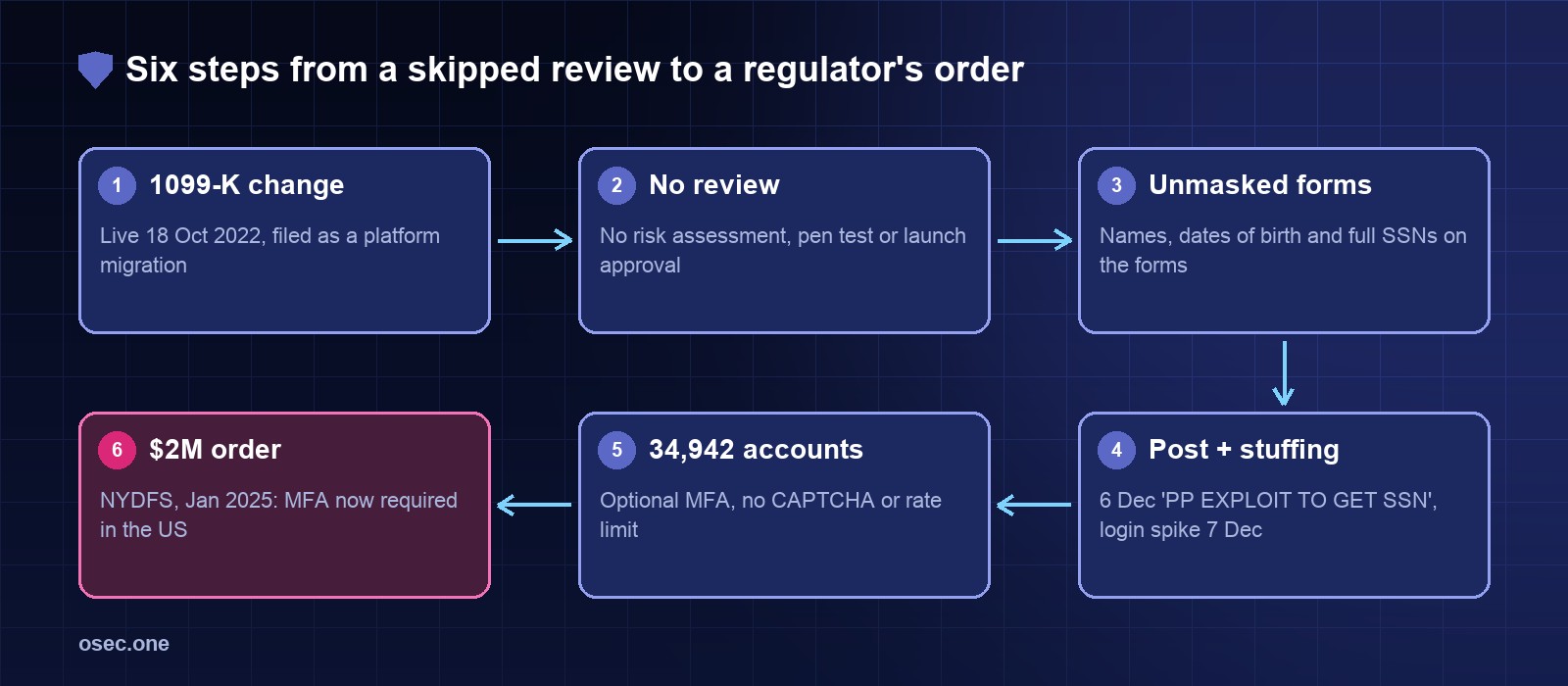
Six steps from a skipped review to a regulator's order. The passwords came from other breaches; the SSNs came from PayPal's own tax forms.
\n
Timeline, from the consent order and the breach notice
\n
\n
Date
What happened
Source
\n
2021
American Rescue Plan Act lowers the Form 1099-K threshold from $20,000 and 200 transactions to $600, with no transaction minimum
Consent order ¶9
\n
2022
PayPal's Program Development team is tasked with making 1099-Ks available to newly eligible customers by changing existing data collection flows
¶10
\n
18 Oct 2022
The updated 1099-Ks go live, with unmasked customer data
¶11
\n
6 Dec 2022
A PayPal security analyst finds an online post: \"PP EXPLOIT TO GET SSN\", with a link to PayPal's site. The same day PayPal finds the unmasked forms
¶7-8
\n
6-8 Dec 2022
Unauthorized logins to customer accounts (PayPal's notice)
Maine AG filing
\n
7 Dec 2022
PayPal's security team sees a spike in login attempts and concludes it is credential stuffing aimed at the forms
¶12
\n
20 Dec 2022
PayPal confirms which accounts were accessed
Breach notice
\n
18 Jan 2023
Notices to 34,942 people (146 in Maine), 24 months of Equifax monitoring offered
Maine AG filing
\n
23 Jan 2025
NYDFS consent order: $2,000,000 penalty, no insurance or tax deduction allowed
¶23-25
\n
\n
Two gaps stand out. The forms were exposed for 49 days (18 October to 6 December) before anyone at PayPal noticed, and the one who noticed was an analyst reading a public post, not a test or a review. Then it took 29 days from confirming the accounts (20 December) to the customer notices (18 January).
\n
How it worked, step by step
\n
1. A compliance change filed under the wrong label
\n
PayPal's development policy said a new product, capability or feature needs a Risk and Control Identification Process (RCIP): review, analysis and testing before launch. The team making the 1099-K change classed it as a "platform migration" rather than a new capability. A migration didn't need RCIP, so, in the order's words, "a risk assessment, penetration test, and/or vulnerability scan of this change did not occur, and no formal approval to launch was given." NYDFS traced the wrong label to the engineers not being trained on PayPal's code deployment policies.
\n
2. A document that showed the whole SSN
\n
The forms carried each customer's full Social Security number. IRS rules let the payee's copy of an information return show a truncated number (asterisks or Xs and the last four digits), and the IRS gets its own copy separately, so nothing in the copy a customer downloads needed the full number. Masking was one of the first fixes PayPal made.
\n
3. Someone noticed, and said so in public
\n
By 6 December a post advertising "PP EXPLOIT TO GET SSN" explained how to reach the numbers through a link to PayPal's site. The order doesn't say whether this was a separate flaw or simply "log in and open the tax form". The next day's credential stuffing spike suggests the second: anyone with a working PayPal login could read an SSN.
\n
4. Leaked passwords, tried at speed
\n
Attackers replayed email and password pairs from other breaches against PayPal's login. PayPal's notice says there was "no evidence that your login credentials were obtained from any PayPal systems." The login form had no CAPTCHA and no rate limiting on this traffic (NYDFS press release), and two-factor sign-in was optional, although PayPal's own Authentication and Session Management policy said that "all activity that permits access to account information must be protected by risk-based authentication."
\n
5. 34,942 accounts and the data on their forms
\n
PayPal's notice lists names, addresses, Social Security numbers, individual tax identification numbers and dates of birth as viewable. PayPal said no financial information was accessed and payments weren't affected. For an attacker, a name, date of birth and SSN together are worth more than a PayPal login: they are what identity fraud and tax refund fraud need.
\n
6. The fix, then the order
\n
PayPal added CAPTCHA and rate limiting, which the order says "successfully stopped the automated account access", masked the numbers and forced password resets on the affected accounts. Later it clarified when RCIP applies, trained the team that skipped it, added monitoring so code reaching production must carry an RCIP approval when one is required, and made two-factor sign-in mandatory for every US customer account login. NYDFS cited three sections of 23 NYCRR Part 500: 500.3 (written policies on access control, development and customer data privacy), 500.10 (qualified, trained cybersecurity staff) and 500.12 (effective controls such as MFA against unauthorized access).
\n
The numbers, worked through
\n
PayPal didn't publish how many login attempts it saw. Credential stuffing success rates are usually put somewhere between 0.1% and 2% of attempts, so here is what 34,942 hits mean at three rates, spread over the two days PayPal named (48 hours) and over three full calendar days (72 hours):
\n
\n
Assumed success rate
Attempts for 34,942 hits
Rate over 48 h
Rate over 72 h
\n
2%
1.75 million
10 a second
6.7 a second
\n
1%
3.49 million
20 a second
13.5 a second
\n
0.1%
34.9 million
202 a second
135 a second
\n
\n
Worked line for 1%: 34,942 / 0.01 = 3,494,200 attempts; 48 hours = 172,800 seconds; 3,494,200 / 172,800 = 20.2 attempts a second, or about 72,800 an hour. That is not low-and-slow. Compare Roku's first wave, which at the same 1% rate worked out to one attempt every 3 seconds over 56 days. PayPal's traffic was loud enough that its team saw the spike within a day. What it lacked was a brake to pull: CAPTCHA and rate limits had to be added during the incident.
\n
The penalty, per account: $2,000,000 / 34,942 = about $57 an account, paid two years after the event, on top of 24 months of credit monitoring for each person and a negligence lawsuit filed in March 2023. The cost of the missing review was a risk assessment and a pen test on one change.
\n
A footnote on the cause: the low threshold that started it never took full effect. The IRS delayed the $600 rule, set a $5,000 threshold for 2024, and the One Big Beautiful Bill Act of July 2025 put the threshold back to $20,000 and 200 transactions (IRS FAQ, 23 October 2025). The forms were rushed out for a rule that was later reversed; the exposure stayed done.
\n
Controls that break each step
\n
\n
Step
Control
Effect here
\n
Change labelled as a migration
Classify by what the change touches, not what it's called: any change that renders or exports personal data (SSN, tax ID, date of birth) needs a review, whatever its ticket type. Enforce it in CI: a pull request that touches those templates or fields can't merge without a reviewer from security
The 1099-K change gets its risk review
\n
Full SSN on a downloadable form
Mask by default (last 4 digits) in every customer-facing view; full values only in the filing sent to the tax authority. Add a test that fails if a rendered document matches an SSN pattern
Even a working login reads nothing useful
\n
49 days before anyone noticed
Scan rendered pages and PDFs in staging and production for SSN-shaped strings; watch paste sites and forums for your brand plus \"exploit\" or \"SSN\"
Detection from your own check, not someone's post
\n
Stuffed logins at 10-200 a second
Count failed logins site-wide and per account, not only per IP; keep a switch ready that adds a challenge or a slowdown when the site's failure rate jumps
The brake exists before the incident
\n
Correct password from another breach
Check passwords against known breached ones (Pwned Passwords range API), and ask for a second factor on a new device
A reused password alone doesn't open the account
\n
Sensitive document opened after login
Step-up before showing tax documents or identity data: a fresh one-time code even inside a signed-in session
A hijacked session still can't open the form
\n
\n
The cheapest of these is to leave no password to stuff. A sign-in that uses only a one-time email code, Google or Apple gives a combo list nothing to try. osec.one's passwordless sign-in does email codes, Google and Apple with no OAuth app to set up on your side, and it's free. If you keep passwords, sign-in rules that count emails and wrong codes, not just IPs are the ready-made brake for the fourth row.
\n
How it differs from Roku and 23andMe
\n
\n
PayPal 2022
Roku 2024
23andMe 2023
\n
What the attacker got
Full SSN, date of birth, address from a tax form
Stored card for purchases, resold accounts
Ancestry data of 6.9 million relatives
\n
Accounts opened
34,942
about 591,000
about 14,000
\n
Why the login was worth it
A new compliance feature showed unmasked identity data
A card on file and a shipping address
A sharing feature exposed other people
\n
Regulatory result
NYDFS $2M penalty (Jan 2025)
None published; 2FA made mandatory
UK ICO £2.31M fine (June 2025)
\n
\n
Same first step in all three, different payoff. At 23andMe a sharing feature multiplied each login; at PayPal a document did. The lesson for anyone shipping a feature behind a login: assume some of those logins belong to attackers, and decide what a stranger with a valid password would see.
\n
Sign-ins with email codes, Google and Apple: no password to stuff, no OAuth app to set up on your side. Free.
PayPal 2022: 34,942 accounts opened by credential stuffing in two days, and a $2 million New York penalty
Between 6 and 8 December 2022, attackers signed in to 34,942 PayPal accounts with email and password pairs leaked elsewhere. PayPal's own systems didn't leak the passwords. What made the logins worth having was a tax form: seven weeks earlier PayPal had put IRS Form 1099-Ks online for millions of newly eligible users, and those forms showed each customer's name, date of birth and full Social Security number, unmasked.
Ad
Two years later, on 23 January 2025, New York's Department of Financial Services (NYDFS) fined PayPal $2 million under its cybersecurity regulation. The consent order explains how it happened: the change that published the forms was filed as a "platform migration", so it skipped PayPal's own risk review, and two-factor sign-in on customer accounts was optional. This write-up follows each step from the order and PayPal's breach notice, works through the numbers, and lists the control that breaks each step.
Six steps from a skipped review to a regulator's order. The passwords came from other breaches; the SSNs came from PayPal's own tax forms.
Timeline, from the consent order and the breach notice
Date
What happened
Source
2021
American Rescue Plan Act lowers the Form 1099-K threshold from $20,000 and 200 transactions to $600, with no transaction minimum
Consent order ¶9
2022
PayPal's Program Development team is tasked with making 1099-Ks available to newly eligible customers by changing existing data collection flows
¶10
18 Oct 2022
The updated 1099-Ks go live, with unmasked customer data
¶11
6 Dec 2022
A PayPal security analyst finds an online post: "PP EXPLOIT TO GET SSN", with a link to PayPal's site. The same day PayPal finds the unmasked forms
¶7-8
6-8 Dec 2022
Unauthorized logins to customer accounts (PayPal's notice)
Maine AG filing
7 Dec 2022
PayPal's security team sees a spike in login attempts and concludes it is credential stuffing aimed at the forms
¶12
20 Dec 2022
PayPal confirms which accounts were accessed
Breach notice
18 Jan 2023
Notices to 34,942 people (146 in Maine), 24 months of Equifax monitoring offered
Maine AG filing
23 Jan 2025
NYDFS consent order: $2,000,000 penalty, no insurance or tax deduction allowed
¶23-25
Two gaps stand out. The forms were exposed for 49 days (18 October to 6 December) before anyone at PayPal noticed, and the one who noticed was an analyst reading a public post, not a test or a review. Then it took 29 days from confirming the accounts (20 December) to the customer notices (18 January).
How it worked, step by step
1. A compliance change filed under the wrong label
PayPal's development policy said a new product, capability or feature needs a Risk and Control Identification Process (RCIP): review, analysis and testing before launch. The team making the 1099-K change classed it as a "platform migration" rather than a new capability. A migration didn't need RCIP, so, in the order's words, "a risk assessment, penetration test, and/or vulnerability scan of this change did not occur, and no formal approval to launch was given." NYDFS traced the wrong label to the engineers not being trained on PayPal's code deployment policies.
2. A document that showed the whole SSN
The forms carried each customer's full Social Security number. IRS rules let the payee's copy of an information return show a truncated number (asterisks or Xs and the last four digits), and the IRS gets its own copy separately, so nothing in the copy a customer downloads needed the full number. Masking was one of the first fixes PayPal made.
3. Someone noticed, and said so in public
By 6 December a post advertising "PP EXPLOIT TO GET SSN" explained how to reach the numbers through a link to PayPal's site. The order doesn't say whether this was a separate flaw or simply "log in and open the tax form". The next day's credential stuffing spike suggests the second: anyone with a working PayPal login could read an SSN.
4. Leaked passwords, tried at speed
Attackers replayed email and password pairs from other breaches against PayPal's login. PayPal's notice says there was "no evidence that your login credentials were obtained from any PayPal systems." The login form had no CAPTCHA and no rate limiting on this traffic (NYDFS press release), and two-factor sign-in was optional, although PayPal's own Authentication and Session Management policy said that "all activity that permits access to account information must be protected by risk-based authentication."
5. 34,942 accounts and the data on their forms
PayPal's notice lists names, addresses, Social Security numbers, individual tax identification numbers and dates of birth as viewable. PayPal said no financial information was accessed and payments weren't affected. For an attacker, a name, date of birth and SSN together are worth more than a PayPal login: they are what identity fraud and tax refund fraud need.
6. The fix, then the order
PayPal added CAPTCHA and rate limiting, which the order says "successfully stopped the automated account access", masked the numbers and forced password resets on the affected accounts. Later it clarified when RCIP applies, trained the team that skipped it, added monitoring so code reaching production must carry an RCIP approval when one is required, and made two-factor sign-in mandatory for every US customer account login. NYDFS cited three sections of 23 NYCRR Part 500: 500.3 (written policies on access control, development and customer data privacy), 500.10 (qualified, trained cybersecurity staff) and 500.12 (effective controls such as MFA against unauthorized access).
The numbers, worked through
PayPal didn't publish how many login attempts it saw. Credential stuffing success rates are usually put somewhere between 0.1% and 2% of attempts, so here is what 34,942 hits mean at three rates, spread over the two days PayPal named (48 hours) and over three full calendar days (72 hours):
Assumed success rate
Attempts for 34,942 hits
Rate over 48 h
Rate over 72 h
2%
1.75 million
10 a second
6.7 a second
1%
3.49 million
20 a second
13.5 a second
0.1%
34.9 million
202 a second
135 a second
Worked line for 1%: 34,942 / 0.01 = 3,494,200 attempts; 48 hours = 172,800 seconds; 3,494,200 / 172,800 = 20.2 attempts a second, or about 72,800 an hour. That is not low-and-slow. Compare Roku's first wave, which at the same 1% rate worked out to one attempt every 3 seconds over 56 days. PayPal's traffic was loud enough that its team saw the spike within a day. What it lacked was a brake to pull: CAPTCHA and rate limits had to be added during the incident.
The penalty, per account: $2,000,000 / 34,942 = about $57 an account, paid two years after the event, on top of 24 months of credit monitoring for each person and a negligence lawsuit filed in March 2023. The cost of the missing review was a risk assessment and a pen test on one change.
A footnote on the cause: the low threshold that started it never took full effect. The IRS delayed the $600 rule, set a $5,000 threshold for 2024, and the One Big Beautiful Bill Act of July 2025 put the threshold back to $20,000 and 200 transactions (IRS FAQ, 23 October 2025). The forms were rushed out for a rule that was later reversed; the exposure stayed done.
Controls that break each step
Step
Control
Effect here
Change labelled as a migration
Classify by what the change touches, not what it's called: any change that renders or exports personal data (SSN, tax ID, date of birth) needs a review, whatever its ticket type. Enforce it in CI: a pull request that touches those templates or fields can't merge without a reviewer from security
The 1099-K change gets its risk review
Full SSN on a downloadable form
Mask by default (last 4 digits) in every customer-facing view; full values only in the filing sent to the tax authority. Add a test that fails if a rendered document matches an SSN pattern
Even a working login reads nothing useful
49 days before anyone noticed
Scan rendered pages and PDFs in staging and production for SSN-shaped strings; watch paste sites and forums for your brand plus "exploit" or "SSN"
Detection from your own check, not someone's post
Stuffed logins at 10-200 a second
Count failed logins site-wide and per account, not only per IP; keep a switch ready that adds a challenge or a slowdown when the site's failure rate jumps
The brake exists before the incident
Correct password from another breach
Check passwords against known breached ones (Pwned Passwords range API), and ask for a second factor on a new device
A reused password alone doesn't open the account
Sensitive document opened after login
Step-up before showing tax documents or identity data: a fresh one-time code even inside a signed-in session
A hijacked session still can't open the form
The cheapest of these is to leave no password to stuff. A sign-in that uses only a one-time email code, Google or Apple gives a combo list nothing to try. osec.one's passwordless sign-in does email codes, Google and Apple with no OAuth app to set up on your side, and it's free. If you keep passwords, sign-in rules that count emails and wrong codes, not just IPs are the ready-made brake for the fourth row.
How it differs from Roku and 23andMe
PayPal 2022
Roku 2024
23andMe 2023
What the attacker got
Full SSN, date of birth, address from a tax form
Stored card for purchases, resold accounts
Ancestry data of 6.9 million relatives
Accounts opened
34,942
about 591,000
about 14,000
Why the login was worth it
A new compliance feature showed unmasked identity data
A card on file and a shipping address
A sharing feature exposed other people
Regulatory result
NYDFS $2M penalty (Jan 2025)
None published; 2FA made mandatory
UK ICO £2.31M fine (June 2025)
Same first step in all three, different payoff. At 23andMe a sharing feature multiplied each login; at PayPal a document did. The lesson for anyone shipping a feature behind a login: assume some of those logins belong to attackers, and decide what a stranger with a valid password would see.
Sign-ins with email codes, Google and Apple: no password to stuff, no OAuth app to set up on your side. Free.