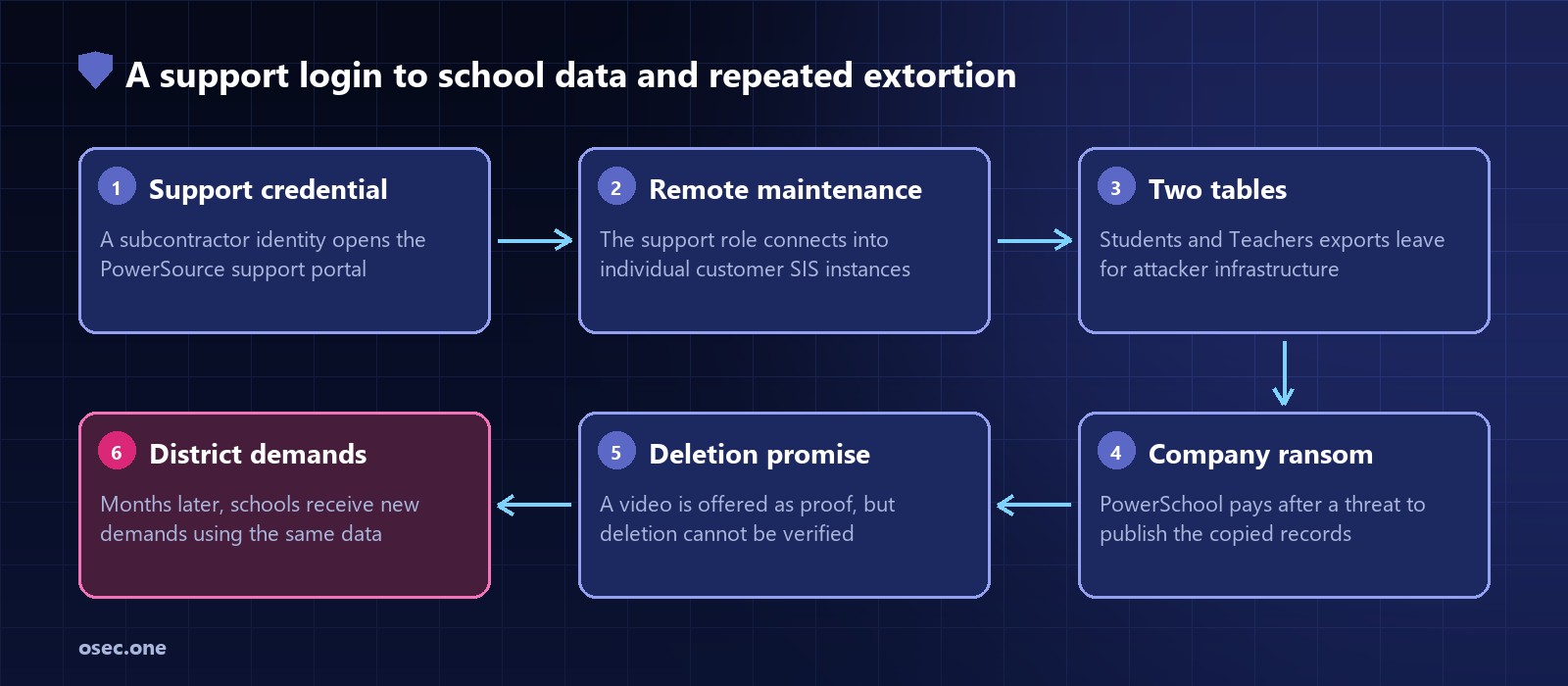
This was not malware spreading through 6,505 school networks. PowerSchool's forensic report found application-level access through its own web interface, followed by exports from the Students and Teachers tables. The blast radius came from one vendor support path sitting above many customer databases.
"},{"id":147368,"block_type":"screenshot","html":"The first ransom did not end the incident. A deletion promise was followed by new demands sent directly to schools."},{"id":147369,"block_type":"heading_h2","html":"
Confirmed facts, claims and counts
"},{"id":147370,"block_type":"html","html":"
\n
Figure
What it means
Confidence
\n
19-28 Dec 2024
Maintenance Remote Support activity attributed to the December attacker
Confirmed by CrowdStrike logs
\n
19-23 Dec 2024
Window in which data left affected SIS instances
Confirmed by CrowdStrike logs
\n
2 tables
Students and Teachers; CrowdStrike found no evidence that other SIS tables were exfiltrated
Confirmed within the available evidence
\n
6,505 districts
Districts the attacker said were represented in the stolen data
Attacker claim; PowerSchool did not confirm it
\n
62.4m students + 9.5m teachers
People the attacker claimed were in the exports
Attacker claim; not a verified headcount
\n
more than 880,000 Texans
Texas students and teachers named in the state attorney general's later lawsuit
Official state figure
\n
about $2.85m
Bitcoin ransom demanded from the education-software company, according to federal charges
Allegation in the criminal case
\n
"},{"id":147371,"block_type":"paragraph","html":"
The distinction is important. A district can keep years of former-student records, and one person may appear in several historical rows or systems. The attacker's row totals are not automatically unique people. PowerSchool did not publish a global affected-person total, so the claimed 71.9 million student-plus-teacher records should not be presented as a confirmed victim count.
CrowdStrike also found the same credential used by an unknown actor between 16 August and 17 September 2024. Available SIS logs did not reach far enough back to show whether those earlier logins touched customer data, and the investigators could not attribute them to the December attacker. That is a retention lesson: if privileged-access logs expire before an incident is found, the answer becomes permanently uncertain.
How the maintenance feature turned one identity into many customers
"},{"id":147376,"block_type":"paragraph","html":"
The chain was short: 1. Sign in to PowerSource. The credential belonged to a support user; later government filings described it as a subcontractor account. 2. Start Maintenance Remote Support. PowerSource allowed a technician with enough permission to reach a customer's SIS database for maintenance. 3. Move customer by customer. The attacker repeated the legitimate support operation against individual SIS instances. 4. Export the two broad tables. North Carolina's early technical notice said an export utility script used the admin maintenance tunnel. CrowdStrike later confirmed exfiltration from Students and Teachers. 5. Send the files away. CrowdStrike tied three IP addresses to December data exfiltration. It found no system-layer access, malware or lateral movement beyond the application path.
"},{"id":147377,"block_type":"paragraph","html":"
Encryption at rest did not help here. PowerSchool told CrowdStrike that stored data used AES-256, but the application had to decrypt records for an authorised support session. Once the stolen identity was treated as authorised, the export feature returned readable data.
The two table names sound narrow; their columns were not. North Carolina said affected tables included names, contact details, birthdays, parent/guardian information, medical notes, limited Social Security numbers and some passwords. Toronto's board listed addresses, health-card numbers, medical and accommodation information, discipline notes and records reaching back to 1985. Other districts stored no Social Security numbers at all.
"},{"id":147380,"block_type":"paragraph","html":"
That variation is why a vendor cannot answer impact with one generic list. Each customer needs a field-level export inventory: which columns existed, which years were retained, which rows were selected, and whether sensitive optional fields were populated.
Federal prosecutors alleged that the attackers demanded about $2.85 million in Bitcoin from the unnamed education-software provider; reporting and later official statements connected the case to PowerSchool. PowerSchool acknowledged paying a ransom in an attempt to secure deletion of the data. The amount it paid was not disclosed.
"},{"id":147383,"block_type":"paragraph","html":"
A deletion video was not proof of deletion. In early May 2025, school districts began receiving new messages from threat actors who said they still held the December data. North Carolina told schools not to open the embedded link, not to engage and not to pay. Alberta's privacy commissioner said multiple institutions there received similar demands. Toronto stated plainly that during the week of 4 May it learned the data had not been destroyed.
"},{"id":147384,"block_type":"paragraph","html":"
Paying changed the attacker incentive, not the evidence. A copied file can exist on another host, in a collaborator's account or in a backup that never appears in a screen recording. Incident plans should assume exfiltrated data remains usable indefinitely.
Phishing-resistant MFA and managed-device access for employees and every subcontractor
Reject privileged support sign-ins without a FIDO2/passkey assertion and compliant device certificate
\n
PowerSource reached from outside
VPN plus SSO and MFA
PowerSchool added this after the incident; test that no legacy portal route bypasses it
\n
One role reaches many tenants
Just-in-time, customer-scoped elevation
Require a ticket, named customer, approver and short expiry for every maintenance session
\n
Bulk table export
Export-specific approval and volume alarms
Alert on full Students/Teachers exports, rapid tenant switching and first-seen destinations
\n
Old activity cannot be reconstructed
Immutable privileged audit logs
Keep identity, maintenance-session and export logs longer than the contractual incident window
\n
District cannot assess impact quickly
Field inventory and retention limits
Delete obsolete optional data; document populated sensitive columns per year and table
\n
Attacker promises deletion
Plan for permanent compromise
Notify, monitor, freeze credit where relevant and prepare for follow-on phishing and extortion
\n
"},{"id":147387,"block_type":"paragraph","html":"
The closest osec.one parallel is Okta and Lapsus$ in 2022, where a support contractor's access created a vendor-to-customer path. Okta's 2023 support-system breach shows a second version: customer support files carried live session cookies. In all three, support access deserved production-grade identity controls and customer-visible audit trails.
"},{"id":147388,"block_type":"paragraph","html":"
For a low-volume application, osec Login Protection can count failures and suspicious sign-in patterns by account rather than relying on IP limits alone, without moving DNS. It does not replace privileged-access management, but it can close the first reusable-password route on your own support console.
"},{"id":147389,"block_type":"cta","html":"
Remove reusable passwords from your own customer and support sign-ins with email codes, Google and Apple sign-in, without setting up Google or Apple OAuth on your side.
On 19 December 2024, someone used a compromised support credential to enter PowerSchool's PowerSource portal. The account could invoke Maintenance Remote Support: a legitimate feature that let sufficiently privileged technicians connect to individual customers' Student Information System (SIS) instances.
\n
Ad
\n
This was not malware spreading through 6,505 school networks. PowerSchool's forensic report found application-level access through its own web interface, followed by exports from the Students and Teachers tables. The blast radius came from one vendor support path sitting above many customer databases.
\n
The first ransom did not end the incident. A deletion promise was followed by new demands sent directly to schools.
\n
Confirmed facts, claims and counts
\n
\n
Figure
What it means
Confidence
\n
19-28 Dec 2024
Maintenance Remote Support activity attributed to the December attacker
Confirmed by CrowdStrike logs
\n
19-23 Dec 2024
Window in which data left affected SIS instances
Confirmed by CrowdStrike logs
\n
2 tables
Students and Teachers; CrowdStrike found no evidence that other SIS tables were exfiltrated
Confirmed within the available evidence
\n
6,505 districts
Districts the attacker said were represented in the stolen data
Attacker claim; PowerSchool did not confirm it
\n
62.4m students + 9.5m teachers
People the attacker claimed were in the exports
Attacker claim; not a verified headcount
\n
more than 880,000 Texans
Texas students and teachers named in the state attorney general's later lawsuit
Official state figure
\n
about $2.85m
Bitcoin ransom demanded from the education-software company, according to federal charges
Allegation in the criminal case
\n
\n
The distinction is important. A district can keep years of former-student records, and one person may appear in several historical rows or systems. The attacker's row totals are not automatically unique people. PowerSchool did not publish a global affected-person total, so the claimed 71.9 million student-plus-teacher records should not be presented as a confirmed victim count.
\n
The nine-day access window
\n
\n
UTC time / date
Observed event
\n
19 Dec, 04:06:24
Earliest December activity: an HTTP GET to support.powerschool.com from 146.70.128[.]186
\n
19 Dec, 19:43:14
First attributed Maintenance Remote Support activity in PowerSource
\n
19 Dec, 19:43:37
A remote-support connection reaches PowerSchool SIS using the compromised support credentials
\n
19 Dec, 23:02:54
First confirmed exfiltration in CrowdStrike's time window
\n
23 Dec, 08:04:45
Last confirmed exfiltration from Student and Teacher tables
\n
28 Dec, 06:31:18
Last attributed activity: another login to the PowerSource maintenance interface
\n
28 Dec
PowerSchool identifies suspicious use of the support credential
CrowdStrike also found the same credential used by an unknown actor between 16 August and 17 September 2024. Available SIS logs did not reach far enough back to show whether those earlier logins touched customer data, and the investigators could not attribute them to the December attacker. That is a retention lesson: if privileged-access logs expire before an incident is found, the answer becomes permanently uncertain.
\n
How the maintenance feature turned one identity into many customers
\n
The chain was short: 1. Sign in to PowerSource. The credential belonged to a support user; later government filings described it as a subcontractor account. 2. Start Maintenance Remote Support. PowerSource allowed a technician with enough permission to reach a customer's SIS database for maintenance. 3. Move customer by customer. The attacker repeated the legitimate support operation against individual SIS instances. 4. Export the two broad tables. North Carolina's early technical notice said an export utility script used the admin maintenance tunnel. CrowdStrike later confirmed exfiltration from Students and Teachers. 5. Send the files away. CrowdStrike tied three IP addresses to December data exfiltration. It found no system-layer access, malware or lateral movement beyond the application path.
\n
Encryption at rest did not help here. PowerSchool told CrowdStrike that stored data used AES-256, but the application had to decrypt records for an authorised support session. Once the stolen identity was treated as authorised, the export feature returned readable data.
\n
The data was different in every district
\n
The two table names sound narrow; their columns were not. North Carolina said affected tables included names, contact details, birthdays, parent/guardian information, medical notes, limited Social Security numbers and some passwords. Toronto's board listed addresses, health-card numbers, medical and accommodation information, discipline notes and records reaching back to 1985. Other districts stored no Social Security numbers at all.
\n
That variation is why a vendor cannot answer impact with one generic list. Each customer needs a field-level export inventory: which columns existed, which years were retained, which rows were selected, and whether sensitive optional fields were populated.
\n
One payment, then a second extortion round
\n
Federal prosecutors alleged that the attackers demanded about $2.85 million in Bitcoin from the unnamed education-software provider; reporting and later official statements connected the case to PowerSchool. PowerSchool acknowledged paying a ransom in an attempt to secure deletion of the data. The amount it paid was not disclosed.
\n
A deletion video was not proof of deletion. In early May 2025, school districts began receiving new messages from threat actors who said they still held the December data. North Carolina told schools not to open the embedded link, not to engage and not to pay. Alberta's privacy commissioner said multiple institutions there received similar demands. Toronto stated plainly that during the week of 4 May it learned the data had not been destroyed.
\n
Paying changed the attacker incentive, not the evidence. A copied file can exist on another host, in a collaborator's account or in a backup that never appears in a screen recording. Incident plans should assume exfiltrated data remains usable indefinitely.
\n
Controls that break each step
\n
\n
Attack step
Control
Concrete check
\n
Support credential stolen
Phishing-resistant MFA and managed-device access for employees and every subcontractor
Reject privileged support sign-ins without a FIDO2/passkey assertion and compliant device certificate
\n
PowerSource reached from outside
VPN plus SSO and MFA
PowerSchool added this after the incident; test that no legacy portal route bypasses it
\n
One role reaches many tenants
Just-in-time, customer-scoped elevation
Require a ticket, named customer, approver and short expiry for every maintenance session
\n
Bulk table export
Export-specific approval and volume alarms
Alert on full Students/Teachers exports, rapid tenant switching and first-seen destinations
\n
Old activity cannot be reconstructed
Immutable privileged audit logs
Keep identity, maintenance-session and export logs longer than the contractual incident window
\n
District cannot assess impact quickly
Field inventory and retention limits
Delete obsolete optional data; document populated sensitive columns per year and table
\n
Attacker promises deletion
Plan for permanent compromise
Notify, monitor, freeze credit where relevant and prepare for follow-on phishing and extortion
\n
\n
The closest osec.one parallel is Okta and Lapsus$ in 2022, where a support contractor's access created a vendor-to-customer path. Okta's 2023 support-system breach shows a second version: customer support files carried live session cookies. In all three, support access deserved production-grade identity controls and customer-visible audit trails.
\n
For a low-volume application, osec Login Protection can count failures and suspicious sign-in patterns by account rather than relying on IP limits alone, without moving DNS. It does not replace privileged-access management, but it can close the first reusable-password route on your own support console.
\n
Remove reusable passwords from your own customer and support sign-ins with email codes, Google and Apple sign-in, without setting up Google or Apple OAuth on your side.
PowerSchool 2024: one support credential, a claimed 6,505 districts and two extortion rounds
On 19 December 2024, someone used a compromised support credential to enter PowerSchool's PowerSource portal. The account could invoke Maintenance Remote Support: a legitimate feature that let sufficiently privileged technicians connect to individual customers' Student Information System (SIS) instances.
Ad
This was not malware spreading through 6,505 school networks. PowerSchool's forensic report found application-level access through its own web interface, followed by exports from the Students and Teachers tables. The blast radius came from one vendor support path sitting above many customer databases.
The first ransom did not end the incident. A deletion promise was followed by new demands sent directly to schools.
Confirmed facts, claims and counts
Figure
What it means
Confidence
19-28 Dec 2024
Maintenance Remote Support activity attributed to the December attacker
Confirmed by CrowdStrike logs
19-23 Dec 2024
Window in which data left affected SIS instances
Confirmed by CrowdStrike logs
2 tables
Students and Teachers; CrowdStrike found no evidence that other SIS tables were exfiltrated
Confirmed within the available evidence
6,505 districts
Districts the attacker said were represented in the stolen data
Attacker claim; PowerSchool did not confirm it
62.4m students + 9.5m teachers
People the attacker claimed were in the exports
Attacker claim; not a verified headcount
more than 880,000 Texans
Texas students and teachers named in the state attorney general's later lawsuit
Official state figure
about $2.85m
Bitcoin ransom demanded from the education-software company, according to federal charges
Allegation in the criminal case
The distinction is important. A district can keep years of former-student records, and one person may appear in several historical rows or systems. The attacker's row totals are not automatically unique people. PowerSchool did not publish a global affected-person total, so the claimed 71.9 million student-plus-teacher records should not be presented as a confirmed victim count.
The nine-day access window
UTC time / date
Observed event
19 Dec, 04:06:24
Earliest December activity: an HTTP GET to support.powerschool.com from 146.70.128[.]186
19 Dec, 19:43:14
First attributed Maintenance Remote Support activity in PowerSource
19 Dec, 19:43:37
A remote-support connection reaches PowerSchool SIS using the compromised support credentials
19 Dec, 23:02:54
First confirmed exfiltration in CrowdStrike's time window
23 Dec, 08:04:45
Last confirmed exfiltration from Student and Teacher tables
28 Dec, 06:31:18
Last attributed activity: another login to the PowerSource maintenance interface
28 Dec
PowerSchool identifies suspicious use of the support credential
CrowdStrike also found the same credential used by an unknown actor between 16 August and 17 September 2024. Available SIS logs did not reach far enough back to show whether those earlier logins touched customer data, and the investigators could not attribute them to the December attacker. That is a retention lesson: if privileged-access logs expire before an incident is found, the answer becomes permanently uncertain.
How the maintenance feature turned one identity into many customers
The chain was short: 1. Sign in to PowerSource. The credential belonged to a support user; later government filings described it as a subcontractor account. 2. Start Maintenance Remote Support. PowerSource allowed a technician with enough permission to reach a customer's SIS database for maintenance. 3. Move customer by customer. The attacker repeated the legitimate support operation against individual SIS instances. 4. Export the two broad tables. North Carolina's early technical notice said an export utility script used the admin maintenance tunnel. CrowdStrike later confirmed exfiltration from Students and Teachers. 5. Send the files away. CrowdStrike tied three IP addresses to December data exfiltration. It found no system-layer access, malware or lateral movement beyond the application path.
Encryption at rest did not help here. PowerSchool told CrowdStrike that stored data used AES-256, but the application had to decrypt records for an authorised support session. Once the stolen identity was treated as authorised, the export feature returned readable data.
The data was different in every district
The two table names sound narrow; their columns were not. North Carolina said affected tables included names, contact details, birthdays, parent/guardian information, medical notes, limited Social Security numbers and some passwords. Toronto's board listed addresses, health-card numbers, medical and accommodation information, discipline notes and records reaching back to 1985. Other districts stored no Social Security numbers at all.
That variation is why a vendor cannot answer impact with one generic list. Each customer needs a field-level export inventory: which columns existed, which years were retained, which rows were selected, and whether sensitive optional fields were populated.
One payment, then a second extortion round
Federal prosecutors alleged that the attackers demanded about $2.85 million in Bitcoin from the unnamed education-software provider; reporting and later official statements connected the case to PowerSchool. PowerSchool acknowledged paying a ransom in an attempt to secure deletion of the data. The amount it paid was not disclosed.
A deletion video was not proof of deletion. In early May 2025, school districts began receiving new messages from threat actors who said they still held the December data. North Carolina told schools not to open the embedded link, not to engage and not to pay. Alberta's privacy commissioner said multiple institutions there received similar demands. Toronto stated plainly that during the week of 4 May it learned the data had not been destroyed.
Paying changed the attacker incentive, not the evidence. A copied file can exist on another host, in a collaborator's account or in a backup that never appears in a screen recording. Incident plans should assume exfiltrated data remains usable indefinitely.
Controls that break each step
Attack step
Control
Concrete check
Support credential stolen
Phishing-resistant MFA and managed-device access for employees and every subcontractor
Reject privileged support sign-ins without a FIDO2/passkey assertion and compliant device certificate
PowerSource reached from outside
VPN plus SSO and MFA
PowerSchool added this after the incident; test that no legacy portal route bypasses it
One role reaches many tenants
Just-in-time, customer-scoped elevation
Require a ticket, named customer, approver and short expiry for every maintenance session
Bulk table export
Export-specific approval and volume alarms
Alert on full Students/Teachers exports, rapid tenant switching and first-seen destinations
Old activity cannot be reconstructed
Immutable privileged audit logs
Keep identity, maintenance-session and export logs longer than the contractual incident window
District cannot assess impact quickly
Field inventory and retention limits
Delete obsolete optional data; document populated sensitive columns per year and table
Attacker promises deletion
Plan for permanent compromise
Notify, monitor, freeze credit where relevant and prepare for follow-on phishing and extortion
The closest osec.one parallel is Okta and Lapsus$ in 2022, where a support contractor's access created a vendor-to-customer path. Okta's 2023 support-system breach shows a second version: customer support files carried live session cookies. In all three, support access deserved production-grade identity controls and customer-visible audit trails.
For a low-volume application, osec Login Protection can count failures and suspicious sign-in patterns by account rather than relying on IP limits alone, without moving DNS. It does not replace privileged-access management, but it can close the first reusable-password route on your own support console.
Remove reusable passwords from your own customer and support sign-ins with email codes, Google and Apple sign-in, without setting up Google or Apple OAuth on your side.