

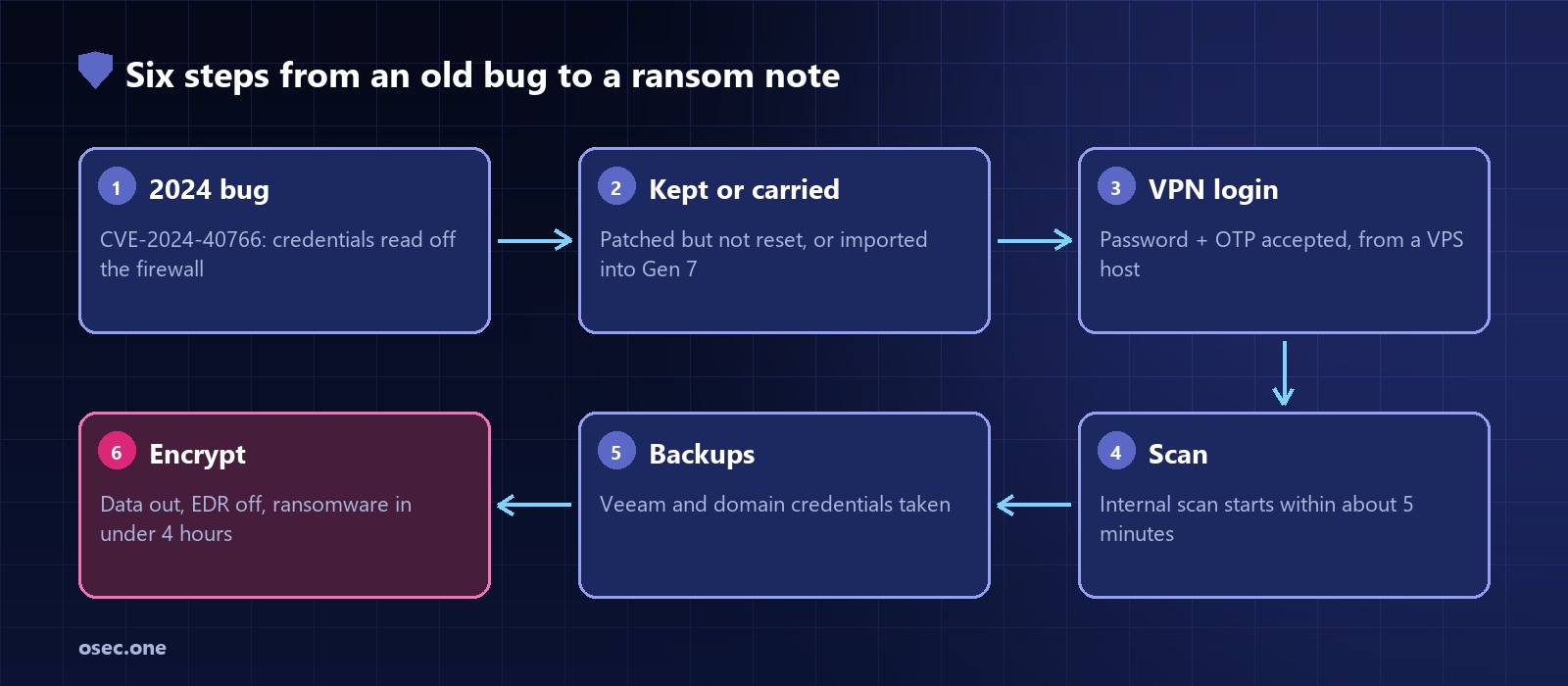
In late July 2025 Akira ransomware affiliates started logging into SonicWall firewalls' SSL VPN with real usernames and passwords, then encrypting the network behind them, often in under four hours. Arctic Wolf first thought it was a zero-day. SonicWall's answer, after looking at fewer than 40 incidents, was less dramatic: no new bug, just CVE-2024-40766, patched in August 2024, and passwords that nobody reset after the patch. Many came from firewalls moved from Gen 6 to Gen 7 with the old local accounts imported as they were.
That explanation covered most cases but not all of them. Over half of the intrusions Arctic Wolf analysed hit accounts with one-time-password MFA turned on, and some victims were on fully patched firmware. This write-up goes through how a password stolen in 2024 was still opening doors in 2025, what the four-hour timeline looks like from inside, where the MFA question stands, and the controls that break each step.
Timeline
| When | What happened | Source |
|---|---|---|
| 23 Aug 2024 | CVE-2024-40766 published: improper access control in SonicOS management access, later extended to SSL VPN. Gen 5, Gen 6, and Gen 7 up to 7.0.1-5035 affected | SonicWall SNWLID-2024-0015, CVE record |
| 9 Sep 2024 | Added to CISA's Known Exploited Vulnerabilities list, marked as used in ransomware campaigns | CISA KEV |
| Oct 2024 on | Malicious SSL VPN logins by Akira and Fog seen on and off | Arctic Wolf |
| 21-22 Jul 2025 | New surge starts: logins, then ransomware within hours | Arctic Wolf |
| 4 Aug 2025 | SonicWall notice: possible new issue on Gen 7 with SSL VPN; advises limiting or disabling SSL VPN | SonicWall notice |
| 6-7 Aug 2025 | "High confidence" it is not a zero-day; under 40 incidents; many were Gen 6 to Gen 7 migrations with passwords carried over | SonicWall notice, BleepingComputer |
| 14-21 Aug 2025 | Notice adds LDAP bind credentials, the LDAP SSL VPN Default User Group, Botnet Filtering and account lockout | SonicWall notice |
| 26 Sep 2025 | Arctic Wolf: "dozens" of intrusions, OTP accounts hit, firmware up to 7.3.0-7012 among victims, infrastructure active to 20 Sep | Arctic Wolf Labs |
The gap that matters is between the first row and the fourth: about 11 months between the patch and the campaign. Every password read off a vulnerable box in 2024 and never changed was still good in July 2025. The patch closed the hole; it didn't take back what had already gone through it.
How a migration carried the password forward
Many SonicWall customers replaced Gen 6 firewalls (TZ and NSa models on SonicOS 6.5) with Gen 7 ones using the usual path: export the Gen 6 settings, import them into the new box. That import brings the local user accounts with their passwords. The user never notices; the old password just works on the new hardware. SonicWall's 2024 advisory had already told customers to reset local SSL VPN passwords on affected boxes. On a firewall that was replaced instead of patched, that step was easy to skip, because the new box was never vulnerable.
Three settings made it worse in the cases Rapid7 and Arctic Wolf looked at:
1. LDAP-synced accounts that were never meant for VPN. Arctic Wolf saw logins with Active Directory accounts synced over LDAP that had no business using the VPN. The SSL VPN Default User Group setting can add every user who passes LDAP authentication to a local group with VPN access.
2. An internet-facing Virtual Office portal. Rapid7 found portals where an attacker holding a password could enrol their own one-time-password device on an account.
3. No lockout, no geography. Account lockout and Botnet / Geo-IP filtering were off on many boxes, so password guessing and logins from hosting providers met no resistance. SonicWall added both to its notice on 18 August.
Inside the four hours
Arctic Wolf's 26 September analysis gives the pace. These are the figures it reports, counted from the VPN login.
| Time from login | What the attacker did | What it leaves behind |
|---|---|---|
| 0 | SSL VPN login (firewall event 1080) from a VPS: mostly AS62240 Clouvider, also Hivelocity, QuadraNet, DigitalOcean and others | A login from a hosting ASN, often in a country you don't operate in |
| ~5 min | Internal scan with Advanced IP Scanner or SoftPerfect; SMB sessions that look like Impacket | Windows network logons (event 4624/4625, type 3) from the VPN pool |
| Next | Domain and share mapping: NetExec, BloodHound, ldapdomaindump; RDP to servers | LDAP queries from an address that never makes them |
| Next | A PowerShell script pulls credentials from the Veeam Backup & Replication database; new domain accounts; AnyDesk, RustDesk, Cloudflared or ssh -R tunnels | New admin accounts, new remote tools |
| As short as 55 min | WinRAR with no compression in 3 GB volumes, only files changed in the past 365 days; out by rclone, FileZilla or WinSCP | Large outbound transfer to a VPS |
| Before encryption | Vulnerable drivers (rwdrv.sys, hlpdrv.sys) loaded from %temp% to stop EDR; shadow copies deleted | EDR goes silent |
| Under 4 h | akira.exe / locker.exe / w.exe encrypts servers and VM storage | The ransom note |
Worked: if VPN alerts are reviewed "next business day", a Friday 6 pm login is looked at on Monday at 8 am, 62 hours later. The whole intrusion fits in the first four. With 3 GB volumes, 60 GB of documents is 20 archives; that's the transfer an egress alert would need to catch. Usually only one or two VPN accounts were used per intrusion, so a single unusual login is nearly the whole signal you get before the scan starts.
The MFA question
Arctic Wolf says over half of the intrusions it analysed used accounts with SonicWall's OTP (TOTP) MFA enabled. It ruled out scratch codes and saw no OTP unbinding (event 1382) in the five days before. The login event (1080) is only written after both the password and the code pass. Arctic Wolf's own conclusion: the bypass method is unclear and the evidence points to valid credentials.
Possible explanations, none confirmed in the public reports: TOTP seeds stored on the firewall and taken along with passwords (the seed generates the codes, so whoever has it has the codes); OTP enrolled by the attacker through an exposed Virtual Office portal; or a path nobody has found yet. The practical answer is the same for all three: when you reset passwords on a box that was ever exposed, re-enrol OTP too, and move the VPN to SSO/SAML with your identity provider's MFA where you can. Arctic Wolf saw no abuse of SAML-backed VPN logins in this campaign.
Some users also reported accounts hit that were created after the migration, which the migration explanation doesn't cover; that wasn't verified. SonicWall's MySonicWall cloud backup incident (every cloud-backup customer's configuration file taken, September 2025) is another route to the same secrets, though SonicWall and Arctic Wolf both say they found no link to these attacks. Our MySonicWall write-up has the 29-item reset list.
Who was exposed
| Situation | Exposed? | Why |
|---|---|---|
| Gen 6 box patched in 2024, passwords never reset | Yes | Credentials read before the patch still valid |
| Gen 6 settings imported into Gen 7, no reset | Yes | Old passwords travel with the import |
| Gen 7 on 7.3.0, local passwords reset, OTP re-enrolled | Much lower | Old secrets dead; 7.3.0 adds brute-force and MFA controls |
| LDAP users only, Default User Group adds everyone | Yes, differently | Any AD account with a weak or reused password gets VPN |
| SSL VPN through SAML with IdP MFA | Not seen abused | The firewall holds no reusable password or seed |
| SSL VPN off, IPsec with certificates | Not this path | No password login on the internet |
Controls that break each step
| Step | Control | Notes |
|---|---|---|
| Old credentials | Reset every local SSL VPN and admin password on any box that ever ran a vulnerable build, before or after migration | SonicWall: the reset doesn't apply to LDAP/RADIUS users, whose passwords SonicOS doesn't store |
| Migrated accounts | Don't import local users from Gen 6; recreate the few you need | An import is a password copy |
| OTP | Re-enrol TOTP for every user after the reset; keep Virtual Office off the internet or require existing MFA to enrol | A new password with an old seed is half a reset |
| LDAP | Rotate the LDAP bind account; limit the SSL VPN Default User Group to a named VPN group | Arctic Wolf: treat LDAP sync accounts as critical |
| Login | SonicOS 7.3.0 or later; account lockout; Botnet and Geo-IP filters; block VPN auth from hosting ASNs | Scope the ASN block to VPN auth only; privacy VPN users may be caught |
| Scan and move | Alert on SMB/LDAP enumeration from the VPN address pool; allow RDP from VPN only to named jump hosts | Scanning began within about 5 minutes |
| Backups | Separate Veeam credentials from the domain; keep an immutable or offline copy | The Veeam database script went straight for backup credentials |
| Exfil and EDR | Alert on large outbound transfers to VPS ranges; block vulnerable drivers (Microsoft's driver blocklist, HVCI) | rclone and 3 GB WinRAR volumes are the signature here |
For the first row you need to know whether a box ever ran a vulnerable build. The osec Firmware branch check takes a SonicOS version and lists every CISA known-exploited CVE that still applies, with the fixed release on your branch, and a Firmware version watch emails you when a new one starts applying.
How it compares
This is the third SonicWall case in a year where patching wasn't the end of it. In SMA 100 OVERSTEP, stolen admin credentials put a rootkit back on fully patched appliances. In the MySonicWall incident, the vendor's cloud copy of the configuration was enough. Here it was a password from 2024 on hardware bought in 2025. The pattern matches Change Healthcare 2024, where a remote-access portal with a valid password and no MFA led to ransomware, and Ivanti Connect Secure 2024: the VPN gateway is the front door, and whatever secret it accepts is the key.
Type your SonicOS version and see which known-exploited CVEs still apply and the fixed release on your branch. Free, nothing to install.
Check your firewall versionSources
• SonicWall, Gen 7 and newer SonicWall Firewalls – SSLVPN Recent Threat Activity (published 4 Aug 2025, change log to 22 Aug 2025): https://www.sonicwall.com/support/notices/gen-7-and-newer-sonicwall-firewalls-sslvpn-recent-threat-activity/kA1VN0000000RDG0A2
• CVE-2024-40766 record (SonicWall SNWLID-2024-0015; CVSS, affected versions, CISA KEV entry): https://cve.circl.lu/vuln/cve-2024-40766
• Arctic Wolf, July 2025 uptick in Akira ransomware activity targeting SonicWall SSL VPN (updated 7 Aug and 22 Sep 2025): https://arcticwolf.com/resources/blog/arctic-wolf-observes-july-2025-uptick-in-akira-ransomware-activity-targeting-sonicwall-ssl-vpn/
• Arctic Wolf Labs, Smash and grab: aggressive Akira campaign targets SonicWall VPNs (26 Sep 2025): https://arcticwolf.com/resources/blog/smash-and-grab-aggressive-akira-campaign-targets-sonicwall-vpns/
• BleepingComputer, SonicWall finds no SSLVPN zero-day, links ransomware attacks to 2024 flaw (7 Aug 2025): https://www.bleepingcomputer.com/news/security/sonicwall-finds-no-sslvpn-zero-day-links-ransomware-attacks-to-2024-flaw/
• Help Net Security, Akira ransomware: from SonicWall VPN login to encryption in under four hours (29 Sep 2025, with Rapid7's findings): https://www.helpnetsecurity.com/2025/09/29/akira-ransomware-sonicwall-vpn/