In June 2026 the same thing happened again on a smaller scale: 13,322 people in three days. This write-up follows the 2023 run from the customer notice and the court file, works out what the login traffic must have looked like, explains why points are such easy money, and gives a control with a starting threshold for each step. It also corrects a figure that gets attached to this case: the $4.4 million Chick-fil-A settlement has nothing to do with it.
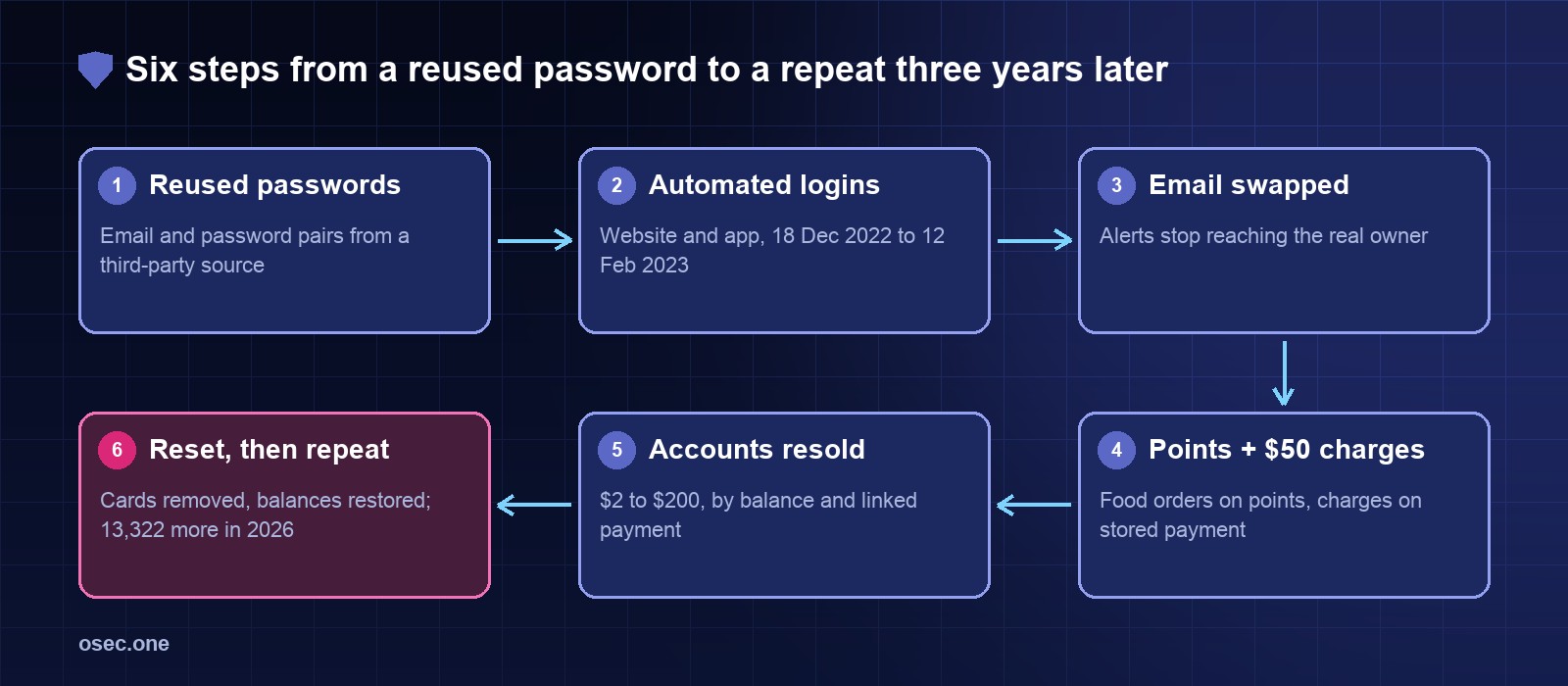
"},{"id":145393,"block_type":"screenshot","html":"Six steps. The notice blames passwords from a third-party source; everything after the login was the app working as designed."},{"id":145394,"block_type":"heading_h2","html":"
Timeline, from the notice, the press and the court file
"},{"id":145395,"block_type":"html","html":"
\n
Date
What happened
Source
\n
18 Dec 2022
Automated attack on the website and app begins, using credentials \"obtained from a third-party source\"
Customer notice, 2 Mar 2023
\n
Before Christmas 2022
BleepingComputer emails Chick-fil-A about accounts being stolen by credential stuffing and sold online
BleepingComputer
\n
2 Jan 2023
A customer posts that the attacker changed the account email, so notifications stopped arriving
The Record
\n
4 Jan 2023
Chick-fil-A on Twitter: it is investigating, and \"this is not due to a compromise of Chick-fil-A Inc.'s internal systems\"
The Record; complaint ¶12
\n
5 Jan 2023
A customer posts that someone used the account's points to order food
The Record
\n
6 Jan 2023
Website alert: \"We are investigating suspicious activity on some customer accounts\"
Complaint ¶13
\n
2 Feb 2023
A Georgia customer's account is charged twice, $50 each; her bank refunds the $100
Complaint ¶44-45 (allegation)
\n
4 Feb 2023
A Missouri customer's account is charged $50; he says support read a script telling him there was no data breach. Refunded 16 Feb
Complaint ¶35-37 (allegation)
\n
12 Feb 2023
End of the attack window; Chick-fil-A determines the accounts were accessed
Customer notice
\n
14 Feb 2023
Form email to a customer: changed emails reverted, passwords reset, Chick-fil-A One Card funds frozen
Complaint ¶47
\n
2 Mar 2023
Notice letters go out; state filings put the total at 71,473 accounts
Notice; BleepingComputer
\n
6 Mar 2023
Stephens et al. v. Chick-fil-A, Inc., No. 1:23-cv-00964 (N.D. Ga.), filed
Complaint
\n
11 Oct 2023
Parties report a settlement in principle and ask for a stay to 11 Dec 2023
Court document 38
\n
17-19 Jun 2026
A second automated attack on the website and app
BleepingComputer
\n
13 Jul 2026
Chick-fil-A determines account information may have been accessed
BleepingComputer
\n
23 Jul-1 Sep 2026
Williams v. Chick-fil-A, No. 1:26-cv-04160, filed and then voluntarily dismissed without prejudice
OpenClassActions docket summary
\n
"},{"id":145396,"block_type":"paragraph","html":"
Three gaps matter. The window lasted 57 calendar days. It stayed open for 39 days after the 4 January statement and 41 days after the first customer post cited here. And the formal notice came 57 days after that statement. The statement about internal systems may well have been accurate (the notice later said the same thing), but it answered a different question from the one customers had, which was whether someone was in their account.
Chick-fil-A's notice says the credentials came from "a third-party source", and it tells customers to pick a password "unique to Chick-fil-A". Neither the notice nor the coverage names the source or says how large the list was. A loyalty app is a good target for this because people treat it as low stakes: a password chosen for a sandwich app is likely to be one they already use elsewhere.
The notice names both surfaces. That detail matters, because mobile login APIs are often protected less than the web form: no page for a CAPTCHA widget to live on, and traffic that looks like an app rather than a browser. Nothing published says which surface carried most of the traffic, or which login controls existed at the time. The complaint alleges Chick-fil-A had no multi-factor authentication (¶112); that claim was never tested in court.
A customer reported this on 2 January, and Chick-fil-A's own 14 February form email confirms it happened: "If we detected an email change for your account, we have reverted your email address." Customer posts cited by The Record say the change hid withdrawal notices. It's the step that turns a one-off theft into a stolen account: the real owner stops hearing about activity, and the reset link now goes to the attacker.
Customers reported food orders on points, money loaded from linked bank accounts, and charges. Both named plaintiffs saw $50 charges, one of them twice in a day. The complaint doesn't say what the $50 bought; a round figure fits a top-up of the Chick-fil-A One Card better than a food order, though that is our reading. Card numbers themselves weren't the prize: the notice says attackers could see only the last four digits. They didn't need more, since the app would charge the stored card for them.
Accounts were sold for $2 to $200, depending on balance, linked payment and reward points, according to a researcher quoted by BleepingComputer and The Record. BleepingComputer saw one Telegram channel where buyers posted pictures of what they had bought with them. So the people doing the logins and the people eating the food need not be the same, and a velocity check on spending has to expect a fresh device for every purchase.
Chick-fil-A forced password resets, removed stored cards, froze loaded funds for a while, reverted changed emails, restored balances (with refunds to the original payment method where possible) and added rewards as an apology. It also said it "continues to enhance its security, monitoring, and fraud controls", without saying how. The notice offered no credit monitoring, only a guide to credit reports, fraud alerts and freezes.
Chick-fil-A didn't publish how many login attempts it saw. Credential stuffing success rates are usually put somewhere between 0.1% and 2%, the same range used in our PayPal analysis. Here is what 71,473 hits imply over 57 days, assuming an even spread:
"},{"id":145415,"block_type":"html","html":"
\n
Assumed success rate
Attempts for 71,473 hits
Attempts a day
Attempts a second
\n
2%
3.57 million
62,696
0.73
\n
1%
7.15 million
125,391
1.45
\n
0.1%
71.5 million
1,253,912
14.5
\n
"},{"id":145416,"block_type":"paragraph","html":"
Worked line for 1%: 71,473 / 0.01 = 7,147,300 attempts; 57 days = 4,924,800 seconds; 7,147,300 / 4,924,800 = 1.45 attempts a second. The hits average 71,473 / 57 = 1,254 accounts a day. Now spread the 1% case across attacking IP addresses, against a limit of 10 attempts a minute per IP:
"},{"id":145417,"block_type":"html","html":"
\n
Attacking IPs
Attempts per IP a day
Per IP per minute
Trips 10 a minute?
\n
1
125,391
87
Yes
\n
10
12,539
8.7
No
\n
100
1,254
0.87
No
\n
1,000
125
0.09
No
\n
"},{"id":145418,"block_type":"paragraph","html":"
Ten addresses are enough to stay under that limit, and a rented proxy pool has far more than ten. The per-account view is no better. NIST SP 800-63B-4 caps consecutive failed attempts at 100 per account, a sound rule against guessing, but a stuffing run usually tries one known password per account, so the counter sits at 1. Neither brake sees the attack. What does show up is the aggregate: at a 1% success rate there are 99 failures for every success, and many of the emails on a combo list have no account with you at all.
"},{"id":145419,"block_type":"paragraph","html":"
The per-IP arithmetic is an illustration, since no attacker's IP count has been published. Real traffic also comes in bursts rather than evenly. Our write-up of sign-in rules that count emails and wrong codes covers the same slow, spread-out pattern.
Published point charts give a sense of what a balance represents. These figures are from 2026 guides, not the December 2022 chart, which was changed in April 2023. The earn rate is 10 points per dollar at the base tier and 13 at Signature:
"},{"id":145422,"block_type":"html","html":"
\n
Reward
Points
Spend to earn it at 10 points/$
At 13 points/$
\n
Dipping sauce or small side
200
$20
$15
\n
Large waffle fries
500
$50
$38
\n
Nuggets or 2-count strips
600
$60
$46
\n
Full meal
2,500
$250
$192
\n
"},{"id":145423,"block_type":"paragraph","html":"
So a customer who has spent $250 is holding one free meal. That is small for the customer and useful for a thief, and our reading is that the reasons are structural rather than specific to this chain:
"},{"id":145424,"block_type":"paragraph","html":"
• No bank in the loop. Points never appear on a card statement, so there is no issuer fraud model and no chargeback. The Georgia customer's bank refunded her $100 quickly; nobody had that lever for points. • Balances build up unwatched. Chick-fil-A's points don't expire under the current program, and few people check a rewards balance before they want to use it. • The spend is instant and can't be recovered. The goods are eaten within the hour. Restoring points costs the company, not the thief. • The login is the only gate. None of the reports describe a second check before points were spent. Adding one would slow the checkout the app exists to speed up. • Victims report late and low. A missing free sandwich rarely prompts a call, which delays the signal that something is wrong.
"},{"id":145425,"block_type":"paragraph","html":"
On the reseller's side, 71,473 accounts at the $2 floor comes to $142,946. That is a lower bound under the assumption that every account sold, and we have no evidence that they did. It isn't an estimate of what the attackers made, but it does show why this is worth running for weeks.
The second run was shut down far sooner: 3 days instead of 57, and about 19% of the first count. That is real progress. But it hit at about 3.5 times the daily rate (4,441 / 1,254), and the fields exposed are essentially the same, so a working reused password still opened an account three years on. Faster detection limits the damage from a run; it doesn't change what one good password gets you. We can't tell from public filings what login controls were in place in 2026, or how much the two counts are comparable, since one is accounts and the other is people.
Some settlement sites and summaries blur two separate Chick-fil-A cases, so here they are apart. Regulators publish figures; private class settlements often don't, and this one didn't.
"},{"id":145431,"block_type":"html","html":"
\n
Case
What it was about
Published figure
\n
Stephens v. Chick-fil-A (2023)
This breach: 71,473 accounts
None. Settlement in principle reported 11 Oct 2023, 219 days after filing, with no amount, no public terms and no claim process we could find. The complaint's $5 million is the threshold for federal jurisdiction, not a settlement figure
\n
Delivery fee class action (2024)
Alleged hidden delivery charges, Nov 2019-Apr 2021. Not a data breach
$4.4 million: $1.45 million cash and $2.95 million gift cards, up to $29.25 a claimant; claims closed 15 Feb 2024
\n
Williams v. Chick-fil-A (2026)
The June 2026 run
None. Voluntarily dismissed 1 Sep 2026, no class certified
\n
"},{"id":145432,"block_type":"paragraph","html":"
For a public number on a loyalty stuffing case, the closest comparison is Dunkin'. New York's Attorney General settled in September 2020 for $650,000 in penalties and costs, over DD Perks attacks from 2015 on, with nearly 20,000 accounts in one five-day sample alone and refunds of stolen DD card funds. That's at most $32.50 an account on the sample ($650,000 / 20,000), and less on the real total, which the AG put at tens of thousands. The AG's complaint was about what happened after the alert: Dunkin' was told of the attacks by a third-party app developer and, according to the AG, did not investigate properly, notify customers or reset passwords. Set that beside our PayPal case, about $57 an account from a regulator. These are what regulators charged elsewhere. Chick-fil-A's own cost, in restored balances, refunds and added rewards, isn't public.
"},{"id":145433,"block_type":"paragraph","html":"
The one per-person number in the 2023 complaint is a damages theory: credit monitoring at about $200 a year for at least five years (¶138). Across the class that would be 71,473 x $200 x 5 = $71.5 million. That is what the plaintiffs' theory implies at its full extent, not what anyone paid, and the fields in the notice didn't include Social Security numbers, which is a weak footing for a five-year monitoring claim.
The thresholds below are our suggested starting points for a small or mid-size consumer app, not published standards. Tune them against your own traffic and watch the false positives for a week before you block on them.
"},{"id":145436,"block_type":"html","html":"
\n
Step
Control
Starting point
\n
Reused password
Check against a breached-password list at signup, at password change and at login (NIST SP 800-63B-4 §3.1.1.2 requires a blocklist for new passwords). Better, remove the password
Force a reset when a login password appears on the list
\n
Automated logins
Alarm on aggregate signals rather than per-IP counts: failed login ratio, and share of attempts for emails with no account. Apply the same rules to the app API as to the web form
Page someone at 3 times the 7-day median, per hour
\n
Valid password, new device
Step-up code before the session can do anything of value. OWASP calls MFA \"by far the best defense\" against password attacks
Every new device, no exceptions for the app
\n
Email change
Code to the old address, an alert to the old address that can't be turned off, and a hold on spending afterwards
24-hour hold on redemptions and top-ups
\n
Redeeming points
Step-up on the first redemption from a new device. Cap redemptions per device and per account
1 redemption per new device in the first 24 hours
\n
Stored-card charge or top-up
Ask for the CVV or a passkey on a new device. Cap top-ups
1 top-up in 24 hours on a new device; would have flagged the second $50 charge
\n
In-store QR and pay numbers
Short-lived codes bound to the session, reissued on password reset
Rotate in under a minute
\n
Resale
Count accounts per device. Search Telegram and forums for your brand name each week
Review any device touching 3 or more accounts in a day
\n
Support and statements
A script that says what you know, not that nothing happened. Separate \"our systems weren't breached\" from \"your account is safe\"
Flag the account on the first report and reset it the same day
\n
"},{"id":145437,"block_type":"paragraph","html":"
OWASP also warns that fingerprints can be spoofed and that IP blocks shouldn't be the main defence, so treat each row as one layer. The device count in the resale row is the sort of thing Fingerprint Lite gives a small site without an enterprise contract.
"},{"id":145438,"block_type":"paragraph","html":"
The cheapest fix is the same as in the other stuffing cases: leave no password to replay. A combo list has nothing to try on a sign-in that only takes an email code, Google or Apple. That moves the risk to the inbox rather than removing it (a reused password on the mailbox is still a problem), but an attacker now has to break into a mail account per victim rather than replay a list. If you keep passwords, take the spending rows above first, since they still work after a login has been stolen.
Roku's two waves ended with mandatory two-factor sign-in. PayPal's did too, for US accounts. A food app has a harder trade: every extra step at the counter costs orders, which is probably why the checks belong at the risky moments (new device, email change, first redemption) rather than at every login.
"},{"id":145442,"block_type":"cta","html":"
Sign-ins with email codes, Google and Apple: no password to stuff, no OAuth app to set up on your side. Free.
From 18 December 2022 to 12 February 2023, an automated attack ran against Chick-fil-A's website and app using email and password pairs from somewhere else. It opened 71,473 Chick-fil-A One accounts. Inside were reward points, gift card balances and stored payment methods that could be spent with no further check. Customers complained in public from the first days of January, yet the attack window stayed open for another six weeks.
\n
Ad
\n
In June 2026 the same thing happened again on a smaller scale: 13,322 people in three days. This write-up follows the 2023 run from the customer notice and the court file, works out what the login traffic must have looked like, explains why points are such easy money, and gives a control with a starting threshold for each step. It also corrects a figure that gets attached to this case: the $4.4 million Chick-fil-A settlement has nothing to do with it.
\n
Six steps. The notice blames passwords from a third-party source; everything after the login was the app working as designed.
\n
Timeline, from the notice, the press and the court file
\n
\n
Date
What happened
Source
\n
18 Dec 2022
Automated attack on the website and app begins, using credentials \"obtained from a third-party source\"
Customer notice, 2 Mar 2023
\n
Before Christmas 2022
BleepingComputer emails Chick-fil-A about accounts being stolen by credential stuffing and sold online
BleepingComputer
\n
2 Jan 2023
A customer posts that the attacker changed the account email, so notifications stopped arriving
The Record
\n
4 Jan 2023
Chick-fil-A on Twitter: it is investigating, and \"this is not due to a compromise of Chick-fil-A Inc.'s internal systems\"
The Record; complaint ¶12
\n
5 Jan 2023
A customer posts that someone used the account's points to order food
The Record
\n
6 Jan 2023
Website alert: \"We are investigating suspicious activity on some customer accounts\"
Complaint ¶13
\n
2 Feb 2023
A Georgia customer's account is charged twice, $50 each; her bank refunds the $100
Complaint ¶44-45 (allegation)
\n
4 Feb 2023
A Missouri customer's account is charged $50; he says support read a script telling him there was no data breach. Refunded 16 Feb
Complaint ¶35-37 (allegation)
\n
12 Feb 2023
End of the attack window; Chick-fil-A determines the accounts were accessed
Customer notice
\n
14 Feb 2023
Form email to a customer: changed emails reverted, passwords reset, Chick-fil-A One Card funds frozen
Complaint ¶47
\n
2 Mar 2023
Notice letters go out; state filings put the total at 71,473 accounts
Notice; BleepingComputer
\n
6 Mar 2023
Stephens et al. v. Chick-fil-A, Inc., No. 1:23-cv-00964 (N.D. Ga.), filed
Complaint
\n
11 Oct 2023
Parties report a settlement in principle and ask for a stay to 11 Dec 2023
Court document 38
\n
17-19 Jun 2026
A second automated attack on the website and app
BleepingComputer
\n
13 Jul 2026
Chick-fil-A determines account information may have been accessed
BleepingComputer
\n
23 Jul-1 Sep 2026
Williams v. Chick-fil-A, No. 1:26-cv-04160, filed and then voluntarily dismissed without prejudice
OpenClassActions docket summary
\n
\n
Three gaps matter. The window lasted 57 calendar days. It stayed open for 39 days after the 4 January statement and 41 days after the first customer post cited here. And the formal notice came 57 days after that statement. The statement about internal systems may well have been accurate (the notice later said the same thing), but it answered a different question from the one customers had, which was whether someone was in their account.
\n
How it worked, step by step
\n
1. Passwords from somewhere else
\n
Chick-fil-A's notice says the credentials came from "a third-party source", and it tells customers to pick a password "unique to Chick-fil-A". Neither the notice nor the coverage names the source or says how large the list was. A loyalty app is a good target for this because people treat it as low stakes: a password chosen for a sandwich app is likely to be one they already use elsewhere.
\n
2. Automated logins, website and app both
\n
The notice names both surfaces. That detail matters, because mobile login APIs are often protected less than the web form: no page for a CAPTCHA widget to live on, and traffic that looks like an app rather than a browser. Nothing published says which surface carried most of the traffic, or which login controls existed at the time. The complaint alleges Chick-fil-A had no multi-factor authentication (¶112); that claim was never tested in court.
\n
3. The email address changes
\n
A customer reported this on 2 January, and Chick-fil-A's own 14 February form email confirms it happened: "If we detected an email change for your account, we have reverted your email address." Customer posts cited by The Record say the change hid withdrawal notices. It's the step that turns a one-off theft into a stolen account: the real owner stops hearing about activity, and the reset link now goes to the attacker.
\n
4. Spending points and stored payment
\n
Customers reported food orders on points, money loaded from linked bank accounts, and charges. Both named plaintiffs saw $50 charges, one of them twice in a day. The complaint doesn't say what the $50 bought; a round figure fits a top-up of the Chick-fil-A One Card better than a food order, though that is our reading. Card numbers themselves weren't the prize: the notice says attackers could see only the last four digits. They didn't need more, since the app would charge the stored card for them.
\n
5. Resale
\n
Accounts were sold for $2 to $200, depending on balance, linked payment and reward points, according to a researcher quoted by BleepingComputer and The Record. BleepingComputer saw one Telegram channel where buyers posted pictures of what they had bought with them. So the people doing the logins and the people eating the food need not be the same, and a velocity check on spending has to expect a fresh device for every purchase.
\n
6. The clean-up
\n
Chick-fil-A forced password resets, removed stored cards, froze loaded funds for a while, reverted changed emails, restored balances (with refunds to the original payment method where possible) and added rewards as an apology. It also said it "continues to enhance its security, monitoring, and fraud controls", without saying how. The notice offered no credit monitoring, only a guide to credit reports, fraud alerts and freezes.
\n
What the notice lists, and what each field is for
\n
The right-hand column is our reading of how each field can be misused. The notice doesn't say any of these uses happened.
\n
\n
Field in the notice
Use to an attacker
\n
Name, email address
Targeted phishing that quotes the real account
\n
Membership number, mobile pay number, QR code
Identifiers tied to in-store use of the account
\n
Masked card number (last four digits)
Convincing support staff or the victim that a caller is genuine
\n
Chick-fil-A credit, e.g. e-gift card balance
Tells a reseller what to charge for the account, and is itself spendable
\n
Month and day of birthday, phone, address (if saved)
Answers to knowledge-based checks, SMS phishing
\n
\n
The numbers, worked through
\n
Chick-fil-A didn't publish how many login attempts it saw. Credential stuffing success rates are usually put somewhere between 0.1% and 2%, the same range used in our PayPal analysis. Here is what 71,473 hits imply over 57 days, assuming an even spread:
\n
\n
Assumed success rate
Attempts for 71,473 hits
Attempts a day
Attempts a second
\n
2%
3.57 million
62,696
0.73
\n
1%
7.15 million
125,391
1.45
\n
0.1%
71.5 million
1,253,912
14.5
\n
\n
Worked line for 1%: 71,473 / 0.01 = 7,147,300 attempts; 57 days = 4,924,800 seconds; 7,147,300 / 4,924,800 = 1.45 attempts a second. The hits average 71,473 / 57 = 1,254 accounts a day. Now spread the 1% case across attacking IP addresses, against a limit of 10 attempts a minute per IP:
\n
\n
Attacking IPs
Attempts per IP a day
Per IP per minute
Trips 10 a minute?
\n
1
125,391
87
Yes
\n
10
12,539
8.7
No
\n
100
1,254
0.87
No
\n
1,000
125
0.09
No
\n
\n
Ten addresses are enough to stay under that limit, and a rented proxy pool has far more than ten. The per-account view is no better. NIST SP 800-63B-4 caps consecutive failed attempts at 100 per account, a sound rule against guessing, but a stuffing run usually tries one known password per account, so the counter sits at 1. Neither brake sees the attack. What does show up is the aggregate: at a 1% success rate there are 99 failures for every success, and many of the emails on a combo list have no account with you at all.
\n
The per-IP arithmetic is an illustration, since no attacker's IP count has been published. Real traffic also comes in bursts rather than evenly. Our write-up of sign-in rules that count emails and wrong codes covers the same slow, spread-out pattern.
\n
Why loyalty points are such easy money
\n
Published point charts give a sense of what a balance represents. These figures are from 2026 guides, not the December 2022 chart, which was changed in April 2023. The earn rate is 10 points per dollar at the base tier and 13 at Signature:
\n
\n
Reward
Points
Spend to earn it at 10 points/$
At 13 points/$
\n
Dipping sauce or small side
200
$20
$15
\n
Large waffle fries
500
$50
$38
\n
Nuggets or 2-count strips
600
$60
$46
\n
Full meal
2,500
$250
$192
\n
\n
So a customer who has spent $250 is holding one free meal. That is small for the customer and useful for a thief, and our reading is that the reasons are structural rather than specific to this chain:
\n
• No bank in the loop. Points never appear on a card statement, so there is no issuer fraud model and no chargeback. The Georgia customer's bank refunded her $100 quickly; nobody had that lever for points. • Balances build up unwatched. Chick-fil-A's points don't expire under the current program, and few people check a rewards balance before they want to use it. • The spend is instant and can't be recovered. The goods are eaten within the hour. Restoring points costs the company, not the thief. • The login is the only gate. None of the reports describe a second check before points were spent. Adding one would slow the checkout the app exists to speed up. • Victims report late and low. A missing free sandwich rarely prompts a call, which delays the signal that something is wrong.
\n
On the reseller's side, 71,473 accounts at the $2 floor comes to $142,946. That is a lower bound under the assumption that every account sold, and we have no evidence that they did. It isn't an estimate of what the attackers made, but it does show why this is worth running for weeks.
\n
2023 and 2026 side by side
\n
\n
Dec 2022-Feb 2023
June 2026
\n
Window
57 days
3 days
\n
People or accounts
71,473
13,322 (Maine filing)
\n
Average per day
1,254
4,441
\n
Attempts a second at an assumed 1%
1.45
5.14
\n
From end of attack to the company's determination
Same day (12 Feb)
24 days (13 Jul)
\n
Data listed
Name, email, membership and mobile pay numbers, QR code, last four card digits, credit balance; birthday, phone, address if saved
The same fields, with birth dates, phones and addresses if stored
The second run was shut down far sooner: 3 days instead of 57, and about 19% of the first count. That is real progress. But it hit at about 3.5 times the daily rate (4,441 / 1,254), and the fields exposed are essentially the same, so a working reused password still opened an account three years on. Faster detection limits the damage from a run; it doesn't change what one good password gets you. We can't tell from public filings what login controls were in place in 2026, or how much the two counts are comparable, since one is accounts and the other is people.
\n
The settlement: what is and isn't known
\n
Some settlement sites and summaries blur two separate Chick-fil-A cases, so here they are apart. Regulators publish figures; private class settlements often don't, and this one didn't.
\n
\n
Case
What it was about
Published figure
\n
Stephens v. Chick-fil-A (2023)
This breach: 71,473 accounts
None. Settlement in principle reported 11 Oct 2023, 219 days after filing, with no amount, no public terms and no claim process we could find. The complaint's $5 million is the threshold for federal jurisdiction, not a settlement figure
\n
Delivery fee class action (2024)
Alleged hidden delivery charges, Nov 2019-Apr 2021. Not a data breach
$4.4 million: $1.45 million cash and $2.95 million gift cards, up to $29.25 a claimant; claims closed 15 Feb 2024
\n
Williams v. Chick-fil-A (2026)
The June 2026 run
None. Voluntarily dismissed 1 Sep 2026, no class certified
\n
\n
For a public number on a loyalty stuffing case, the closest comparison is Dunkin'. New York's Attorney General settled in September 2020 for $650,000 in penalties and costs, over DD Perks attacks from 2015 on, with nearly 20,000 accounts in one five-day sample alone and refunds of stolen DD card funds. That's at most $32.50 an account on the sample ($650,000 / 20,000), and less on the real total, which the AG put at tens of thousands. The AG's complaint was about what happened after the alert: Dunkin' was told of the attacks by a third-party app developer and, according to the AG, did not investigate properly, notify customers or reset passwords. Set that beside our PayPal case, about $57 an account from a regulator. These are what regulators charged elsewhere. Chick-fil-A's own cost, in restored balances, refunds and added rewards, isn't public.
\n
The one per-person number in the 2023 complaint is a damages theory: credit monitoring at about $200 a year for at least five years (¶138). Across the class that would be 71,473 x $200 x 5 = $71.5 million. That is what the plaintiffs' theory implies at its full extent, not what anyone paid, and the fields in the notice didn't include Social Security numbers, which is a weak footing for a five-year monitoring claim.
\n
Controls that break each step
\n
The thresholds below are our suggested starting points for a small or mid-size consumer app, not published standards. Tune them against your own traffic and watch the false positives for a week before you block on them.
\n
\n
Step
Control
Starting point
\n
Reused password
Check against a breached-password list at signup, at password change and at login (NIST SP 800-63B-4 §3.1.1.2 requires a blocklist for new passwords). Better, remove the password
Force a reset when a login password appears on the list
\n
Automated logins
Alarm on aggregate signals rather than per-IP counts: failed login ratio, and share of attempts for emails with no account. Apply the same rules to the app API as to the web form
Page someone at 3 times the 7-day median, per hour
\n
Valid password, new device
Step-up code before the session can do anything of value. OWASP calls MFA \"by far the best defense\" against password attacks
Every new device, no exceptions for the app
\n
Email change
Code to the old address, an alert to the old address that can't be turned off, and a hold on spending afterwards
24-hour hold on redemptions and top-ups
\n
Redeeming points
Step-up on the first redemption from a new device. Cap redemptions per device and per account
1 redemption per new device in the first 24 hours
\n
Stored-card charge or top-up
Ask for the CVV or a passkey on a new device. Cap top-ups
1 top-up in 24 hours on a new device; would have flagged the second $50 charge
\n
In-store QR and pay numbers
Short-lived codes bound to the session, reissued on password reset
Rotate in under a minute
\n
Resale
Count accounts per device. Search Telegram and forums for your brand name each week
Review any device touching 3 or more accounts in a day
\n
Support and statements
A script that says what you know, not that nothing happened. Separate \"our systems weren't breached\" from \"your account is safe\"
Flag the account on the first report and reset it the same day
\n
\n
OWASP also warns that fingerprints can be spoofed and that IP blocks shouldn't be the main defence, so treat each row as one layer. The device count in the resale row is the sort of thing Fingerprint Lite gives a small site without an enterprise contract.
\n
The cheapest fix is the same as in the other stuffing cases: leave no password to replay. A combo list has nothing to try on a sign-in that only takes an email code, Google or Apple. That moves the risk to the inbox rather than removing it (a reused password on the mailbox is still a problem), but an attacker now has to break into a mail account per victim rather than replay a list. If you keep passwords, take the spending rows above first, since they still work after a login has been stolen.
\n
How it differs from Roku and PayPal
\n
\n
Chick-fil-A 2023
Roku 2024
PayPal 2022
\n
Accounts opened
71,473
about 591,000
34,942
\n
Length
57 days
two waves
2-3 days
\n
What the login was worth
Points, gift balances, stored payment
Stored card for purchases, resold accounts
Full SSN on a tax form
\n
Accounts actually used to spend
Not published
Fewer than 400, refunded
No financial information accessed, per PayPal
\n
Resale price reported
$2 to $200
From $0.50
Not the point: the SSN was
\n
Public penalty figure
None
None in our sources
$2 million (NYDFS)
\n
\n
Roku's two waves ended with mandatory two-factor sign-in. PayPal's did too, for US accounts. A food app has a harder trade: every extra step at the counter costs orders, which is probably why the checks belong at the risky moments (new device, email change, first redemption) rather than at every login.
\n
Sign-ins with email codes, Google and Apple: no password to stuff, no OAuth app to set up on your side. Free.
Chick-fil-A 2023: 71,473 app accounts, loyalty points and stored cards in a 57-day stuffing run, and a repeat in 2026
From 18 December 2022 to 12 February 2023, an automated attack ran against Chick-fil-A's website and app using email and password pairs from somewhere else. It opened 71,473 Chick-fil-A One accounts. Inside were reward points, gift card balances and stored payment methods that could be spent with no further check. Customers complained in public from the first days of January, yet the attack window stayed open for another six weeks.
Ad
In June 2026 the same thing happened again on a smaller scale: 13,322 people in three days. This write-up follows the 2023 run from the customer notice and the court file, works out what the login traffic must have looked like, explains why points are such easy money, and gives a control with a starting threshold for each step. It also corrects a figure that gets attached to this case: the $4.4 million Chick-fil-A settlement has nothing to do with it.
Six steps. The notice blames passwords from a third-party source; everything after the login was the app working as designed.
Timeline, from the notice, the press and the court file
Date
What happened
Source
18 Dec 2022
Automated attack on the website and app begins, using credentials "obtained from a third-party source"
Customer notice, 2 Mar 2023
Before Christmas 2022
BleepingComputer emails Chick-fil-A about accounts being stolen by credential stuffing and sold online
BleepingComputer
2 Jan 2023
A customer posts that the attacker changed the account email, so notifications stopped arriving
The Record
4 Jan 2023
Chick-fil-A on Twitter: it is investigating, and "this is not due to a compromise of Chick-fil-A Inc.'s internal systems"
The Record; complaint ¶12
5 Jan 2023
A customer posts that someone used the account's points to order food
The Record
6 Jan 2023
Website alert: "We are investigating suspicious activity on some customer accounts"
Complaint ¶13
2 Feb 2023
A Georgia customer's account is charged twice, $50 each; her bank refunds the $100
Complaint ¶44-45 (allegation)
4 Feb 2023
A Missouri customer's account is charged $50; he says support read a script telling him there was no data breach. Refunded 16 Feb
Complaint ¶35-37 (allegation)
12 Feb 2023
End of the attack window; Chick-fil-A determines the accounts were accessed
Customer notice
14 Feb 2023
Form email to a customer: changed emails reverted, passwords reset, Chick-fil-A One Card funds frozen
Complaint ¶47
2 Mar 2023
Notice letters go out; state filings put the total at 71,473 accounts
Notice; BleepingComputer
6 Mar 2023
Stephens et al. v. Chick-fil-A, Inc., No. 1:23-cv-00964 (N.D. Ga.), filed
Complaint
11 Oct 2023
Parties report a settlement in principle and ask for a stay to 11 Dec 2023
Court document 38
17-19 Jun 2026
A second automated attack on the website and app
BleepingComputer
13 Jul 2026
Chick-fil-A determines account information may have been accessed
BleepingComputer
23 Jul-1 Sep 2026
Williams v. Chick-fil-A, No. 1:26-cv-04160, filed and then voluntarily dismissed without prejudice
OpenClassActions docket summary
Three gaps matter. The window lasted 57 calendar days. It stayed open for 39 days after the 4 January statement and 41 days after the first customer post cited here. And the formal notice came 57 days after that statement. The statement about internal systems may well have been accurate (the notice later said the same thing), but it answered a different question from the one customers had, which was whether someone was in their account.
How it worked, step by step
1. Passwords from somewhere else
Chick-fil-A's notice says the credentials came from "a third-party source", and it tells customers to pick a password "unique to Chick-fil-A". Neither the notice nor the coverage names the source or says how large the list was. A loyalty app is a good target for this because people treat it as low stakes: a password chosen for a sandwich app is likely to be one they already use elsewhere.
2. Automated logins, website and app both
The notice names both surfaces. That detail matters, because mobile login APIs are often protected less than the web form: no page for a CAPTCHA widget to live on, and traffic that looks like an app rather than a browser. Nothing published says which surface carried most of the traffic, or which login controls existed at the time. The complaint alleges Chick-fil-A had no multi-factor authentication (¶112); that claim was never tested in court.
3. The email address changes
A customer reported this on 2 January, and Chick-fil-A's own 14 February form email confirms it happened: "If we detected an email change for your account, we have reverted your email address." Customer posts cited by The Record say the change hid withdrawal notices. It's the step that turns a one-off theft into a stolen account: the real owner stops hearing about activity, and the reset link now goes to the attacker.
4. Spending points and stored payment
Customers reported food orders on points, money loaded from linked bank accounts, and charges. Both named plaintiffs saw $50 charges, one of them twice in a day. The complaint doesn't say what the $50 bought; a round figure fits a top-up of the Chick-fil-A One Card better than a food order, though that is our reading. Card numbers themselves weren't the prize: the notice says attackers could see only the last four digits. They didn't need more, since the app would charge the stored card for them.
5. Resale
Accounts were sold for $2 to $200, depending on balance, linked payment and reward points, according to a researcher quoted by BleepingComputer and The Record. BleepingComputer saw one Telegram channel where buyers posted pictures of what they had bought with them. So the people doing the logins and the people eating the food need not be the same, and a velocity check on spending has to expect a fresh device for every purchase.
6. The clean-up
Chick-fil-A forced password resets, removed stored cards, froze loaded funds for a while, reverted changed emails, restored balances (with refunds to the original payment method where possible) and added rewards as an apology. It also said it "continues to enhance its security, monitoring, and fraud controls", without saying how. The notice offered no credit monitoring, only a guide to credit reports, fraud alerts and freezes.
What the notice lists, and what each field is for
The right-hand column is our reading of how each field can be misused. The notice doesn't say any of these uses happened.
Field in the notice
Use to an attacker
Name, email address
Targeted phishing that quotes the real account
Membership number, mobile pay number, QR code
Identifiers tied to in-store use of the account
Masked card number (last four digits)
Convincing support staff or the victim that a caller is genuine
Chick-fil-A credit, e.g. e-gift card balance
Tells a reseller what to charge for the account, and is itself spendable
Month and day of birthday, phone, address (if saved)
Answers to knowledge-based checks, SMS phishing
The numbers, worked through
Chick-fil-A didn't publish how many login attempts it saw. Credential stuffing success rates are usually put somewhere between 0.1% and 2%, the same range used in our PayPal analysis. Here is what 71,473 hits imply over 57 days, assuming an even spread:
Assumed success rate
Attempts for 71,473 hits
Attempts a day
Attempts a second
2%
3.57 million
62,696
0.73
1%
7.15 million
125,391
1.45
0.1%
71.5 million
1,253,912
14.5
Worked line for 1%: 71,473 / 0.01 = 7,147,300 attempts; 57 days = 4,924,800 seconds; 7,147,300 / 4,924,800 = 1.45 attempts a second. The hits average 71,473 / 57 = 1,254 accounts a day. Now spread the 1% case across attacking IP addresses, against a limit of 10 attempts a minute per IP:
Attacking IPs
Attempts per IP a day
Per IP per minute
Trips 10 a minute?
1
125,391
87
Yes
10
12,539
8.7
No
100
1,254
0.87
No
1,000
125
0.09
No
Ten addresses are enough to stay under that limit, and a rented proxy pool has far more than ten. The per-account view is no better. NIST SP 800-63B-4 caps consecutive failed attempts at 100 per account, a sound rule against guessing, but a stuffing run usually tries one known password per account, so the counter sits at 1. Neither brake sees the attack. What does show up is the aggregate: at a 1% success rate there are 99 failures for every success, and many of the emails on a combo list have no account with you at all.
The per-IP arithmetic is an illustration, since no attacker's IP count has been published. Real traffic also comes in bursts rather than evenly. Our write-up of sign-in rules that count emails and wrong codes covers the same slow, spread-out pattern.
Why loyalty points are such easy money
Published point charts give a sense of what a balance represents. These figures are from 2026 guides, not the December 2022 chart, which was changed in April 2023. The earn rate is 10 points per dollar at the base tier and 13 at Signature:
Reward
Points
Spend to earn it at 10 points/$
At 13 points/$
Dipping sauce or small side
200
$20
$15
Large waffle fries
500
$50
$38
Nuggets or 2-count strips
600
$60
$46
Full meal
2,500
$250
$192
So a customer who has spent $250 is holding one free meal. That is small for the customer and useful for a thief, and our reading is that the reasons are structural rather than specific to this chain:
• No bank in the loop. Points never appear on a card statement, so there is no issuer fraud model and no chargeback. The Georgia customer's bank refunded her $100 quickly; nobody had that lever for points. • Balances build up unwatched. Chick-fil-A's points don't expire under the current program, and few people check a rewards balance before they want to use it. • The spend is instant and can't be recovered. The goods are eaten within the hour. Restoring points costs the company, not the thief. • The login is the only gate. None of the reports describe a second check before points were spent. Adding one would slow the checkout the app exists to speed up. • Victims report late and low. A missing free sandwich rarely prompts a call, which delays the signal that something is wrong.
On the reseller's side, 71,473 accounts at the $2 floor comes to $142,946. That is a lower bound under the assumption that every account sold, and we have no evidence that they did. It isn't an estimate of what the attackers made, but it does show why this is worth running for weeks.
2023 and 2026 side by side
Dec 2022-Feb 2023
June 2026
Window
57 days
3 days
People or accounts
71,473
13,322 (Maine filing)
Average per day
1,254
4,441
Attempts a second at an assumed 1%
1.45
5.14
From end of attack to the company's determination
Same day (12 Feb)
24 days (13 Jul)
Data listed
Name, email, membership and mobile pay numbers, QR code, last four card digits, credit balance; birthday, phone, address if saved
The same fields, with birth dates, phones and addresses if stored
The second run was shut down far sooner: 3 days instead of 57, and about 19% of the first count. That is real progress. But it hit at about 3.5 times the daily rate (4,441 / 1,254), and the fields exposed are essentially the same, so a working reused password still opened an account three years on. Faster detection limits the damage from a run; it doesn't change what one good password gets you. We can't tell from public filings what login controls were in place in 2026, or how much the two counts are comparable, since one is accounts and the other is people.
The settlement: what is and isn't known
Some settlement sites and summaries blur two separate Chick-fil-A cases, so here they are apart. Regulators publish figures; private class settlements often don't, and this one didn't.
Case
What it was about
Published figure
Stephens v. Chick-fil-A (2023)
This breach: 71,473 accounts
None. Settlement in principle reported 11 Oct 2023, 219 days after filing, with no amount, no public terms and no claim process we could find. The complaint's $5 million is the threshold for federal jurisdiction, not a settlement figure
Delivery fee class action (2024)
Alleged hidden delivery charges, Nov 2019-Apr 2021. Not a data breach
$4.4 million: $1.45 million cash and $2.95 million gift cards, up to $29.25 a claimant; claims closed 15 Feb 2024
Williams v. Chick-fil-A (2026)
The June 2026 run
None. Voluntarily dismissed 1 Sep 2026, no class certified
For a public number on a loyalty stuffing case, the closest comparison is Dunkin'. New York's Attorney General settled in September 2020 for $650,000 in penalties and costs, over DD Perks attacks from 2015 on, with nearly 20,000 accounts in one five-day sample alone and refunds of stolen DD card funds. That's at most $32.50 an account on the sample ($650,000 / 20,000), and less on the real total, which the AG put at tens of thousands. The AG's complaint was about what happened after the alert: Dunkin' was told of the attacks by a third-party app developer and, according to the AG, did not investigate properly, notify customers or reset passwords. Set that beside our PayPal case, about $57 an account from a regulator. These are what regulators charged elsewhere. Chick-fil-A's own cost, in restored balances, refunds and added rewards, isn't public.
The one per-person number in the 2023 complaint is a damages theory: credit monitoring at about $200 a year for at least five years (¶138). Across the class that would be 71,473 x $200 x 5 = $71.5 million. That is what the plaintiffs' theory implies at its full extent, not what anyone paid, and the fields in the notice didn't include Social Security numbers, which is a weak footing for a five-year monitoring claim.
Controls that break each step
The thresholds below are our suggested starting points for a small or mid-size consumer app, not published standards. Tune them against your own traffic and watch the false positives for a week before you block on them.
Step
Control
Starting point
Reused password
Check against a breached-password list at signup, at password change and at login (NIST SP 800-63B-4 §3.1.1.2 requires a blocklist for new passwords). Better, remove the password
Force a reset when a login password appears on the list
Automated logins
Alarm on aggregate signals rather than per-IP counts: failed login ratio, and share of attempts for emails with no account. Apply the same rules to the app API as to the web form
Page someone at 3 times the 7-day median, per hour
Valid password, new device
Step-up code before the session can do anything of value. OWASP calls MFA "by far the best defense" against password attacks
Every new device, no exceptions for the app
Email change
Code to the old address, an alert to the old address that can't be turned off, and a hold on spending afterwards
24-hour hold on redemptions and top-ups
Redeeming points
Step-up on the first redemption from a new device. Cap redemptions per device and per account
1 redemption per new device in the first 24 hours
Stored-card charge or top-up
Ask for the CVV or a passkey on a new device. Cap top-ups
1 top-up in 24 hours on a new device; would have flagged the second $50 charge
In-store QR and pay numbers
Short-lived codes bound to the session, reissued on password reset
Rotate in under a minute
Resale
Count accounts per device. Search Telegram and forums for your brand name each week
Review any device touching 3 or more accounts in a day
Support and statements
A script that says what you know, not that nothing happened. Separate "our systems weren't breached" from "your account is safe"
Flag the account on the first report and reset it the same day
OWASP also warns that fingerprints can be spoofed and that IP blocks shouldn't be the main defence, so treat each row as one layer. The device count in the resale row is the sort of thing Fingerprint Lite gives a small site without an enterprise contract.
The cheapest fix is the same as in the other stuffing cases: leave no password to replay. A combo list has nothing to try on a sign-in that only takes an email code, Google or Apple. That moves the risk to the inbox rather than removing it (a reused password on the mailbox is still a problem), but an attacker now has to break into a mail account per victim rather than replay a list. If you keep passwords, take the spending rows above first, since they still work after a login has been stolen.
How it differs from Roku and PayPal
Chick-fil-A 2023
Roku 2024
PayPal 2022
Accounts opened
71,473
about 591,000
34,942
Length
57 days
two waves
2-3 days
What the login was worth
Points, gift balances, stored payment
Stored card for purchases, resold accounts
Full SSN on a tax form
Accounts actually used to spend
Not published
Fewer than 400, refunded
No financial information accessed, per PayPal
Resale price reported
$2 to $200
From $0.50
Not the point: the SSN was
Public penalty figure
None
None in our sources
$2 million (NYDFS)
Roku's two waves ended with mandatory two-factor sign-in. PayPal's did too, for US accounts. A food app has a harder trade: every extra step at the counter costs orders, which is probably why the checks belong at the risky moments (new device, email change, first redemption) rather than at every login.
Sign-ins with email codes, Google and Apple: no password to stuff, no OAuth app to set up on your side. Free.