

On 18 November 2022, a credential-stuffing ring tried stolen email-and-password pairs against DraftKings. About 60,000 accounts opened. A working login was more than a profile or a saved card: it was an account that could already hold withdrawable cash.
The trick was small enough to look ordinary. Add a new payment method, make a $5 deposit to verify it, then withdraw the victim's full balance to that newly added financial account. Federal prosecutors say about $600,000 was taken from roughly 1,600 accounts. Access to other accounts was sold in online shops.
Three public counts, and why they differ
| Count | What it measures | Source and date |
|---|---|---|
| 67,995 people | People notified after DraftKings' investigation; this is the broad breach-notice population | Maine AG filing, 16 Dec 2022 |
| about 60,000 accounts | Accounts prosecutors say the ring successfully accessed in the 18 Nov stuffing run | SDNY complaint, 18 May 2023 |
| about 1,600 accounts | Accounts from which the conspirators ultimately stole money | SDNY, 29 Jan 2024 |
These are not competing versions of one number. The notice count covers people DraftKings believed were affected. The criminal complaint follows the accounts attributed to the ring. The 1,600 is the smaller set that was monetised. On the federal figures, 1,600 / 60,000 = 2.7% of the opened accounts were drained.
What happened, in order
| Date | Event |
|---|---|
| 18 Nov 2022 | Joseph Garrison, Nathan Austad and others allegedly launch the stuffing run using a large list of credentials leaked elsewhere. |
| 18-20 Nov | DraftKings detects suspicious logins, resets passwords on affected accounts and restores amounts it identifies as withdrawn. |
| 16 Dec 2022 | DraftKings reports 67,995 affected people to Maine. The notice lists name, address, phone, email, last four payment-card digits, profile photo, transaction history, account balance and last password-change date as potentially viewable. |
| Feb 2023 | FBI search of Garrison's home finds stuffing programs, about 700 site-specific configuration files and nearly 40 million username/password pairs. |
| 18 May 2023 | Garrison is charged. Prosecutors disclose the $5 deposit-and-withdraw method, about 60,000 opened accounts and roughly $600,000 stolen. |
| 15 Nov 2023 | Garrison pleads guilty to conspiracy to commit computer intrusion. |
| 29 Jan 2024 | Austad and Kamerin Stokes are charged. Prosecutors say access was sold through shops and about 1,600 accounts were drained. |
The charges against Austad and Stokes were allegations when announced; defendants are presumed innocent unless proved guilty. Garrison's guilty plea is different: he admitted the computer-intrusion conspiracy.
The money path
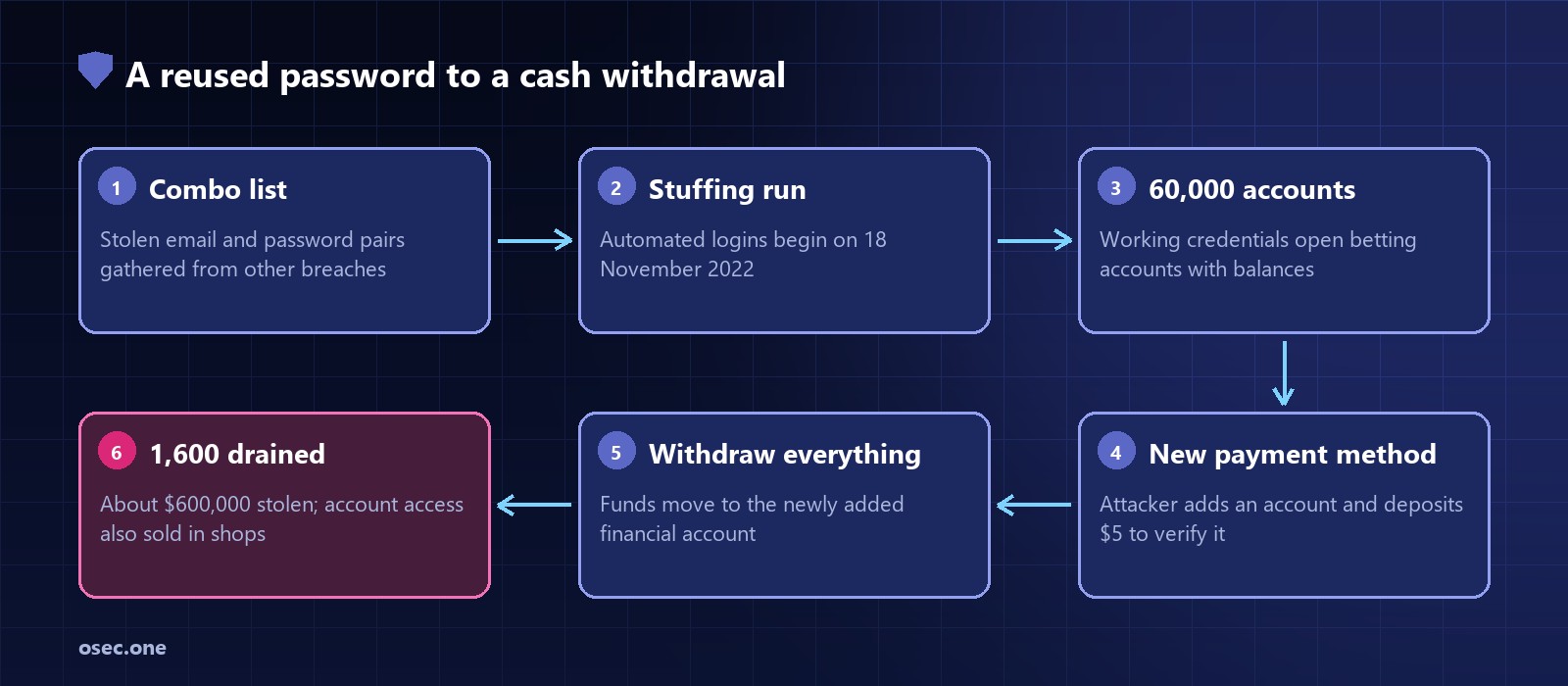
1. Find a working login. The ring used credentials stolen from other services. DraftKings said it found no evidence that its own systems were the source.
2. Read the value. The session exposed the account balance and transaction history.
3. Attach a destination. The attacker added a new payment method or financial account.
4. Verify it for $5. A small deposit made the new method eligible.
5. Withdraw the old balance. The victim's money went to the new account.
6. Sell the rest. Accounts were listed in shops or sold in bulk to other sellers.
The averages show why the ring could profit without draining most accounts. $600,000 / 1,600 = $375 stolen per drained account. Across all 60,000 opened accounts it is only $10 per opened account. A defender watching only the average loss over every login would miss the small high-value group.
| Published figure | Worked result | What it says |
|---|---|---|
| $600,000 / 1,600 drained accounts | $375 per drained account | The payoff once an account had usable funds |
| 1,600 / 60,000 opened accounts | 2.7% drained | Most working logins did not need to pay out for the run to work |
| $600,000 / 60,000 opened accounts | $10 per opened account | Why an all-account average hides the cash-out tail |
| $600,000 / 67,995 notified people | $8.82 per notified person | Useful only as incident scale, not an individual loss estimate |
The account shop made the attack a supply chain
The people running the stuffing tool did not have to drain every account themselves. Prosecutors say Garrison and Austad sold access in shops they controlled and in bulk to resellers. Stokes allegedly bought accounts from Garrison; one batch had a listed account value above $125,000. Austad's cryptocurrency accounts received about $465,000 that appeared to be proceeds from stuffing attacks and account sales.
That split matters during response. Blocking the IPs that ran the first stuffing tool does not remove buyers who already hold valid sessions or exported credentials. Reset the password, revoke every session, remove newly added payment methods, and review withdrawals as one action.
Controls that break each step
| Attack step | Control | Starting rule for a small site |
|---|---|---|
| Reused password works | Block known-breached passwords at signup and reset; better, remove passwords | Force a reset when the submitted password is on a breached-password list |
| Distributed automated logins | Count failures across the whole site and per email, not only per IP | Challenge at 3× the same hour's 7-day median failure rate |
| New device opens a funds account | Step-up authentication before showing balances or enabling money movement | Every new device; never trust the password alone |
| New payment method added | Verify through an existing trusted channel and notify the old email/phone | 24-hour withdrawal hold after a destination is added or changed |
| $5 verifies a destination | Do not let a tiny inbound payment prove ownership for a large outbound transfer | Withdraw only back to a previously verified funding source, or perform identity step-up |
| Whole balance withdrawn | Risk-score destination age, device age, balance share and velocity together | Manual review when a destination under 24 hours old receives over 50% of the balance |
| Account sold to a buyer | Revoke all sessions on incident reset; watch one device touching many accounts | Review a device seen on 3 accounts in 24 hours |
The New York Attorney General's credential-stuffing guide, published before this attack, names bot detection, MFA and passwordless authentication as three effective safeguards. It also says an incident plan must cover investigation, blocking continued access and notice. For a funds account, add a fourth layer: a fresh check and a delay when the withdrawal destination changes.
For a small site that keeps passwords, osec Login Protection counts email and wrong-code patterns instead of trusting IP limits alone. The simpler option is a sign-in with no reusable password: email codes, Google and Apple give a stolen combo list nothing to replay.
How this differs from PayPal and Chick-fil-A
| DraftKings 2022 | PayPal 2022 | Chick-fil-A 2023 | |
|---|---|---|---|
| Working logins | about 60,000 | 34,942 | 71,473 |
| Payoff | Cash balance withdrawn to a new financial account | Full SSN and identity data on a tax form | Points, gift balance and stored payment |
| Confirmed money movement | about $600,000 from about 1,600 accounts | Payments not affected, PayPal said | Total not published |
| Public enforcement result | Federal criminal cases | $2 million NYDFS penalty | No published penalty |
The shared first step is a reused password. The control after login depends on what the account holds. PayPal needed to hide the tax document behind a fresh check. Chick-fil-A needed a check before points or stored payment could be spent. DraftKings needed to distrust a brand-new withdrawal destination even after it received $5.
Email codes, Google and Apple: no reusable password for a credential-stuffing list to try, and no OAuth app to set up on your side.
Add passwordless sign-inSources
• U.S. Attorney's Office, SDNY, Wisconsin man charged with hacking fantasy sports and betting website (18 May 2023): https://www.justice.gov/usao-sdny/pr/wisconsin-man-charged-hacking-fantasy-sports-and-betting-website
• United States v. Garrison complaint (18 May 2023): https://www.justice.gov/d9/2023-05/u.s._v._garrison_complaint.pdf
• U.S. Attorney's Office, SDNY, Wisconsin man pleads guilty (15 Nov 2023): https://www.justice.gov/usao-sdny/pr/wisconsin-man-pleads-guilty-hacking-fantasy-sports-and-betting-website
• U.S. Attorney's Office, SDNY, two more men charged (29 Jan 2024): https://www.justice.gov/usao-sdny/pr/two-more-men-charged-hacking-fantasy-sports-and-betting-website
• United States v. Austad and Stokes complaint (29 Jan 2024): https://www.justice.gov/usao-sdny/media/1335441/dl
• Maine Attorney General, DraftKings breach filing (16 Dec 2022; 67,995 affected): https://www.maine.gov/agviewer/content/ag/985235c7-cb95-4be2-8792-a1252b4f8318/224e06d4-90d1-402d-ae66-bfde68c87924.shtml
• DraftKings notice supplied to Maryland Attorney General (26 Jan 2023): https://oag.maryland.gov/resources-info/SBN%20Documents/2023/ITU-367229.pdf
• New York Attorney General, Business guide for credential-stuffing attacks: https://ag.ny.gov/publications/business-guide-credential-stuffing-attacks
• OWASP, Credential Stuffing Prevention Cheat Sheet: https://cheatsheetseries.owasp.org/cheatsheets/Credential_Stuffing_Prevention_Cheat_Sheet.html