

On 5 January 2022, New York Attorney General Letitia James and the Bureau of Internet and Technology (BIT) released a landmark report: the Business Guide for Credential Stuffing Attacks. It was not a theoretical advisory. It was the public summary of a months-long investigation into underground attack forums that uncovered 1.1 million compromised customer accounts across 17 well-known companies.
The victims were household names in online retail, restaurant chains, and on-demand food delivery. Yet the most striking finding was not the total account count. It was that most of the 17 companies had no idea attacks had occurred until the Attorney General's office reached out with customer credential lists.
The investigation by the numbers
| Metric | Figure | Source and context |
|---|---|---|
| Compromised customer accounts | Over 1,100,000 | NY OAG master audit across monitored dark web forums |
| Companies investigated | 17 brands | Major US online retailers, restaurant chains, and food delivery apps |
| Internal attack awareness | Majority unaware | Most companies had zero active alarms or breach investigations underway |
| Average accounts per company | 64,706 accounts | 1,100,000 accounts / 17 firms; several had over 100,000 compromised accounts |
| Attacker tooling documented | OpenBullet, SilverBullet, Storm | Automation engines using site-specific configuration files (configs) |
| Proxy infrastructure | Rotating residential proxies | Thousands of consumer home IP addresses rotating per connection |
A standard credential stuffing run does not guess passwords by brute force. It exploits the fact that users reuse the same email and password across dozens of services. Attackers load username-and-password combo lists leaked from previous third-party breaches into automation tools, testing millions of combinations against target login endpoints.
How the Attorney General detected what companies missed
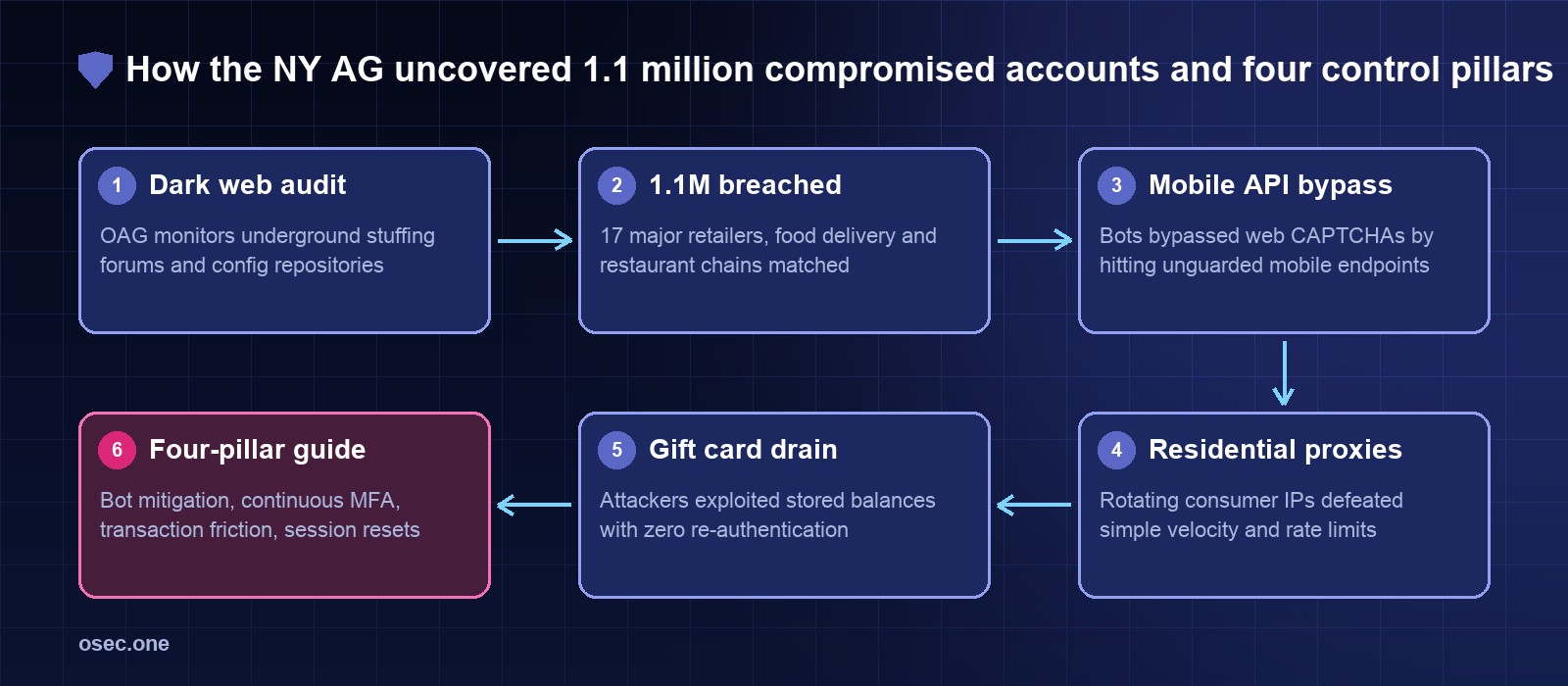
The New York OAG did not discover the breaches by auditing server logs from inside the companies. Investigators audited the attackers' own infrastructure:
• Underground forum surveillance: Investigators monitored cybercrime forums and specialized credential stuffing Telegram channels where attackers share, buy, and sell configuration files.
• Testing valid 'hits': Attackers do not merely check if a password works; their automated scripts test whether the account has saved credit cards, reward points, or gift card balances, dumping confirmed 'hits' into text lists.
• Compiling proof sets: The OAG cross-referenced thousands of forum dumps and verified active customer accounts directly, accumulating over 1.1 million validated records before alerting the 17 firms.
• Mandatory notification: The OAG alerted each firm, requiring immediate password resets, consumer notifications, and technical debriefs on why existing controls failed.
Five structural failure patterns found across the 17 firms
When the Attorney General's engineers examined how the attackers bypassed existing security perimeters, they documented five common technical deficiencies:
| Vulnerability | What went wrong | Real-world attacker bypass |
|---|---|---|
| 1. Mobile API blind spot | WAFs and CAPTCHAs were deployed on the website, but backend mobile REST APIs had zero bot protection. | Attackers pointed OpenBullet scripts directly at the mobile app's JSON login endpoint (`/api/v1/auth/login`), completely bypassing web CAPTCHAs. |
| 2. Residential proxy evasion | Rate limiting was set strictly per IP address (e.g. max 10 failed logins per minute per IP). | Attackers routed traffic through residential proxy networks. Each request originated from a distinct consumer ISP, keeping per-IP velocity under 1 attempt per hour. |
| 3. Flawed MFA implementation | Multi-factor authentication was configured, but business logic or parameters were poorly tested. | In at least one major company, an attacker could manipulate request parameters or change response codes to skip the MFA step entirely, compromising hundreds of thousands of accounts. |
| 4. Asymmetric checkout verification | Changing a shipping address on a stored credit card required entering the CVV, but paying with gift cards required zero re-authentication. | Attackers checked account balances for stored gift cards or loyalty points, ordered high-value merchandise or food, and checked out without triggering payment security prompts. |
| 5. Incomplete session revocation | When forced password resets were triggered, existing session cookies and OAuth refresh tokens were not revoked. | Attackers who had already signed in remained logged in with valid session cookies even after the legitimate user reset their password. |
Notice the recurring theme: perimeter controls on the primary browser login form are useless if an API endpoint, a mobile interface, or an unauthenticated gift-card redemption route exists beside it.
The New York AG's four-pillar defense framework
The Business Guide for Credential Stuffing Attacks outlines four non-negotiable operational areas every consumer-facing platform must establish:
| Defense pillar | Core requirement | Concrete technical safeguards |
|---|---|---|
| 1. Defending against attacks | Stop automated bot traffic before it reaches authentication databases. | • Dedicated bot detection assessing behavioral telemetry, client fingerprinting, and TLS/JA3/JA4 signatures. • Properly audited Multi-Factor Authentication (MFA) and passwordless passkeys. • Screening passwords at signup and reset against breach datasets (e.g. Have I Been Pwned API). • Uniform protection across web, mobile apps, and backend APIs. |
| 2. Detecting a breach | Continuously monitor authentication telemetry for automated bursts. | • Track whole-site failed login volume against rolling historical medians. • Alert when the ratio of failed logins to successful logins spikes abnormally. • Monitor account lockouts and password-reset velocity across ISP/ASN ranges. |
| 3. Preventing fraud and misuse | Stop attackers who obtain a working login from cashing out. | • Enforce step-up re-authentication (password re-entry or email OTP) before updating email, phone, or shipping address. • Mask full credit card and gift card numbers. • Treat stored balances, gift cards, and loyalty points with the same transaction verification friction as credit cards. |
| 4. Incident response | Pre-plan containment and remediation playbooks. | • Immediate revocation of all active session tokens, OAuth refresh tokens, and cookies upon password reset. • Block automated traffic patterns identified during the incident. • Prompt, clear consumer breach notifications detailing what data was exposed. |
Worked calculations: the economics of stuffing 17 firms
Credential stuffing is an asymmetry game. The numbers from the New York report explain why attackers run these campaigns continuously:
| Variable | Conservative estimate | What it shows |
|---|---|---|
| Credential list size | 100,000,000 pairs | Standard combo lists circulating on dark web marketplaces |
| Average hit rate | 1.1% | 1.1M accounts across 17 companies (~0.1% to 2% hit rate per individual company) |
| Cost of residential proxies | $3 to $5 per GB (~$150 total) | Low cost to rotate 50,000 residential IP addresses |
| Config creation / purchase | $20 to $100 | Site-specific OpenBullet configs sold openly in illicit forums |
| Monetization rate | 2% to 5% of opened accounts | Accounts holding stored gift cards, reward points, or saved cards |
| Monetized accounts | 22,000 to 55,000 accounts | 2% to 5% of 1.1 million verified working logins |
| Estimated fraud yield ($25/account) | $550,000 to $1,375,000 | Value extracted via food delivery, gift cards, and resale |
Because an attacker spends under $300 on proxies and configs to test millions of credentials, yielding hundreds of thousands of dollars in illicit orders, stuffing remains the most profitable automated cyberattack.
How this compares to single-firm credential stuffing cases
osec.one has documented several landmark credential-stuffing breaches. Comparing them with the NY AG report highlights how common the playbook is across industries:
| Incident | Target industry | Compromised accounts | Primary monetization | Enforcement / Result |
|---|---|---|---|---|
| NY AG 2022 Report | Retail, restaurants, food delivery | 1,100,000 (17 firms) | Gift cards, food orders, customer data | Mandatory security guide & ordered resets |
| DraftKings 2022 | Sports betting / gaming | about 60,000 | Cash withdrawals ($5 deposit bridge) | Federal criminal prosecutions (SDNY) |
| Dunkin' DD Perks | Quick-serve restaurant | 19,715 + 300,000 | Stored-value loyalty cards | $650,000 New York AG penalty |
| PayPal 2022 | Fintech / payments | 34,942 | Tax documents & identity data | $2,000,000 NYDFS penalty |
Practical defenses for small sites
You do not need an enterprise budget to implement the New York AG's four pillars. A small site or SaaS can implement five direct defenses today:
1. Stop relying on IP rate limits alone. Count failed login attempts per email address and across the whole domain. If your site sees 50 failures in 5 minutes across 50 different IP addresses, you are under a residential stuffing attack.
2. Protect your APIs with the same rigor as web forms. If you use an edge firewall or CAPTCHA on your website, ensure mobile endpoints (/api/*) require the exact same bot verification or cryptographically signed client tokens.
3. Screen passwords against known breaches. Use the Have I Been Pwned API or an offline k-anonymity bloom filter to reject passwords that have appeared in public breach dumps.
4. Revoke sessions on password changes. When an account password changes, immediately invalidate all outstanding JWT refresh tokens, Redis session keys, and persistent login cookies.
5. Require step-up verification for high-risk actions. Never let an account change its contact email, add a new withdrawal destination, or redeem stored value without re-entering a verification code.
For low-volume sites and APIs, osec Login Protection monitors failed login rates across email addresses without requiring a DNS move. You can also evaluate your site's edge protection with the free osec Site Protection Scan.
The ultimate solution to credential stuffing is eliminating reusable passwords entirely. When you switch to passwordless authentication—using one-time email codes, passkeys, Google, or Apple sign-in—stolen credential combo lists have literally nothing to test against your site.
Passwordless sign-in with email codes, Google and Apple: eliminate passwords so credential-stuffing combo lists have nothing to replay, with zero OAuth configuration on your side.
Add passwordless sign-inSources
• New York Attorney General, Business Guide for Credential Stuffing Attacks (January 2022): https://ag.ny.gov/sites/default/files/businessguide-credentialstuffingattacks.pdf
• New York Attorney General Letitia James press release, Attorney General James Alerts Consumers and Businesses to Credential Stuffing Attacks (5 Jan 2022): https://ag.ny.gov/press-release/2022/attorney-general-james-alerts-consumers-and-businesses-credential-stuffing-attacks
• New York State Office of the Attorney General, Bureau of Internet and Technology (BIT): https://ag.ny.gov/about/about-office/division-economic-justice/bureau-internet-and-technology
• OWASP Automated Threat Handbook, Credential Stuffing (OAT-008): https://owasp.org/www-project-automated-threats-to-web-applications/assets/oat-008.html
• Federal Trade Commission (FTC), You don't have to take credential stuffing sitting down (January 2022): https://www.ftc.gov/business-guidance/blog/2022/01/you-dont-have-take-credential-stuffing-sitting-down
• osec.one case study, DraftKings 2022: 60,000 betting accounts, a $5 deposit and $600,000 stolen: https://osec.one/articles/draftkings-2022-credential-stuffing-60000-accounts-600000-stolen
• osec.one case study, Dunkin' DD Perks 2015-2019: 19,715 accounts, 300,000 more and New York's $650,000 order: https://osec.one/articles/dunkin-dd-perks-credential-stuffing-19715-accounts-650000-order
• osec.one case study, PayPal 2022: 34,942 accounts opened by credential stuffing in two days, and a $2 million New York penalty: https://osec.one/articles/paypal-2022-credential-stuffing-34942-accounts-nydfs-2-million